Lending

Lending protocols form the backbone of the decentralized money market, allowing users to lend or borrow digital assets without intermediaries. Using smart contracts, platforms like Aave and Morpho automate interest rates based on supply and demand while requiring over-collateralization for security. The 2026 lending landscape features advanced permissionless vaults and institutional-grade credit lines. This tag covers the evolution of capital efficiency, liquidations, and the integration of diverse collateral types, including LSTs and tokenized RWAs.

15969 Articles
Created: 2026/02/02 18:52
Updated: 2026/02/02 18:52

Bitcoin flywheel fails, how can Strategy recover its losses?

Bitcoin flywheel fails, how can Strategy recover its losses?

Author: Chloe, ChainCatcher Since October, MSTR has fallen by about 50%. After reaching a high of $457 last year, it has fallen sharply and far underperformed the market. MarketBeat data shows that the 12-month low is about $155.61 and the high is over $450. It has now entered a relatively undervalued low level and is extremely volatile. Why has MSTR's stock price remained sluggish for months, significantly underperforming the broader market and even worse than Bitcoin itself? This has led the market to question whether the Bitcoin flywheel effect has failed. Enjoy double the joy in a bull market, and suffer double the pain in a bear market. The sharp drop in Bitcoin prices was the most direct trigger. Bitcoin has fallen by about 31% since its peak on October 6th, and Strategy, holding approximately 650,000 Bitcoins (3.1% of the total supply), was naturally not spared. MarketWatch further calculated that the correlation between BTC and MSTR is close to 0.97, meaning that the two are almost in a one-to-one linkage. However, due to the leverage effect, the volatility of MSTR was further amplified; while Bitcoin fell by 31%, MSTR fell by more than 50%. The market is also questioning whether MSTR's flywheel model, on which it relies, is failing. Strategy's mNAV is currently 1.15. According to CryptoSlate, the market is only willing to pay a 15% premium to its Bitcoin holdings for MSTR. Once mNAV falls below 1.0, further share issuance will become extremely dilutive. Bloomberg also points out that with Strategy's market capitalization only slightly above its Bitcoin holdings, the premium has been severely compressed, and this positive feedback loop is failing. Furthermore, Strategy purchased only 130 bitcoins between November 17th and November 30th, spending $11.7 million, a negligible amount for a company holding approximately 650,000 bitcoins. This suggests that Strategy recognized that at the current premium level, a large-scale issuance of shares would harm rather than enhance shareholder interests, and therefore proactively applied the brakes. The Financial Times also noted that after its peak, MSTR's share price has begun to underperform Bitcoin itself, raising questions about whether an equity vehicle can still generate more value than simply holding BTC. Especially with the launch of Bitcoin spot ETFs, allowing investors easier access to Bitcoin, why should they bear the debt burden, management risks, and potential equity dilution associated with MSTR? Furthermore, Strategy has financed its Bitcoin purchase program this year by issuing a large number of convertible bonds and high-yield preferred shares, creating a heavy fixed-payment burden. A Seeking Alpha analysis indicates this will increase the annual preferred stock dividend burden to hundreds of millions of dollars; CryptoSlate estimates this figure could reach as high as $750 million to $800 million annually, not including convertible bond interest. The problem is that while MSTR's traditional software business still generates over $100 million in revenue each quarter, it cannot independently support this ever-increasing preferred stock dividend burden. This is the core reason why the company announced the establishment of a $1.44 billion cash reserve. To address concerns about cashing out through cryptocurrency sales, Strategy has established a US dollar reserve. On Monday, Strategy announced the establishment of a $1.44 billion dollar reserve specifically for paying preferred stock dividends and interest on existing debt, in an effort to address concerns that Strategy might "sell cryptocurrency to raise cash" to pay preferred stock dividends. According to Strategy's press release, the $1.44 billion came from proceeds from the sale of Class A common stock under its market offering plan. The company currently plans to maintain reserves sufficient to cover at least 12 months of dividend payments and intends to gradually increase these reserves, with the ultimate goal of building a buffer pool capable of covering dividend payments for 24 months or more. This time, Strategy invested most of the funds raised from the stock sale into its US dollar cash reserves, instead of buying Bitcoin like it had in the past. It can be said that even Saylor had to find a more defensive financial strategy in the face of volatile cryptocurrency prices. However, even with the release of the reserve fund news, the market reaction remained lukewarm, with MSTR falling more than 11% intraday, marking its fourth consecutive month of decline. With the company's mNAV remaining close to 1 for an extended period, it signifies that the initial "sell stocks, buy crypto" flywheel strategy has officially become ineffective. CEO Phong Le has previously admitted that if funding runs out, the company may ultimately consider selling its Bitcoin holdings. Reserves temporarily alleviated market concerns, but risks related to capital structure remain. According to independent researcher Spreek, mNAV has declined across the board, and Bitcoin strategies have encountered bottlenecks. Saylor had already begun to turn to debt instruments as a new financing channel earlier this year. These instruments have less direct correlation with stock prices and are intended to avoid further depressing MSTR prices and mNAV. Spreek stated that STRC targets retail investors directly, emphasizing stability and high returns, but neglecting underlying risks. "STRC is more like Luna and UST than MSTR's previous products." However, MSTR's balance sheet is still much stronger than Luna's back then, but the reflexivity mechanism still exists: every time Strategy raises the product interest rate, the annual cash dividend payout increases significantly, and it may only be a matter of time before they consider selling Bitcoin to raise funds. According to research predictions, Strategy has roughly three predictable trajectories. First, it will choose to reduce leverage, adopt a conservative stance, cease issuing large amounts of STR series preferred stock or debt, reduce the scale and speed of Bitcoin purchases, maintain reserves as much as possible, and refrain from selling BTC, even if this means the stock price will remain below mNAV for a long time, and this is essentially a default end to the Bitcoin flywheel, with MSTR trading at a discount for an extended period. Another path relies on external macroeconomic drivers, such as liquidity injections from the Federal Reserve or political factors reigniting the Bitcoin craze, allowing Saylor to temporarily escape the mire and restart its old strategy: using the stock price recovery to issue more shares and convertible bonds, and then adding to its Bitcoin holdings at higher prices. However, this will likely only postpone the end result, because the structural flaws in the company's cash inflows mean that always buying at the peak will keep Saylor at the edge of profitability, even if its direction is correct. From Bitcoin's perspective, this is the most favorable development in the near term, as it can alleviate selling pressure and support prices. The third path involves rapidly expanding preferred shares such as STRCs to maintain operations, attracting retail investors by raising yields and pushing debt to billions or even tens of billions of dollars. In the short term, this seems superior to directly selling stocks or Bitcoin, avoiding immediate market shocks and allowing the flywheel to temporarily recover. However, the previously mentioned reflexivity mechanism is likely to be amplified: as payment obligations swell—currently nearly $750 million in annual dividends, potentially doubling in the future—the company will face a heavy burden of dollar debt, and selling Bitcoin to raise funds for repayment may ultimately become a last resort. According to a recent Bloomberg report, Strategy CEO Phong Le stated that Strategy is considering lending out some of its tokens. This implies that Strategy hopes to gain a new revenue stream through lending, with annual interest rates typically between 3-5%, but this is still a long way from being implemented. Strategy's decision to release $1.4 billion in reserves may be a concession to its strategy of not selling Bitcoin. However, in the face of reality, Strategy has also simultaneously lowered its full-year financial forecast and key performance indicators, setting the year-end price of Bitcoin between $85,000 and $110,000. The full-year book value target for Bitcoin in US dollars has also been significantly reduced from the original $20 billion to $8.4 billion to $12.8 billion. Furthermore, Strategy predicts that the full-year net profit will fall within a huge range of a loss of $5.5 billion to a profit of $6.3 billion, a significant reduction from the original forecast of $24 billion for the full-year net profit.

Author: PANews
North Korean crypto hackers got caught live — by fake laptops

North Korean crypto hackers got caught live — by fake laptops

The post North Korean crypto hackers got caught live — by fake laptops appeared on BitcoinEthereumNews.com. North Korean operatives were caught on camera, live, after security researchers lured them into a booby-trapped “developer laptop,” capturing how the Lazarus-linked crew tried to blend into a US crypto job pipeline using legitimate AI hiring tools and cloud services. The evolution in state-sponsored cybercrime was reportedly captured in real time by researchers at BCA LTD, NorthScan, and the malware-analysis platform ANY.RUN. Catching the North Korean attacker Hacker News shared how, in a coordinated sting operation, the team deployed a “honeypot,” which is a surveillance environment disguised as a legitimate developer’s laptop, to bait the Lazarus Group. The resulting footage offers the industry its clearest look yet at how North Korean units, specifically the Famous Chollima division, are bypassing traditional firewalls by simply getting hired by the target’s human resources department. The operation began when researchers created a developer persona and accepted an interview request from a recruiter alias known as “Aaron.” Instead of deploying a standard malware payload, the recruiter steered the target toward a remote employment arrangement common in the Web3 sector. When the researchers granted access to the “laptop,” which was actually a heavily monitored virtual machine designed to mimic a US-based workstation, the operatives did not attempt to exploit code vulnerabilities. Instead, they focused on establishing their presence as seemingly model employees. Building trust Once inside the controlled environment, the operatives demonstrated a workflow optimized for blending in rather than breaking in. They utilized legitimate job-automation software, including Simplify Copilot and AiApply, to generate polished interview responses and populate application forms at scale. This use of Western productivity tools highlights a disturbing escalation, showing that state actors are leveraging the very AI technologies designed to streamline corporate hiring to defeat them. The investigation revealed that the attackers routed their traffic through Astrill VPN to mask their…

Author: BitcoinEthereumNews
Secret laptop footage exposes North Korean spies infiltrating US companies

Secret laptop footage exposes North Korean spies infiltrating US companies

North Korean operatives were caught on camera, live, after security researchers lured them into a booby-trapped “developer laptop,” capturing how the Lazarus-linked crew tried to blend into a US crypto job pipeline using legitimate AI hiring tools and cloud services. The evolution in state-sponsored cybercrime was reportedly captured in real time by researchers at BCA […] The post Secret laptop footage exposes North Korean spies infiltrating US companies appeared first on CryptoSlate.

Author: CryptoSlate
Solana Could See A Bit Of Upside But It Is This $0.035 Nearing Presale Phase 6 Sellout That Is The Top Crypto To Buy

Solana Could See A Bit Of Upside But It Is This $0.035 Nearing Presale Phase 6 Sellout That Is The Top Crypto To Buy

Solana’s strength is evident as it has been able to capture a record 99% market share of the tokenized market. Although this development excites expectations of a SOL breakout beyond the $150 level due to this outstanding achievement, Solana’s growth will ultimately rely on market sentiments and technical analysis. For those interested in exponential growth […]

Author: Cryptopolitan
O’Leary Bets On High-Throughput BTC

O’Leary Bets On High-Throughput BTC

The post O’Leary Bets On High-Throughput BTC appeared on BitcoinEthereumNews.com. As macro chatter cools, attention is shifting from Fed cuts toward how a bitcoin layer 2 can turn long-term BTC conviction into real transaction utility. Kevin O’Leary shifts the Bitcoin debate away from Fed policy Kevin O’Leary has taken a blunt stance on Bitcoin in 2024: if the asset’s appeal hinges on a single Federal Reserve meeting, the thesis was never solid. The Canadian businessman and TV personality argues that $BTC can stand on its own even without imminent rate cuts, pushing focus back to adoption, utility, and real demand. For everyday $BTC holders, that is a major pivot from the usual ‘pivot or no pivot’ guessing game over Fed decisions. Instead of trading on macro headlines, investors are increasingly asking what infrastructure actually lets people pay, trade, and build financial applications on Bitcoin. However, this question quickly exposes the base layer’s structural limits. Bitcoin still processes roughly seven transactions per second, with long confirmation times and periodic fee spikes during congestion. That works for a store-of-value ledger, but it is a non-starter for high-frequency DeFi, NFTs, or gaming workloads. Moreover, it leaves most bitcoin defi and gaming activity migrating to faster chains rather than staying inside the BTC economy. Why macro fatigue is driving attention back to Bitcoin infrastructure After nearly two years of ‘will they, won’t they’ speculation on Fed cuts, investor fatigue around macro narratives is growing. Bitcoin’s resilience through several rate-hike cycles has already challenged the idea that it is simply a leveraged bet on global liquidity conditions. Increasingly, the more durable story is that $BTC can ride out macro noise if it continues to gain real-world usage. At the same time, Bitcoin’s base chain was never designed for modern, smart-contract-heavy workloads. Competing Layer 1s such as Solana and Ethereum deliver sub-second or low-single-second finality and…

Author: BitcoinEthereumNews
Ethereum Price Rallied 4% Today to Hit $3,144: Is the Altcoin Bottom In?

Ethereum Price Rallied 4% Today to Hit $3,144: Is the Altcoin Bottom In?

The post Ethereum Price Rallied 4% Today to Hit $3,144: Is the Altcoin Bottom In? appeared first on Coinpedia Fintech News Ethereum (ETH) price has signaled a potential market reversal ahead. The large-cap altcoin, with a fully diluted valuation of about $377 billion, rallied 4% during the past 24 hours to trade above a crucial midterm supply level around $3,082.  In the four-hour timeframe, the ETH/USD pair will have formed a potential higher low, after consistently …

Author: CoinPedia
Tron Hits $80.2B Stablecoin Milestone After Tether Mints 1B USDT On The Network

Tron Hits $80.2B Stablecoin Milestone After Tether Mints 1B USDT On The Network

the heldTron has emerged as one of the strongest performers during the latest market downturn, showing a level of resilience rarely seen among major altcoins. While most large-cap cryptocurrencies have suffered drawdowns of 40% or more since August, Tron has limited its losses to just 24%, outperforming nearly the entire altcoin sector. This relative strength highlights the network’s unique positioning and the steady demand it continues to attract despite broader market weakness. Related Reading: Bitcoin Liquidation Dominance Hits Multi-Year High: The Real Cause Behind BTC’s Breakdown A major factor behind this resilience is Tron’s growing dominance in the stablecoin ecosystem. According to data from Tronscan, shared by Lookonchain, Tether minted another 1 billion USDT on Tron, signaling continued confidence in the network’s ability to handle large-scale stablecoin issuance. This new mint has pushed Tron’s stablecoin market cap above $80.2 billion, solidifying its role as the leading chain for USDT circulation. As capital rotates defensively into stablecoins, Tron tends to benefit disproportionately. Its ability to maintain relative stability while the rest of the market capitulates reinforces the idea that Tron’s utility-driven demand remains intact—and may continue to offer support even if volatility persists. Tron Strengthens Its Position as the Second-Largest Stablecoin Network Tron has become a central pillar of the global stablecoin ecosystem, securing its position as the second-largest blockchain for stablecoin activity. Its appeal comes from fast settlement times, extremely low transaction fees, and deep liquidity—features that make it the preferred network for high-volume USDT transfers, especially across exchanges, OTC desks, and remittance corridors. This infrastructure has allowed Tron to attract massive stablecoin flows, with its total stablecoin market cap now exceeding $80.2 billion, largely driven by Tether’s continual issuance on the network. However, despite Tron’s remarkable growth, Ethereum still dominates the stablecoin landscape, maintaining a market cap of roughly $166 billion, which is nearly double that of Tron. Ethereum’s dominance is supported by its broader DeFi ecosystem, institutional presence, and the higher-value activity that takes place through smart contracts, lending protocols, and on-chain financial applications. Stablecoins on Ethereum often serve as liquidity for sophisticated trading and yield strategies, whereas on Tron, they are primarily used for settlement, payments, and exchange flows. The two ecosystems complement different market needs. Ethereum anchors the institutional and DeFi-driven segment of stablecoin usage, while Tron leads in high-throughput, cost-efficient transactions. As stablecoin demand grows globally, both networks continue to reinforce their positions. One through scalability and speed, the other through DeFi depth and capital concentration. Related Reading: Ethereum Open Interest Cut In Half As $6.4B In Positions Vanish: Market Reset Accelerates TRX Holds Strong Weekly Structure Despite Volatility Tron’s weekly chart shows a notable level of resilience compared to broader market conditions. While many altcoins have experienced far deeper drawdowns, TRX has held above the $0.27–$0.28 support zone. Maintaining a strong higher-timeframe structure. The recent correction pulled the price down from the $0.36 region, but TRX continues to trade comfortably above the 50-week SMA. Which now sits around $0.28 and acts as immediate dynamic support. This strength is significant. Throughout 2025, TRX has respected its rising moving averages. The 50-week SMA in particular has provided consistent support during each market pullback. The 100-week and 200-week SMAs, positioned well below the current price, show a broad, healthy long-term uptrend that remains intact. Related Reading: Massive Ethereum Distribution Continues: Whale Sends Another 5,000 ETH To Binance For Tron to regain bullish momentum, it must reclaim the $0.30–$0.32 region. Which served as support during the previous uptrend and now acts as resistance. A strong weekly close above this zone could open the door for a retest of the $0.34–$0.36 highs. Until then, TRX remains one of the market’s more stable performers, showing controlled downside and structural strength. Featured image from ChatGPT, chart from TradingView.com

Author: NewsBTC
Best Crypto to Buy Now: Solana Price Prediction, Next Crypto to Explode

Best Crypto to Buy Now: Solana Price Prediction, Next Crypto to Explode

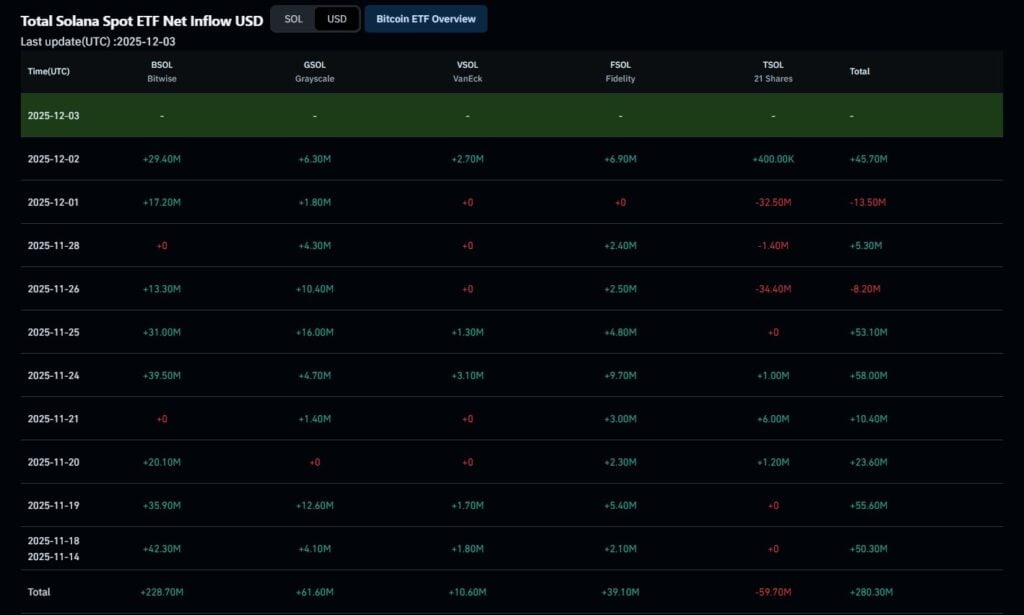
Solana continues to sit at the center of market attention as traders monitor its structure, short-term outlook, ETF flows, and long-term targets. The past week delivered fresh volatility for SOL, but the latest rebound, combined with new ETF inflows, brings renewed strength to the chart. With momentum returning, many traders now look at Solana alongside […]

Author: The Cryptonomist
Strategy’s Bitcoin Lending Pivot Could Help Hedge Funds Short Its Premium

Strategy’s Bitcoin Lending Pivot Could Help Hedge Funds Short Its Premium

TLDR Strategy plans to lend its 650,000 BTC, raising risks for Bitcoin’s borrowing market. Lending Bitcoin could lower borrowing costs, benefiting hedge funds looking to short it. Strategy’s shift from passive holding to lending exposes it to counterparty risks. The firm faces pressure to find yield as its stock valuation compresses. Strategy, the company formerly [...] The post Strategy’s Bitcoin Lending Pivot Could Help Hedge Funds Short Its Premium appeared first on CoinCentral.

Author: Coincentral
Bitcoin treasury giant Strategy eyes crypto lending shift

Bitcoin treasury giant Strategy eyes crypto lending shift

The post Bitcoin treasury giant Strategy eyes crypto lending shift appeared on BitcoinEthereumNews.com. Strategy, formerly known as MicroStrategy, is considering a pivot that would fundamentally alter the risk profile of the world’s largest corporate Bitcoin treasury. For a decade, the company sold Wall Street on a singular thesis: it was a digital vault, offering unencumbered exposure to Bitcoin without the risks of custody or counterparty risk. That stand is changing as it is now exploring an entry into the crypto lending market. On Dec. 2, Strategy CEO Phong Le told Bloomberg the firm was in talks with banks about lending out its holdings. However, he cautioned that the firm was still waiting for major financial institutions to enter the space before making any decision. He said: “We’ve had a lot of constructive discussions. They have primarily been: we are thinking about offering Bitcoin services—custody, exchange, lending, etc. You are the largest corporate holder of Bitcoin in the world; what is your advice to us, and should we work together?” While framed as a maturation of the business, the move exposes the company to re-hypothecation risks that contradict the “cold storage” ethos that built its $55 billion reserve. Nonetheless, the pivot signals that Strategy is moving from a passive holding company to an active credit desk. This shift is driven by the need to justify its valuation premium in a market where spot ETFs have commoditized Bitcoin access. The yield trap Strategy currently holds 650,000 BTC. Historically, this stockpile has sat idle in the firm’s coffers. So, lending it out would generate revenue. However, it introduces a paradox as the primary institutional demand for borrowing Bitcoin comes from market makers and hedge funds looking to short the asset. To understand the risk, one must look at the mechanics of the trade. In the institutional market, demand for borrowing Bitcoin is rarely for holding, as it is…

Author: BitcoinEthereumNews