Lending

Lending protocols form the backbone of the decentralized money market, allowing users to lend or borrow digital assets without intermediaries. Using smart contracts, platforms like Aave and Morpho automate interest rates based on supply and demand while requiring over-collateralization for security. The 2026 lending landscape features advanced permissionless vaults and institutional-grade credit lines. This tag covers the evolution of capital efficiency, liquidations, and the integration of diverse collateral types, including LSTs and tokenized RWAs.

14354 Articles
Created: 2026/02/02 18:52
Updated: 2026/02/02 18:52

OnRe Introduces Points Program Rewarding ONyc Participation Across DeFi

OnRe Introduces Points Program Rewarding ONyc Participation Across DeFi

Hamilton, Bermuda, 11th September 2025, Chainwire

Author: Blockchainreporter
SEC delays Franklin and BlackRock crypto ETF decisions

SEC delays Franklin and BlackRock crypto ETF decisions

The post SEC delays Franklin and BlackRock crypto ETF decisions appeared on BitcoinEthereumNews.com. The US Securities and Exchange Commission has delayed decisions on multiple crypto exchange traded funds (ETF) proposals Wednesday, pushing back deadlines for funds including BlackRock and Franklin Templeton. According to SEC filings, the agency has set a new deadline of Nov. 13 for Franklin’s Ethereum staking amendment, and Nov. 14 for its Solana and XRP ETFs. A proposal seeking to permit staking in BlackRock’s iShares Ethereum Trust is now slated for Oct. 30. The filings do not indicate how the SEC is leaning on the applications; only that more time is needed to evaluate them. The commission is using the maximum extension available before issuing a final decision. Franklin’s proposals for the Ethereum, Solana and XRP products were filed with Cboe BZX in mid-March, while Nasdaq submitted BlackRock’s iShares Ethereum staking amendment on July 16. Under Section 19(b) of the Securities Exchange Act, the SEC has up to 45 days from publication to act on a proposed rule change, which can extend to 90 or 180 days, and in some cases by an additional 60 days.  Related: BlackRock leads $287M spot Ether ETF inflows after 4-day outflow streak ETF delays continue to pile up at the SEC The SEC has dramatically shifted its stance on digital assets since US President Donald Trump took office in January.  On July 31, SEC Chair Paul Atkins unveiled “Project Crypto,” a commission-wide initiative to modernize securities rules and bring digital asset trading, lending and staking under a unified framework. At the Organisation for Economic Co-operation and Development (OECD) Roundtable on Global Financial Markets in Paris Wednesday, Atkins underscored the pivot, declaring, “Crypto’s time has come.”  Despite the pro-crypto push, the SEC continues to delay decisions on ETF applications, with proposals piling up across altcoin and staking products. On Tuesday, the federal agency postponed decisions on the…

Author: BitcoinEthereumNews
Ethereum and Stellar Stay Steady, While BullZilla’s Price Rises in a Few Hours – Could it Be the Next 100x Crypto Presale?

Ethereum and Stellar Stay Steady, While BullZilla’s Price Rises in a Few Hours – Could it Be the Next 100x Crypto Presale?

The post Ethereum and Stellar Stay Steady, While BullZilla’s Price Rises in a Few Hours – Could it Be the Next 100x Crypto Presale? appeared first on Coinpedia Fintech News The crypto market thrives on bold narratives, rapid adoption, and the relentless pursuit of the next 100x crypto presale. Every cycle crowns a handful of projects that reshape the industry, blending disruptive technology with unstoppable momentum. In 2025, three names rise above the noise, BullZilla, Ethereum, and Stellar. Each represents a different force: an unleashed …

Author: CoinPedia
Decentralization Diehards Unite in Their Critique of Corporate L1s Like Tempo

Decentralization Diehards Unite in Their Critique of Corporate L1s Like Tempo

The post Decentralization Diehards Unite in Their Critique of Corporate L1s Like Tempo appeared on BitcoinEthereumNews.com. Web2 firms are betting on their own blockchains, but many web3 industry leaders are questioning the move away from Satoshi Nakamoto’s vision and ethos. A wave of corporate blockchain networks is gathering on the horizon, promising faster stablecoin payments and smoother adoption. The long-awaited vision of companies embracing blockchain tech seems to be finally taking shape, but not in the way many crypto veterans expected. Payments giant Stripe, backed by crypto VC firm Paradigm, is building its own Layer 1 chain, Tempo, for global payments, choosing to build the network from scratch instead of making another Layer 2 on Ethereum. Circle, one of the largest stablecoin issuers, is also developing its own L1 for its stablecoin, while Google is working on its own chain, though it won’t be targeting retail users like the other two. Yet, despite big names behind the initiatives, the decisions have drawn wide criticism from some in the crypto community, who say corporate chains move away from the open, decentralized vision Bitcoin’s creator Satoshi Nakamoto had in mind. L1 vs L2 Debate Stripe and Paradigm’s Tempo stands out among corporate L1s in that the team behind it has made an effort to present the protocol as a more open, public-focused network, compared to product-specific chains like Circle’s Arc or Google’s GCUL. Unlike competitors, Tempo is positioning itself as a “neutral platform with respect to stablecoins, allowing users to make transfers and pay gas fees in any stablecoin,” according to a post from Tempo’s official X account. Matt Huang, co-founder and managing partner at Paradigm, said in an X post on Sept. 6 that the plan is to have “permissionless validation and permissionless smart contract deployment,” drawing comparison with Bitcoin, Ethereum and Solana. Anurag Arjun, co-founder of modular blockchain infrastructure project Avail, as well as a co-founder…

Author: BitcoinEthereumNews
Best Presales to Buy as SEC Delays Most ETFs: HODLing Might Be Better Now

Best Presales to Buy as SEC Delays Most ETFs: HODLing Might Be Better Now

The SEC has delayed its decision on BlackRock’s staking application for its spot ETH ETF and Franklin Templeton’s ETF applications tracking SOL and XRP.

Author: Brave Newcoin
Creditcoin Universal Smart Contract: Unlocking Revolutionary Cross-Chain Finance

Creditcoin Universal Smart Contract: Unlocking Revolutionary Cross-Chain Finance

BitcoinWorld Creditcoin Universal Smart Contract: Unlocking Revolutionary Cross-Chain Finance The world of blockchain is constantly evolving, and one of its most persistent challenges has been the seamless verification of data across different networks. Imagine a financial system where information flows freely and securely between diverse digital ledgers. This vision is now closer to reality with the recent launch of the Creditcoin Universal Smart Contract (USC) testnet. This groundbreaking development from the Layer 1 blockchain Creditcoin (CTC) aims to bridge critical gaps, promising a more integrated and efficient decentralized future. What Makes the Creditcoin Universal Smart Contract a Game-Changer? Creditcoin officially launched its Universal Smart Contract testnet on September 11, marking a significant step forward. The core idea behind the USC is to tackle the complex problem of verifying data that originates from various disparate blockchains. This isn’t just a technical exercise; it’s about building robust infrastructure. The current blockchain landscape often operates in silos, making it difficult for applications on one chain to trust or utilize data from another. The Creditcoin Universal Smart Contract offers a novel solution to this fragmentation. Bridging Blockchains: It creates a mechanism for secure, reliable cross-chain data verification. Real-World Integration: The USC is designed to connect blockchain financial tools directly with the traditional economy. Enhanced Trust: By providing verifiable data, it builds a foundation for more sophisticated decentralized applications. How Does the Creditcoin Universal Smart Contract Actually Verify Data? The system employs a clever approach to ensure data integrity and authenticity. It involves a carefully selected group of network participants who play a crucial role in the verification process. These participants are responsible for gathering and reaching a consensus on transaction data originating from other blockchains. This collective agreement then forms a secure “chain of authentication blocks.” Think of it as a meticulously maintained ledger of verified cross-chain information. Once this history is established, any prover can confidently demonstrate that specific data exists within that authenticated record. This mechanism is central to the functionality of the Creditcoin Universal Smart Contract. This method ensures that the data being used is not only accurate but also traceable and verifiable, addressing a major hurdle for many decentralized finance (DeFi) applications that rely on external data. Why is the Creditcoin Universal Smart Contract Crucial for Financial Infrastructure? Creditcoin has made it clear that the Universal Smart Contract is far more than just another technical experiment. It represents a pivotal moment for the integration of blockchain financial infrastructure with the real-world economy. The ability to verify real-world assets or off-chain data on a blockchain opens up a vast array of possibilities. Consider these potential impacts: Improved Lending: Financial institutions could securely verify credit histories or asset collateral from different chains. Seamless Payments: Facilitating more reliable cross-border payments by authenticating transaction details across networks. Tokenized Assets: Enabling the secure representation and transfer of real-world assets on the blockchain with verifiable backing. Enhanced DeFi: Powering more robust and interconnected decentralized applications that require external data. The Creditcoin Universal Smart Contract aims to lay the groundwork for a truly interconnected financial ecosystem, where the benefits of blockchain technology can extend beyond crypto-native applications into everyday economic activities. What’s Next for the Creditcoin Universal Smart Contract and Creditcoin? The launch of the testnet is an exciting first step. It allows developers and the community to experiment with the USC’s capabilities, identify potential improvements, and build innovative applications on top of this new infrastructure. This iterative process is vital for refining the technology and ensuring its robustness. Creditcoin’s commitment to solving real-world problems through blockchain technology is evident in the development of the Creditcoin Universal Smart Contract. As the testnet evolves, we can anticipate more detailed insights into its performance, scalability, and broader adoption potential. The journey towards a truly interoperable and integrated financial future powered by blockchain continues, with Creditcoin leading the charge in critical areas like data verification. The Creditcoin Universal Smart Contract testnet marks a significant milestone in the quest for blockchain interoperability and real-world utility. By providing a robust and verifiable method for cross-chain data authentication, Creditcoin is paving the way for a more integrated, trustworthy, and efficient global financial system. This innovation has the potential to unlock new paradigms in decentralized finance and beyond, bridging the gap between digital assets and the traditional economy. Frequently Asked Questions About Creditcoin Universal Smart Contract What is the primary purpose of the Creditcoin Universal Smart Contract (USC)?The USC’s primary purpose is to address the major challenge of verifying data across different blockchains, enabling secure and reliable cross-chain data authentication. When was the Creditcoin Universal Smart Contract testnet launched?The Creditcoin Universal Smart Contract testnet was officially launched on September 11. How does the USC verify data from other blockchains?Select network participants collect and reach a consensus on transaction data from other blockchains, creating a chain of authentication blocks. A prover can then demonstrate that specific data exists within that verified history. Why is the USC considered a significant development for the real-world economy?It’s seen as a turning point because it integrates blockchain financial infrastructure with the real-world economy by enabling verifiable off-chain data, crucial for applications like lending, payments, and tokenized assets. Is the Creditcoin Universal Smart Contract currently live on the mainnet?No, it was launched as a testnet, allowing for development, testing, and refinement before a potential mainnet deployment. Found this article insightful? Share your thoughts and help spread the word about the groundbreaking Creditcoin Universal Smart Contract! Connect with us and share this article on your favorite social media platforms to keep the conversation going about the future of cross-chain finance. To learn more about the latest explore our article on key developments shaping blockchain interoperability and decentralized finance. This post Creditcoin Universal Smart Contract: Unlocking Revolutionary Cross-Chain Finance first appeared on BitcoinWorld and is written by Editorial Team

Author: Coinstats
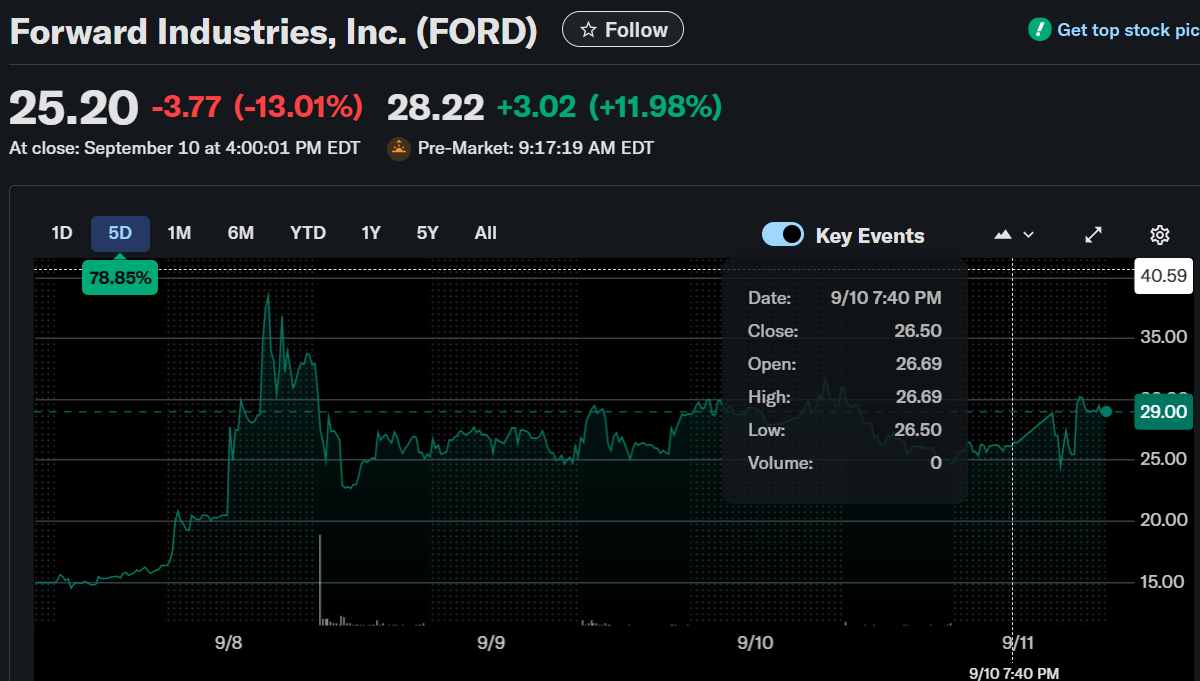
Forward Industries (FORD) Stock: Soars on $1.65B Solana-Focused PIPE Backed by Galaxy and Multicoin

Forward Industries (FORD) Stock: Soars on $1.65B Solana-Focused PIPE Backed by Galaxy and Multicoin

TLDR Forward Surges 13% After $1.65B Crypto Deal Led by Galaxy and Multicoin Forward Industries Bets Big on Solana With $1.65B Crypto Treasury Plan $1.65B Crypto Injection Sends Forward Soaring—Solana at the Core Forward Eyes Solana Dominance After $1.65B Backing From Crypto Giants PIPE Dream: Forward Rallies With $1.65B in Strategic Crypto Funding Forward Industries, [...] The post Forward Industries (FORD) Stock: Soars on $1.65B Solana-Focused PIPE Backed by Galaxy and Multicoin appeared first on CoinCentral.

Author: Coincentral
GENIUS Act Loophole Risks Draining Small Banks, Senator Warns

GENIUS Act Loophole Risks Draining Small Banks, Senator Warns

TLDR: Alabama Senator Keith Kelley says the GENIUS Act rewards loophole could reduce deposits in small rural banks. Crypto platforms offer high rewards without FDIC coverage, pulling funds away from community lending networks. Lower deposits could cut credit access for farms, small businesses, and rural economies dependent on local banks. Lawmaker urges Congress to close [...] The post GENIUS Act Loophole Risks Draining Small Banks, Senator Warns appeared first on Blockonomi.

Author: Blockonomi
Ethereum and Solana Lead Stablecoin Growth: What It Means for ETH and SOL Prices in 2025

Ethereum and Solana Lead Stablecoin Growth: What It Means for ETH and SOL Prices in 2025

The post Ethereum and Solana Lead Stablecoin Growth: What It Means for ETH and SOL Prices in 2025 appeared first on Coinpedia Fintech News Stablecoin flows are reshaping the crypto landscape, with Ethereum and Solana absorbing the majority of fresh supply in 2025. As these digital dollars drive liquidity into DeFi and payments, they directly impact gas usage, validator rewards, and ultimately the price trajectory of ETH and SOL. Can Ethereum’s stablecoin dominance push ETH price beyond $5,000, or …

Author: CoinPedia
From Fat Protocols to Fat Apps: Is Crypto Shifting Its Value Layer?

From Fat Protocols to Fat Apps: Is Crypto Shifting Its Value Layer?

Every cycle, crypto finds a new narrative that drives adoption — from ICOs to DeFi to NFTs. But in 2025, another contender is gaining traction: Fat Apps. These are not protocols, not just dApps, but heavyweight applications designed to dominate user attention and capture value at scale. What Are Fat Apps? In traditional Web3 discussions, value capture is often framed as “fat protocols” vs. “thin applications.” Fat Apps flip that thinking. They are: Applications with massive user networks. Built on top of existing blockchains. Designed to monetize data, liquidity, and user engagement directly. Instead of blockchain layers being the sole value driver, Fat Apps themselves could become the new giants. Why Fat Apps Could Be the Next Narrative User-first adoption: Retail users don’t care about L1 vs L2 — they care about apps that solve problems. Value capture: Fat Apps control front-end distribution, making them powerful gatekeepers. Ecosystem growth: As protocols compete for relevance, Fat Apps may dictate where liquidity flows. In many ways, the rise of Fat Apps echoes the Web2 model — think Facebook, Amazon, or Google — except now it’s on decentralized rails. Signals Already Emerging Some early signs suggest we’re entering a Fat Apps cycle: DeFi super-apps consolidating lending, swaps, and staking. SocialFi platforms where attention = tokenized value. Gaming ecosystems capturing users with built-in marketplaces. If this narrative takes off, the “winners” won’t just be protocols — they’ll be the apps that dominate user behavior. Fat Apps may sound like just another buzzword, but if history is a guide, new narratives drive cycles — and Fat Apps could be crypto’s next big story. We explored this in detail in our full editorial here: Fat Apps may sound like just another buzzword, but if history is a guide, new narratives drive cycles — and Fat Apps could be crypto’s next big story. We explored this in detail in our full editorial here: What Are Fat Apps in Crypto? From Fat Protocols to Fat Apps: Is Crypto Shifting Its Value Layer? was originally published in Coinmonks on Medium, where people are continuing the conversation by highlighting and responding to this story

Author: Medium