Lending

Lending protocols form the backbone of the decentralized money market, allowing users to lend or borrow digital assets without intermediaries. Using smart contracts, platforms like Aave and Morpho automate interest rates based on supply and demand while requiring over-collateralization for security. The 2026 lending landscape features advanced permissionless vaults and institutional-grade credit lines. This tag covers the evolution of capital efficiency, liquidations, and the integration of diverse collateral types, including LSTs and tokenized RWAs.

16010 Articles
Created: 2026/02/02 18:52
Updated: 2026/02/02 18:52
CNBC Partners with Kalshi for Regulated Prediction Market Data

CNBC Partners with Kalshi for Regulated Prediction Market Data

CNBC has announced a groundbreaking partnership with Kalshi, a regulated prediction market platform, to integrate real-time market data into its coverage starting next year. This collaboration aims to enhance CNBC’s financial reporting by offering predictive insights into major events, presenting audiences with a unique data-driven perspective.

Author: MEXC NEWS
What Advisors Should Know as the Market Matures

What Advisors Should Know as the Market Matures

The post What Advisors Should Know as the Market Matures appeared on BitcoinEthereumNews.com. In today’s “Crypto for Advisors” newsletter, Gregory Mall from Lionsoul Global breaks down crypto yield, highlighting its maturity, along with its role in a portfolio. We look at why yield may ultimately become crypto’s most durable bridge to mainstream portfolios. Then, in “Ask an Expert,” Kevin Tam highlights key investments from the recent 13F filings, including the news that combined United Arab Emirates sovereign exposure hit $1.08 billion, making them the fourth-largest global holder. Yield in Digital Assets: What Advisors Should Know as the Market Matures For most of its history, crypto has been defined by directional bets: buy, hold, and hope the next cycle delivers. But a quieter transformation has been unfolding beneath the surface. As the digital asset ecosystem has matured, one of its most important and misunderstood developments has been the emergence of yield: systematic, programmatic, and increasingly institutional. The story begins with infrastructure. Bitcoin introduced self-custody and scarcity; Ethereum extended that foundation with smart contracts, turning blockchains into programmable platforms capable of running financial services. Over the past five years, this architecture has given rise to a parallel, transparent credit and trading ecosystem known as decentralized finance (DeFi). While still niche relative to traditional markets, DeFi has grown from under $1 million of total value locked in 2018 to well over $100 billion at peak (DefiLlama). Even after the 2022 downturn, activity has rebounded sharply. For advisors, this expansion matters because it has unlocked something crypto rarely offered in its early years: cash-flow-based returns, not reliant on speculation. But the complexity behind those yields and the risks beneath the surface require careful navigation. Where Crypto Yield Comes From Yield in digital assets does not come from a single source but from three broad categories of market activity. 1. Trading and liquidity provision Automated market makers (AMMs)…

Author: BitcoinEthereumNews
Canton Network Integrates Circle’s xReserve to Enable Privacy-Focused USDC Stablecoin Payments

Canton Network Integrates Circle’s xReserve to Enable Privacy-Focused USDC Stablecoin Payments

Canton Network becomes first Blockchain to integrate Circle's xReserve, launches USDCz Stablecoin with configurable privacy for institutions.

Author: Blockchainreporter
Lyrics, Hum to Search Hits Taylor Swift, Bad Bunny, KPop Demon Hunters

Lyrics, Hum to Search Hits Taylor Swift, Bad Bunny, KPop Demon Hunters

The post Lyrics, Hum to Search Hits Taylor Swift, Bad Bunny, KPop Demon Hunters appeared on BitcoinEthereumNews.com. Arden Cho and Kevin Woo hop on the KPop Demon Hunters-Sing Along Experience at Paris Theater on August 23, 2025 in New York City. (Photo by Roy Rochlin/Getty Images for Netflix) Getty Images for Netflix Google’s Year in Search 2025 reveals listeners as truly enthused hunters when it came to music discovery this year. The search engine giant’s annual trend report shows that song and lyric lookups skewed toward defining pop-culture superstars like Bad Bunny and Taylor Swift, while hum-to-search results captured the year’s viral earworms and soundtrack hits, with KPop Demon Hunter tracks repeatedly breaking through in both text- and audio-search behavior. Google’s Year in Search lists measure trending searches as queries that increased fastest in interest between January 1 and November 25, 2025, compared with the same period the year before — meaning these lists capture spikes in curiosity rather than traditional search volume so the lists spotlight what was unique to 2025 and not necessarily “most searched.” Year in Search for the United States, used data from Google Trends, Nielsen, and other internal tools. The top trending Lyrics list from Google’s Year in Search reads like a ranking of the most quotable and talked about songs from the biggest LP releases. Bad Bunny’s “DtMF,” the abbreviated title track for DeBÍ TiRAR MáS FOToS that dropped five days into the year, led global lyric searches, but Taylor Swift placed multiple songs in the Top 10 titles. The Life of a Showgirl cuts covered Nos. 5-8 of trending songs of the year led by “Eldest Daughter” at No. 5, followed by “Fate of Ophelia,” “Opalite,” and “Father Figure” at No. 8. Emerging acts also broke through on a global scale with two 2026 Best New Artist Grammy nominees claiming spots in the worldwide Top 10 with “Ordinary” by newly…

Author: BitcoinEthereumNews
PANews November 2025 Columnist Influence and Article Popularity Ranking Released

PANews November 2025 Columnist Influence and Article Popularity Ranking Released

PANews' November 2025 Columnist Influence Ranking TOP5 and Column Article Popularity Ranking TOP10 (hereinafter referred to as "Double Ranking") are released today. We have conducted a comprehensive evaluation of the posting status of all columnists and the popularity of all column articles on the PANews platform in November to produce the Double Ranking. Top 5 Most Influential Columnists We have compiled a ranking of the top 5 most influential columnists for November based on a comprehensive evaluation of posting frequency, post quality, and readership . As shown in the image above, the five columnists on the list are: No.1 Biteye Biteye is a blockchain research institution and community focusing on L1/L2, DeFi, NFTs, and Web3. In November, Biteye published three articles, among which the analysis on the four-year cycle of Bitcoin became a viral hit and topped the article rankings. Click here to visit the author's homepage . No.2 On-Chain View ChainView is a self-media brand focusing on on-chain data, security insights, and trending topic analysis. In November, the author published multiple articles covering AI, x402, privacy, and other related fields, all of which garnered significant attention. Click here to visit the author's homepage . No. 3 Bitget Wallet Bitget Wallet is the wallet brand under the Bitget exchange. During November, this author published three articles, two of which made it to the top of the article charts. Click here to visit the author's homepage. No.4 Blockchain Knight Blockchain Knight frequently publishes content covering various aspects of the market. During November, the author produced a significant amount of content, primarily focusing on macro-level issues, which garnered considerable readership. Click here to visit the author's homepage . No. 5 Yue Xiaoyu Yue Xiaoyu, formerly a product manager at Alibaba, now focuses on Web3 project research and investment. In November, she published several articles, all of which garnered significant readership. Click here to visit her homepage . Top 10 Most Popular Articles Based on a comprehensive evaluation of content quality and article readership , a Top 10 Ranking of Popular Articles for November has been compiled. As shown in the image above, the 10 articles on the list are: No.1 " Has Bitcoin's Four-Year Cycle Failed? " by Biteye For ordinary retail investors, the most realistic approach may not be to predict cycles, but to try to develop their own market awareness. For example, they can learn to use data to assist in judgment, avoid the traps brought by emotional fluctuations, and look for high-value opportunities instead of chasing every hot trend. No. 2 " A Brief Review of FLock's AI Launchpad: Issuing Assets to Large Models a Viable Path? " by ChainView Once a model is assetized, trainers have the motivation to continuously optimize it, and once the revenue can be continuously distributed, the ecosystem will have the ability to generate its own revenue. No. 3 " Stream Finance Collapse Triggers $1 Billion Outflow: Is DeFi Entering Its Darkest Week Ever? " by Weissman Notes The DeFi market is facing a crisis of algorithmic stablecoins! The collapse of Stream Finance triggered a $1 billion outflow of funds, causing xUSD to plummet to $0.11, and the crisis has spread to mainstream lending platforms. Compound's emergency market shutdown barely contained the systemic collapse, exposing the structural risks of algorithmic stablecoins. No. 4 " Bitcoin May Face a 'Final Drop': The Real Script of Liquidity Tightening Is Playing Out " by SoSo Value BTC is likely undergoing its 'final drop,' at least the reopening of government offices and future interest rate cuts are certain, although the timing and pace are uncertain. No. 5 " The Truth About KOL Funds: A Wealth Experiment Driven by Traffic " by Biteye KOL (Key Opinion Leader) funding has become a new financing method in the crypto market: project teams offer KOLs tokens at low prices in exchange for publicity, and KOLs profit from their influence. In a bull market, this can yield returns of tens of times, but in a bear market, losses and being trapped are likely. Behind this is a three-way game between project teams, KOLs, and retail investors, with intermediary institutions controlling resource allocation. No. 6 " x402 is Currency, ERC-8004 is a Passport: Deciphering the Economic Model of Intelligent Agents " by Bitget Wallet If the x402 is the "currency" of the machine economy, then the ERC-8004 provides the "passport" and "credit report". No. 7 " Will ERC-8004 Repeat the Mistakes of Account Abstraction? " by ChainView AA is a sophisticated project driven by a researcher's mindset, while the x402 protocol is a pragmatic approach driven by market demand. No. 8 " The Death Trap Behind the IPO Profits: How Retail Investors Use 'Chain Schemes' to Counter Investor Attacks? " by Agintender The ultimate victory for retail investors lies in taking multiple defensive measures to transform the risk of liquidation from a "certain event" into a "cost event," until they can safely exit the market. No. 9 " Macroeconomic Turning Point for the Crypto Market in the Second Half of 2025: Q3 Uptrend Ends, Q4 Enters Repricing Range " by ArkStream Capital The third quarter of 2025 was crucial for the crypto market, serving as a bridge between the past and the future: it built upon the rebound in risk assets that began in July and further confirmed the macroeconomic turning point after the September interest rate cut. However, entering the fourth quarter, the market was simultaneously impacted by macroeconomic uncertainties and the outbreak of structural risks within the crypto market itself, leading to a sharp reversal in market dynamics and shattering previous optimistic expectations. No. 10 " Behind the 1460% Surge in ZEC: A Perfect Marketing Strategy for Mining Machine Sales? " by Bitget Wallet Are ZEC's miner economic model, network security, and on-chain interaction activity really enough to support an FDV of over 10 billion US dollars? at last If you have in-depth insights into the market, industry, and crypto space , and if you excel at writing content on trending events, emerging projects, in-depth research reports, and sector observations , please don't hesitate to contact us immediately. PANews will recommend high-quality content to its homepage, and may even feature it at the top, promote it on the app, include it on banners, and share it in communities ; outstanding authors will also be featured on the homepage . The December double rankings will be released around January 5, 2026. We look forward to seeing more new faces. Scan the QR code to add the PANews column manager, open a column, and build a Web3 account:

Author: PANews
Massive 283 Million USDT Transfer to OKX: What This Whale Movement Reveals

Massive 283 Million USDT Transfer to OKX: What This Whale Movement Reveals

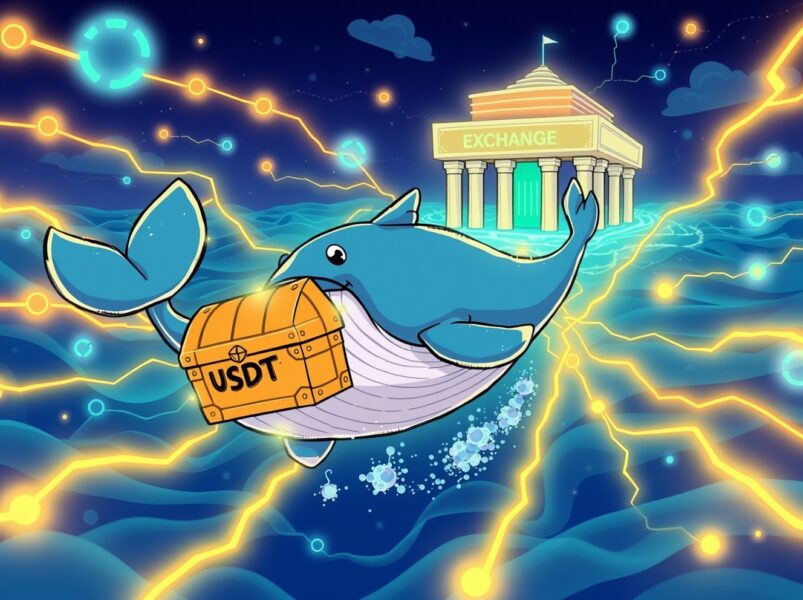
BitcoinWorld Massive 283 Million USDT Transfer to OKX: What This Whale Movement Reveals In a move that has captured the crypto community’s attention, blockchain tracker Whale Alert reported a staggering transaction: 283,050,936 USDT, valued at approximately $283 million, was transferred from an unknown wallet to the major cryptocurrency exchange OKX. This colossal USDT transfer to OKX is more than just a number on a screen; it’s a significant […] This post Massive 283 Million USDT Transfer to OKX: What This Whale Movement Reveals first appeared on BitcoinWorld.

Author: bitcoinworld
IMF Report Examines Stablecoin Risks Amid US GENIUS Act and EU MiCA Divergences Impacting USDT

IMF Report Examines Stablecoin Risks Amid US GENIUS Act and EU MiCA Divergences Impacting USDT

The post IMF Report Examines Stablecoin Risks Amid US GENIUS Act and EU MiCA Divergences Impacting USDT appeared on BitcoinEthereumNews.com. Stablecoin regulation is evolving globally to balance innovation with financial stability, as highlighted by the IMF’s analysis. Key frameworks like the US GENIUS Act and EU’s MiCA address risks such as market volatility and currency substitution through reserve requirements and oversight, fostering safer adoption while promoting cross-border cooperation. IMF Assessment: Global stablecoin market exceeds $300 billion, primarily US dollar-pegged, with reserves in US Treasuries and deposits. Regulatory Divergence: US GENIUS Act imposes strict reserves and bans yield-bearing coins, contrasting with EU MiCA’s emphasis on EU-based banking. Risk Mitigation: Emerging rules aim to reduce macroeconomic threats, but uneven approaches may fragment liquidity and create arbitrage opportunities, per CertiK analysis; international coordination is vital with 75% of Tether’s reserves in short-term Treasuries. Explore stablecoin regulation trends from IMF insights, US GENIUS Act impacts, and EU MiCA differences. Discover risks, innovations, and global strategies for safer crypto adoption—read now for expert analysis. What is stablecoin regulation and why does it matter? Stablecoin regulation refers to the legal frameworks governments and international bodies are developing to oversee digital assets designed to maintain a stable value, typically pegged to fiat currencies like the US dollar. The IMF’s recent briefing paper, “Understanding Stablecoins,” evaluates these efforts across major economies, emphasizing how they can mitigate risks to financial stability while supporting innovation. As the sector grows beyond $300 billion in market capitalization, robust regulation ensures interoperability, reduces volatility, and prevents currency substitution in vulnerable economies. How are divergent frameworks like the US GENIUS Act and EU MiCA shaping stablecoin liquidity? The US GENIUS Act, signed into law in July, establishes a comprehensive framework for payment stablecoins by mandating full reserve backing, prohibiting yield-bearing options, and integrating issuers into the traditional financial system. This provides regulatory clarity but creates a distinct US liquidity pool, as noted in a…

Author: BitcoinEthereumNews
IMF: Stablecoins May Boost Financial Access But Threaten Central Bank Sovereignty

IMF: Stablecoins May Boost Financial Access But Threaten Central Bank Sovereignty

The post IMF: Stablecoins May Boost Financial Access But Threaten Central Bank Sovereignty appeared on BitcoinEthereumNews.com. Stablecoins offer expanded financial access but pose risks to central banks through currency substitution, potentially eroding monetary sovereignty, according to a recent International Monetary Fund report. This dynamic could reduce control over liquidity and interest rates in affected economies. Stablecoins enable rapid penetration via digital channels, bypassing traditional banking requirements for foreign currencies. They may lead to currency substitution, where local currencies lose dominance in transactions and savings. In regions like Africa and Latin America, stablecoin holdings are growing faster than foreign exchange deposits, per CoinGecko data showing U.S. dollar stablecoins at 97% of the $311 billion market. Explore how stablecoins impact central banks and monetary sovereignty in this IMF analysis. Discover risks, benefits, and policy recommendations for the evolving digital asset landscape today. What is the Impact of Stablecoins on Central Banks? Stablecoins, digital assets pegged to fiat currencies like the U.S. dollar, have the potential to democratize financial services by providing quick access through smartphones and the internet. However, the International Monetary Fund warns in its recent 56-page report that this innovation could undermine central banks’ authority via currency substitution, where stablecoins gradually replace national currencies in everyday use. This shift might diminish central banks’ ability to manage domestic liquidity and set effective interest rates, particularly in emerging markets facing high inflation. How Do Stablecoins Lead to Currency Substitution? Stablecoins facilitate currency substitution by allowing users to hold and transact in foreign-denominated digital assets without needing physical cash or specialized bank accounts, as highlighted in the IMF’s analysis. In cross-border scenarios, especially with unhosted wallets, these tokens can spread rapidly, bypassing regulatory oversight and eroding the use of local currencies. For instance, in economies with unstable fiat money, individuals turn to dollar-pegged stablecoins for stability, leading to a decline in demand for national currency reserves. The IMF notes…

Author: BitcoinEthereumNews
Ripple CEO Predicts 2026 Will Be A Breakout Year For Crypto

Ripple CEO Predicts 2026 Will Be A Breakout Year For Crypto

What does the future of crypto look like in 2026? In this landmark panel from Binance Blockchain Week, three of the industry’s most influential leaders — B...

Author: Bitcoinist
MOBU, ETH, and LINK Lead

MOBU, ETH, and LINK Lead

The post MOBU, ETH, and LINK Lead appeared on BitcoinEthereumNews.com. Crypto Projects MoonBull, Ethereum, and Chainlink analysis with insights, key moves, and guidance on which crypto leads the next 100x cryptos to buy. Chainlink has been swinging like a heavyweight this week after recovering nearly 30 % from Monday’s brutal wipeout that dragged it to $11.74. The bounce to $14.61 shows fresh energy, but analysts warn that the $15 to $16.6 supply zone could cap the move until more substantial volume kicks in. Ethereum also adds heat to the market as it pushes above $3,200 and forms a path toward $3,450. With both majors showing mixed signals, traders hunting the next 100x crypto to buy are scanning early-stage plays before momentum decides its next move. This is where MoonBull’s Stage 6 presale steals the spotlight, especially as the broader market settles into cautious range-trading zones like Chainlink’s $14.2 to $15.4 band. MoonBull offers something different, giving latecomers a fresh shot at the next 100x crypto to buy while prices stay in their cheapest bracket. With Ethereum showing steady strength and Chainlink rebuilding momentum after its ETF-driven shakeout, investors who missed previous moonshots are turning toward the MoonBull presale window as a rare early-entry advantage before prices climb across its twenty-three stages. MoonBull: The Next 100x Crypto to Buy Is Heating the Presale Stage MoonBull is quickly becoming the market’s favorite pick for the next 100x crypto to buy as its Stage 6 presale gains momentum. This token is rewriting the meme-coin narrative by blending humor, culture, and long-term blockchain utility. Investors say MoonBull feels like a peanut-crunching bull ready to stomp into the big leagues with its structured tokenomics, automated liquidity system, price-stabilizing reflections, and steady burn mechanism. While most meme coins rely solely on hype, MoonBull builds a foundation that grows stronger with every buyer entering the ecosystem. The…

Author: BitcoinEthereumNews