Lending

Lending protocols form the backbone of the decentralized money market, allowing users to lend or borrow digital assets without intermediaries. Using smart contracts, platforms like Aave and Morpho automate interest rates based on supply and demand while requiring over-collateralization for security. The 2026 lending landscape features advanced permissionless vaults and institutional-grade credit lines. This tag covers the evolution of capital efficiency, liquidations, and the integration of diverse collateral types, including LSTs and tokenized RWAs.

15427 Articles
Created: 2026/02/02 18:52
Updated: 2026/02/02 18:52

MoonBull Leads Best Crypto to Invest with ADA, LINK, BZIL

MoonBull Leads Best Crypto to Invest with ADA, LINK, BZIL

The post MoonBull Leads Best Crypto to Invest with ADA, LINK, BZIL appeared on BitcoinEthereumNews.com. Crypto Presales MoonBull leads the best crypto to invest in 2025 as ADA, LINK, and HYPE push adoption higher. Join MoonBull presale now for major upside! Have you been wondering which is the best crypto to invest in 2025? As the digital asset market evolves rapidly, opportunities to capture exceptional returns are emerging every day. Coins like MoonBull ($MOBU), Cardano (ADA), Chainlink (LINK), Hyperliquid (HYPE), BullZilla (BZIL), La Culex (CULEX), and Apeing (APEING) are attracting attention for their innovative mechanics and growing adoption. Investors looking for high upside potential are closely tracking MoonBull presale as it promises early-stage rewards and unprecedented ROI scenarios. From blockchain solutions to innovative meme coins, projects like MoonBull ($MOBU) are setting new standards in redistribution and governance. MoonBull ($MOBU): Best Crypto to Invest in 2025 The MoonBull presale is live now, presenting a first-come, first-served opportunity to participate in a revolutionary crypto project. MoonBull ($MOBU) stands out as the best crypto to invest in 2025, designed to reward early adopters while fostering long-term token scarcity. MoonBull’s tokenomics leverage a smart redistribution system that enhances market stability while rewarding holders. Each $MOBU sale channels 2% into liquidity, 2% as passive rewards for holders, and 1% is permanently burned. The combination of liquidity, reflection rewards, and token burn makes MoonBull($MOBU) an attractive vehicle for investors seeking the best crypto to invest in 2025, enabling every trade to support long-term value accumulation. Starting from Stage 12, MoonBull introduces a governance system allowing token holders to influence the project’s trajectory. This mechanism empowers the community, turning passive holders into active participants in strategic decisions, reinforcing MoonBull($MOBU) as the best crypto to invest in 2025 for both potential ROI and governance participation. MoonBull Stage 6 Presale Gains Traction With $550K+ Raised MoonBull (MOBU) has entered Stage 6 at $0.00008388, with…

Author: BitcoinEthereumNews
JPMorgan: Bitcoin Surpasses Gold as Preferred Investment After Deleveraging

JPMorgan: Bitcoin Surpasses Gold as Preferred Investment After Deleveraging

JPMorgan Chase has declared Bitcoin more attractive than gold for investors following recent market deleveraging trends, marking a significant shift in institutional perspectives toward cryptocurrency as a legitimate alternative asset class.

Author: MEXC NEWS
Block posts weak Q3 results despite raising full-year guidance

Block posts weak Q3 results despite raising full-year guidance

The post Block posts weak Q3 results despite raising full-year guidance appeared on BitcoinEthereumNews.com. Block took a heavy hit on Thursday as its stock (XYZ) crashed by almost 12% in after-hours trading, after the FinTech company released third-quarter results that failed to meet expectations, even while it lifted full-year forecasts. The earnings report showed a sharp miss on both earnings per share and revenue, disappointing investors who had been expecting a much stronger performance by the Jack Dorsey-led company. Block’s adjusted EPS came in at $0.54, which far below the analyst consensus of $0.63, a 14% miss, while revenue came in at $6.11 billion, also far below the $6.33 billion predicted by LSEG analysts. The weaker results overshadowed what was otherwise solid operational growth across Block’s key ecosystems Cash App and Square, with gross profit on both increasing 18% year over year to $2.66 billion. Within that, Cash App produced $1.62 billion, up 24%, while Square contributed $1.02 billion, up 9%. Square’s Gross Payment Volume (GPV) also surged by 12%, and Cash App recorded 58 million monthly active users as of September. Jack said, “We had another strong quarter delivering for our customers with high quality and high velocity. Square GPV growth accelerated to 12%, and we gained profitable market share through product innovation and expanded distribution.” Block raises guidance after weak quarterly results Despite missing expectations, Block raised its 2025 full-year guidance, forecasting $10.24 billion in gross profit, which is over 15% year-over-year growth, and $2.06 billion in adjusted operating income at a 20% margin. For the Q4, Block expects gross profit of $2.76 billion, which is a 19% surge from last year. The earnings report also said that Block’s Proto ecosystem generated revenue for the first time last quarter, describing it as a potential “next major ecosystem” for Block, expanding beyond its established platforms. Alongside that, the company continues to embed AI…

Author: BitcoinEthereumNews
Bitcoin.com, Concordium partner on age-verified crypto payments

Bitcoin.com, Concordium partner on age-verified crypto payments

The post Bitcoin.com, Concordium partner on age-verified crypto payments appeared on BitcoinEthereumNews.com. Bitcoin.com and Concordium have teamed up to introduce age-verified stablecoin payments to 75 million wallets, blending privacy with new compliance standards. Crypto media and wallet platform Bitcoin.com has partnered with Concordium, a privacy-focused layer-1 blockchain, to enable age-verified stablecoin payments across more than 75 million wallets on Bitcoin.com’s network. Announced on Thursday, the integration allows wallet users to verify specific identity attributes, such as age or jurisdiction, without revealing personal details. Verification occurs off-chain through independent third-party providers, and no personal data is stored on the blockchain. Each transaction utilizes zero-knowledge proof technology to verify compliance requirements while maintaining user privacy. Read more Source: https://cointelegraph.com/news/bitcoincom-concordium-age-verified-stablecoin-payments?utm_source=rss_feed&utm_medium=feed%3F_refresh%3D39u2ns%26ttl%3D0%26__%3D1762499959695%26rand%3Dx6kdf_1762499959695&utm_campaign=rss_partner_inbound

Author: BitcoinEthereumNews
Stablecoin Network Reaches $10T Annual Volume with Interoperability Focus

Stablecoin Network Reaches $10T Annual Volume with Interoperability Focus

A major stablecoin ecosystem has achieved $10 trillion in annual transaction volume while committing to enhanced cross-chain interoperability, marking a significant milestone in digital currency adoption and blockchain connectivity.

Author: MEXC NEWS
Dalio's latest article: The Fed's resumption of rate cuts is not to save the market, but to inflate the bubble.

Dalio's latest article: The Fed's resumption of rate cuts is not to save the market, but to inflate the bubble.

Author: Ray Dalio Did you notice the Federal Reserve's announcement that it would stop quantitative tightening (QT) and launch quantitative easing (QE)? Although this is described as a technical operation, it is still an easing policy in any case—and it is one of the important indicators I follow to track the evolution of the "Great Debt Cycle" dynamics described in the previous book. As Chairman Powell stated, "At some point, reserves need to grow gradually to match the size of the banking system and the size of the economy. Therefore, we will increase reserves at specific times." The specific increase deserves close attention. Given that the Federal Reserve has the responsibility of "controlling the size of the banking system" during bubble periods, we need to simultaneously monitor the pace at which it injects liquidity into emerging bubbles through interest rate cuts. More specifically, if a significant expansion of the balance sheet occurs against the backdrop of lower interest rates and a high fiscal deficit, we would view it as a classic example of coordinated fiscal and monetary policy by the Federal Reserve and the Treasury to monetize government debt. If, in this scenario, private lending and capital market credit creation remain strong, the stock market repeatedly hits new highs, credit spreads are nearing lows, unemployment is low, inflation is exceeding targets, and artificial intelligence stocks have already formed a bubble (which, according to my bubble indicator, is indeed the case), then in my view, the Federal Reserve is injecting stimulus into the bubble. Given the government and numerous advocacy for a significant easing of policy constraints to implement aggressive, capitalist growth-oriented monetary and fiscal policies, and the urgent need to address the massive outstanding deficits, debt, and bond supply and demand issues, I suspect this is far more than just a technical problem—a concern that should be understood. I understand the Federal Reserve's high level of concern about funding market risks, which means that in the current political environment, it tends to prioritize market stability over aggressively combating inflation. However, whether this will evolve into a full-blown, classic stimulus-driven quantitative easing (accompanied by large-scale net bond purchases) remains to be seen. We should not overlook the fact that when the supply of US Treasury bonds exceeds demand, the central bank purchases bonds through "money printing," and the Treasury shortens debt maturities to make up for the shortfall in long-term bond demand, these are typical dynamic characteristics of the late stage of a debt cycle. Although I have fully explained its operating mechanism in my book "Why Nations Go Bankrupt: The Great Cycle," it is still necessary to point out that we are currently approaching a classic milestone in this great debt cycle and briefly review its operating logic. My goal is to impart knowledge by sharing my thoughts on market mechanisms, revealing the essence of phenomena like teaching someone to fish—explaining the logical thinking and pointing out current dynamics, leaving the rest for the reader to explore. This approach is more valuable to you and avoids me becoming your investment advisor, which is more beneficial for both parties. Below is my interpretation of the operating mechanism: When the Federal Reserve and other central banks purchase bonds, they create liquidity and lower real interest rates (as shown in the diagram below). Subsequent developments depend on where this liquidity flows: If assets remain tied up in financial assets, they will drive up asset prices and lower real yields, leading to an expansion of price-to-earnings ratios, a narrowing of risk premiums, and a rise in gold prices, resulting in "financial asset inflation." This benefits holders of financial assets relative to non-holders, thereby widening the wealth gap. Typically, some liquidity is transmitted to the goods, services, and labor markets, pushing up inflation. However, with the current trend of automation replacing labor, this transmission effect may be weaker than usual. If the inflationary stimulus is strong enough, nominal interest rates could rise to a level sufficient to offset the decline in real interest rates, at which point bonds and stocks will face dual pressure on both nominal and real values. Transmission mechanism: Quantitative easing is transmitted through relative prices. As I explained in my book Why Nations Go Bankrupt: The Great Cycle (which I cannot elaborate on here), all capital flows and market fluctuations are driven by relative attractiveness, not absolute attractiveness. In short, everyone holds a certain amount of capital and credit (the size of which is influenced by central bank policy), and the flow of capital is determined by the relative attractiveness of various options. For example, borrowing or lending depends on the relative relationship between the cost of capital and expected returns; investment choices primarily depend on the relative level of expected total returns across different assets—expected total returns equal to the sum of asset yields and price changes. For example, gold yields 0%, while the 10-year US Treasury yield is currently around 4%. If the expected annual price increase for gold is less than 4%, then holding Treasury bonds is the better choice; if the expected increase is more than 4%, then holding gold is the better choice. When assessing the relative performance of gold and bonds relative to the 4% threshold, inflation must be considered—these investments must provide sufficient returns to offset the erosion of purchasing power by inflation. All else being equal, the higher the inflation rate, the greater the increase in gold prices—because inflation primarily stems from the depreciation of other currencies due to increased supply, while the supply of gold remains relatively constant. For this reason, I pay close attention to the money and credit supply situation and the policy moves of central banks such as the Federal Reserve. More specifically, in the long run, the value of gold always moves in tandem with inflation. The higher the inflation rate, the less attractive a 4% bond yield becomes (for example, a 5% inflation rate would increase the attractiveness of gold and support its price, while reducing the attractiveness of bonds as real yields fall to -1%). Therefore, the more money and credit central banks create, the higher I expect inflation to be, and the lower my preference for bonds will be compared to gold. All else being equal, the Federal Reserve's expansion of quantitative easing is expected to lower real interest rates and increase liquidity by compressing risk premiums, thereby suppressing real yields and pushing up price-to-earnings ratios. This will particularly boost the valuations of long-term assets (such as technology, artificial intelligence, and growth companies) and inflation-hedging assets like gold and inflation-linked bonds. When inflation risks re-emerge, companies with tangible assets such as mining, infrastructure, and physical assets are likely to outperform pure long-term technology stocks. Due to the lagged effect, inflation will be higher than originally expected. If quantitative easing leads to a decline in real yields while inflation expectations rise, nominal price-to-earnings ratios may still expand, but real returns will be eroded. A reasonable expectation is that, similar to late 1999 or 2010-2011, a strong liquidity-driven rally will occur, eventually forcing tightening due to excessive risk. The liquidity frenzy before the bubble bursts—that is, just before the critical point when tightening policies are sufficient to curb inflation—is the classic ideal time to sell. This time it's different because the Federal Reserve will create a bubble through loose monetary policy. While I believe the operational mechanism will proceed as I described, the implementation environment for this round of quantitative easing is drastically different from the past—this easing policy is being implemented amidst a bubble, not a recession. Specifically, in the past, when quantitative easing was implemented: Asset valuations are declining, and prices are either low or not overvalued. The economy is in a state of contraction or extreme weakness. Inflation is at a low level or trending downward. The debt and liquidity problems are severe, and credit spreads are widening. Therefore, quantitative easing is essentially "injecting stimulus into a recession". The current situation is exactly the opposite: Asset valuations are high and continue to rise. For example, the S&P 500 index has a return of 4.4%, while the nominal yield on 10-year Treasury bonds is only 4%, and the real yield is about 1.8%, so the equity risk premium is as low as 0.3%. The economic fundamentals are relatively strong (the average real growth rate over the past year was 2%, and the unemployment rate was only 4.3%). Inflation is slightly above the target (about 3%), but the rate of increase is relatively moderate, while inefficiencies caused by the reversal of globalization and tariff costs continue to push up prices. Credit and liquidity are ample, and credit spreads are approaching historical lows. Therefore, the current quantitative easing is actually "injecting stimulation into the bubble". Therefore, this round of quantitative easing is not "injecting stimulus into recession," but rather "injecting stimulus into bubbles." Let's look at how this mechanism typically affects stocks, bonds, and gold. Because government fiscal policy is currently highly stimulative (as massive outstanding debt and huge deficits are being covered by massive issuance of government bonds, especially in the relatively short-term tranches), quantitative easing is effectively monetizing government debt rather than simply getting the private system flowing again. This makes the current situation different and also makes it look more dangerous and more likely to trigger inflation. It looks like a bold and dangerous gamble on economic growth, especially on artificial intelligence growth, funded by extremely loose fiscal, monetary, and regulatory policies, which we need to watch closely to handle properly.

Author: PANews
Ripple CLO Sees ‘Skinny’ Fed Account As Solution To Banking Concerns, Touts Benefits

Ripple CLO Sees ‘Skinny’ Fed Account As Solution To Banking Concerns, Touts Benefits

Blockchain payment company Ripple, expressed support for the concept of a “skinny” Federal Reserve (Fed) payments account tailored for non-banking entities through its chief legal officer, Stuart Alderoty. This account could reportedly address concerns from traditional banks about financial stability and competitive risks. Ripple Seeks Fed Master Account In an interview with Reuters, Alderoty described […]

Author: Bitcoinist
Radioactive Metal Hits DeFi: Morpho Protocol Integrates Uranium Tokens as Collateral

Radioactive Metal Hits DeFi: Morpho Protocol Integrates Uranium Tokens as Collateral

The post Radioactive Metal Hits DeFi: Morpho Protocol Integrates Uranium Tokens as Collateral appeared on BitcoinEthereumNews.com. Uranium has officially entered the decentralized finance ecosystem with the launch of xU3O8-based lending on the DeFi aggregator Oku, utilizing the Morpho protocol. Unlocking Liquidity for a Traditionally Opaque Market Uranium, the radioactive heavy metal used in nuclear reactors, has been ushered into the decentralized finance (DeFi) ecosystem with the launch of xU3O8-based lending on […] Source: https://news.bitcoin.com/radioactive-metal-hits-defi-morpho-protocol-integrates-uranium-tokens-as-collateral/

Author: BitcoinEthereumNews
Whale Withdraws $114.9 Million USDT, Spikes Aave Utilization

Whale Withdraws $114.9 Million USDT, Spikes Aave Utilization

The post Whale Withdraws $114.9 Million USDT, Spikes Aave Utilization appeared on BitcoinEthereumNews.com. Key Points: Whale withdrawal boosts Aave’s USDT utilization rate, surpassing threshold. Interest rate spikes to curb excessive borrowing. Stablecoin dynamics shift on Aave platform. A large cryptocurrency investor, identified by wallet 0x540C, withdrew $114.9 million USDT from Aave’s main market, raising the USDT utilization rate past its optimal threshold. This increased borrowing costs, aligning with Aave’s risk management mechanisms to stabilize liquidity and incentivize further deposit supply, highlighting potential volatility within decentralized finance markets. Aave’s Utilization Rate Skyrockets to 92.83% Following the significant USDT withdrawal, Aave’s utilization rate rose to 92.83%, which surpasses its optimal threshold. This event has caused interest rates to increase significantly, according to the Aave documentation, encouraging liquidity rebalancing. Industry observers report that the abrupt hike in interest rates aims to manage borrowing and prompt new deposits. As of now, there have been no official statements from Aave’s leadership team regarding this event. According to CoinMarketCap, Tether (USDT) is currently priced at $1.00. It has a market cap of $183.37 billion and market dominance of 5.37%. Trading volume hit $139.37 billion in the last 24 hours with a minor price change of -0.04% over this period. Over the last 90 days, USDT has seen minor fluctuations, with price decreases of 0.06%. “When utilization exceeds this point, Slope 2 kicks in, sharply increasing interest rates to discourage excessive borrowing and protect the remaining liquidity.” — Aave Documentation, Official Documentation Team, Aave DeFi Market Dynamics and Price Analysis Under Scrutiny Did you know? In March 2023, a similar event saw Aave’s DAI market reach near-100% utilization, causing interest rates to spike and new deposits to be incentivized. The Coincu research team highlights the potential for changing borrowing and lending dynamics within the DeFi landscape, stressing the importance of market stability mechanisms during high utilization phases. Tether USDt(USDT), daily…

Author: BitcoinEthereumNews
Zcash Price Prediction: Can ZEC Surge Past $1,000 After 350% Rally?

Zcash Price Prediction: Can ZEC Surge Past $1,000 After 350% Rally?

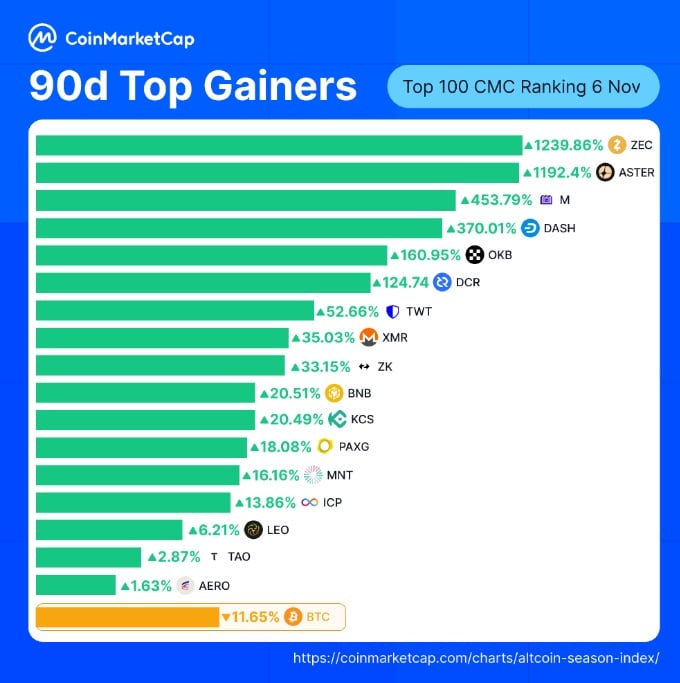
Zcash has emerged as one of the standout privacy-focused crypto, capturing significant attention in recent weeks. The coin has surged past the $500 mark following a remarkable 350% rally over the past month, outperforming many major cryptos despite broader market volatility. The recent price movement has been fueled by increasing derivatives demand, with funding rates […]

Author: The Cryptonomist