Index

A crypto Index provides a way for investors to gain diversified exposure to a specific basket of digital assets through a single tokenized product. These indices often track specific sectors, such as DeFi, DePIN, or RWA, and are automatically rebalanced via smart contracts. In 2026, AI-managed thematic indices have become the gold standard for passive investing, allowing users to track the "blue chips" of the Web3 economy without manual portfolio management. This tag covers index methodology, rebalancing frequency, and the benefits of diversified crypto baskets.

25475 Articles
Created: 2026/02/02 18:52
Updated: 2026/02/02 18:52
Blue Owl plays to broader investor audience as alternative assets go mainstream

Blue Owl plays to broader investor audience as alternative assets go mainstream

The post Blue Owl plays to broader investor audience as alternative assets go mainstream appeared on BitcoinEthereumNews.com. Jelena Ostapenko of Latvia (R) argues with Taylor Townsend of the United States (L) following their Women’s Singles Second Round match on Day Four of the 2025 US Open at USTA Billie Jean King National Tennis Center on August 27, 2025 in the Flushing neighborhood of the Queens borough of New York City. Clive Brunskill | Getty Images At the U.S. Open last week, a terse exchange between players Taylor Townsend and Jelena Ostapenko went viral — and brought alternatives manager Blue Owl Capital further into the limelight. Videos and photos of the exchange flooded social media. Ostapenko, the women’s world No. 26 from Latvia, pointed a finger and shouted insults at Townsend, who had won the second-round match but was later defeated in a competitive match against Barbora Krejčíková. As the camera panned in for viewers to get a closer look at the confrontation, careful observers could see a Blue Owl patch emblazoned on Townsend’s tennis dress. The $284 billion asset management firm, which focuses largely on private credit and real estate, is not exactly the type of household name you might expect to see sponsoring a tennis player.  Townsend is one of about 100 athletes competing in professional tennis tournaments around the world this year who are backed by Blue Owl. It’s part of the firm’s strategy to raise brand awareness primarily among high-net-worth individuals, and part of a broader effort to bring alternative asset managers out of obscurity.  Taylor Townsend of the United States celebrates winning match point against Jelena Ostapenko of Latvia during their Women’s Singles Second Round match on Day Four of the 2025 US Open at USTA Billie Jean King National Tennis Center on August 27, 2025 in the Flushing neighborhood of the Queens borough of New York City. Clive Brunskill | Getty Images…

Author: BitcoinEthereumNews
US stocks stumble into September as Asia ends mixed amid tariff uncertainty

US stocks stumble into September as Asia ends mixed amid tariff uncertainty

The post US stocks stumble into September as Asia ends mixed amid tariff uncertainty appeared on BitcoinEthereumNews.com. US stocks entered September on the back foot as futures dropped early Tuesday, with traders reacting to trade war fallout, rising bond yields, and fresh signals from Asia. All three major US indexes were in the red before markets even opened. Dow futures fell 189 points, or 0.4%, while S&P 500 futures slid 0.5%, and Nasdaq-100 futures dropped 0.7%. Profit-taking kicked in as the summer wrapped. Names that have led the charge this year started bleeding. Nvidia was down 1.5%, and Palantir lost 2%, dragging down the tech sector. The selling was clearly timed with the calendar flip. At the same time, bond traders didn’t hold back either. The 10-year Treasury yield rose to 4.29%, and the 30-year yield climbed to 4.98%, setting the tone for the day. Wall Street shifts focus to jobs report and Fed call August closed strong for US stocks, but nobody’s celebrating this week. Last month, the Dow gained more than 3%, the S&P 500 added nearly 2%, and the Nasdaq rose 1.6%. That made it four consecutive months of gains for the S&P 500. But traders quickly switched gears. The next big piece of data is Friday’s August jobs report, which could shape the Federal Reserve’s rate decision coming mid-September. Overseas, Asia-Pacific markets had no clear direction. Some countries held firm, others slipped. The confusion is partly tied to the Shanghai Cooperation Organization summit in Tianjin. Trade tension weighed on sentiment after a federal appeals court ruled most of President Donald Trump’s global tariffs illegal. On Monday, Trump wrote on Truth Social that India had offered to cut its tariffs on US imports to zero, but he made it clear he wasn’t impressed. “They have now offered to cut their Tariffs to nothing, but it’s getting late. They should have done so years ago,”…

Author: BitcoinEthereumNews
Cardano at Risk? Large Holders Exit While Support Levels Tighten

Cardano at Risk? Large Holders Exit While Support Levels Tighten

The post Cardano at Risk? Large Holders Exit While Support Levels Tighten appeared on BitcoinEthereumNews.com. Cardano whales holding 100M-1B ADA have sold off 30 million tokens in the last seven days alone The selling comes as historical Bitcoin halving cycles suggest a market peak is due by October 2025 Despite the whale sale, ADA has shown relative strength against peers like Avalanche and Dogecoin YTD The crypto market has started September on an upswing, with total market capitalization climbing to $3.81 trillion after a 2.1% gain in the past 24 hours. Bitcoin led the charge, holding steady above $110,000, while Ethereum edged higher near $4,380. XRP made a 3% jump, and Solana added more than 7% in the past week.  However, analyst Ali Martinez has observed that  at the same time, large Cardano holders offloaded 30 million ADA in just a week. Is the Crypto Bull Market Nearing Its Peak? The concern over the whale selling comes as the entire crypto market is entering a historically critical window. What does the historical halving cycle suggest? Historically, bull markets top out 12 to 18 months after the Bitcoin halving. That puts the peak window for this cycle squarely between August and October 2025, meaning we could be in it right now. If that timeline holds, the risk of a major downturn is getting higher every day. What are the key market-wide technical levels? The monthly Bollinger Band average for Bitcoin sits near $82,000, which means prices could drop nearly 30% and still remain in a bull market. However, the “Others” index, which measures smaller altcoins, is only about 10% away from slipping into bearish territory.  For more context: September Macro Outlook for Crypto: Why Data is Key Should ADA Holders Be Worried? The most specific warning sign comes directly from Cardano’s biggest holders.  How much ADA did the whales sell? According to analyst Ali Martinez, wallets…

Author: BitcoinEthereumNews
Mastercard’s Head of European Crypto Sees Cryptocurrencies as Payment Technology, Not a “Revolution”! Here Are the Details

Mastercard’s Head of European Crypto Sees Cryptocurrencies as Payment Technology, Not a “Revolution”! Here Are the Details

The post Mastercard’s Head of European Crypto Sees Cryptocurrencies as Payment Technology, Not a “Revolution”! Here Are the Details appeared on BitcoinEthereumNews.com. Mastercard’s Head of Crypto Europe, Christian Rau, explained that the company sees cryptocurrencies as a potential payment technology rather than a “financial revolution.” Mastercard: Sees Crypto as Payment Technology, Not a “Revolution” Rau emphasized that Mastercard’s strategy is based, above all, on “safe and legally compliant payments.” Rau stated that stablecoins (crypto assets whose value is typically pegged to fiat currencies like the dollar) could improve the efficiency of international payments. However, he added that these assets are unlikely to replace the traditional safeguards offered by the current financial system. The Mastercard executive stated that the company currently has no publicly announced plans to develop its own blockchain infrastructure, but that the option isn’t completely ruled out. This approach suggests Mastercard is pursuing a cautious yet open-ended strategy in the crypto space. Experts, noting the recent increase in interest in crypto assets from major financial institutions, say Mastercard’s stance signals a more balanced and regulatory-focused approach to the sector. The company appears to view crypto as a complementary tool, particularly in the areas of payment technologies and international money transfers. This statement is considered an important clue about how the bridge between traditional finance and the crypto ecosystem will take shape. *This is not investment advice. Follow our Telegram and Twitter account now for exclusive news, analytics and on-chain data! Source: https://en.bitcoinsistemi.com/mastercards-head-of-european-crypto-sees-cryptocurrencies-as-payment-technology-not-a-revolution-here-are-the-details/

Author: BitcoinEthereumNews
Eurozone Harmonized Index of Consumer Prices (MoM) increased to 0.2% in August from previous 0%

Eurozone Harmonized Index of Consumer Prices (MoM) increased to 0.2% in August from previous 0%

The post Eurozone Harmonized Index of Consumer Prices (MoM) increased to 0.2% in August from previous 0% appeared on BitcoinEthereumNews.com. Information on these pages contains forward-looking statements that involve risks and uncertainties. Markets and instruments profiled on this page are for informational purposes only and should not in any way come across as a recommendation to buy or sell in these assets. You should do your own thorough research before making any investment decisions. FXStreet does not in any way guarantee that this information is free from mistakes, errors, or material misstatements. It also does not guarantee that this information is of a timely nature. Investing in Open Markets involves a great deal of risk, including the loss of all or a portion of your investment, as well as emotional distress. All risks, losses and costs associated with investing, including total loss of principal, are your responsibility. The views and opinions expressed in this article are those of the authors and do not necessarily reflect the official policy or position of FXStreet nor its advertisers. The author will not be held responsible for information that is found at the end of links posted on this page. If not otherwise explicitly mentioned in the body of the article, at the time of writing, the author has no position in any stock mentioned in this article and no business relationship with any company mentioned. The author has not received compensation for writing this article, other than from FXStreet. FXStreet and the author do not provide personalized recommendations. The author makes no representations as to the accuracy, completeness, or suitability of this information. FXStreet and the author will not be liable for any errors, omissions or any losses, injuries or damages arising from this information and its display or use. Errors and omissions excepted. The author and FXStreet are not registered investment advisors and nothing in this article is intended…

Author: BitcoinEthereumNews
Chainalysis 2025 Global Index: India and U.S. Top Crypto Adoption Rankings

Chainalysis 2025 Global Index: India and U.S. Top Crypto Adoption Rankings

The sixth annual Chainalysis Global Crypto Adoption Index reveals a transformative year for digital assets, with India and the United States leading the world in overall adoption. Unlike earlier years, where crypto activity leaned heavily toward grassroots usage in emerging markets, 2025 showcases a more balanced picture: retail adoption remains strong, but institutional flows are now a critical driver of growth. The methodology remains rigorous. Chainalysis evaluates 151 countries using four sub-indices: on-chain value received by centralized services; retail-sized value received by those services; on-chain activity in DeFi protocols; and institutional-sized transfers. Each component is weighted by GDP per capita on a purchasing-power-parity basis, ensuring the rankings reflect economic context rather than raw transaction volume. This comprehensive approach highlights not just where crypto is popular, but where it is meaningfully integrated into financial systems. Shifting Methodology for a Maturing Market In 2025, Chainalysis introduced important methodological changes. First, the retail DeFi sub-index was removed, as internal data showed that while DeFi transaction volumes remain significant, grassroots engagement there is far smaller than on centralized platforms. By excluding retail DeFi as a standalone category, the index avoids overrepresenting a relatively niche behavior. Second, an institutional activity sub-index was added, reflecting the surge of large-scale transactions driven by traditional finance. Transfers above $1 million are now captured in the rankings, providing a clearer view of how hedge funds, custodians, ETFs, and banks are shaping the landscape. This shift is timely: with multiple U.S. spot Bitcoin ETFs approved and greater regulatory clarity across key jurisdictions, institutions are no longer testing the waters—they are actively participating. Together, these changes create a more accurate lens. The index continues to focus on grassroots adoption but now incorporates top-down institutional flows, showing how deeply crypto has penetrated mainstream finance. India, the U.S., and the Rise of APAC The 2025 Index crowns India as the number one country for crypto adoption, ranking first across all four sub-indices. India’s dominance reflects both widespread grassroots use and growing integration with financial services. The United States ranks second overall, bolstered by strong institutional participation and the legitimizing effect of regulatory progress. Beyond these leaders, Pakistan (3rd), Vietnam (4th), and Brazil (5th) round out the top five, reflecting a blend of remittance-driven retail usage and rising institutional interest. Notably, APAC has emerged as the fastest-growing region, with on-chain activity rising 69% year-over-year to $2.36 trillion. Latin America follows with 63% growth, showing the region’s reliance on stablecoins for remittances and inflation hedging. When adjusting for population size, Eastern Europe stands out. Ukraine, Moldova, and Georgia top the population-adjusted index, reflecting extraordinary levels of activity relative to population. Factors such as war, inflation, and banking restrictions have accelerated crypto’s role as both a hedge and a cross-border transaction tool. Stablecoins and Bitcoin Dominate On-Ramps Stablecoins remain at the heart of global crypto adoption. Between June 2024 and June 2025, USDT processed more than $1 trillion per month, while USDC peaked at $3.29 trillion. New entrants like EURC and PYUSD are also growing rapidly, with EURC volumes surging nearly 89% month-over-month as MiCA-compliant euro stablecoins gain traction in Europe. At the same time, Bitcoin continues to serve as the primary fiat on-ramp, accounting for over $4.6 trillion in inflows—more than double any other category. The United States leads by volume, with South Korea and the European Union trailing behind. These flows confirm that while altcoins and DeFi tokens are important, Bitcoin and stablecoins remain the central gateways into crypto. A Truly Global Wave Perhaps the most striking finding of the 2025 Index is that adoption is no longer confined to one region or income level. High-income countries are accelerating institutional rails, while lower- and middle-income nations continue to rely on crypto for remittances, dollar access, and mobile-first finance. This synchronicity suggests crypto adoption is now broad-based and durable, not episodic. The challenges ahead remain clear: fragmented regulations, fragile infrastructure in low-income countries, and the need for secure on-ramps. Yet the trajectory is undeniable. With India and the United States setting the pace, and the Global South demonstrating how crypto solves real-world problems, the 2025 Global Adoption Index shows one truth: crypto is no longer an experiment. It is becoming a core feature of the global financial system

Author: CryptoNews
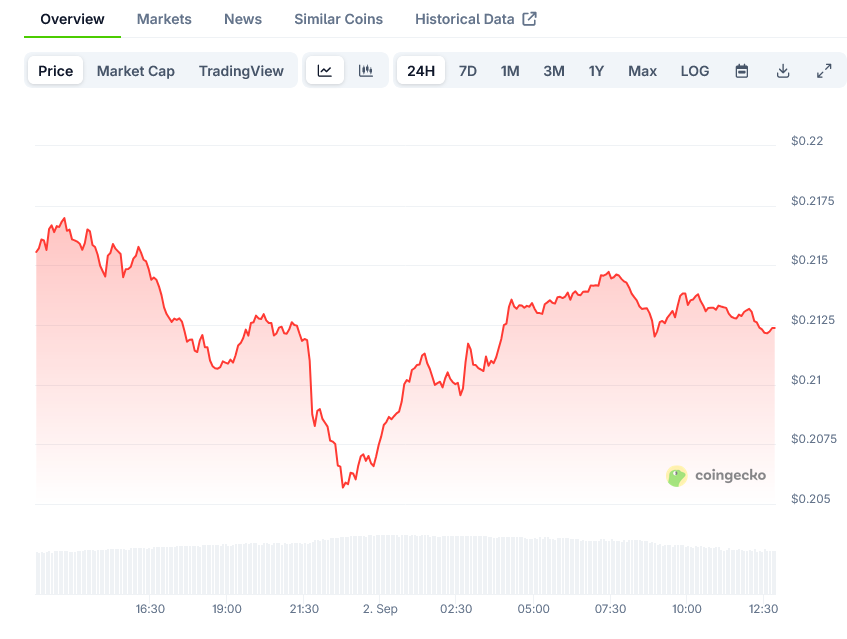
Dogecoin (DOGE) Price: $0.211 Level Emerges as Critical Decision Point for Next Market Move

Dogecoin (DOGE) Price: $0.211 Level Emerges as Critical Decision Point for Next Market Move

TLDR Dogecoin is currently trading around $0.21, near its 200-day EMA, which serves as a critical support level DOGE is forming a triangular pattern similar to those that preceded previous major rallies in 2016 and 2020 Derivatives data shows negative funding rates and increasing short positions, suggesting bearish sentiment Whale addresses have offloaded approximately 250 [...] The post Dogecoin (DOGE) Price: $0.211 Level Emerges as Critical Decision Point for Next Market Move appeared first on Blockonomi.

Author: Blockonomi
DOGE Risks Deeper Correction if $0.211 Support Fails – Dogecoin up 2%

DOGE Risks Deeper Correction if $0.211 Support Fails – Dogecoin up 2%

Dogecoin price tests the $0.211 support as traders increase short bets and whales trim holdings. A close below $0.211 could send DOGE toward $0.181, while holding support may spark recovery to $0.247. MarketCap data shows that leading memecoin Dogecoin traded around $0.2137 on September 2. This price level is key because it could decide if [...]]]>

Author: Crypto News Flash
Bitcoin im roten September – Warum bei BTC jetzt Angst aufkommt

Bitcoin im roten September – Warum bei BTC jetzt Angst aufkommt

Kryptomarkt stolpert in den September – ausgerechnet in den „Problemmonat“ für Bitcoin & Co. Bitcoin, Ethereum und XRP wirken aktuell wie auf dünnem Eis – kaum Bewegung, aber die Unsicherheit ist mit Händen zu greifen. Technische Indikatoren und die allgemeine Marktstimmung lassen nichts Gutes ahnen: Ein erneuter Preisrückgang könnte direkt vor der Tür stehen. Warum […]

Author: Bitcoinist
Expectations of interest rate cuts are intertwined with valuation concerns. BTC will continue its fourth wave of growth after the upward relay.

Expectations of interest rate cuts are intertwined with valuation concerns. BTC will continue its fourth wave of growth after the upward relay.

Author: 0xWeilan Affected by the U.S. economic and employment data, expectations for restarting interest rate cuts are fluctuating, the inflow and outflow of main pricing funds are fluctuating, and coupled with cross-cycle long-term selling and on-site fund rotation, the overall crypto market in August showed a "weak-to-strong-then-weak" trend, and prices showed an "arch" shape. BTC fell 6.49% for the month, closing at $108,247.95. Ethereum, a representative altcoin, surged 18.75% to close at $4,391.83. According to eMerge Engine, BTC is currently in the late stages of a bull market. In our June report, we predicted that BTC would embark on its fourth upward trend in the third quarter, reaching a new all-time high. This prediction was confirmed in July. In August, the impact of the "reciprocal tariff war" began to show up in US economic data, with both CPI and PCE rebounding. This has repeatedly dampened market expectations for a resumption of interest rate cuts in September, causing volatility in the US stock market, which had overpriced in the resumption of rate cuts. This volatility was transmitted to the crypto market through the Crypto Spot ETF, causing BTC, which had reached a record high in mid-month, to ultimately price downward, a typical rebalancing of risk appetite. During this period of volatility, capital outflows were not continuous, appearing to be hesitant. Overall, BTC still received $329 million in inflows this month. The fundamental cause of the price drop was cross-cycle long-term selling and sector rotation within the crypto market. The massive sell-off by whales locked in profits and drained scarce liquidity. Meanwhile, billions of dollars flowed from BTC to ETH both on and off the exchange. EMC Labs believes this contributed to BTC's price plummeting back to the "Trump bottom" of $90,000-110,000 after reaching a record high. The market has essentially repriced in its interest rate cut expectations, with the implied price being a September rate cut, the second 50 basis point cut this year. However, with several economic, employment, and inflation data still to be released before September 17th, the market is expected to remain volatile. However, with the resumption of interest rate cuts, a "soft landing" for the US economy driven by AI capital expenditures and technology-driven growth, and a decline in employment data, but not to a worsening degree, this remains a high probability event. EMC Labs maintains a cautiously optimistic outlook for the September market, believing that after experiencing necessary short-term fluctuations, BTC will continue its fourth wave of growth. Macro-finance: "Inflation rebound" and "employment cooling" pull interest rate cut expectations In August, the US capital market was primarily driven by the oscillation of three variables: economic and inflation data, expectations of when the Federal Reserve would resume rate cuts, and concerns about the Fed's independence. The overall market trend was characterized by a period of cooling, then heating, and then cooling again. On August 1st, employment data was released. The U.S. unemployment rate rose month-over-month in July, with non-farm payrolls increasing by 73,000 jobs, far below the previously expected 100,000. Meanwhile, the Bureau of Labor Statistics significantly revised downward its May and June data, with the June revision exceeding 90%. Following the release of this surprising data, the Nasdaq plummeted 2.24% that day, with BTC following suit, falling 2.17%. Influenced by the data, FedWatch showed that the probability of the Federal Reserve cutting interest rates by 25 basis points in September rose sharply from 37.7% the previous day to 75.5%. The US dollar index fell 1.23% that day and continued its downward trend. This data rekindled market expectations of a September rate cut. US stocks and Bitcoin subsequently continued to rise, with Bitcoin hitting a record high of $124,533.00 on August 14. On August 12, the US CPI data released was in line with market expectations and had no significant impact on the market. However, the market, which has fully priced in interest rate cuts, remains highly sensitive to inflation data. On August 14th, the Producer Price Index (PPI) data was released, showing an annualized growth of 3.3%, significantly exceeding market expectations of 2.5%. Concerns that rising production costs would eventually be passed on to consumers initially dampened market expectations for interest rate cuts. After hitting a record high, BTC began to decline, continuing its decline until the end of the month. During the same period, the tech-heavy Nasdaq began to weaken, with funds shifting from highly valued tech stocks to cyclical and consumer stocks, and the Dow Jones began to strengthen. This suggests that expectations for rate cuts have not been shattered, but rather that expectations have been adjusted downward, prompting investors to seek out assets with safer valuations. On August 20th, at the Jackson Hole Global Central Bank Conference, Federal Reserve Chairman Powell delivered his most dovish tone yet this year, suggesting the Fed will pay more attention to the cooling job market and potentially cut interest rates to stimulate a recovery. This reassured the market, with traders pricing in a September rate cut probability exceeding 70% until the end of the month. The core PCE data released on August 29th, while largely in line with expectations, recorded an annualized 2.9% increase, the highest since February 2025, indicating a slight increase in underlying inflationary pressures. All three major U.S. stock indices fell, but the Dow Jones Industrial Average's drop was significantly smaller than the Nasdaq's. US PCE index annual rate By the end of the month, the market had fully priced in “restarting interest rate cuts in September, twice this year, for a total of 50 basis points.” President Trump has been escalating pressure on the Federal Reserve to cut interest rates. At the end of the month, he announced on social media that he was firing Fed Governor Lisa Cook, who had advocated against a rate cut, for allegedly falsifying mortgage documents. This incident further heightened market concerns about the Fed's independence. Crypto assets: BTC returns to the "Trump bottom", ETH inflows hit a record high In August, BTC exhibited an arching trend. Suppressed by sharply downward revisions to employment data at the beginning of the month, it quickly resumed its upward trend, propelled by an over 80% probability of interest rate cuts, reaching a record high on August 14th. Following the release of PPI data on the 14th, the market continued its downward trend in the second half of the month. Technically, BTC suffered a setback and returned to the "Trump bottom" (US$90,000-110,000), and temporarily broke the "first rising trend line" of this bull market and the important 120-day line. BTC price daily chart On a monthly basis, after a four-month rebound, BTC retreated 6.49%, with trading volume shrinking slightly. This month's BTC price drop can be seen as a technical correction driven by a combination of a correction in overpricing and a shift in capital flows. We believe that with the resumption of the interest rate cut cycle and a shift in market risk appetite, mainstream capital will flow back into BTC, driving its fourth wave of growth in this cycle. BTC's decline has generally tracked the Nasdaq and is related to expectations of interest rate cuts. It's generally believed that risky assets will continue to strengthen after the market enters a period of interest rate cuts. While BTC is also a highly volatile asset, within the crypto market, it is considered a more "blue chip" asset compared to altcoins. As interest rate cuts approach and consensus on public chain assets strengthens, on- and off-exchange funds are flowing into ETH at an accelerated pace. Capital Flow: ETH inflow exceeds BTC by over 10 billion The total inflow of funds into the crypto market this month reached US$27.778 billion, including US$164.14 in stablecoins, 3.420 billion in ETH Spot ETF, 7.485 billion in ETH corporate purchases, 226 million in SOL ETF, and 1.505 billion in BTC corporate purchases, but the BTC Spot ETF saw an outflow of 1.176 billion. Crypto market capital inflow statistics (monthly) Analyzing BTC's current main purchasing power, only $329 million has flowed into the BTC Spot ETF and corporate purchases, significantly lower than last month. This is the fundamental reason for BTC's weak performance this month. Meanwhile, ETH Spot ETFs and corporate ETH purchases totaled $10.805 billion, a record high. EMC Labs believes there is a clear trend of funds flowing from BTC to ETH, both on- and off-exchange. ETH capital inflow statistics (monthly) There are three reasons for this. First, over the past few years, consensus on Bitcoin (BTC) has largely spread in major countries like the United States, leading to a surge in investment in the second-largest cryptocurrency, Ethereum (ETH). Second, as the United States enters a crypto-friendly era, the trend of transforming the traditional financial industry with blockchain technology has begun to emerge. As the native currency of the leading smart contract platform, ETH has begun to attract increasing attention and allocation from industry capital. Finally, BTC has already reached a record high during this cycle, while ETH has yet to surpass the peak of the previous bull market. This, coupled with the historical experience of the eventual Alt Season in a low-interest rate environment, has led to a surge in speculative capital into ETH, driving its price up rapidly. With the resumption of the interest rate cut cycle, the ongoing repricing of risk, and the historical rate of altseason, we reported last month that altseason is underway. We now believe that ETH is in the mid-stage of price rediscovery within this cycle, with significant upside potential. With the resumption of interest rate cuts and increased risk appetite, a wider range of altcoins may experience rapid price increases driven by speculative buying. Chip structure: The third wave of selling continues In addition to capital rotation, another important reason for the divergence in BTC and ETH prices in August is that long-term investors across and within cycles have already initiated the third wave of selling in this cycle of BTC (there were only two waves of selling in previous bull markets). In August, long-term investors accelerated their divestment, reducing their holdings by over 150,000 coins, including accounts from the Satoshi era that profited significantly. These divestments drained scarce inflows, pushing prices downward for rebalancing. Due to the sheer size of a single entity, the sell-off by these whales makes the significant selling figures somewhat contingent. Current long-term holdings remain higher than in February, and with liquidity strengthening, the sell-off is expected to continue. Statistics on long-term, short-term, miners, and centralized exchanges From the perspective of exchanges, 38,620 BTC have flowed out this month, slightly less than last month, which is consistent with the characteristics of a bull market. Conclusion eMerge Engine shows that the BTC Metric is 0.375, and BTC is in an upward relay period. We believe that with the massive influx of treasury firms, spot ETFs, and industrial capital, the crypto market has entered a new phase of mainstream development. For BTC, volatility will gradually decline, and its correlation with US stocks, particularly the Nasdaq, will strengthen. For smart contract platform assets like ETH and SOL, the influx of mainstream capital is just the beginning, and the spread of consensus will inevitably lead to repricing. As we enter September, when interest rate cuts are about to begin, the market will not be smooth sailing. The high valuation of the US stock market and the independence of the Federal Reserve are still plaguing the market. But the cycle will continue.

Author: PANews