The sixth annual Chainalysis Global Crypto Adoption Index reveals a transformative year for digital assets, with India and the United States leading the world in overall adoption. Unlike earlier years, where crypto activity leaned heavily toward grassroots usage in emerging markets, 2025 showcases a more balanced picture: retail adoption remains strong, but institutional flows are now a critical driver of growth. The methodology remains rigorous. Chainalysis evaluates 151 countries using four sub-indices: on-chain value received by centralized services; retail-sized value received by those services; on-chain activity in DeFi protocols; and institutional-sized transfers. Each component is weighted by GDP per capita on a purchasing-power-parity basis, ensuring the rankings reflect economic context rather than raw transaction volume. This comprehensive approach highlights not just where crypto is popular, but where it is meaningfully integrated into financial systems. Shifting Methodology for a Maturing Market In 2025, Chainalysis introduced important methodological changes. First, the retail DeFi sub-index was removed, as internal data showed that while DeFi transaction volumes remain significant, grassroots engagement there is far smaller than on centralized platforms. By excluding retail DeFi as a standalone category, the index avoids overrepresenting a relatively niche behavior. Second, an institutional activity sub-index was added, reflecting the surge of large-scale transactions driven by traditional finance. Transfers above $1 million are now captured in the rankings, providing a clearer view of how hedge funds, custodians, ETFs, and banks are shaping the landscape. This shift is timely: with multiple U.S. spot Bitcoin ETFs approved and greater regulatory clarity across key jurisdictions, institutions are no longer testing the waters—they are actively participating. Together, these changes create a more accurate lens. The index continues to focus on grassroots adoption but now incorporates top-down institutional flows, showing how deeply crypto has penetrated mainstream finance. India, the U.S., and the Rise of APAC The 2025 Index crowns India as the number one country for crypto adoption, ranking first across all four sub-indices. India’s dominance reflects both widespread grassroots use and growing integration with financial services. The United States ranks second overall, bolstered by strong institutional participation and the legitimizing effect of regulatory progress. Beyond these leaders, Pakistan (3rd), Vietnam (4th), and Brazil (5th) round out the top five, reflecting a blend of remittance-driven retail usage and rising institutional interest. Notably, APAC has emerged as the fastest-growing region, with on-chain activity rising 69% year-over-year to $2.36 trillion. Latin America follows with 63% growth, showing the region’s reliance on stablecoins for remittances and inflation hedging. When adjusting for population size, Eastern Europe stands out. Ukraine, Moldova, and Georgia top the population-adjusted index, reflecting extraordinary levels of activity relative to population. Factors such as war, inflation, and banking restrictions have accelerated crypto’s role as both a hedge and a cross-border transaction tool. Stablecoins and Bitcoin Dominate On-Ramps Stablecoins remain at the heart of global crypto adoption. Between June 2024 and June 2025, USDT processed more than $1 trillion per month, while USDC peaked at $3.29 trillion. New entrants like EURC and PYUSD are also growing rapidly, with EURC volumes surging nearly 89% month-over-month as MiCA-compliant euro stablecoins gain traction in Europe. At the same time, Bitcoin continues to serve as the primary fiat on-ramp, accounting for over $4.6 trillion in inflows—more than double any other category. The United States leads by volume, with South Korea and the European Union trailing behind. These flows confirm that while altcoins and DeFi tokens are important, Bitcoin and stablecoins remain the central gateways into crypto. A Truly Global Wave Perhaps the most striking finding of the 2025 Index is that adoption is no longer confined to one region or income level. High-income countries are accelerating institutional rails, while lower- and middle-income nations continue to rely on crypto for remittances, dollar access, and mobile-first finance. This synchronicity suggests crypto adoption is now broad-based and durable, not episodic. The challenges ahead remain clear: fragmented regulations, fragile infrastructure in low-income countries, and the need for secure on-ramps. Yet the trajectory is undeniable. With India and the United States setting the pace, and the Global South demonstrating how crypto solves real-world problems, the 2025 Global Adoption Index shows one truth: crypto is no longer an experiment. It is becoming a core feature of the global financial systemThe sixth annual Chainalysis Global Crypto Adoption Index reveals a transformative year for digital assets, with India and the United States leading the world in overall adoption. Unlike earlier years, where crypto activity leaned heavily toward grassroots usage in emerging markets, 2025 showcases a more balanced picture: retail adoption remains strong, but institutional flows are now a critical driver of growth. The methodology remains rigorous. Chainalysis evaluates 151 countries using four sub-indices: on-chain value received by centralized services; retail-sized value received by those services; on-chain activity in DeFi protocols; and institutional-sized transfers. Each component is weighted by GDP per capita on a purchasing-power-parity basis, ensuring the rankings reflect economic context rather than raw transaction volume. This comprehensive approach highlights not just where crypto is popular, but where it is meaningfully integrated into financial systems. Shifting Methodology for a Maturing Market In 2025, Chainalysis introduced important methodological changes. First, the retail DeFi sub-index was removed, as internal data showed that while DeFi transaction volumes remain significant, grassroots engagement there is far smaller than on centralized platforms. By excluding retail DeFi as a standalone category, the index avoids overrepresenting a relatively niche behavior. Second, an institutional activity sub-index was added, reflecting the surge of large-scale transactions driven by traditional finance. Transfers above $1 million are now captured in the rankings, providing a clearer view of how hedge funds, custodians, ETFs, and banks are shaping the landscape. This shift is timely: with multiple U.S. spot Bitcoin ETFs approved and greater regulatory clarity across key jurisdictions, institutions are no longer testing the waters—they are actively participating. Together, these changes create a more accurate lens. The index continues to focus on grassroots adoption but now incorporates top-down institutional flows, showing how deeply crypto has penetrated mainstream finance. India, the U.S., and the Rise of APAC The 2025 Index crowns India as the number one country for crypto adoption, ranking first across all four sub-indices. India’s dominance reflects both widespread grassroots use and growing integration with financial services. The United States ranks second overall, bolstered by strong institutional participation and the legitimizing effect of regulatory progress. Beyond these leaders, Pakistan (3rd), Vietnam (4th), and Brazil (5th) round out the top five, reflecting a blend of remittance-driven retail usage and rising institutional interest. Notably, APAC has emerged as the fastest-growing region, with on-chain activity rising 69% year-over-year to $2.36 trillion. Latin America follows with 63% growth, showing the region’s reliance on stablecoins for remittances and inflation hedging. When adjusting for population size, Eastern Europe stands out. Ukraine, Moldova, and Georgia top the population-adjusted index, reflecting extraordinary levels of activity relative to population. Factors such as war, inflation, and banking restrictions have accelerated crypto’s role as both a hedge and a cross-border transaction tool. Stablecoins and Bitcoin Dominate On-Ramps Stablecoins remain at the heart of global crypto adoption. Between June 2024 and June 2025, USDT processed more than $1 trillion per month, while USDC peaked at $3.29 trillion. New entrants like EURC and PYUSD are also growing rapidly, with EURC volumes surging nearly 89% month-over-month as MiCA-compliant euro stablecoins gain traction in Europe. At the same time, Bitcoin continues to serve as the primary fiat on-ramp, accounting for over $4.6 trillion in inflows—more than double any other category. The United States leads by volume, with South Korea and the European Union trailing behind. These flows confirm that while altcoins and DeFi tokens are important, Bitcoin and stablecoins remain the central gateways into crypto. A Truly Global Wave Perhaps the most striking finding of the 2025 Index is that adoption is no longer confined to one region or income level. High-income countries are accelerating institutional rails, while lower- and middle-income nations continue to rely on crypto for remittances, dollar access, and mobile-first finance. This synchronicity suggests crypto adoption is now broad-based and durable, not episodic. The challenges ahead remain clear: fragmented regulations, fragile infrastructure in low-income countries, and the need for secure on-ramps. Yet the trajectory is undeniable. With India and the United States setting the pace, and the Global South demonstrating how crypto solves real-world problems, the 2025 Global Adoption Index shows one truth: crypto is no longer an experiment. It is becoming a core feature of the global financial system

Chainalysis 2025 Global Index: India and U.S. Top Crypto Adoption Rankings

4 min read

The sixth annual Chainalysis Global Crypto Adoption Index reveals a transformative year for digital assets, with India and the United States leading the world in overall adoption.

Unlike earlier years, where crypto activity leaned heavily toward grassroots usage in emerging markets, 2025 showcases a more balanced picture: retail adoption remains strong, but institutional flows are now a critical driver of growth.

The methodology remains rigorous. Chainalysis evaluates 151 countries using four sub-indices: on-chain value received by centralized services; retail-sized value received by those services; on-chain activity in DeFi protocols; and institutional-sized transfers.

Each component is weighted by GDP per capita on a purchasing-power-parity basis, ensuring the rankings reflect economic context rather than raw transaction volume. This comprehensive approach highlights not just where crypto is popular, but where it is meaningfully integrated into financial systems.

Shifting Methodology for a Maturing Market

In 2025, Chainalysis introduced important methodological changes. First, the retail DeFi sub-index was removed, as internal data showed that while DeFi transaction volumes remain significant, grassroots engagement there is far smaller than on centralized platforms. By excluding retail DeFi as a standalone category, the index avoids overrepresenting a relatively niche behavior.

Second, an institutional activity sub-index was added, reflecting the surge of large-scale transactions driven by traditional finance. Transfers above $1 million are now captured in the rankings, providing a clearer view of how hedge funds, custodians, ETFs, and banks are shaping the landscape.

This shift is timely: with multiple U.S. spot Bitcoin ETFs approved and greater regulatory clarity across key jurisdictions, institutions are no longer testing the waters—they are actively participating.

Together, these changes create a more accurate lens. The index continues to focus on grassroots adoption but now incorporates top-down institutional flows, showing how deeply crypto has penetrated mainstream finance.

India, the U.S., and the Rise of APAC

The 2025 Index crowns India as the number one country for crypto adoption, ranking first across all four sub-indices. India’s dominance reflects both widespread grassroots use and growing integration with financial services.

The United States ranks second overall, bolstered by strong institutional participation and the legitimizing effect of regulatory progress. Beyond these leaders, Pakistan (3rd), Vietnam (4th), and Brazil (5th) round out the top five, reflecting a blend of remittance-driven retail usage and rising institutional interest.

Notably, APAC has emerged as the fastest-growing region, with on-chain activity rising 69% year-over-year to $2.36 trillion. Latin America follows with 63% growth, showing the region’s reliance on stablecoins for remittances and inflation hedging.
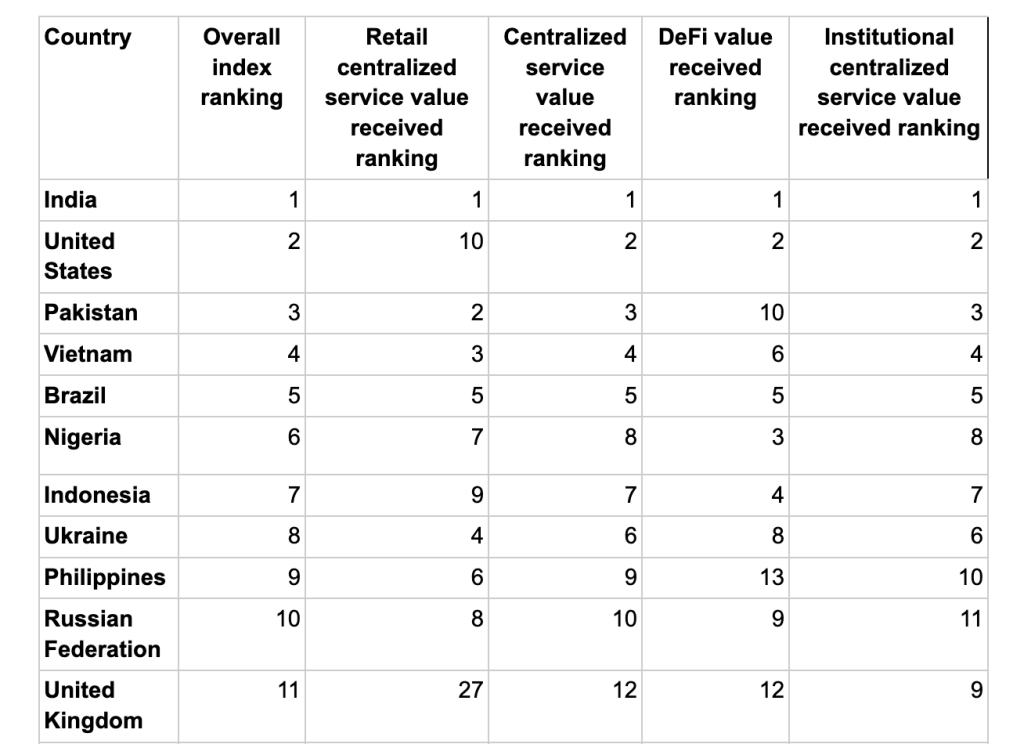
When adjusting for population size, Eastern Europe stands out. Ukraine, Moldova, and Georgia top the population-adjusted index, reflecting extraordinary levels of activity relative to population. Factors such as war, inflation, and banking restrictions have accelerated crypto’s role as both a hedge and a cross-border transaction tool.

Stablecoins and Bitcoin Dominate On-Ramps

Stablecoins remain at the heart of global crypto adoption. Between June 2024 and June 2025, USDT processed more than $1 trillion per month, while USDC peaked at $3.29 trillion. New entrants like EURC and PYUSD are also growing rapidly, with EURC volumes surging nearly 89% month-over-month as MiCA-compliant euro stablecoins gain traction in Europe.

At the same time, Bitcoin continues to serve as the primary fiat on-ramp, accounting for over $4.6 trillion in inflows—more than double any other category. The United States leads by volume, with South Korea and the European Union trailing behind. These flows confirm that while altcoins and DeFi tokens are important, Bitcoin and stablecoins remain the central gateways into crypto.

A Truly Global Wave

Perhaps the most striking finding of the 2025 Index is that adoption is no longer confined to one region or income level. High-income countries are accelerating institutional rails, while lower- and middle-income nations continue to rely on crypto for remittances, dollar access, and mobile-first finance. This synchronicity suggests crypto adoption is now broad-based and durable, not episodic.

The challenges ahead remain clear: fragmented regulations, fragile infrastructure in low-income countries, and the need for secure on-ramps. Yet the trajectory is undeniable.

With India and the United States setting the pace, and the Global South demonstrating how crypto solves real-world problems, the 2025 Global Adoption Index shows one truth: crypto is no longer an experiment. It is becoming a core feature of the global financial system.

Market Opportunity
Index Cooperative Logo
Index Cooperative Price(INDEX)
$0.3042
$0.3042$0.3042
-0.65%
USD
Index Cooperative (INDEX) Live Price Chart
Disclaimer: The articles reposted on this site are sourced from public platforms and are provided for informational purposes only. They do not necessarily reflect the views of MEXC. All rights remain with the original authors. If you believe any content infringes on third-party rights, please contact service@support.mexc.com for removal. MEXC makes no guarantees regarding the accuracy, completeness, or timeliness of the content and is not responsible for any actions taken based on the information provided. The content does not constitute financial, legal, or other professional advice, nor should it be considered a recommendation or endorsement by MEXC.

You May Also Like

Is Putnam Global Technology A (PGTAX) a strong mutual fund pick right now?

Is Putnam Global Technology A (PGTAX) a strong mutual fund pick right now?

The post Is Putnam Global Technology A (PGTAX) a strong mutual fund pick right now? appeared on BitcoinEthereumNews.com. On the lookout for a Sector – Tech fund? Starting with Putnam Global Technology A (PGTAX – Free Report) should not be a possibility at this time. PGTAX possesses a Zacks Mutual Fund Rank of 4 (Sell), which is based on various forecasting factors like size, cost, and past performance. Objective We note that PGTAX is a Sector – Tech option, and this area is loaded with many options. Found in a wide number of industries such as semiconductors, software, internet, and networking, tech companies are everywhere. Thus, Sector – Tech mutual funds that invest in technology let investors own a stake in a notoriously volatile sector, but with a much more diversified approach. History of fund/manager Putnam Funds is based in Canton, MA, and is the manager of PGTAX. The Putnam Global Technology A made its debut in January of 2009 and PGTAX has managed to accumulate roughly $650.01 million in assets, as of the most recently available information. The fund is currently managed by Di Yao who has been in charge of the fund since December of 2012. Performance Obviously, what investors are looking for in these funds is strong performance relative to their peers. PGTAX has a 5-year annualized total return of 14.46%, and is in the middle third among its category peers. But if you are looking for a shorter time frame, it is also worth looking at its 3-year annualized total return of 27.02%, which places it in the middle third during this time-frame. It is important to note that the product’s returns may not reflect all its expenses. Any fees not reflected would lower the returns. Total returns do not reflect the fund’s [%] sale charge. If sales charges were included, total returns would have been lower. When looking at a fund’s performance, it…
Share
BitcoinEthereumNews2025/09/18 04:05
“Vibes Should Match Substance”: Vitalik on Fake Ethereum Connections

“Vibes Should Match Substance”: Vitalik on Fake Ethereum Connections

Vitalik Buterin criticized L2s that use optimistic bridges without adding meaningful technical innovation. Ethereum’s base layer is scaling, reducing the need for
Share
LiveBitcoinNews2026/02/06 11:30
Why Bitcoin Crashed Below $69,000 — Causes & Outlook

Why Bitcoin Crashed Below $69,000 — Causes & Outlook

Cryptsy - Latest Cryptocurrency News and Predictions Cryptsy - Latest Cryptocurrency News and Predictions - Experts in Crypto Casinos Bitcoin crash explained:
Share
Cryptsy2026/02/06 11:20