Token2049

Token2049 is the premier global crypto event series, with flagship 2026 editions in Dubai (April) and Singapore (October). It brings together the most influential VCs, founders, and institutional leaders to define industry trends. This tag tracks high-level networking insights and breakthroughs in DePIN, GameFi, and mass-market Web3 adoption emerging from these world-class summits.

454 Articles
Created: 2026/02/02 18:52
Updated: 2026/02/02 18:52
World Liberty Financial Turns to Tokenizing Real Assets

World Liberty Financial Turns to Tokenizing Real Assets

The post World Liberty Financial Turns to Tokenizing Real Assets appeared on BitcoinEthereumNews.com. World Liberty Financial is setting its sights on one of the biggest frontiers in crypto: the tokenization of real-world assets. Backed by Donald Trump Jr. and led by CEO Zack Witkoff, the project is already behind USD1, a fast-growing stablecoin, and WLFI, its governance token. Now, the team wants to bring commodities like oil, gas, cotton, and timber onto the blockchain, paired with USD1 as the stable and transparent bridge. Announced during Token2049 in Singapore, the move signals World Liberty’s ambition to expand beyond currency and governance tokens into a broader financial ecosystem that blends traditional assets with on-chain innovation. Exploring Tokenized Real-World Assets   World Liberty Financial, the Trump-backed crypto initiative, is moving beyond its initial token launches to explore tokenization of real-world assets. According to CEO Zack Witkoff, the project is actively working on bringing commodities such as oil, gas, cotton, and timber on chain. Witkoff emphasized that these types of assets are natural candidates for blockchain trading, describing commodities as both interesting and necessary to modernize through tokenization. USD1: The Stablecoin at the Core The company plans to pair these tokenized assets with its USD1 stablecoin, positioning it as the trustworthy and transparent backbone for such trades. Witkoff called USD1 the “money for the future of finance,” highlighting its rapid growth. Since launch, USD1 has risen to become the fifth largest stablecoin globally, reaching a market capitalization of about $2.7 billion. Expanding Blockchain Ecosystem World Liberty Financial currently operates with two core tokens: WLFI, its governance token, giving the community a voice in the project’s direction. USD1, its dollar-pegged stablecoin, now expanding to the Aptos blockchain, making it the first Move-based chain to support USD1. This expansion reflects the team’s intent to broaden accessibility and adoption across different ecosystems. Upcoming Products and Services Beyond tokenization and stablecoin…

Author: BitcoinEthereumNews
Cardano (ADA) Price: Consolidation Continues as SEC Changes ETF Approval Process

Cardano (ADA) Price: Consolidation Continues as SEC Changes ETF Approval Process

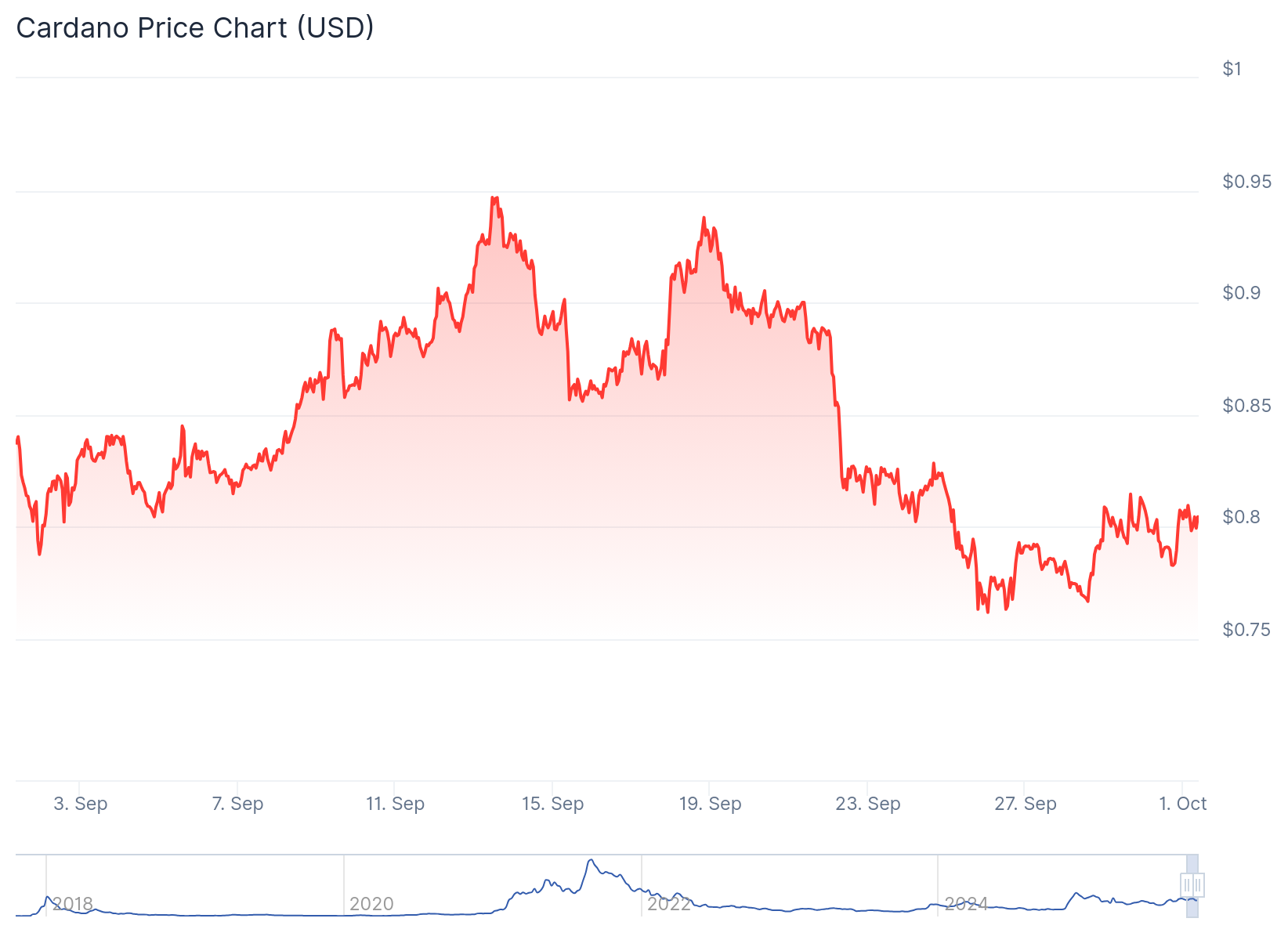
TLDR Cardano (ADA) is trading around $0.80, stuck in a tight range between $0.75 and $0.85 for several weeks with low trading volume. The SEC has directed ETF issuers including Grayscale to withdraw their 19b-4 applications for Cardano ETFs in favor of new Generic Listing Standards that could speed up approval. Bloomberg analysts give Cardano [...] The post Cardano (ADA) Price: Consolidation Continues as SEC Changes ETF Approval Process appeared first on CoinCentral.

Author: Coincentral
CrossBar to Release Daric Chip and EMPC Real-Time Signature Demonstration

CrossBar to Release Daric Chip and EMPC Real-Time Signature Demonstration

PANews reported on October 1st that CrossBar will debut its Daric chip and EMPC (Enhanced Multi-Party Computation) real-time signing demonstration at TOKEN2049 Singapore, showcasing how EMPC eliminates mnemonics and passwords, supports flexible T-of-N configurations, and eliminates single points of failure. Leveraging open-source hardware and transparent auditability, CrossBar will enhance blockchain security and trust. Attendees will also receive an exclusive preview of the PHSM 8 feature, which is still under development.

Author: PANews
BlockDAG’s F1® Sponsorship & XRP Price Prediction In Focus

BlockDAG’s F1® Sponsorship & XRP Price Prediction In Focus

The post BlockDAG’s F1® Sponsorship & XRP Price Prediction In Focus appeared on BitcoinEthereumNews.com. Crypto News Learn how XRP price prediction gets a boost from ETF clarity, but BlockDAG wins on visibility with BWT Alpine F1® and raised $412M+ in presale. XRP is showing renewed strength after the SEC’s decision to streamline ETF listing rules, potentially accelerating institutional exposure. As a result, XRP price prediction models are starting to incorporate capital inflows and compliance-driven confidence. Meanwhile, BlockDAG (BDAG) has taken a very different path to gain momentum. With over $412 million raised in presale, 26.5 billion coins sold, and an ROI of 2,900% since Batch 1, BlockDAG has now achieved a major brand milestone: sponsorship of the BWT Alpine F1®  Team. At just $0.0013 per coin in batch 30, this Layer 1 protocol is merging visibility and infrastructure into a powerful market strategy. The comparison between these two crypto assets highlights different paths to influence, one through regulation, the other through mainstream branding and community reach. BlockDAG Enters the Global Stage Through Sports, Not Just Code While many crypto projects aim for visibility through niche conferences and technical showcases, BlockDAG has accelerated this process by entering the mainstream arena of Formula 1®. By partnering with the BWT Alpine F1®  Team, BlockDAG is not only targeting developers; it is capturing the attention of sports fans, global media outlets, and consumer brands. This exposure creates something technical roadmaps can’t achieve on their own: cultural relevance. When a brand is seen on racetracks, car liveries, and fan activations during Grand Prix weekends, it signals strength, stability, and forward momentum. The question of what crypto to invest in becomes not just about performance metrics, but about perceived staying power. BlockDAG is now playing that game on a global stage. XRP Price Prediction Grows With Regulatory Shifts XRP has gained positive traction from recent SEC rulings that simplify the…

Author: BitcoinEthereumNews
XRP Price Prediction Fires Up, But BlockDAG Accelerates Past the Competition with BWT Alpine F1® Sponsorship!

XRP Price Prediction Fires Up, But BlockDAG Accelerates Past the Competition with BWT Alpine F1® Sponsorship!

XRP is showing renewed strength after the SEC’s decision to streamline ETF listing rules, potentially accelerating institutional exposure. As a […] The post XRP Price Prediction Fires Up, But BlockDAG Accelerates Past the Competition with BWT Alpine F1® Sponsorship! appeared first on Coindoo.

Author: Coindoo
Arthur Hayes' Token2049 speech: Global Transformation: From "America First" to the Eurozone's Systemic Crisis

Arthur Hayes' Token2049 speech: Global Transformation: From "America First" to the Eurozone's Systemic Crisis

Compiled and edited by Yuliya, PANews Maelstrom Chief Investment Officer Arthur Hayes once again delivered a striking statement at the TOKEN2049 conference. In his speech, titled "Bastille Day: Celebrating France's Exit from the Eurozone," he boldly predicted that France would eventually leave the Eurozone due to irreconcilable internal economic pressures and continued capital flight, potentially triggering a global banking crisis. PANews compiled and edited the speech; the following is the full text: Since Trump ascended to the throne of "American hegemony" in 2016, his core policy has always revolved around "America First." What does this mean? It means reversing the pattern of surpluses and deficits among countries. The Trump administration has long grown weary of the US model whereby the rest of the world provides financing for the US, which in turn holds assets in the US. It believes that US companies should be able to export their products and profitably compete with countries like Germany and Japan. Therefore, the implementation of the "America First" policy effectively closes off this vast US export market. This shift has forced traditionally export-oriented countries like Germany and Japan to adopt corresponding "Germany First" and "Japan First" policies in response. They need to repatriate their overseas savings and capital to counter the closure of the US market. The direct consequence of this move is that these countries will no longer be able to provide financing to deficit countries like France or even the United States as they did in the past. The French crisis: The truth about capital flight In the European financial system, there's a key indicator: the Target Balance. The European Central Bank publishes the net balance of the Target System monthly, reflecting capital flows within the eurozone. For example, France still had a surplus at the beginning of 2021, indicating capital inflows. However, a comparison of the changes between 2021 and now reveals a massive outflow of capital from the French banking system. Data shows that France is experiencing the most severe capital outflows in the eurozone. French depositors and capital holders have clearly lost confidence in their country's financial system and are reluctant to deposit their funds in French banks. Instead, they are transferring euros to locations like Germany and Luxembourg. As this situation worsens, France may be forced to implement measures such as capital controls to address the imbalances. So, what exactly are Target Balances? It's essentially a centralized clearing system operated by the ECB, designed to allow the Eurozone, which consists of around 17-18 different central banks, to function smoothly. Through this system, countries like Germany and France can run surpluses and deficits with each other without requiring each country's central bank to have bilateral accounts with all the others. To understand the essence of the Target system, consider this: If a Eurozone country exits the Eurozone and redenominates its currency to its own, such as the franc or the Deutsche Mark, would investors be willing to hold that currency? If a country runs a deficit and gradually loses its ability to raise funds, it may impose capital controls. Rational investors would choose to shift funds to a strong country like Germany while the Euro remains freely circulated, as Germany is the wealthiest and most stable country in the Eurozone. The deterioration of the Target balance is the "canary in the coal mine," demonstrating the unease of French domestic capital about the system. By transferring funds, the French public has expressed their distrust in the most direct way. *Note: Target Balances in the financial field specifically refer to the balance of claims or liabilities formed by the central banks of Eurozone countries in cross-border payments within the Eurosystem through the pan-European Real-time Gross Automated Clearing System (TARGET2). The ECB's Dilemma and Lagarde's Role Christine Lagarde, the President of the European Central Bank, is nicknamed the "Crocodile Countess." A French-born lawyer, she ultimately rose to the top position at the European Central Bank. Her role is not to respect the will of the people of the eurozone, but to maintain the ECB's control over its member states. Looking back at the Greek debt crisis of 2011-2012 and other Eurozone elections, we can see the ECB's consistent approach: it presents an ultimatum to governments: "If you don't do what we say, we will stop printing money to buy your bonds." This leads directly to government bankruptcy, currency devaluation, and an inability to buy oil, food, and medicine. The subtext is: "Shut up and vote for the party that complies, and we'll keep financing you." Lagarde achieves this control precisely by controlling the printing press. Since the COVID-19 pandemic, the European Central Bank has maintained a relatively tight monetary policy, setting rules such as "fiscal deficits must not exceed 3% of GDP." If a country's spending exceeds this limit, the ECB threatens to withhold support for its bond market until it passes an "acceptable" budget. This presents a significant dilemma for domestic politicians, particularly Macron of France. Macron's desperate situation and the government's inevitable choice French President Emmanuel Macron is caught in a dilemma. On the one hand, the French people want more social welfare and demand increased government spending. On the other hand, the European Central Bank is adamantly opposed, demanding fiscal austerity or threatening to cut off financial support. This conflict has degenerated into a constitutional crisis. In the past year, two French prime ministers have resigned for failing to pass budgets. Every hint of austerity measures and spending cuts from the government has been met with widespread street protests and strikes. The public's message is clear: "We don't want austerity. We want to print money for France and for ourselves. We don't care what the ECB or Brussels says." This puts Macron in an unresolvable dilemma. When a government is under pressure to fill a fiscal hole, what does it do first? The answer is: steal foreign assets. This isn't an exaggeration. Although France prides itself on being a capitalist nation that respects property rights, when national solvency is threatened, the first option is to plunder foreign wealth. Data shows that 53% of French stocks and bonds are held by foreigners. As a leading Communist Party member of the French parliament put it a few months ago, "Don't worry about raising taxes on the French people. All our debts are owed abroad; we just need to take their money first." This action would trigger a chain reaction. First, the plundering of foreign assets would scare away domestic capital, forcing the government to implement stricter domestic capital controls. Ultimately, private capital remaining in France would be forced to purchase government bonds at interest rates the government could afford, which is far from optimal for capital holders. Systemic Risk and the Future of Global Money Printing Any move by France to seize foreign assets or impose capital controls would have disastrous consequences. First, it would directly lead to the insolvency of the entire EU banking system. Since EU banks hold significant French assets, a French default would trigger a systemic collapse. It is estimated that the European Central Bank would need to provide a massive bailout of approximately €5 trillion to ensure the solvency of the EU banking system. Second, the crisis would quickly spread globally. What would the Bank of Japan do if it found hundreds of billions of dollars in investments trapped in France? What would the Federal Reserve do if the US faced the same situation? They would all be forced to print money to bail out their financial institutions that had lent money to France. Thus, this localized crisis in Europe would become the catalyst for a new round of massive money printing worldwide. To understand how this will play out, we must continue to monitor the evolution of the Target 2 system. Once France sets a precedent for capital controls, all investors will ask, "Who's next?" Capital will flee from all other vulnerable eurozone countries. No country's citizens will accept a fiscal deficit cap of just 3% when they crave more, not less, government spending. Ultimately, the question falls on Germany. What will it choose? Stay in the eurozone and pay for all this, or leave? This is a political decision fraught with uncertainty, and investors hate this kind of binary political game. For the European Central Bank, the so-called "choice" it faces is actually a false proposition: Printing money now : accepting fiscal expansion in various countries, restarting quantitative easing (QE), and buying bonds in various countries. This means returning power to national politicians and the ECB losing control. Print money later : Wait for France to threaten to leave the EU and seize foreign assets, then be forced to print 5 trillion euros for bailouts and restart QE for the remaining countries. The result is also out of control. The conclusion is obvious: the euro is fundamentally a failure, a fact that has taken us 30 years to recognize. The ECB has no choice but to print money. Without it, the euro is doomed; by printing money, Lagarde and her successors might be able to maintain their grip on Europe. Investment Lesson: Escape Europe and Embrace Real Assets From an investment perspective, historical data clearly illustrates the plight of European assets. Since the COVID-19 pandemic, the Euro Stoxx Index has not only underperformed the MSCI World Equity Index, but has also performed miserably compared to real hard assets like gold and Bitcoin. Given this information, and the fact that capital is fleeing France, it's hard to justify holding onto European assets. The conclusion is clear: get out while you still can. The most important monitoring tool remains the Target system balance. It is the core indicator for determining when the ECB is forced to print money. Simply checking the Target balances of various countries each month on the ECB website or Bloomberg provides a true insight into fund flows. With France's funding gap widening, the ECB has no way out. In reality, the ECB has exhausted all its options. France is too large to be rescued, yet it is also impossible not to rescue it. Once capital flight from France reaches a critical point, local measures will no longer be sufficient to maintain stability. The only response will be massive money printing. Whether or not France actually leaves the euro, the outcome will be the same: trillions of euros will be created out of thin air. This is particularly important for cryptocurrency investors. The United States is reshaping the global order, reversing the pattern of surpluses and deficits. Deficit countries will shift to surpluses, and surplus countries will shift to deficits. Countries like France, which lack reserve currencies, face a lack of buyers for their bonds, forcing them to rely on central bank money printing. For investors, this means European assets will remain unattractive for a long time, further emphasizing the importance of Bitcoin and other decentralized assets.

Author: PANews
IoTeX Launches Decentralized AI Foundry with Vodafone and Filecoin

IoTeX Launches Decentralized AI Foundry with Vodafone and Filecoin

The post IoTeX Launches Decentralized AI Foundry with Vodafone and Filecoin appeared on BitcoinEthereumNews.com. Decentralized identity protocol IoTeX has launched the Real-World AI Foundry, a global initiative to build open, decentralized and blockchain-powered artificial intelligence. At the R3al World AI Summit during the Singapore Token2049 conference, IoTeX unveiled the project in collaboration with a group of founding Alignment Partners, including Vodafone, the Blockchain Association, Filecoin, Theta Network, Aethir and others. The Foundry aims to challenge traditional AI systems, which IoTeX describes as “closed-source, costly, and controlled by a few.” A spokesperson told Cointelegraph, “Real-World AI requires the opposite: open collaboration where live, trusted data from machines, people, and sensors flows into shared models.” The spokesperson added that blockchain ensures this data is securely recorded, while crypto provides the incentives for global participation. “Users can contribute data, compute or validation and earn rewards each time an AI agent or model accesses these verified data streams,” they said. The R3al World AI Summit. Source: IoTeX Related: How to use ChatGPT to find hidden gems in the crypto market Real-World Models offer live AI At the heart of the initiative are Real-World Models (RWMs), intelligent systems trained on live data from machines, sensors and human interaction. These models are built to understand cause and effect, adapt to changing environments and deliver real-time responses in high-impact sectors such as mobility, energy, healthcare and robotics. “Rather than just distributing compute or agent hosting, the Foundry creates the first open ecosystem of RWMs, governed collectively to ensure interoperability, accountability, and alignment with human values,” the IoTeX spokesperson said. The Foundry begins with real-world data flowing from IoTeX’s existing network of over 40 million connected devices. These devices can opt in as trusted data sources using ioID, a decentralized identity protocol that verifies authenticity without exposing personal information. Data privacy is protected using encryption and zero-knowledge proofs. Data providers, infrastructure partners,…

Author: BitcoinEthereumNews
AI May Soon Need Nuclear Reactors, Decentralization Could Help

AI May Soon Need Nuclear Reactors, Decentralization Could Help

The post AI May Soon Need Nuclear Reactors, Decentralization Could Help appeared on BitcoinEthereumNews.com. Artificial intelligence is hitting a wall on energy, and as models increase, training them may soon require energy outputs like nuclear reactors, according to Akash Network founder Greg Osuri.  In an interview with Cointelegraph’s Andrew Fenton at Token2049 in Singapore, Osuri said the industry underestimates how fast compute demands are multiplying and their environmental costs. He noted that data centers already consume hundreds of megawatts of fossil fuel power. Osuri warned the trend could trigger an energy crisis, raising household power bills and adding millions of tons of new emissions each year. “We’re getting to a point where AI is killing people,” he said, pointing to health impacts from concentrated fossil fuel use around data hubs. Greg Osuri at the Token2049 event in Singapore. Source: Cointelegraph How decentralization could mitigate AI’s power problem On Tuesday, Bloomberg reported that AI data centers are sending power costs surging in the US. The report highlighted how data centers have contributed to the rising energy bills of everyday households. According to the report, wholesale electricity costs have risen 267% in five years in areas near data centers. Osuri told Cointelegraph that the alternative is decentralization. Instead of concentrating chips and energy in single mega-data centers, Osuri said that distributed training across networks of smaller, mixed GPUs — ranging from high-end enterprise chips to gaming cards in home PCs — could unlock efficiency and sustainability.  “Once incentives are figured out, this will take off like mining did,” he said, adding that home computers may also eventually earn tokens by providing spare compute power.  This vision bears similarities to the early days of Bitcoin (BTC) mining, where ordinary users could contribute their processing power to the network and get rewarded in return. This time, the “mining” would be training AI models instead of crunching cryptographic puzzles. …

Author: BitcoinEthereumNews
Cardano Price Backtracks as US SEC Demands Crypto ETFs’ 19b-4 Withdrawal

Cardano Price Backtracks as US SEC Demands Crypto ETFs’ 19b-4 Withdrawal

The post Cardano Price Backtracks as US SEC Demands Crypto ETFs’ 19b-4 Withdrawal appeared on BitcoinEthereumNews.com. Key Insights: Cardano price trades at $0.7884 after a large $54.3 million withdrawal from Coinbase. SEC directs ETF issuers, including Grayscale’s Cardano ETF, to withdraw 19b-4 filings. Cardano roadmap targets stablecoins, DeFi growth, and stronger governance. The United States Securities and Exchange Commission (SEC) has asked ETF issuers, including Grayscale Investments, to withdraw their 19b-4 applications. Notably, the request follows new Generic Listing Standards that have now replaced individual reviews. Following this, the change could speed up ETF approvals as Cardano price reacts to the news. SEC Pushes for Withdrawal of 19b-4 Applications The US SEC has told several ETF issuers to withdraw their pending 19b-4 applications. Among them is the filing for Grayscale’s Cardano ETF. The update comes after the SEC announced new Generic Listing Standards, which will take the place of the individual review process. The standards are designed to create a single framework for how exchange-traded funds are approved. This means that rather than each application being examined separately, they can now be assessed under a uniform rule. According to the update, market observers believe this could speed up the approval timeline. Cardano ETF Update | Source: Cardanians Before the update, the deadline for the ADA ETF was October 26. With the new system in place, approval could come earlier than expected. Analysts at Bloomberg have suggested approval odds as high as 100%, while prediction market Polymarket has placed the probability at 95%. The shift highlights how regulators are adjusting to the growing demand for crypto-related investment products. If Cardano secures approval under the new process, it would give the asset wider visibility in financial markets. In other words, it could boost the Cardano price in the near future. Cardano Price Reaction and Market Signals ADA price has shown a modest pullback. Cardano price traded at $0.7884,…

Author: BitcoinEthereumNews
Anchorage Digital plans to integrate Solana Swap and Jupiter into its Porto wallet

Anchorage Digital plans to integrate Solana Swap and Jupiter into its Porto wallet

Anchorage Digital plans to add Solana swap and liquidity aggregator Jupiter within Porto’s dashboard, its institutional self-custody wallet. The initiative aims to expand the crypto bank’s services for traditional finance clients engaging with DeFi. The integration of Jupiter to Porto seeks to simplify crypto conversions and other DeFi processes within the self-custody wallet. Anchorage Digital stated that the integration will reduce reliance on external applications and enhance Solana liquidity by mitigating trade slippage, which is the discrepancy between the expected and executed prices. Anchorage seeks to maintain security and compliance within Solana With the @JupiterExchange x Porto integration ✔️ Access Jupiter’s routing engine directly from Porto ✔️ Get optimal trade execution and minimal slippage across diverse liquidity sources in the Solana ecosystem ✔️ Swap securely right within the Porto web dashboard, no external… pic.twitter.com/XzWamcddRX — Anchorage Digital @ TOKEN2049 (@Anchorage) September 30, 2025 The digital asset platform provider believes that institutions aren’t able to manage decentralized applications and third-party risks properly. Anchorage also noted that Jupiter users encounter difficulties accessing the platform through an institutional interface. Nathan McCauley, CEO and Co-founder at Anchorage Digital, argued that true institutional adoption of DeFi requires foundational infrastructure that meets the highest standards of security and compliance. He also acknowledged that the integration with Jupiter is a critical step in building that foundation on Solana. Anchorage Digital also integrated Uniswap with Porto in June as part of its efforts to provide institutions with direct access to DeFi swaps and liquidity. McCauley stated that the integration aims to enable DeFi to move at crypto-native speed without compromising security. Porto has also integrated with Maple Finance, the Sui Foundation, and decentralized exchange dYdX.  Solana has seen increased interest among institutional investors in the wake of a friendlier regulatory and political environment for crypto in the U.S. CoinShares reported last week that investment into Solana exchange-traded products generated nearly $300 million, surpassing products tracking major altcoins, including Bitcoin and Ethereum. The crypto-focused investment firm also reported that Solana ETPs have accounted for almost $1.9 billion in inflows year-to-date, more than other digital assets except for Bitcoin and Ethereum. Solana ETFs await launch approval from the SEC CoinShares’s head of research, James Butterfill, said Solana funds have seen increased inflows partly in anticipation of forthcoming exchange-traded fund (ETF) launches in the U.S. NocaDius Wealth Management president Nate Geraci hinted on Sunday that the upcoming two weeks could be enormous for U.S. spot crypto ETFs, as the SEC is expected to make decisions on multiple ETF filings. Bloomberg ETF analyst Eric Balchunas said the odds of a Solana ETF being approved by the SEC are at 100%. He also claims that a Solana Fund could come at any time. “Generic listing standards make the 19b-4s and their ‘clock’ meaningless. That just leaves the S-1s waiting for formal greenlight from Corp Finance. And they just submitted amendment #4 for Solana.” –Eric Balchunas, Senior ETF Analyst at Bloomberg. Nick Ducoff, Head of Institutional Growth at the Solana Foundation, argued that the approval of Solana ETFs is transformative for the market. He believes that the SEC’s surprise announcement minimizes the time required for issuers to navigate the filing process, giving projects like Solana a faster track to launch. Ducoff also hinted that Solana and XRP ETFs are expected to launch around the same time. He argued that the stock market hitting new highs and the Fed lowering interest rates favor the current bull market for risk assets, such as crypto. He also noted that Solana has historically moved in line with risk-on markets, making the timing promising. Solana is trading at around $205 at the time of publication, down 2.13% in the last 24 hours. SOL has also dropped by nearly 7% in the last seven days.  Matt Hougan, chief investment officer at ETF issuer Bitwise, said earlier this month that the approval of Solana ETFs points towards an epic end-of-year for SOL. Jeffrey Ding, chief analyst at HashKey Group, argued that a Solana ETF could trigger speculative buying ahead of its approval, followed by a potential correction once it is launched, similar to what happened with Bitcoin and Ethereum ETFs. Don’t just read crypto news. Understand it. Subscribe to our newsletter. It's free.

Author: Coinstats