Oracle

Oracles are essential infrastructure components that feed real-time, off-chain data (such as price feeds, weather, or sports results) into blockchain smart contracts. Without decentralized oracles like Chainlink and Pyth, DeFi could not function. In 2026, oracles have evolved to support verifiable randomness and cross-chain data synchronization. This tag covers the technical evolution of data availability, tamper-proof price feeds, and the critical role oracles play in ensuring the deterministic execution of complex decentralized applications.

5129 Articles
Created: 2026/02/02 18:52
Updated: 2026/02/02 18:52
This $0.035 New Crypto Is Selling Out Fast, Could It Be the Best Crypto to Buy Before 2026?

This $0.035 New Crypto Is Selling Out Fast, Could It Be the Best Crypto to Buy Before 2026?

Increasingly, investors are no longer focusing on the large cap, which moves slowly but steadily, but looking at up-and-coming crypto projects expressing actual momentum. A single token is sweeping the market in a fashion not anticipated by many, and it is starting to gain traction in an unexpected rapidity, with many of its early adopters […]

Author: Cryptopolitan
Oracle Recognized as Market Leader in Workforce Management by ISG

Oracle Recognized as Market Leader in Workforce Management by ISG

The post Oracle Recognized as Market Leader in Workforce Management by ISG appeared on BitcoinEthereumNews.com. Ted Hisokawa Nov 21, 2025 07:41 Oracle is named a Market Leader in the 2025 ISG Buyers Guide for Workforce Management, highlighting its innovative solutions in workforce management technology. Oracle has been acknowledged as a Market Leader in the 2025 ISG Buyers Guide for Workforce Management, according to oracle.com. This recognition underscores Oracle’s commitment to advancing workforce management technology in a rapidly evolving labor market. Oracle’s Leadership in Workforce Management The ISG Buyers Guide highlighted Oracle’s exemplary performance in meeting both product and customer experience requirements. Oracle Workforce Management, a component of Oracle Fusion Cloud Human Capital Management (HCM), was distinguished as the only software provider to achieve leadership status in all seven evaluated categories, including adaptability, capability, manageability, reliability, usability, total cost of ownership/return on investment, and software provider validation. This accolade reinforces Oracle’s leadership across industries with complex workforce demands. The company’s AI-powered insights and native integrations with Oracle Fusion Cloud Enterprise Resource Planning (ERP), Supply Chain & Manufacturing (SCM), and Oracle Health provide HR and business leaders with the tools needed to optimize workforce planning and align schedules with business goals. Industry-Specific Innovations and Future Plans Oracle’s solutions are trusted by organizations in diverse sectors such as healthcare, manufacturing, retail, and the public sector. Features like shift swap options, predictive scheduling, and AI-assisted forecasting are designed to streamline scheduling and improve labor forecasting. Looking forward, Oracle plans to expand its capabilities further, deepen industry-specific features, and enhance intelligence across the workforce lifecycle. This strategic focus aims to empower organizations to unlock the full potential of their workforce. About Oracle Fusion Cloud HCM Oracle Fusion Cloud HCM is part of Oracle Fusion Cloud Applications. It offers a comprehensive solution connecting all human resource processes from hire to retire with a…

Author: BitcoinEthereumNews
U.S. stocks closed higher across the board, with Circle (CRCL) rising more than 6%.

U.S. stocks closed higher across the board, with Circle (CRCL) rising more than 6%.

PANews, November 22nd - According to Cailian Press, the three major U.S. stock indexes closed higher across the board: the Dow Jones Industrial Average rose 1.08%, the S&P 500 rose 0.98%, and the Nasdaq Composite rose 0.88%. The Nasdaq has fallen 2.74% this week, the S&P 500 has fallen 1.95%, and the Dow has fallen 1.91%. Large-cap tech stocks showed mixed performance: Google rose over 3%, Intel rose over 2%, Apple and Amazon rose over 1%, Oracle fell over 5%, and Netflix, Microsoft, AMD, Nvidia, and Tesla fell over 1%. Blockchain concept stocks generally rose, with Circle (CRCL) rising 6.57% and Coinbase (COIN) rising 0.94%.

Author: PANews
Cracks In AI-driven Nvidia Chip Sales Raise Red Flag Triggering Selloff

Cracks In AI-driven Nvidia Chip Sales Raise Red Flag Triggering Selloff

The post Cracks In AI-driven Nvidia Chip Sales Raise Red Flag Triggering Selloff appeared on BitcoinEthereumNews.com. Key Insights Nvidia has been at the helm of the AI-driven market rally, but the house of cards is starting to crumble under the weight of unpaid chip bills and vibe revenue. Investor panic erases Nvidia’s post earnings rally. Why the AI bubble concerns could be deeply entrenched into the latest liquidity exodus across the markets. Is the AI bubble on the verge of popping and will such an outcome add fuel to the fire that has been engulfing the markets lately? Nvidia has been at the helm of the AI-driven market rally, but recent data revealed a major sales-related problem that could bring down the house of cards. Multiple analysts previously warned that the stock market was in a bubble. However, not many have gone into details regarding this said bubble and its potential impact if it pops. A recent post by author Shanaka Anslem Perera revealed some underlying risks around Nvidia that may be the thorn that pops the AI bubble. Nvidia reportedly revealed roughly $33.4 billion worth of unpaid dues from its customers, which were equivalent to an 89% surge in the last 12 months. Moreover, the tech giant’s unsold chips worth over $19 billion have been piling up. Furthermore, both Nvidia and Microsoft have been funding AI companies such as OpenAI. The latter reportedly plans to pump $50 billion into Microsoft Cloud, while Microsoft has a $100 billion order for Nvidia chips to power the same cloud purchase from OpenAI. Meanwhile, OpenAI received $300 million from Oracle. OpenAI also placed chip orders for Oracle data centers. The intertwined capital flows between the companies underscored rising concerns over AI-driven liquidity. Moreover, OpenAI has been operating with an annual loss of about $5.6 billion, hence profitability was still elusive. These factors have no doubt triggered eye-brow raises in…

Author: BitcoinEthereumNews
Kaito, Polymarket have launched the first “verifiable mindshare markets"

Kaito, Polymarket have launched the first “verifiable mindshare markets"

The post Kaito, Polymarket have launched the first “verifiable mindshare markets" appeared on BitcoinEthereumNews.com. Kaito, the Web3 information platform that specializes in indexing hard-to-reach crypto data, has launched what it describes as the first “verifiable mindshare markets” on Polymarket, opening a new category of prediction markets built on AI-derived sentiment, popularity, and social media chatter.  The partnership also highlights the work of two other partners of Kaito, with the three of them working at the intersection of AI, cryptography, and decentralized markets: Kaito for data and inference, Brevis for zero-knowledge verification, and EigenCloud for auditable AI compute. Polymarket opens a new category of markets Kaito announced the collaboration on X, stating that “This is the start of a new category – where anyone, anywhere can predict mindshare, sentiment, and popularity for anything.”  The Kaito-Polymarket product is designed to be verifiable at every stage, which is quite different from traditional sentiment indices or social-media-driven indicators, which rely on opaque algorithms. Kaito wrote “transforming AI from opaque to a verifiable system is a challenging task,” and to solve that challenge, it partnered with EigenCloud using its EigenAI product, which enables it to turn “what used to be an opaque model into verifiable compute that anyone can audit before Polymarket settles payouts.” EigenCloud wrote on X, that “AI creates the markets, EigenCloud makes the AI verifiable, and Polymarket brings it to the world,” and went further to describe the launch as “the beginning of verifiable markets.” Proprietary algorithms will be auditable The second leg of the technical system comes from Brevis, a zero-knowledge proving service that allows Kaito to keep its proprietary scoring algorithms private while still enabling users to verify that the calculations were performed correctly. Pointing out the challenge it solves for Kaito and how it ties into the Polymaket, Brevis wrote on X, “prediction markets only work if participants trust the data feeding them.…

Author: BitcoinEthereumNews
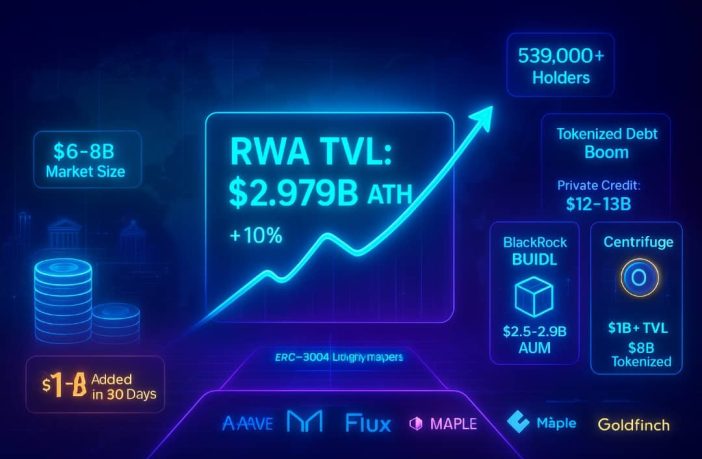
RWA TVL Hits New All-Time High as Tokenization Wave Accelerates in November

RWA TVL Hits New All-Time High as Tokenization Wave Accelerates in November

The tokenized Real World Asset (RWA) market continues its rapid climb, closing November with another major milestone. Total on-chain RWA TVL has reached $2.979 billion, marking a 10% month-over-month jump and signaling intensifying adoption across institutional and DeFi rails. According to data from rwa.xyz, the sector now records more than 539,000 unique holders, underscoring the [...]

Author: Null TX
As Crypto Matures, Centralization Creeps Back Into the System

As Crypto Matures, Centralization Creeps Back Into the System

The value of tokenized real-world assets has grown almost fivefold in three years. Wall Street is absorbing blockchain while preserving its power structures. The problem is marketing centralized infrastructure as decentralized innovation.

Author: Hackernoon
Kalshi Goes Head to Head With Polymarket Following $1B Funding: Report

Kalshi Goes Head to Head With Polymarket Following $1B Funding: Report

The post Kalshi Goes Head to Head With Polymarket Following $1B Funding: Report appeared on BitcoinEthereumNews.com. The prediction market’s reported raise was at a valuation of $11 billion, just days after reports that Polymarket is looking to raise funds at $12 billion. Kalshi, a U.S.-based prediction marketplace, has raised $1 billion in a funding round led by existing backers Sequoia and CapitalG, according to TechCrunch, citing sources familiar with the deal. The round, which saw participation from Andreessen Horowitz, Paradigm, Anthos Capital, and Neo, puts Kalshi’s valuation at about $11 billion, narrowing the gap with leading on-chain prediction market Polymarket, which is reportedly seeking new funds at a $12 billion valuation. A Kalshi spokesperson declined to comment on the report when contacted by The Defiant. Kalshi’s reported funding comes just about one month after it raised $300 million at a $5 billion valuation. Prediction Market Season It also landed as October marked the prediction market sector’s strongest month yet, with Kalshi and Polymarket processing a combined $7.4 billion in volume, The Defiant reported earlier. In October, Kalshi processed $4.4 billion, while Polymarket had $3 billion, setting all-time highs for both platforms. Meanwhile, prediction markets continue to pick up momentum with new integrations and partnerships, with Google Finance recently announcing that users will soon see live market data from Polymarket and Kalshi. Unlike Polymarket, which is preparing for its U.S. return and operates fully on-chain, Kalshi is off-chain, though it’s moving to integrate on-chain components through a partnership with RedStone, an oracle data provider. Kalshi received approval from the Commodity Futures Trading Commission to operate as a prediction market in the U.S. back in 2020, but the firm had no explicit crypto ambitions at the time. Kalshi began accepting crypto for deposits last year, and revealed its crypto push in earnest this summer. Source: https://thedefiant.io/news/cefi/kalshi-usd1b-funding-usd11b-valution-report

Author: BitcoinEthereumNews
F1 Standings Ahead Of The 2025 Las Vegas Grand Prix

F1 Standings Ahead Of The 2025 Las Vegas Grand Prix

The post F1 Standings Ahead Of The 2025 Las Vegas Grand Prix appeared on BitcoinEthereumNews.com. MIAMI, FLORIDA – MAY 03: Sprint winner Lando Norris of Great Britain and McLaren and Second placed Oscar Piastri of Australia and McLaren talk in parc ferme during the Sprint ahead of the F1 Grand Prix of Miami at Miami International Autodrome on May 03, 2025 in Miami, Florida. (Photo by Bryn Lennon – Formula 1/Formula 1 via Getty Images) Formula 1 via Getty Images Formula 1 reaches the final stretch of the 2025 season, with Las Vegas kicking off a crucial final triple-header that will decide the drivers’ championship. The title fight took a dramatic turn recently when Lando Norris of McLaren retook the lead from his teammate Oscar Piastri with a win in round 20 in Mexico City. The Briton then went on to secure dominant victories in the sprint and the main race at Interlagos in Sao Paulo, now holding a 24-point lead over Piastri heading into round 22 in Las Vegas. Max Verstappen’s hope for a fifth consecutive world championship is still alive after a series of outstanding performances that brought him back into the title conversation. The Dutchman faces a critical task this weekend however, needing to avoid losing nine points or more to Norris to stay mathematically in contention heading to Qatar. ForbesWhat Time Is The 2025 F1 Las Vegas Grand Prix? Here’s How To WatchBy Yara Elshebiny There are 83 points to play for over the remaining three rounds (25 points for each race plus eight for the Qatar sprint), meaning the championship can’t be decided this weekend, as 58 points will still be up for grabs after Las Vegas. For Norris, the earliest he could secure the title is next Saturday at the sprint race in Qatar, provided that he manages at least a 51-point lead over Piastri after the 100 km…

Author: BitcoinEthereumNews
ROI Can’t Save Us: Why Today’s Money Fails at Humanity’s Biggest Problems

ROI Can’t Save Us: Why Today’s Money Fails at Humanity’s Biggest Problems

We don’t lack ideas or tools to clean up; we lack a monetary logic that funds non-ROI necessities at planetary scale. If we keep asking capital markets to solve problems that don’t return capital, we will keep getting underinvestment. The path forward is to redefine what we’re willing—and able—to finance, with mechanisms built for public goods rather than profits alone.

Author: Hackernoon