Lending

Lending protocols form the backbone of the decentralized money market, allowing users to lend or borrow digital assets without intermediaries. Using smart contracts, platforms like Aave and Morpho automate interest rates based on supply and demand while requiring over-collateralization for security. The 2026 lending landscape features advanced permissionless vaults and institutional-grade credit lines. This tag covers the evolution of capital efficiency, liquidations, and the integration of diverse collateral types, including LSTs and tokenized RWAs.

15724 Articles
Created: 2026/02/02 18:52
Updated: 2026/02/02 18:52
Crypto News: Paxos Acquires Fordefi to Boost Institutional Custody and Wallet Infrastructure

Crypto News: Paxos Acquires Fordefi to Boost Institutional Custody and Wallet Infrastructure

The post Crypto News: Paxos Acquires Fordefi to Boost Institutional Custody and Wallet Infrastructure appeared on BitcoinEthereumNews.com. Paxos acquires Fordefi to expand regulated custody and wallet tools for institutions seeking secure digital asset operations.   Institutional demand for stronger custody and wallet tools continues to grow, and Paxos is moving to meet it. The company has confirmed the acquisition of Fordefi, which is a well known provider of institutional crypto wallet and custody technology. The move increases Paxos reach in the on chain economy and expands its set of tools for businesses that use digital assets. Fordefi is known for its multi party computation wallet system. It supports secure transaction approvals and offers simple integration for firms active in decentralized finance. Paxos intends to merge this technology with its regulated custody platform, and the company expects this will create a unified system for stablecoin issuance, asset tokenization, and institutional level transaction management. Paxos is acquiring @FordefiHQ, the leading custody and wallet technology platform for on-chain operations. This strengthens our ability to support institutions with more flexible and sophisticated digital asset infrastructure. pic.twitter.com/t7aFVhyflu — Paxos (@Paxos) November 25, 2025 Expansion of Custody and Wallet Capabilities Paxos has provided regulated digital asset services for many years, and the company aims to secure a broader role in institutional markets. The addition of Fordefi brings advanced wallet controls, which include strong security checks and policy settings for on chain activity. These features give institutions more ways to manage transactions and permissions with reduced operational risk. The acquisition also gives Paxos new ways to serve enterprises with different asset needs. Many companies want a platform that supports tokenization, payments, and stablecoin services in one place. Paxos plans to use Fordefi software to strengthen that model and offer a platform that can support a wide range of digital asset operations. Fordefi will continue to run its existing product for now, and its clients…

Author: BitcoinEthereumNews
This $0.035 New Crypto Token Is Almost Sold Out, Phase 6 Hits 95% as Buyers Rush In

This $0.035 New Crypto Token Is Almost Sold Out, Phase 6 Hits 95% as Buyers Rush In

The post This $0.035 New Crypto Token Is Almost Sold Out, Phase 6 Hits 95% as Buyers Rush In appeared on BitcoinEthereumNews.com. One of the most competitive moments ever is a new crypto token that has come into the market at a price of $0.035. The presale phase 6 is at 95% and the buyers are rushing up since they predict the next price jump to be launched soon. The pace at which this stage has been achieved has even shocked those who were initially in support, and as the number of investors increases on a daily basis, this project has become the potential best crypto opportunity of any kind by 2026. Mutuum Finance (MUTM) Mutuum Finance (MUTM) is building a complete lending ecosystem that is based on smart contracting. The construction is of transparency, safety and real yield rather than meme or speculation trends. The Peer to Contract side has users who deposit their assets to a liquidity pool, which returns them in the form of mtTokens. These mtTokens will surge in value, as borrowers make interest payments.  On the Peer to Peer side, borrowers borrow funds by posting security under transparent Loan to Value limits. They do have an opportunity to pick another type of a borrow rate and the system modifies the rates with regard to the usage of the pools. In the event of collateral depreciation and falls below the liquidation threshold, liquidators repay some of the debt and get discounted collateral. This insures the lending pool and maintains a healthy system. Mutuum Finance integrates these two layers giving users the ability to lend and borrow, and gain yield together in a single platform.  MUTM Presale Numbers The presale began at $0.01 in early 2025. MUTM has since then reported up to $0.035, 250% increase. Launch price will be at $0.06, and this provides the current buyers with a clear direction of elevated potential. Presale expansion has been…

Author: BitcoinEthereumNews
Best Crypto to Buy Now? Mutuum Finance (MUTM) Nears $19 Million Ahead of V1 Testnet Launch

Best Crypto to Buy Now? Mutuum Finance (MUTM) Nears $19 Million Ahead of V1 Testnet Launch

The increasing hype within the DeFi space has placed Mutuum Finance (MUTM) firmly on investors’ radars as one of the top cryptos to buy right now, particularly as it hastens towards an important development phase. With its presale crossing the $19 million mark in no time and Phase 6 almost out, investor interest is pouring […]

Author: Cryptopolitan
Crypto News: SUI Shows Renewed Strength as Grayscale Trust Trading Begins and Key Support Holds

Crypto News: SUI Shows Renewed Strength as Grayscale Trust Trading Begins and Key Support Holds

SUI stabilizes at major support as Grayscale Trust trading opens, adding new liquidity channels and steady network engagement.   SUI is showing early signs of recovery as steady support levels continue to attract attention across the market. SUI has faced strong pressure this year, yet several network and liquidity trends are adding new interest. Market […] The post Crypto News: SUI Shows Renewed Strength as Grayscale Trust Trading Begins and Key Support Holds appeared first on Live Bitcoin News.

Author: LiveBitcoinNews
Coinbase Ventures Targets Bold Cryptocurrency Investments for 2026

Coinbase Ventures Targets Bold Cryptocurrency Investments for 2026

Coinbase Ventures outlines strategic crypto investments for 2026, focusing on DeFi, RWA, AI, and trading tech.

Author: bitcoininfonews
This $0.035 DeFi Crypto Could Explode 3300% and Outshine Solana’s (SOL) Next Rally

This $0.035 DeFi Crypto Could Explode 3300% and Outshine Solana’s (SOL) Next Rally

A new coin is rapidly rising through the ranks of the DeFi crypto market, and predictions show it may have the explosive potential to outpace even Solana’s (SOL) next major rally. Priced at only $0.035 per token, very fast growth is already visible for Mutuum Finance (MUTM), and estimates see this newcomer for DeFi potentially […]

Author: Cryptopolitan
Crypto Experts Reveal What Crypto to Buy Now for Recovery Gains As Solana (SOL) Lags

Crypto Experts Reveal What Crypto to Buy Now for Recovery Gains As Solana (SOL) Lags

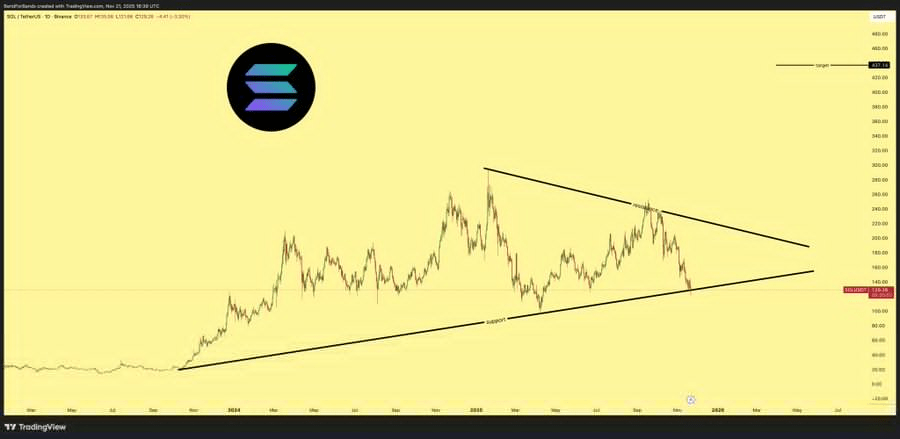
The post Crypto Experts Reveal What Crypto to Buy Now for Recovery Gains As Solana (SOL) Lags appeared on BitcoinEthereumNews.com. Despite the need for its own sustainable growth in the cryptocurrency market, analysts are seeing a clear disparity in its progress. It appears that Solana (SOL), with its impressive network, has lagged behind other assets and has struggled with congestion and its prices to the point where investors seek alternative assets with more pressing catalysts. This kind of quest for “high pot” or growth prospects has ignited interest in presale projects that are well-grounded in fundamentals and have well-defined growth strategies. It is within this context that projects like Mutuum Finance (MUTM) rank highest as far as recommendations for ‘what crypto to buy in the crypto market now’ are concerned. Solana’s Momentum Challenge Many investors are frustrated with Solana lately for failing to take full advantage of market rebounds. Despite its technology showing so much promise, certain factors seem to have impeded its success, including network stability and competition pressures. This has caused experts in the cryptosphere to suggest spreading investments into projects that involve lower overhead resistance and event-driven cycles for growth. The quest for the most ideal crypto to invest in has started to lean towards new cryptos like Mutuum Finance (MUTM) in their last stages of presales, where entry points are tailored for optimal gain post-listing. A Presale Nearing Complete Allocation Mutuum Finance offers a very compelling reason for capital redefinition, as its presale has reached notable milestones that stress its ability to rank as one of the top cryptos to buy immediately. The project has managed to secure $19,000,000 and create a holder base of 18,200 investors. Phase 6 is Now Over 95% Sold out, where tokens are priced at $0.035 – which is last-chance buying to secure MUTM before its price increases to $0.040 in the next phase. With the launch price pegged at only…

Author: BitcoinEthereumNews
We're still in the crypto supercycle, but not the one you're expecting.

We're still in the crypto supercycle, but not the one you're expecting.

Original title: The Supercycle Is Here. Just Not the One You Were Promised Original author: Lomashuk Compiled by Odaily Planet Daily; Translated by Asher Recently, a quick five-minute scroll through the internet has easily led to the conclusion that we're back in a bear market. BTC prices continue to fall, altcoins are plummeting even further, and retail investor sentiment has almost evaporated. The ultimate bullish narrative proposed by Su Zhu—the "Supercycle"—which embodied the industry's vision of "crypto assets breaking free from cyclical constraints and achieving escape velocity," now seems more like a collective illusion. However, the supercycle is not over. The real problem is that we have been misinterpreting it. The traditional narrative of a supercycle is a perpetual boom where "digital always goes up," a period where traditional finance fully embraces crypto and the market breaks free from the four-year boom-bust cycle. However, as more and more people directly reject this vision, a deeper, more sobering reality emerges—the supercycle has indeed begun, but it is drastically different from what people once imagined. In fact, as crypto rapidly integrates into global finance, 90% of assets in the market are being ruthlessly revalued to near zero. The Great Divergence in the Crypto Market The most undeniable reality is that the era of "a rising tide lifts all boats" is completely over in this cycle. In past bull markets, retail investors could simply pick any altcoin on CoinMarketCap and earn a decent return in the next rally. But the current market offers a completely different answer—the vast majority of altcoins are indiscriminately declining, with no signs of reversal. In fact, most crypto assets are slowly going to zero. The once-glorious Meme coin, countless governance tokens, "Ethereum killers," and the worthless projects of the last cycle—they no longer have the potential to return to their all-time highs. The slump in prices doesn't reflect a temporary downturn in sentiment; rather, it means they have lost their value within the current narrative and fundamentals, becoming true "zombie assets." At the same time, the market structure is maturing, and investors are more rational than ever before. Capital is no longer buying into a white paper, a vision, or a Discord community; instead, it is returning to the most basic fundamentals: cash flow, fee revenue, and use cases. In this fragmented crypto market landscape, only two types of assets can weather economic cycles: Public blockchains that have become systemic infrastructure—such as Ethereum and Solana; An agreement that can consistently generate real transaction fees and revenue. Other Web 3 projects, no matter how dazzling their narratives, are being ruthlessly eliminated by the market. The continuous evolution of encryption Despite the slump in speculative sentiment at the price level, the underlying architecture of the global financial system is undergoing a silent but profound rewriting. For a long time, "regulation" has been seen as the biggest obstacle to the entire industry. However, in 2024 and 2025, this looming shadow unexpectedly transformed into certainty. The increasingly clear policy framework not only did not stifle the technology, but instead gave the green light to giants who were once considered traditional "enemies." At the same time, the supply of stablecoins is breaking historical records at an unstoppable pace, becoming a new engine for global liquidity. New internet banks are evolving into crypto-native financial gateways, while Visa and Mastercard are embedding stablecoin settlements directly into their core payment networks. Visa is already processing billions of dollars worth of stablecoin transactions, providing the underlying power for the next generation of internet banking; Mastercard acquires ZeroHash; Stripe is fully shifting its focus to stablecoins as the infrastructure for global payments; CashApp integrates USDC on its front end; Revolut introduces a zero-fee stablecoin exchange path. They may all realize that to survive, they must embrace the technology, not resist it. This deep integration is forming a sticky and irreversible demand base—not reflected in short-term speculative trading, but continuously amplified in real global trading volumes. Funds may return to the blockchain. The macroeconomic environment is quietly changing the rules of the game. With the Federal Reserve cutting interest rates and ending quantitative tightening (QT), the once easily attainable 4% risk-free yield on US Treasury bonds is gradually disappearing. Faced with declining yields, capital will not remain idle. What's about to emerge is a large-scale trend of funds flowing back onto the blockchain. However, unlike in the past, this time the funds won't rush into Ponzi schemes, but rather towards DeFi protocols that can generate real returns through transaction fees and lending spreads. As traditional yields decline, the actual returns of DeFi protocols are becoming a new high ground for capital, as evidenced by the data—Aave's TVL has hit an all-time high, further reflecting the market's strong pursuit of real on-chain returns. Next-generation decentralized finance and artificial intelligence economy Crypto infrastructure is being leveraged by new financial primitives that are finally finding a product-market fit. Derivatives and perpetual contracts initially gained acceptance among "geek" groups but are now expanding into liquid on-chain hedging environments available to institutions. Prediction markets have also evolved from niche experiments into reliable global information sources: Google has integrated Polymarket, and Kalshi has partnered with the NBA. However, the ultimate catalyst that truly makes this supercycle unstoppable is artificial intelligence. We are building a world of AI agents that, instead of walking into JPMorgan Chase to open a checking account, will directly generate wallets, use cryptocurrencies for transactions, exchanges, and payments, and will instantly generate new auction markets based on user intent. In this system, blockchain will become the native underlying layer of the "cyber economy," and AI agents will coordinate and conduct transactions on top of it. summary We are in the midst of a true supercycle, but it is entirely different from the frenzied, short-term surge of 2021. This current supercycle is quieter, more stable, and more structural: it no longer relies on speculative sentiment, nor does it cause all assets to rise together. In this process, the prices of tokens and projects without real value will continue to fall, which is a natural market selection mechanism. At the same time, cryptocurrencies are quietly integrating into the global financial system, from stablecoin settlements to institutional on-chain hedging, from payment infrastructure to the underlying AI economy; blockchain is becoming a new infrastructure for the global economy.

Author: PANews
Is Ripple (XRP) Still the Best Cryptocurrency to Invest In Despite Recent Dip?

Is Ripple (XRP) Still the Best Cryptocurrency to Invest In Despite Recent Dip?

Ripple (XRP) is showing warning signs to investors as it trades around $1.90, extending its 19% decline in the last 30 days. Although data shows a possible bottom formation, Capitulation for short-term holders is at its lowest level this year, a full healing appears to be delayed. Analysis for spent coins indicates that healing could […]

Author: Cryptopolitan
Here’s why Barclays, NatWest, Lloyds shares jumped ahead of Reeves budget

Here’s why Barclays, NatWest, Lloyds shares jumped ahead of Reeves budget

UK bank stocks popped by over 3% on Tuesday as investors waited for the upcoming Rachel Reeves budget reading and as traders anticipated more returns. Lloyds share price jumped by 3.78% to 90.69p, up from this week’s low of 85.86. It has jumped by over 80% from its lowest level this year.Barclays stock price rose by 2.36% to $410, up by 85% from the year-to-date low, while Natwest soared by 3.75%. NatWest stock has jumped by 75% from its lowest point this year. Other bank stocks like Standard Chartered and HSBC also soared.Lloyds, Barclays, and NatWest stocks jumped ahead of Reeves’ speechBarclays, NatWest, and Lloyds share prices rose ahead of Rachel Reeves speech The main reason why the Barclays, NatWest, and Lloyds share price jumped as traders waited for the upcoming Rachel Reeves budget speech. According to Bloomberg, Reeves, the unpopular Chancellor of the Exchequer, has decided not to introduce a windfall tax on the country’s banks.She will also not increase taxes on the industry, a move she expects will boost the sector and spur lending in the economy.Additionally, she will not make changes to the banking levy, which is known as the surcharge. As was widely expected, Reeves will not introduce a new tax on banks income from reserves.The new reporting came a few months after an influential think tank argued that introducing a windfall tax would help the country move from the multi-billion pound deficit into a surplus over the years.The think tank pointed to the substantial profits the banks have made in the past few years, helped by structural hedges, which help to reduce sensitivity to interest rates.On the other hand, banks have argued that imposing more taxes would make the country and the financial sector less attractive considering that they already pay more than their European counterparts.UK banks investors eye sweeteners amid rising pessimismLloyds, Barclays, and NatWest investors are also hoping that the companies will unveil more policies to boost returns, as investors caution that the bull run may be about to run out of steam. Just recently, Unicredit’s Andrea Orcel warned:“As we go into 2026, it is going to be tougher for European banks. I think net interest income will be more brutal than people expect.”Some European banks have started offering sweeteners as the recent rally fades. For example, BNP Paribas and Société Générale recently announced an accelerated share repurchase program, giving investors €2.5 billion earlier than expected.Additionally, Deutsche Bank announced new targets, which pointed to higher returns and payouts to investors.UK banks published strong financial results recently, with the only blemish being the multi-million-pound provisions because of the motor insurance scandal.Lloyds Bank said that its statutory profit after tax was £3.3 billion, even as it reported a £800 million charge related to the motor insurance issue. Its underlying net interest income in the first nine months of the year rose by 6% to £10.1 billion.NatWest also published strong results, with its total income rising to £4.2 billion in the first nine months of the year and its impairment charges falling to £153 million.Barclays, on the other hand, reported strong financial results as its profit before tax rose by 4% to £2.5 billion, helped by its investment banking division. However, its credit impairment charges jumped to £334 million from the £82 million.The post Here’s why Barclays, NatWest, Lloyds shares jumped ahead of Reeves budget appeared first on Invezz

Author: Coinstats