Lending

Lending protocols form the backbone of the decentralized money market, allowing users to lend or borrow digital assets without intermediaries. Using smart contracts, platforms like Aave and Morpho automate interest rates based on supply and demand while requiring over-collateralization for security. The 2026 lending landscape features advanced permissionless vaults and institutional-grade credit lines. This tag covers the evolution of capital efficiency, liquidations, and the integration of diverse collateral types, including LSTs and tokenized RWAs.

16016 Articles
Created: 2026/02/02 18:52
Updated: 2026/02/02 18:52

DefiLlama Starts Tracking Hybrid Hyper AMM of Atmos Protocol on Supra Labs

DefiLlama Starts Tracking Hybrid Hyper AMM of Atmos Protocol on Supra Labs

DefiLlama now tracking Atmos Protocol’s Hybrid Hyper AMM on Supra Labs to boost liquidity insights and strengthen bullish sentiment across the ecosystem.

Author: Blockchainreporter
The Market Is Down — But LILSHIB’s Presale Makes It a Prime Entry Point for Investors Seeking Cheap, High-Upside Meme Coin Exposure

The Market Is Down — But LILSHIB’s Presale Makes It a Prime Entry Point for Investors Seeking Cheap, High-Upside Meme Coin Exposure

With the broader crypto market trending downward, many high-risk investors are turning their attention to low-priced new entries that offer strong upside potential. One such opportunity is the $LILSHIB presale, which gives buyers early access at a fixed price, zero taxes, and immediate crypto-based rewards. The token also features staking at launch, a deflationary model […] The post The Market Is Down — But LILSHIB’s Presale Makes It a Prime Entry Point for Investors Seeking Cheap, High-Upside Meme Coin Exposure appeared first on Live Bitcoin News.

Author: LiveBitcoinNews
Hacker drains $1M from USPD stablecoin protocol

Hacker drains $1M from USPD stablecoin protocol

USPD stablecoin protocol suffers a sophisticated hack, with attackers minting 98M USPD and draining over $1 million in liquidity.

Author: Cryptopolitan
N3XT unveils blockchain bank to facilitate cross-border B2B transactions

N3XT unveils blockchain bank to facilitate cross-border B2B transactions

The post N3XT unveils blockchain bank to facilitate cross-border B2B transactions appeared on BitcoinEthereumNews.com. Blockchain-powered banking institution N3XT has launched a narrow bank in the U.S. The bank will utilize a decentralized and permissionless blockchain technology to facilitate B2B transactions. The bridge between traditional finance and decentralized technology is shrinking as banking institutions explore blockchain technology. N3XT recently launched its U.S.-based blockchain-powered “narrow banking” platform to facilitate B2B transactions.  The bank’s financial model will focus strictly on customer deposits and payment services, while investing in low-risk, liquid assets. N3XT said it will not offer any lending services and claims that every dollar of deposits will be backed by cash or short-term U.S. treasuries in a one-to-one ratio. N3XT rolls out crypto banking platform for business transactions Wyoming is leading the way in securing America’s leadership in financial innovation. Digital assets give us the freedom to make instant, 24/7 transactions. @N3XTinc is building the future of finance, and it all starts in the Cowboy State.🔗https://t.co/me3Yrw3tED pic.twitter.com/gt2OoW33gK — Senator Cynthia Lummis (@SenLummis) December 4, 2025 According to a press release, the banking platform will operate globally under a Wyoming Special Purpose Depository Institution charter. The bank’s blockchain will integrate stablecoins, utility tokens, and other cryptocurrency assets to offer a range of cryptocurrencies for its customers. Businesses will be able to schedule international crypto payments on the N3XT platform.  The bank aims to address the challenges facing global business transactions. The usual channels typically require multiple approvals from different players, extending the process for days due to differences in time zones, according to the announcement. The announcement also detailed that N3XT has been rolled out as a proven concept for companies in crypto, shipping and logistics, foreign exchange, and other sectors. The company stated that it secured three rounds of financing from leading companies and major investors, including Potenza Capital, Paradigm, Pharsalus, Reciprocal Ventures, Winklevoss Capital, HACK VC,…

Author: BitcoinEthereumNews
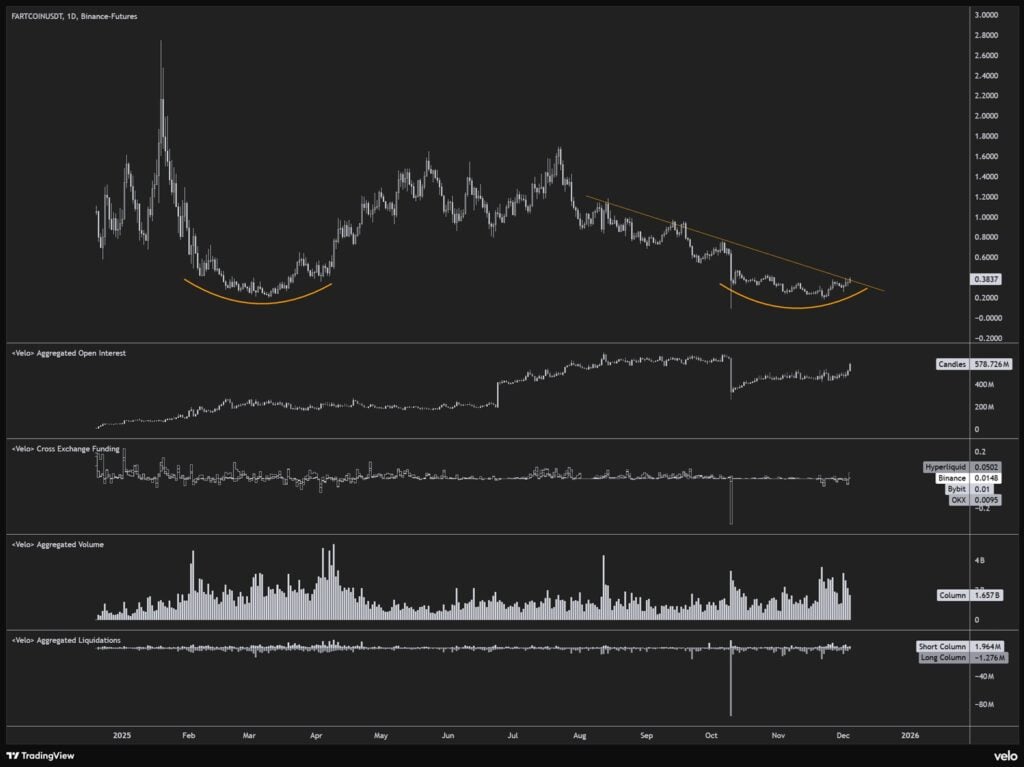
Best Meme Coins to Buy – Fartcoin Price Prediction

Best Meme Coins to Buy – Fartcoin Price Prediction

The market drops about 1% on the day. Fear and greed sits at 25, altcoin season index sits at 22, and the crypto RSI sits around 46. These readings show caution but not heavy fear. Bitcoin trades in the green on the hourly chart. Ethereum turned green earlier today and still holds gains for the […]

Author: The Cryptonomist
N3XT launches US narrow bank with Wyoming Special Purpose Depository Institution charter

N3XT launches US narrow bank with Wyoming Special Purpose Depository Institution charter

N3XT, a new blockchain-powered bank backed by Paradigm and Winklevoss, has launched, focused on 24-hour cross-border B2B transactions.

Author: Cryptopolitan
Bitcoin Hyper Presale Hits $29M, 2025’s Hottest Bitcoin Ecosystem Launch

Bitcoin Hyper Presale Hits $29M, 2025’s Hottest Bitcoin Ecosystem Launch

The post Bitcoin Hyper Presale Hits $29M, 2025’s Hottest Bitcoin Ecosystem Launch appeared on BitcoinEthereumNews.com. Crypto Projects Takeaways: Bitcoin’s base layer remains slow, costly, and hard to program directly, leaving most $BTC holders unable to tap rich on-chain opportunities. The market is actively searching for infrastructure that unlocks DeFi, NFTs, and real-time payments on Bitcoin without compromising its settlement assurances. Bitcoin Hyper introduces the fastest Bitcoin Layer 2 with SVM integration, targeting faster-than-Solana execution for smart contracts and high-speed $BTC payments. The project’s token presale has raised over $29M to date, making it one of the year’s hottest presales. Bitcoin’s 2025 resurgence has been driven less by meme coins and more by a simple question: how do you actually put idle $BTC to work? Spot ETFs and custodial yield products scratched the surface, but on-chain, most holders are still limited to slow, expensive transactions and basic transfers. That gap has turned Bitcoin DeFi into one of the year’s most-watched narratives. Capital is hunting for infrastructure that finally lets Bitcoin act as more than digital gold, without sacrificing the security and trust that made it king. Ethereum and Solana proved what programmable blockchains can do, but $BTC’s trillion-dollar base remains largely underutilized. Branded as the fastest Bitcoin Layer 2 with Solana Virtual Machine (SVM) integration, it aims to deliver Solana-style throughput on top of Bitcoin’s settlement layer, opening the door to high-speed payments, DeFi, and gaming that still settle back to $BTC. That pitch appears to be landing. The $HYPER presale has already attracted more than $29M in commitments as investors look for exposure to a pure Bitcoin L2 narrative rather than another general-purpose L1. Bitcoin Hyper Channels $BTC Belief Into High-Speed Utility Bitcoin Hyper’s core promise is straightforward: take Bitcoin’s brand and security, bolt on SVM performance, and give $BTC holders something meaningful to do on-chain. For you, that means wrapped $BTC payments that finalize…

Author: BitcoinEthereumNews
With its ecosystem data hitting new highs, is Starknet, which strongly promotes privacy and the Bitcoin narrative, on the verge of a breakout?

With its ecosystem data hitting new highs, is Starknet, which strongly promotes privacy and the Bitcoin narrative, on the verge of a breakout?

Author: Pink Brains Compiled by: Tim, PANews Starknet is in the early stages of a Solana-style rebound. This L2 is not mentioned much, but it uses unique technology and focuses on creating highly available products. Since July, DeFi TVL has tripled, currently reaching approximately $300 million, nearing its all-time high. Stablecoin market capitalization hit a record high of $154 million. It ranked second in net capital inflows over the past three months, with a net inflow of $584 million. Active accounts are on the rise, reaching 50,000 to 60,000 per day. Why has Starknet made such progress? First, Starknet did not simply copy Ethereum's existing solutions, but instead built its DeFi ecosystem from scratch. STRK native staking functionality: the first L2 token with a viable application scenario. Through Endur.fi 's LST products, an annualized yield of approximately 7% can be achieved. Over 1 billion STRK have been staked within a year (approximately 22% of the circulating supply, a 120% increase in the past three months). Native BTC staking functionality: A dual-token staking mechanism was implemented for the first time at the Starknet consensus layer. Within just one month of its launch, the staked amount reached 1791 BTC, worth approximately $166 million. The staking feature is now available on wallets such as Ready, Braavos, and Xverse. Anchorage, an institutional-grade custody platform, also supports BTC staking on the Starknet network. Starknet is one of the most liquid Bitcoin Layer 2 networks and is at the core of the BTCFi narrative. It supports cross-chain BTC transfers from Bitcoin, Ethereum, and other Layer 2 networks, BTC staking, and out-of-the-box DeFi suites. Re7 Capital: Offers institutional-grade strategies, including mRe7 Yields (stablecoin yields) and mRe7 Bitcoin (Bitcoin yields), tokenized through the Midas RWA platform. Endur.fi: The largest LST project on Starknet. It has locked 60 million STRK (7.75% annualized yield) and 340 BTC. Vesu offers BTC-collateralized lending and revolving strategies. Users can deposit wBTC, tBTC, LBTC, and SolvBTC to earn an annualized deposit interest rate of up to 2.5%, and borrow USDT and USDC at an annualized borrowing rate of approximately 2.8%. Total deposits have now exceeded $60 million, and total borrowings have reached $19 million. Extended, Avnu, and Ekubo Protocol: Focused on BTC trading and liquidity. Ekubo is the largest automated market maker DEX on Starknet, featuring Uni v4-like scalability, support for dollar-cost averaging, and an upcoming limit order mode. Uncap and Opus: Allow users to borrow Starknet's native stablecoin by using BTC as collateral. 0D Finance, Troves, and Starknet Earn: Providing Convenient One-Click DeFi Strategies Starknet is also improving its interoperability. Starknet will support LayerZero, Stargate Finance, native USDC, CCTP v2, and the NEAR interaction mechanism in December. This could accelerate the inflow of stablecoins and facilitate cross-chain transactions between assets such as STRK, ZEC, BTC, and SOL. Starknet is pushing the privacy narrative very hard. StarkWare's ZK stack powers three of the top ten perpetual contract DEXs, all of which are privacy-focused perpetual contract DEXs. It currently faces fierce competition from Hyperliquid and Aster. edgeX (built on Starknet): 30-day perpetual contract trading volume reaches $170 billion Paradex (independent blockchain): 30-day perpetual contract trading volume reached $26 billion, with a total transaction value (TVL) of $144 million. Extended (Rollup expansion plan): 30-day perpetual contract trading volume reached $28 billion, with a TVL of $99 million. Indeed, as privacy becomes a key feature, privacy-focused DEXs built on StarkWare and Starknet technologies have greater development potential. Starknet's zero-knowledge proof technology not only enhances transaction privacy protection but also balances scalability and security, laying the foundation for the long-term value of DeFi. Ethereum + Bitcoin + Zcash = Starknet Ztarknet is an L2 network based on Starknet, designed specifically for Zcash. It runs high-throughput applications on CairoVM and uses STARK proofs to settle state to the Zcash mainnet. It adds basic layer privacy features, enabling ZEC to achieve scalable programmability and post-quantum security. Yes, StarkWare is also developing Zoro, a Zcash light client that utilizes STARK proofs and aims to compress the Zcash chain verification process into concise, verifiable proofs. The Starknet ecosystem will fully support Zcash. This means that Zcash will be able to leverage Starknet's high-performance infrastructure, including the Cairo programming language and STARK proof technology, to enhance scalability, privacy, and programmability, while maintaining interoperability with the Ethereum ecosystem. Starknet is designed to be quantum resistant. Vitalik recently warned that quantum computers could break the elliptic curve cryptography that protects Bitcoin and Ethereum within the next four years. Starknet uses STARK proofs. Unlike ECC, which relies on large number factorization (easily broken by quantum computers), STARKs are based on collision-resistant hash functions, which quantum computers cannot quickly crack. Mathematically, Starknet possesses post-quantum security. In most Layer 1 networks, a private key is equivalent to a wallet. However, Starknet's smart contract wallet mechanism allows its security to be directly enhanced through protocol upgrades without transferring funds, which is fundamentally different from EOA wallets. Quantum-secure signatures are typically large in size, but Starknet can compress them into proofs in batches, enabling Bitcoin or Ethereum networks to verify them at lower gas costs while reducing the processing load on the base layer. In short: Starknet is at the crossroads of the most critical paths in the crypto industry. The technology is ready; we await market validation.

Author: PANews
Stunning Bitcoin Withdrawal: Matrixport Pulls $470M from Binance in 24 Hours

Stunning Bitcoin Withdrawal: Matrixport Pulls $470M from Binance in 24 Hours

BitcoinWorld Stunning Bitcoin Withdrawal: Matrixport Pulls $470M from Binance in 24 Hours In a move that has sent ripples through the crypto community, financial services giant Matrixport has executed a staggering Bitcoin withdrawal. The firm pulled 5,805 BTC, worth approximately $470 million, from the Binance exchange within a single day. This massive transfer isn’t just a routine transaction; it’s a powerful signal that could hint at the […] This post Stunning Bitcoin Withdrawal: Matrixport Pulls $470M from Binance in 24 Hours first appeared on BitcoinWorld.

Author: bitcoinworld
Ethereum's New Value Proposition: From Public Chain Infrastructure to a "Financial Windows Operating System"

Ethereum's New Value Proposition: From Public Chain Infrastructure to a "Financial Windows Operating System"

I. Underlying Logic of Public Blockchains: Platform Thinking Drives Ecosystem Expansion Ethereum's core advantage lies in its open ecosystem and platform-based development, following a path of "Internet-style expansion": - Initial focus on L2 expansion: reduce transaction costs and increase throughput through technologies such as Rollup, and quickly gather DeFi, NFT and other ecosystem applications and user base (refer to the Internet thinking of Alipay and WeChat of "traffic first, monetization later"). - Later, it will be able to handle large-scale settlements: After the mainnet TPS (transactions per second) increases, it will gradually take on the large-scale settlement needs of payments, asset transactions, etc., forming a positive cycle of "user growth → ecosystem prosperity → settlement capability upgrade". II. Value Anchoring: A Valuation System Driven by TVL The lower limit of ETH's valuation is determined by the total value locked (TVL) in its ecosystem, and it continues to rise as the ecosystem expands. - Ecosystem stickiness creates profit potential: After users develop usage habits due to the application, the platform can achieve "turnaround" (profit) by slightly increasing transaction fees, while the prosperity of the ecosystem in turn pushes up TVL, consolidating the intrinsic value of ETH. - New trends amplify value boundaries: Tokenization of US stocks and RWA (Real-world asset tokenization, such as real estate and bonds) directly increase the ecosystem's TVL (Total Value Limit) and transaction fee throughput. Based on a 30-year timeframe, if stablecoins reach 3 trillion and RWAs reach 20 trillion, ETH's minimum market capitalization could correspond to a scale of 3 trillion. III. The Evolution of Monetary Attributes: From Payment Instrument to "Monetary Settlement Layer" The use cases for currency always flow to the areas with the largest transaction volume, and the ultimate value of ETH lies in becoming a "settlement layer for currency": - Payment System vs. Monetary System: If ETH is only used as a payment tool, its market capitalization is comparable to SWIFT (lower valuation limit); if its ecosystem corresponds to the global monetary system (covering all scenarios such as payments, assets, and credit), then its value potential is limitless; - Specific needs in the AI era: AI-driven small-amount, rapid settlements (such as computing power transactions and cross-domain micro-payments) require stablecoins (stable prices and efficient execution), and ETH, as the underlying public chain, supports stablecoin issuance, cross-chain settlement, and complex financial logic, becoming the "infrastructure for monetary automation". IV. Beyond Payment: Building a Full-Stack Financial Ecosystem The value of ETH extends far beyond "payments," encompassing a full-stack financial infrastructure that includes asset issuance, banking services, and commercial functions. Asset issuance and trading: Supports the tokenization of US stocks and RWA (Real-world Asset On-chain), and realizes standardized issuance, on-chain trading and settlement of assets through smart contracts, breaking down traditional intermediary barriers; Bank-level financial services: - Deposits: Users can earn interest by depositing ETH or stablecoins into DeFi protocols (such as Aave) (decentralized "deposits"); - Lending: You can quickly obtain loans by staking ETH (such as issuing DAI on MakerDAO), without bank review, and the interest rate is adjusted in real time by the algorithm; - Exchange Functionality: Supports decentralized exchanges (DEX) and NFT platforms, enabling autonomous trading and circulation of assets; Empowering the business ecosystem: - Payment and Settlement: Global merchants accept ETH/stablecoin payments, cross-border payments arrive in seconds, and the cost is only 1/10 of the traditional SWIFT; - Supply chain finance: Smart contracts automatically complete account verification and loan disbursement (such as trade finance "cash on delivery" which is automatically triggered); - Business Automation: Supports enterprises in building decentralized marketplaces (such as digital art trading platforms) to achieve full-chain automation of "issuance-trading-settlement". V. Open Ecosystem: ETH's Long-Term Competitive Advantage ETH's "openness" is its core barrier to entry, distinguishing it from BTC (a closed system focused on value storage). - Developer-friendly: Supports programming languages such as Solidity, allowing any developer to freely build applications (from finance to games, from social to IoT). - Boundless Scenarios: Embracing emerging trends such as AI and RWA, enabling traditional financial assets (such as stocks and bonds) and emerging digital assets (such as AI computing power and data) to circulate on the blockchain; - Programmable financial logic: Through smart contracts, financial transactions and business logic can be executed in a "coded" manner (such as automatic dividends and automatic liquidation), completely breaking the geographical, time, and intermediary limitations of traditional finance. VI. Future Outlook: From "Financial Operating System" to "Global Settlement Underlying Layer" The fundamental logic behind ETH's development is an upgrade from a "payment network" to a "global financial operating system": - Short term: Reduce transaction costs through L2 expansion and gather users and ecosystem (refer to Amazon's "scale first, profit later" logic); - Mid-term: Promote the tokenization of US stocks, implement RWA, and expand TVL (Total Value Locked) and application scenarios; - Long-term: To become the settlement foundation of the global monetary system in the AI era, covering all scenarios of "payment + assets + finance + commerce", and releasing unlimited value potential. Conclusion ETH's ultimate ambition is to become the "Windows of finance"—when currencies need automated, globalized, and intelligent settlement, the comprehensive functions of its open ecosystem will reshape the global financial ecosystem, and its value space will continue to expand as the ecosystem grows.

Author: PANews