Lending

Lending protocols form the backbone of the decentralized money market, allowing users to lend or borrow digital assets without intermediaries. Using smart contracts, platforms like Aave and Morpho automate interest rates based on supply and demand while requiring over-collateralization for security. The 2026 lending landscape features advanced permissionless vaults and institutional-grade credit lines. This tag covers the evolution of capital efficiency, liquidations, and the integration of diverse collateral types, including LSTs and tokenized RWAs.

14479 Articles
Created: 2026/02/02 18:52
Updated: 2026/02/02 18:52
Why Top Analysts Are Calling This Crypto the Next Solana (SOL)

Why Top Analysts Are Calling This Crypto the Next Solana (SOL)

While Solana earned its reputation for high-speed, low-cost transactions, Mutuum Finance is carving out its own lane by addressing one […] The post Why Top Analysts Are Calling This Crypto the Next Solana (SOL) appeared first on Coindoo.

Author: Coindoo
Base coin issuance: a long-planned conspiracy?

Base coin issuance: a long-planned conspiracy?

Author: cole Produced by: Vernacular Blockchain In the crypto world, launching a new coin always sets the market on fire. When Coinbase, the industry's most compliant "regular force," incubated its Layer 2 network, Base, shifted its stance from "never launching a coin" to "exploring the future," everyone knew a major drama was about to unfold. This isn't just another token launch; it's a calculated strategic move by Coinbase, aiming to transform Base from a traffic gateway into a self-sustaining economic hub. Will this yet-to-be-launched token be the rocket fuel that ignites a bull market, or another "launch-and-reach" capital story? To answer this question, we must delve into the fabric of Base and analyze the vulnerabilities behind its glamorous data. 01. From “NO” to “YES” — Why does Base have to issue a token? Once upon a time, Base was a breath of fresh air in the Layer 2 world, with its leadership repeatedly stating that it had "no plans to issue a coin." However, the tide has turned. Base founder Jesse Pollak and Coinbase CEO Brian Armstrong have now publicly stated that the team is "exploring the issuance of a native token," believing it to be an excellent tool for accelerating decentralization and ecosystem growth. The official justification is grand and politically correct: achieving complete decentralization of the network. Currently, Base's core sorter remains centrally controlled by Coinbase. Issuing tokens can attract independent node participation through incentive mechanisms, a necessary step towards true decentralization. This technology-driven rhetoric aligns with the spirit of the crypto world and provides a "compliance" shield against regulatory scrutiny. However, the data reveals a harsher reality: Base is facing severe capital outflows. Data shows that over the past three quarters, Base has experienced a net outflow of $4.6 billion, with the majority of funds flowing back into the Ethereum mainnet. This suggests that while Base has successfully attracted a large number of users thanks to Coinbase's traffic, particularly during the meme coin and SocialFi (social finance) boom, it lacks user stickiness. Capital, like mercenaries, comes and goes with impatience. Base faces the risk of becoming a mere low-cost transit point. Meanwhile, competitors Arbitrum and Optimism have already built strong economic moats using tokens. Therefore, Base's token issuance is more a survival imperative than a philosophical evolution. Its core economic goal is a single one: anchoring capital. Through token incentives, Base aims to transform speculative "tourists" into long-term "residents," creating a self-reinforcing economic closed loop. 02. A Song of Ice and Fire: A Panoramic Scan of the Base Ecosystem To understand the power of the Base token, we must first understand its current state. On-chain data paints a picture of both ice and fire: user activity is in full swing, but capital depth is relatively calm. Judging by the data, Base is undoubtedly a top player. Its TVL exceeds $5 billion. But what's most astonishing is its transaction processing capacity, with an average TPS of 148.77, far exceeding Arbitrum's 22.49. The network has nearly one million daily active addresses, and annualized network revenue is projected to reach $75 million. These data clearly reveal Base's uniqueness: while it is an undisputed giant in user activity, it remains a laggard in terms of capitalization. Base has already solved the "how to attract people" problem; now it needs to use its token to solve the "how to retain people" problem. Base's application ecosystem exhibits a unique "leverage structure." On one end are multi-chain giants like Uniswap and Aave, which contribute the majority of TVL. On the other end are vibrant meme coins. Of greatest strategic value, however, are the "native protocols" sandwiched in the middle—they are Base's true moat and the core goal of future token incentives. DeFi: In the decentralized finance sector, Aerodrome Finance, Base's native automated market maker (AMM), is rising at an astonishing rate, with its TVL exceeding $1.1 billion, aiming to become Base's central liquidity hub. In the lending market, the native protocol SeamlessFi has also made a name for itself. SocialFi: This is Base's unique trump card. The phenomenal emergence of Friend.tech not only brought a massive amount of traffic to Base but also pioneered a new on-chain social monetization model. Furthermore, the decentralized social protocol Farcaster is also thriving here. Games and NFTs: This sector is still in its early stages, with no blockbuster hits yet. However, Base's low gas fee environment is ideal for the development of on-chain games, and its native token can serve as a catalyst to attract top game studios. 03. Redistribution of wealth - who will be the biggest winner? The issuance of Base tokens will be a redistribution of wealth on an unprecedented scale. Ecosystem protocols: For native protocols such as Aerodrome and SeamlessFi, Base tokens will be their ammunition to compete head-on with multi-chain giants. Users and community: Issuing coins will bring about a wealth effect, and tokens will also give the community the power of governance and cultivate a deep sense of "ownership". Base Network: The token treasury will free Base from its dependence on Coinbase and become a self-sustaining and self-developing public product. Coinbase: This might be the most exciting part. Currently, Base directly contributes less than 1% of Coinbase's total revenue. However, the fully diluted valuation (FDV) of a single Base token could reach tens of billions of dollars. This means that Coinbase is performing a brilliant financial trick: giving up a negligible amount of operating income in exchange for a massive asset potentially worth tens of billions of dollars. By issuing tokens and decentralizing the platform, Coinbase not only mitigates regulatory risk but also transforms a small profit into a massive asset. 04. Summary Base's exploration of issuing a token is a deliberate strategic necessity. It marks Base's official transition from a successful "traffic acquisition machine" to a self-sustaining "on-chain economy." Will Base's coin launch, like Arbitrum's, use a "big bang" launch to generate hype but potentially trigger a catastrophic sell-off? Or will it be like Optimism, using a phased, narrative-heavy approach to steadily guide the market and direct the community's attention to long-term development? Considering Base's close ties with Coinbase and its "compliance first" stance, the latter seems more likely. Regardless of which path it chooses, Base holds a trump card: the massive retail user base brought by Coinbase and the unique SocialFi ecosystem. For all participants in the crypto world, this drama is worth your close attention.

Author: PANews
Top Crypto to Buy Now: Ripple (XRP) Investors Pivot to Mutuum Finance (MUTM) for Bigger ROI in 2025

Top Crypto to Buy Now: Ripple (XRP) Investors Pivot to Mutuum Finance (MUTM) for Bigger ROI in 2025

With Ripple (XRP) facing a shrinking investor base, capital is shifting to Mutuum Finance (MUTM), a DeFi protocol that is reinventing what the actual utility in crypto should be. The project is a $0.035 altcoin that has been bought by more than 16,400 investors. Its lending and borrowing ecosystem that aims to bridge the traditional […]

Author: Cryptopolitan
Why Mutuum Finance (MUTM) is the Next Big Altcoin, Surpassing Solana (SOL)

Why Mutuum Finance (MUTM) is the Next Big Altcoin, Surpassing Solana (SOL)

The post Why Mutuum Finance (MUTM) is the Next Big Altcoin, Surpassing Solana (SOL) appeared on BitcoinEthereumNews.com. Each bull cycle has its breakout star, and this time, investors are watching Mutuum Finance (MUTM). As Solana (SOL) had previously blinded the market with speed, Mutuum Finance is rewriting the hype to hard utility. Mutuum Finance is not only currently promising scalability, but is providing a platform on which the future of lending and borrowing can grow sustainably, something that competitors do not pose a threat of doing. Mutuum Finance (MUTM) could outpace Solana (SOL) in performance. Solana Price Maintains Strength Near $236 as Market Monitors Resistance Solana (SOL) is trading at $236.42 with slight improvements of about 1.2% in the last 24 hours with a 1-day range of between $231.88 and $240.55. The token has witnessed an approximate 9% increase in the last one week, which is backed by institutional investors and the high activity of the ecosystem.  Resistance is seen between $250-$260 whereas the support is shaping between $220-$230 which indicates that SOL might require achieving a higher break. A portion of investors, in comparison to the well-established infrastructure and relative maturity of SOL, have been finding that emergent DeFi Mutuum Finance, presents higher growth potential under existing market conditions. Mutuum Finance Presale Rise  Mutuum Finance has had an incredible rate of presale traction and has over 16,400 investors buying coins to raise over $16 million raised so far. During Phase 6, tokens can be purchased at $0.035 a token. Its hierarchical system is a rewards scheme and the ones who come early are set to see maximum rewards. In a bid to provide security within its ecosystem, Mutuum Finance has teamed with CertiK to initiate a formal bug bounty program and a pool of rewards, which amounts to $50,000 USDT. In a way that all the vulnerabilities may be discovered and eradicated, reward is provided in…

Author: BitcoinEthereumNews
Best Crypto to Buy as Ethereum (ETH) Looks Set to Reach $5,500 in September

Best Crypto to Buy as Ethereum (ETH) Looks Set to Reach $5,500 in September

As Ethereum (ETH) aims for $5,500 this September, excitement within the investor community is high. However, it is not just about Ethereum (ETH). Mutuum Finance (MUTM), a new DeFi altcoin, is steadily gaining traction thanks to its lending and borrowing protocol. As Ethereum still leads as a foundational layer, Mutuum Finance is trending, with its […]

Author: Cryptopolitan
The Next Ten Days Will Be Crucial For Crypto, But This Cheap Altcoin Is Poised To Lead The Rest, Here is Why

The Next Ten Days Will Be Crucial For Crypto, But This Cheap Altcoin Is Poised To Lead The Rest, Here is Why

The post The Next Ten Days Will Be Crucial For Crypto, But This Cheap Altcoin Is Poised To Lead The Rest, Here is Why appeared first on Coinpedia Fintech News The next ten days are shaping up as pivotal for the crypto market, as Bitcoin’s consolidation is signaling a potential shift in momentum. Analysts are stressing that this short-term period may decide whether a powerful altcoin season ignites in the fourth quarter of 2025.  Global economic developments are adding to the urgency, since both China’s …

Author: CoinPedia
Why Did Whales Buy $418K Bitcoin Hyper in 18 Days? Presale Nears $17M

Why Did Whales Buy $418K Bitcoin Hyper in 18 Days? Presale Nears $17M

Let’s start by saying that it’s quite common for crypto investors to flock to an exciting new project. Hype and raw degen energy are, after all, two of the most important pillars of this industry. That said, when a crypto presale is so good investors pour a whopping $418K into it in just 18 days, […]

Author: Bitcoinist
‘Don’t FUD XRP,’ Warns Crypto Trader as Price Tops $3

‘Don’t FUD XRP,’ Warns Crypto Trader as Price Tops $3

The post ‘Don’t FUD XRP,’ Warns Crypto Trader as Price Tops $3 appeared on BitcoinEthereumNews.com. XRP, the third largest cryptocurrency by market cap, has received positive updates within the last 24 hours. Yesterday, digital fund asset manager REX Osprey announced that XRP ETF XRPR, the first U.S.-listed ETF offering spot exposure to XRP, was set to go live, offering investors a way to access XRP through an ETF structure. According to Grayscale CEO Peter Mintzberg, Grayscale Digital Large Cap Fund (GDLC) has been approved for trading along with the Generic Listing Standards. This move would bring the “first” multi crypto asset ETP to market with Bitcoin, Ethereum, XRP, Solana and Cardano. In light of this, Grayscale Digital Large Cap Fund has filed a registration statement (including a prospectus) with the SEC for the offering. In the most recent news, Ripple announced its partnership with DBS Bank and Franklin Templeton to establish repo markets powered by tokenized collateral and stablecoins. Don’t FUD XRP Following recent developments for XRP Ledger and Ripple, Crypto trader Oscar Ramos warned to not FUD XRP. FUD refers to fear, uncertainty and doubt. Ramos wrote, “Do not FUD XRP or you will regret it” highlighting Ripple’s new groundbreaking partnership beneficial for the XRP Ledger. DBS, Franklin Templeton and Ripple have announced a partnership to provide institutional investors with trading and lending solutions powered by tokenized money market funds on XRP Ledger and stablecoins, including Ripple USD (RLUSD). Ramos predicts XRP going to $10 next, boosted by positive developments: “You don’t see it yet, but XRP is going to $10 Next.” At press time, XRP was trading up 3.59% in the last 24 hours to $3.12, extending its recovery from a low of $2.95 on Sept. 15 into the third day. XRP has risen well above $3, which coincides with the daily SMA 50. Source: https://u.today/dont-fud-xrp-warns-crypto-trader-as-price-tops-3

Author: BitcoinEthereumNews
Nubank to Launch Stablecoin Pilot for Credit Card Users

Nubank to Launch Stablecoin Pilot for Credit Card Users

        Highlights:  Nubank is driving innovation by introducing stablecoin payments on its credit cards. Roberto Campos Neto explains that banks face hurdles using tokenized deposits for safe lending. Stablecoins are transforming Latin America as people seek protection against currency and inflation risks.  Nubank, Latin America’s largest digital bank, is set to introduce dollar-pegged stablecoins into its payment system, starting with credit cards. The move was revealed by vice-chairman and former Central Bank of Brazil governor, Roberto Campos Neto, during the Meridian 2025 event, where he highlighted blockchain’s potential to connect digital assets with traditional banking.   Nubank is testing stablecoin credit cards! Accept dollar-pegged stablecoins for payments Enable tokenized deposits & lending Faster, dollar-linked payments across Latin America #Crypto #Stablecoins #FinTech #Nubank pic.twitter.com/vZjjmGATyb — PrincipeCripto (@PrincipeCripto) September 19, 2025  Stablecoin Payments Pilot and Banking Challenges Neto told local media that Nubank will start testing stablecoin payments with its credit cards later this year. The initiative aims to bring digital assets closer to mainstream banking. The company has not shared an exact timeline or launch date for the pilot yet. Campos Neto said that most people buy cryptocurrencies to keep their value, not to use them for daily payments. He added that it is important to understand why this is happening, even if the trend is slowly changing. He also explained that banks face a challenge in accepting tokenized deposits and using them to give credit to clients. According to him, central banks are concerned about the rapid growth of digital assets and how to manage them without disrupting traditional credit. “The main problem is finding a solution in which the bank can take a deposit in the form of a token and carry out a credit operation on top of it,” he said. He also talked about the fast adoption of stablecoins, especially in emerging markets. He explained that they provide easier access to the U.S. dollar and help protect against local currency losses and economic uncertainty. Stablecoins in Latin America and Nubank’s Crypto Expansion Nubank started in São Paulo in 2013 and now serves over 100 million customers across Brazil, Mexico, and Colombia. The bank began working with digital assets about three years ago. It invested 1% of its net assets in Bitcoin and let customers trade crypto. In March, Nubank added four new altcoins for customers. These are Cardano, Cosmos, Near Protocol, and Algorand. This gave people more ways to buy and trade digital assets.  Latin America's fintech giant Nubank starts offering services with Cardano, Algorand https://t.co/YQpHmqWOH8 — Cardano Feed ($ADA) (@CardanoFeed) March 26, 2025  In key Latin American markets, remittances are important for many households, and stablecoin use has grown in recent years. In Brazil, stablecoins now account for the majority of crypto transactions. The Central Bank president noted at a Bank for International Settlements event in February that 90% of crypto activity in the country involves stablecoins.  Meanwhile, in Argentina, people are increasingly using USDt and USDC as inflation surged into triple digits. In Venezuela, dollar-pegged tokens are beginning to replace the bolívar in everyday transactions. Neighboring countries are witnessing growing stablecoin use. The GENIUS Act, recently signed by President Trump, seeks to strengthen the dollar’s global dominance by supporting dollar-backed stablecoins. The Treasury Department forecasts the stablecoin market will exceed $2 trillion by 2028. This growth highlights the need for better liquidity, smoother interoperability, and clearer regulatory frameworks.   US Treasury Secretary: "Stablecoins could reach $2 trillion by 2028" During a hearing before the US Senate, Treasury Secretary Scott Bessent predicted that the market for dollar-backed stablecoins could surpass $2 trillion within three years. The GENIUS Act, the stablecoin… pic.twitter.com/iLWYnYN3gU — Atlas21 (@Atlas21_news) June 12, 2025     eToro Platform    Best Crypto Exchange   Over 90 top cryptos to trade Regulated by top-tier entities User-friendly trading app 30+ million users    9.9   Visit eToro eToro is a multi-asset investment platform. The value of your investments may go up or down. Your capital is at risk. Don’t invest unless you’re prepared to lose all the money you invest. This is a high-risk investment, and you should not expect to be protected if something goes wrong. 

Author: Coinstats
Passive Income in Crypto: Why Waiting for Altseason Is a Bad Strategy

Passive Income in Crypto: Why Waiting for Altseason Is a Bad Strategy

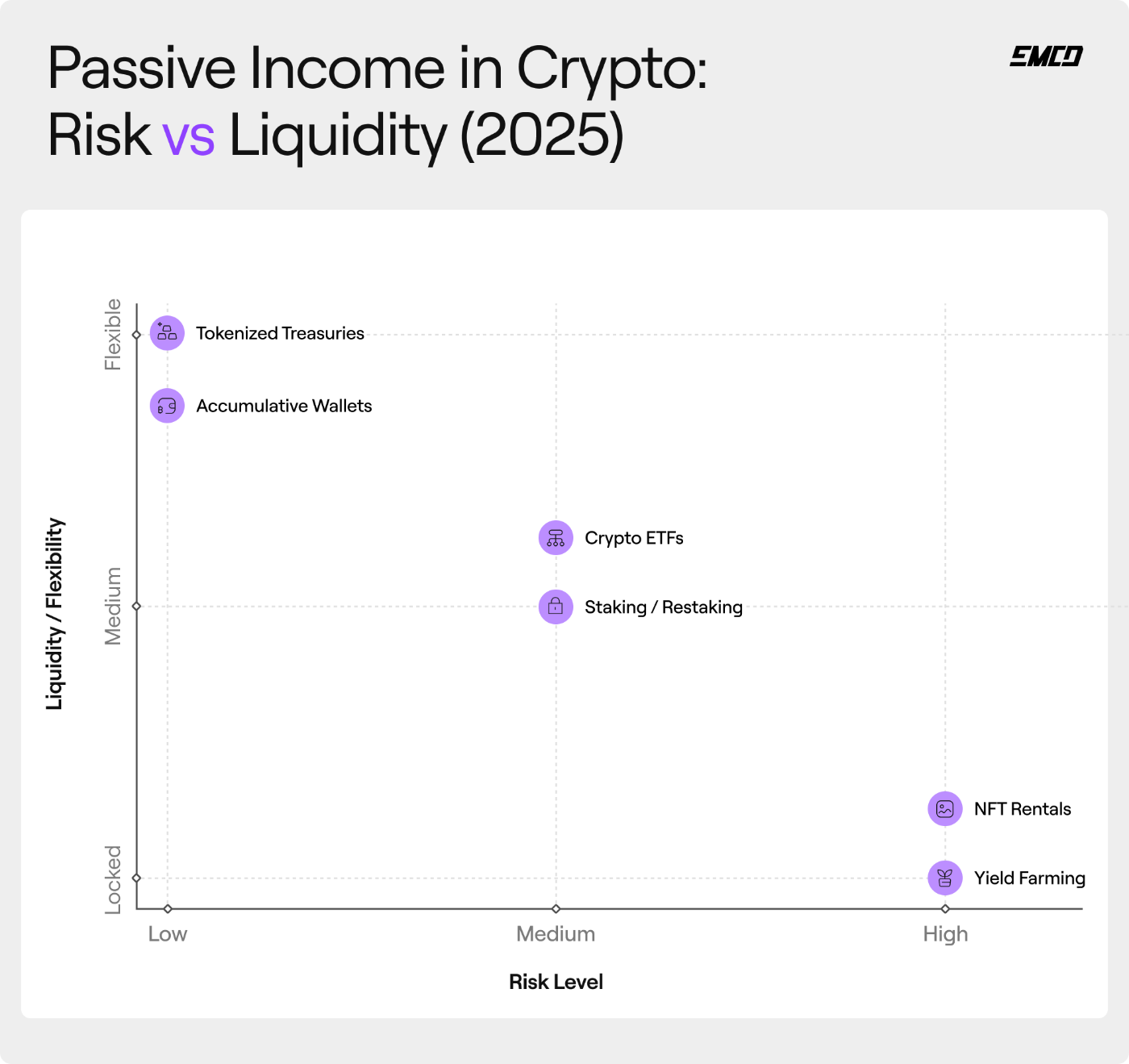
Altseason is tempting, but most investors miss the timing. In 2025, passive income strategies offer steadier growth without relying on hype cycles. Tokenized bonds bring traditional yields on-chain with better accessibility. Crypto savings accounts like Coinhold give up to 14% APY with flexible withdrawals. Staking & restaking unlock extra yield, though risks remain tied to networks and smart contracts. Lending is still the backbone of passive income — now safer and more transparent. Yield farming hasn’t died, it’s just smarter, while NFT rentals and staking ETFs show how mainstream passive yield is becoming. The bottom line: no product is risk-free, but if you match the right tools to your risk appetite and liquidity needs, you can build steady returns in any market.

Author: Hackernoon