Index

A crypto Index provides a way for investors to gain diversified exposure to a specific basket of digital assets through a single tokenized product. These indices often track specific sectors, such as DeFi, DePIN, or RWA, and are automatically rebalanced via smart contracts. In 2026, AI-managed thematic indices have become the gold standard for passive investing, allowing users to track the "blue chips" of the Web3 economy without manual portfolio management. This tag covers index methodology, rebalancing frequency, and the benefits of diversified crypto baskets.

25066 Articles
Created: 2026/02/02 18:52
Updated: 2026/02/02 18:52

Crypto Fear & Greed Index: Navigating the Market’s Crucial Neutral Stance

Crypto Fear & Greed Index: Navigating the Market’s Crucial Neutral Stance

BitcoinWorld Crypto Fear & Greed Index: Navigating the Market’s Crucial Neutral Stance The cryptocurrency market often feels like a rollercoaster of emotions, swinging wildly between euphoria and panic. For investors seeking clarity amidst this volatility, tools like the Crypto Fear & Greed Index offer a fascinating snapshot of prevailing market sentiment. As of August 22, this crucial index, provided by software development platform Alternative, stands firmly at 50, holding its ‘Neutral’ position from the previous day. But what does a truly neutral Crypto Fear & Greed Index reading really mean for your investment strategy? What Does the Crypto Fear & Greed Index Tell Us? The Crypto Fear & Greed Index serves as a barometer for the emotional state of the crypto market. It operates on a simple principle: when investors are too fearful, it could signal a buying opportunity. Conversely, when they are excessively greedy, it might indicate that a correction is imminent. This index ranges from 0 to 100, with 0 representing “extreme fear” and 100 indicating “extreme greed.” A score of 50, as we see currently, places the market squarely in the “Neutral” zone. This suggests a period where neither fear nor greed dominates investor decisions. It’s a moment of equilibrium, where market participants are perhaps taking a pause, waiting for clearer signals, or simply reacting to existing data without strong emotional bias. Understanding this balance is key to making informed decisions. Decoding a Neutral Crypto Fear & Greed Index A neutral reading on the Crypto Fear & Greed Index can be interpreted in several ways. It’s not necessarily a call to action, but rather an indication of the current market psychology. Here’s what it could imply: Market Indecision: Investors might be unsure about the next major price movement, leading to sideways trading. Balanced Forces: Buying and selling pressures are relatively equal, preventing significant swings in either direction. Waiting for Catalysts: The market could be anticipating a major news event, regulatory update, or technological development that will break the deadlock. Reduced Volatility: A neutral stance often accompanies periods of lower volatility, which can be a relief after intense price fluctuations. For savvy investors, a neutral Crypto Fear & Greed Index offers a chance to re-evaluate portfolios and strategies without the emotional pressure of extreme market conditions. It’s an opportunity to conduct thorough research and plan for potential future shifts. How is the Crypto Fear & Greed Index Calculated? The methodology behind the Crypto Fear & Greed Index is robust, incorporating a blend of factors to provide a comprehensive view of market sentiment. Alternative, the platform behind the index, considers six distinct components, each weighted differently: Volatility (25%): Measures the current volatility and maximum drawdowns of Bitcoin compared to its average values. Higher volatility often indicates fear. Market Momentum/Volume (25%): Compares the current volume and market momentum with long-term averages. High buying volume in a strong market suggests greed. Social Media (15%): Analyzes the number of cryptocurrency-related hashtags and interactions on various social media platforms, along with the speed of these interactions. Increased positive sentiment can indicate greed. Surveys (15%): Gathers investor sentiment through weekly polls. (Note: Surveys are currently paused, impacting this component’s contribution.) Bitcoin Dominance (10%): Assesses Bitcoin’s share of the total crypto market cap. A rising Bitcoin dominance often signals fear in altcoin markets as investors flock to the perceived safety of BTC. Google Trends (10%): Examines search queries related to Bitcoin and other cryptocurrencies. A surge in “Bitcoin price manipulation” searches, for example, might suggest fear. By combining these diverse data points, the index aims to offer a holistic and objective measure of the market’s emotional temperature, helping to cut through the noise. Navigating Market Sentiment with the Crypto Fear & Greed Index While the Crypto Fear & Greed Index is an invaluable tool, it’s essential to use it as part of a broader analytical framework. It provides insight into sentiment, but it does not predict future price movements with certainty. Investors should consider it alongside fundamental analysis, technical analysis, and macroeconomic factors. For example, during a neutral phase, you might choose to: Refine your Watchlist: Identify promising projects that are consolidating. Educate Yourself: Use this calmer period to deepen your understanding of blockchain technology and new crypto innovations. Dollar-Cost Average: Continue your regular investment schedule, taking advantage of potentially stable prices. Manage Risk: Re-evaluate your stop-loss orders and portfolio allocation. The index is a powerful indicator of human psychology in action, reminding us that emotions often drive market behavior. A neutral reading simply means that for now, the crowd is holding its breath. In Summary: The Crypto Fear & Greed Index at 50, in its neutral stance, offers a moment of calm in the often-turbulent crypto seas. It’s a period of equilibrium, reflecting balanced market sentiment rather than extreme fear or greed. While not a standalone investment guide, it serves as a crucial indicator, helping investors understand the collective psychology of the market. Use this insight to make rational, data-driven decisions, rather than being swayed by fleeting emotions. Frequently Asked Questions (FAQs) Q1: What exactly is the Crypto Fear & Greed Index? A1: The Crypto Fear & Greed Index is a tool that measures the prevailing emotional sentiment in the cryptocurrency market, ranging from 0 (extreme fear) to 100 (extreme greed). Q2: How should I interpret a “Neutral” reading of 50 on the Crypto Fear & Greed Index? A2: A “Neutral” reading of 50 indicates a balanced market where neither fear nor greed is dominant. It suggests indecision among investors and often precedes periods of consolidation or anticipation for new catalysts. Q3: What are the main factors used to calculate the Crypto Fear & Greed Index? A3: The index considers six factors: volatility, market momentum/volume, social media activity, surveys (currently paused), Bitcoin dominance, and Google Trends data. Q4: Can the Crypto Fear & Greed Index predict future price movements? A4: No, the index is a sentiment indicator, not a predictive tool. It reflects current market psychology but should be used in conjunction with other analytical methods for making investment decisions. Q5: Where can I find the latest Crypto Fear & Greed Index value? A5: The latest value of the Crypto Fear & Greed Index is typically provided by platforms like Alternative.me and is often cited by cryptocurrency news outlets. Call to Action: Did this article help you understand the Crypto Fear & Greed Index better? Share your insights with fellow crypto enthusiasts on social media! Your shares help us continue providing valuable market analysis and empower more investors with knowledge. To learn more about the latest crypto market trends, explore our article on key developments shaping Bitcoin and Ethereum price action. This post Crypto Fear & Greed Index: Navigating the Market’s Crucial Neutral Stance first appeared on BitcoinWorld and is written by Editorial Team

Author: Coinstats
Australia’s S&P Global Manufacturing PMI improves to 52.9 in August, Services PMI rises to 55.1

Australia’s S&P Global Manufacturing PMI improves to 52.9 in August, Services PMI rises to 55.1

The post Australia’s S&P Global Manufacturing PMI improves to 52.9 in August, Services PMI rises to 55.1 appeared on BitcoinEthereumNews.com. The preliminary reading of Australia’s S&P Global Manufacturing Purchasing Managers Index (PMI) came in at 52.9 in August versus 51.3 prior, the latest data published by S&P Global showed on Thursday. The Australia’s S&P Global Services PMI rose to 55.1 in August from the previous reading of 54.1, while the Composite PMI improved to 54.9 in August versus 53.8 prior.  Market reaction At the press time, the AUD/USD pair was down 0.02% on the day to trade at 0.6433. Australian Dollar FAQs One of the most significant factors for the Australian Dollar (AUD) is the level of interest rates set by the Reserve Bank of Australia (RBA). Because Australia is a resource-rich country another key driver is the price of its biggest export, Iron Ore. The health of the Chinese economy, its largest trading partner, is a factor, as well as inflation in Australia, its growth rate and Trade Balance. Market sentiment – whether investors are taking on more risky assets (risk-on) or seeking safe-havens (risk-off) – is also a factor, with risk-on positive for AUD. The Reserve Bank of Australia (RBA) influences the Australian Dollar (AUD) by setting the level of interest rates that Australian banks can lend to each other. This influences the level of interest rates in the economy as a whole. The main goal of the RBA is to maintain a stable inflation rate of 2-3% by adjusting interest rates up or down. Relatively high interest rates compared to other major central banks support the AUD, and the opposite for relatively low. The RBA can also use quantitative easing and tightening to influence credit conditions, with the former AUD-negative and the latter AUD-positive. China is Australia’s largest trading partner so the health of the Chinese economy is a major influence on the value of the Australian Dollar (AUD). When the Chinese…

Author: BitcoinEthereumNews
How Much Could 1,000 Tokens of Polkadot, NEAR, and Chainlink Be Worth by 2030?

How Much Could 1,000 Tokens of Polkadot, NEAR, and Chainlink Be Worth by 2030?

Altcoins have had a rough week. The Altcoin Season Index slipped to 42, showing that money is moving back into Bitcoin and away from smaller tokens.  That shift has weighed on Polkadot (DOT), NEAR Protocol (NEAR), and Chainlink (LINK), all of which have seen their prices dip.  But for long-term holders, the real question isn’t

Author: Coinstats
Institutional Interest in Ethereum in the Crypto Ecosystem Reaches Record Level! Here’s the Latest Data

Institutional Interest in Ethereum in the Crypto Ecosystem Reaches Record Level! Here’s the Latest Data

The post Institutional Interest in Ethereum in the Crypto Ecosystem Reaches Record Level! Here’s the Latest Data appeared on BitcoinEthereumNews.com. Institutional interest in Ethereum is growing rapidly within the crypto ecosystem. Recent data reveals that 69 institutions hold a total of 4.1 million ETH, worth approximately $17.6 billion. This brings their holdings to 3.39% of the total supply. Ethereum Treasures of 69 Institutions Exceed $17 Billion According to data shared by StrategicETHReserve, BitMine Immersion Technologies holds the largest Ethereum treasury. With approximately 1.5 million ETH, the company’s assets are worth around $6.6 billion. The company has shifted its strategy from Bitcoin mining to Ethereum accumulation. SharpLink Gaming came in second in ETH holdings. The company holds 740,800 ETH, worth approximately $3.2 billion. Ether Machine follows with 345,400 ETH, while the Ethereum Foundation holds 231,600 ETH. Digital asset treasuries are becoming increasingly important. Ethereum-focused investments, in particular, are seeing remarkable growth in the sector. As of Wednesday, publicly traded companies’ Ethereum treasuries reached 2.6 million ETH ($10.9 billion). Meanwhile, spot Ethereum ETFs traded in the US hold approximately 6.7 million ETH, equivalent to 5.5% of the total available supply and highlighting the extent of institutional interest. *This is not investment advice. Follow our Telegram and Twitter account now for exclusive news, analytics and on-chain data! Source: https://en.bitcoinsistemi.com/institutional-interest-in-ethereum-in-the-crypto-ecosystem-reaches-record-level-heres-the-latest-data/

Author: BitcoinEthereumNews
From Boom to Slowdown: Crypto Stocks Lose Steam After 500% Surge

From Boom to Slowdown: Crypto Stocks Lose Steam After 500% Surge

Key names like Coinbase, Strategy, and Metaplanet have declined amid a lack of immediate market catalysts.

Author: CryptoPotato
S&P 500 fell for the fifth straight day ahead of Jerome Powell’s Jackson Hole speech

S&P 500 fell for the fifth straight day ahead of Jerome Powell’s Jackson Hole speech

The US stock market fell again on Thursday, dragging major indexes deeper into red territory as investors brace for Federal Reserve Chair Jerome Powell’s remarks this Friday at the central bank’s annual gathering in Jackson Hole, Wyoming. The S&P 500 fell 0.4%, closing at 6,370.17, its fifth straight day of losses. The Nasdaq Composite slipped 0.34% to end at 21,100.31, and the Dow Jones dropped 152.81 points, or 0.34%, closing at 44,785.50. Powell’s Friday appearance could bring a signal on what’s next for monetary policy, especially as inflation pressures stay hot. Traders on CME’s FedWatch tool have priced in a 74% chance that the Fed will lower rates at its September meeting. Retail investors pull back as tech giants lose steam For the first time in two months, retail investors flipped to the sell side. Data compiled by JPMorgan strategists revealed that mom-and-pop investors offloaded roughly $140 million in tech stocks just in the past week. That’s a big reversal after weeks of daily buying averaging over $1 billion a day. The pullback comes as megacap tech stocks, the heavy hitters like Nvidia, Microsoft, Meta, Alphabet, and Amazon, all slid through the week. Their losses were enough to pull the entire market down. The S&P 500 lost 0.8%, and the Nasdaq dropped 2.1% during the same stretch. Palantir, a darling among retail traders, tumbled more than 13% over the week. Tom Essaye, founder of The Sevens Report, wrote that tech had been carrying the market for years, but valuations had gotten way out of hand. “Investors have benefited greatly from the impressive performance of the tech sector, not only so far in 2025, but also over the past several years,” Tom said. He didn’t hold back about Palantir, calling it a perfect example of inflated expectations: “Palantir (PLTR), a stock that is the best performer in the S&P 500 YTD, also trades at a quasi-absurd 212X forward earnings.” Even with this retreat, retail investors haven’t ditched the market entirely. They’re stepping away from the overheated tech names, but they haven’t left the game. They’re just not buying blindly anymore. Trump increases pressure on Powell ahead of Fed speech As Powell prepares to speak, pressure is coming from more than just Wall Street. President Donald Trump has been relentlessly criticizing Powell and the Fed, pushing hard for lower rates. That part’s familiar. But now it’s gotten personal. Earlier this summer, the White House went after the Fed over its massive renovation project at its Washington, D.C. headquarters. Around that same time, Trump floated the idea of removing Powell altogether, but eventually backed off. This week, Trump’s administration turned its attention to Fed Governor Lisa Cook, accusing her of mortgage fraud involving two government-backed loans. It’s a shift from monetary complaints to personal accusations. All of it puts Powell in a political storm heading into his Jackson Hole remarks. Despite the noise, Powell is expected to keep his tone steady. That’s been his style for more than seven years. Michael Arone, the chief investment strategist at State Street Global Advisors, said Powell stays focused on the Fed’s responsibilities: “He’s done a good job in terms of keeping the Fed’s independence, ignoring the noise and some of the questions he gets, and keeping it focused on the data dependency and the Fed’s dual mandate.” Michael added that Powell “has taken the high road as it relates to the Fed’s independence and some of the pressure he’s clearly getting from the Trump administration.” Even if Powell doesn’t name names in his Friday speech, there’s a chance he nods to the chaos. The last few months have put the Fed under intense scrutiny, both from political attacks and from the market itself. The Fed chair may use the stage to push back subtly, without breaking from his usual calm public face. Get seen where it counts. Advertise in Cryptopolitan Research and reach crypto’s sharpest investors and builders.

Author: Coinstats
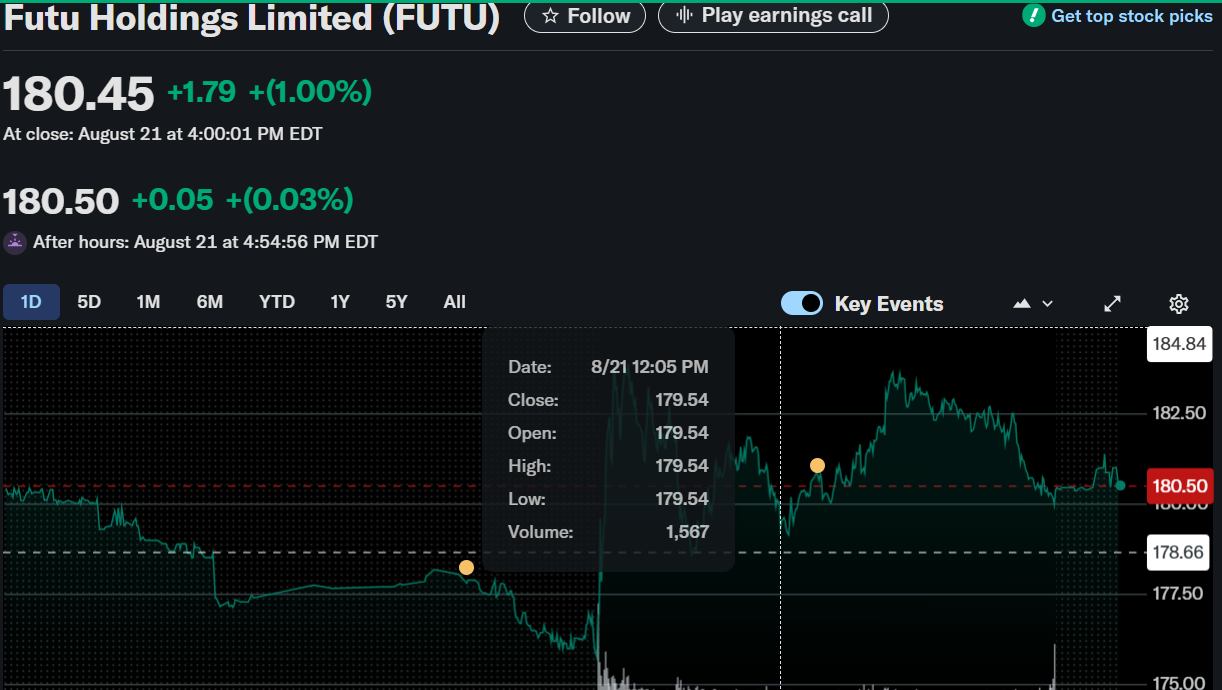
Futu Holdings Ltd. ($FUTU) Stock: Record Q2 2025 Earnings with Strong Growth

Futu Holdings Ltd. ($FUTU) Stock: Record Q2 2025 Earnings with Strong Growth

TLDR Q2 2025 revenue reached HKD5.3 billion, up 7% year over year. Net income rose 113% year over year to HKD2.6 billion. Total trading volume hit HKD3.59 trillion, up 121% year over year. Client assets reached a record HKD974 billion, up 68% year over year. Over 50% of funded accounts came from international clients. Futu [...] The post Futu Holdings Ltd. ($FUTU) Stock: Record Q2 2025 Earnings with Strong Growth appeared first on CoinCentral.

Author: Coincentral
BAY Miner Mobile App Aligns with MiCA Standards, Offering Secure Cloud Mining Access

BAY Miner Mobile App Aligns with MiCA Standards, Offering Secure Cloud Mining Access

The post BAY Miner Mobile App Aligns with MiCA Standards, Offering Secure Cloud Mining Access appeared on BitcoinEthereumNews.com. Amid volatile crypto markets and rising regulatory oversight, BAY Miner delivers secure and sustainable access to digital asset mining Cryptocurrency is changing fast and stricter regulations are changing how platforms are run. BAY Miner is taking a bold step forward in launching its mobile cloud mining app that completely complies with MiCA (Markets in Crypto-Assets) regulations. By now fully complying with MiCA regulations, BAY Miner is not only legally compliant but also increases trust, transparency, and investor protection in the mining ecosystem. BAY Miner promises users they are using a legitimate and transparent platform by complying with MiCA regulation. At a time with apps deployed without regulations and scams dominating headlines, BAY Miner represents confident and regulated choice for global investors. The Significance of MiCA Compliance in Cloud Mining MiCA is the landmark framework for crypto-assets globally, and it provides transparency around parameters of operation, investor protection, and financial processes across assets. To comply with MiCA is good indication that BAY Miner is committed to sustainable, legal, and safe growth. For miners, this means that they no longer have to worry. Their funds are safe under recognised regulatory regimes, and their profits are returned in accordance with a structure that is compliant. It creates trust locally and credibly establishes BAY Miner as the foremost mobile mining app with a long-term focus over rapid gains. Mining Anytime, Anywhere With Your Smartphone With BAY Miner’s mobile application, cryptocurrency mining is no longer limited to expensive rigs and complicated setups. Users can now mine Bitcoin (BTC), Ethereum (ETH), and Ripple (XRP) all on their phones! The App is available on iOS and Android devices, putting cloud mining in the reach of anyone around the world without technical limitations. This mobile-first concept is founded on the principles of simplicity and transparency. Having a dashboard…

Author: BitcoinEthereumNews
Chainlink Achieves 2 Major Security Milestones: Can They Boost LINK to ATH?

Chainlink Achieves 2 Major Security Milestones: Can They Boost LINK to ATH?

The post Chainlink Achieves 2 Major Security Milestones: Can They Boost LINK to ATH?  appeared first on Coinpedia Fintech News Chainlink (LINK), a top-tier decentralized oracle network, has achieved two major security milestones. On Thursday, Chainlink network announced that its oracles have achieved ISO 27001 certification and a SOC 2 Type 1 attestation. The Chainlink products covered by Frye latest security milestones include its data feeds, the proof of reserves, the NAVLink, and the cross-chain …

Author: CoinPedia
Maestro’s Real-Time Indexing Supercharges Liquidium’s Bitcoin Lending Platform

Maestro’s Real-Time Indexing Supercharges Liquidium’s Bitcoin Lending Platform

The post Maestro’s Real-Time Indexing Supercharges Liquidium’s Bitcoin Lending Platform appeared on BitcoinEthereumNews.com. A new partnership between Bitcoin infrastructure firm Maestro and lending protocol Liquidium has injected unprecedented speed and precision into Bitcoin’s emerging DeFi ecosystem (referred to as ‘BTCFi’).  To elaborate, Maestro’s enterprise-grade indexing and real-time mempool tracking services will now power Liquidium’s lending protocols, enabling near-instant reactions (for on-chain events) as well as unlocking lending/borrowing directly on Bitcoin’s base layer.  To date, Liquidium’s flagship Bitcoin-native lending platform ‘LiquidiumWTF’ has facilitated over 4,230 BTC (roughly $500 million) in loans using Bitcoin-centric assets (including Ordinals, Runes, and BRC-20 tokens) as collateral, proving that such inscribed assets, too, can be put to productive use rather than left idle in wallets.  That said, supporting such a novel market requires live access to accurate asset data and real-time transaction status. That’s where Maestro comes in, providing a digital infrastructure that can keep Liquidium updated on pending transactions and the latest state of the network, allowing it to execute loans and manage collateral with lightning-fast precision. On the development, Peter Giammanco, Liquidium co-founder and CTO, was quoted as saying: “We’ve only been using Maestro for two months, but it’s already saved us what amounts to 100% of the time and resources we would’ve spent building our own infrastructure. It’s hard to overstate the speed boost it’s given our dev cycle.”   From instant BTC loans to cross-chain lending without bridges With Maestro handling much of the backend heavy lifting, Liquidium has been able to rapidly expand its capabilities on Bitcoin’s L1 and beyond. Its primary protocol, LiquidiumWTF, recently rolled out an ‘Instant Loans’ feature, allowing users to borrow BTC within seconds. To make this possible, lenders have to pre-fund on-chain vaults so that liquidity can be tapped into almost immediately without having to wait for a counterparty.  Furthermore, Liquidium’s second protocol, LiquidiumFi, is pushing the envelope of cross-chain…

Author: BitcoinEthereumNews