DeFi

DeFi eliminates intermediaries by using smart contracts on blockchains to provide financial services like lending, borrowing, and trading. In 2026, the "DeFi 3.0" era is defined by Institutional DeFi and the integration of Real-World Assets (RWA). From liquidity provisioning on Uniswap to advanced lending on Aave, this tag tracks the evolution of autonomous financial systems, yield optimization, and the rise of AI-driven portfolio management in the decentralized economy.

67817 Articles
Created: 2026/02/02 18:52
Updated: 2026/02/02 18:52
DeFi Development announced an increase of approximately 180,000 SOL tokens, bringing its total holdings to approximately 1.18 million.

DeFi Development announced an increase of approximately 180,000 SOL tokens, bringing its total holdings to approximately 1.18 million.

According to CoinDesk, the listed company DeFi Development announced on July 29 that it had increased its holdings of SOL by 181,303 from July 21 to July 28, with an

Author: PANews
Ethereum: A Decade of Narrative Metamorphosis

Ethereum: A Decade of Narrative Metamorphosis

Authors: Ada and David, TechFlow At 3:26 PM on July 30, 2015, Ethereum's first block was successfully mined. With this genesis moment, known as "Frontier," came an ambitious prophecy: the

Author: PANews
Solana BAM Block Assembly Market Analysis: When Speed Is No Longer the Only Quest

Solana BAM Block Assembly Market Analysis: When Speed Is No Longer the Only Quest

Solana is fast enough, and its trading volume is high enough. But is that really enough? When we examine those transactions, a persistent question remains: Are they truly creating

Author: PANews
pump.fun's daily revenue falls below $300,000 for the first time since September 2024

pump.fun's daily revenue falls below $300,000 for the first time since September 2024

According to PANews on July 29, citing DEFILLAMA data from DEGEN NEWS, pump.fun's revenue on July 28 was approximately $293,000, marking the first time its daily revenue has fallen below

Author: PANews
From fair launch to the capital market for attention, Web3 AI's primary market is undergoing major changes.

From fair launch to the capital market for attention, Web3 AI's primary market is undergoing major changes.

Author: 0xJeff Compiled by: Tim, PANews In just one quarter, the Web3 AI sector has shifted directly from a fair launch model (Virtuals) to a medium-sized, medium-sized FDV strategy (i.e.,

Author: PANews
Nasdaq-Listed Mill City Ventures Raises $450M to Pivot Into Crypto with Sui Treasury

Nasdaq-Listed Mill City Ventures Raises $450M to Pivot Into Crypto with Sui Treasury

Mill City Ventures III, a Nasdaq-listed non-bank lender, has raised $450 million in a private placement to overhaul its business model and establish a cryptocurrency treasury centered on Sui, the native token of the Sui blockchain. Key Takeaways: Mill City Ventures raised $450M to build the first public Sui token treasury. 98% of the funds will be used to acquire SUI, with Galaxy managing the treasury. Despite the move, SUI’s price fell 11% amid broader altcoin market weakness. The Minneapolis-based firm disclosed Monday that it sold 83 million shares to institutional investors, with capital commitments from prominent crypto backers including Pantera Capital, Electric Capital, ParaFi Capital, Arrington Capital, and FalconX. Galaxy Asset Management has been tapped to manage the new treasury. Mill City Allocates 98% of $450M Raise to Build First Public Sui Treasury Roughly 98% of the funds will be used to purchase SUI tokens, marking what Mill City describes as the first public company Sui treasury. The remaining 2% will support its legacy short-term lending operations. Stephen Mackintosh, the firm’s incoming chief investment officer, framed the move as a bet on the convergence of crypto and artificial intelligence. “We believe that Sui is well-positioned for mass adoption with the speed and efficiency institutions require for crypto at scale, plus the technical architecture capable of supporting AI workloads,” he said. Mysten Labs co-founder Adeniyi Abiodun echoed that sentiment, calling Sui the infrastructure of choice for crypto, AI, and stablecoins at scale. The Sui ecosystem has experienced rapid growth in recent months, particularly in DeFi. Total value locked (TVL) across its protocols reached an all-time high of $2.22 billion over the weekend, up nearly 400% since July 2024, according to DefiLlama. Leading protocols like Suilend, NAVI, and Haedal currently account for $1.7 billion of that TVL. Galaxy is investing and managing the treasury for Mill City Ventures III, Ltd., following a $450M private placement to initiate a $SUI treasury strategy. Backed by a broad group of institutional investors, including the @SuiFoundation , @Karatage_ , and others. Galaxy Asset… — Galaxy (@galaxyhq) July 28, 2025 Despite the strategic shift and institutional support, the market response has been muted. SUI dropped 11% over the past 24 hours amid a broader altcoin selloff. The token, which reached an all-time high of $5.35 in January, is now down 27% from its peak. Crypto Treasuries Aren’t Really Buying Crypto A growing number of publicly traded companies are raising hundreds of millions of dollars to build crypto treasuries, but one analyst says many aren’t actually buying digital assets from the open market . As reported, crypto analyst Ran Neuner claimed that crypto treasury firms are acting less like buyers and more like exit vehicles for crypto insiders. Instead of purchasing assets directly from exchanges, these companies often receive crypto contributions from existing holders, in exchange for shares that later trade at massive premiums on public markets. Skepticism around the sustainability of the crypto treasury trend is also growing. Last month, Glassnode lead analyst James Check raised concerns over the longevity of the corporate Bitcoin treasury strategy, arguing the easy gains might already be gone for new entrants as the market matures. The warning echoes recent comments from Matthew Sigel, head of digital asset research at VanEck, who has voiced concerns over the Bitcoin treasury strategies adopted by some publicly traded firms.

Author: CryptoNews
Will the GENIUS Act bring about another DeFi Summer?

Will the GENIUS Act bring about another DeFi Summer?

By: Blockchain Knights Welcome to Slate Sundays, a new weekly column from CryptoSlate that features in-depth interviews, expert analysis, and thought-provoking commentary that goes beyond the headlines to explore the

Author: PANews
When AI meets the prediction market: Kalshi trading revolution enabled by Grok

When AI meets the prediction market: Kalshi trading revolution enabled by Grok

Author: Thejaswini M A Compiled by: Luffy, Foresight News You’ve been watching the Fed meetings for months and know they’re about to adjust interest rates. The economic data is loudly

Author: PANews
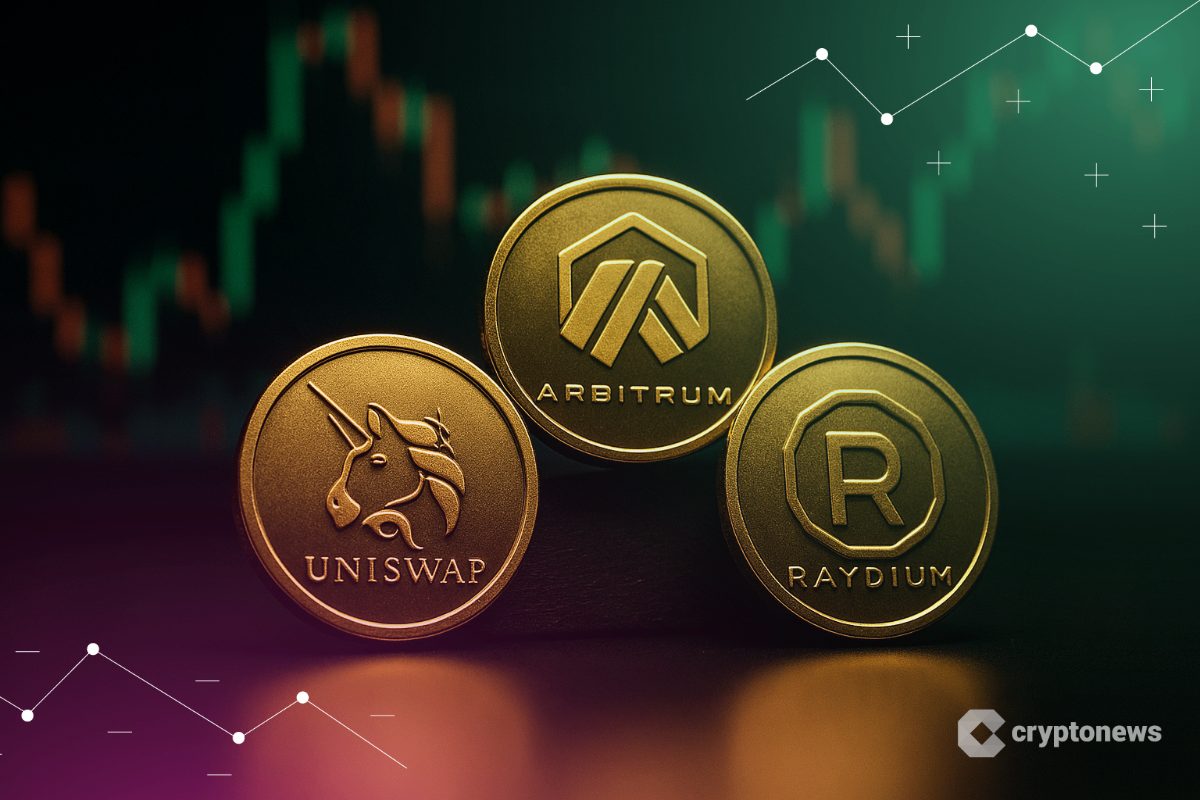
Altcoin Season Index Stalls but UNI, ARB, RAY Catch Bid on On-chain Activity

Altcoin Season Index Stalls but UNI, ARB, RAY Catch Bid on On-chain Activity

With the Altcoin Season Index hovering near 40 and Bitcoin dominance rising again, traders are scanning for selective opportunities outside the majors. While not a full-fledged altseason, the current environment is rewarding tokens that connect narrative rotation with actual usage. Uniswap, Arbitrum, and Raydium stand out as examples of DeFi protocols attracting renewed attention as 2025 enters its second half. Uniswap: DEX Liquidity Engine and Governance Token Uniswap continues to anchor decentralized trading, with UNI priced over $10 and a market cap of around $6.6 billion, according to CoinMarketCap. Daily volume remains close to $500 million, ensuring it holds a central role in the DEX space. Beyond trading liquidity, Uniswap’s development team is preparing for its v4 upgrade, which could streamline liquidity pools and expand features for builders. UNI’s governance function remains latent, but discussions around fee accrual have kept it relevant among analysts. In an altcoin rotation, UNI benefits from its entrenched role in DeFi and its governance potential. Arbitrum: Ethereum’s L2 Powerhouse Arbitrum remains the leading Ethereum Layer-2 by total value secured, with ARB trading around $0.44 and a $2.3 billion market cap, per CoinMarketCap. Its 24-hour trading volume sits above $400 million, reflecting steady demand even amid subdued index readings. Arbitrum Price (Source: CoinMarketCap) The ARB token underpins governance through the Arbitrum DAO, which has recently overseen grants and the rollout of upgrades like Stylus, designed to broaden developer access with Rust and C++. With Layer-2 adoption rising, ARB’s position at the center of Ethereum scaling could strengthen its market role as capital rotates into utility-driven plays. Raydium: Solana DEX with Growing Depth Raydium has consolidated its place as a liquidity hub within the Solana ecosystem. Priced near $3.20 with a market cap close to $850 million and daily volume above $160 million, it supports both retail traders and DeFi participants. Its integration with Solana staking and yield farming has expanded its user base, making it a candidate for increased visibility if Solana’s DeFi rebound continues. Waiting for Altcoin Season UNI, ARB, and RAY illustrate how capital rotation in a muted altcoin season can still favor tokens tied to functional ecosystems. While the index remains below the 75 threshold, these projects show that utility and governance continue to attract flows when market sentiment turns risk-on.

Author: CryptoNews
5 Bonk alternatives that could steal the spotlight in 2025

5 Bonk alternatives that could steal the spotlight in 2025

Forget Bonk. Five explosive memecoins are heating up for 2025, and LILPEPE might just lead the next meme-fueled market takeover. #partnercontent

Author: Crypto.news