Dapp

Dapps are digital applications that run on a P2P network of computers rather than a single server, typically utilizing smart contracts to ensure transparency and uptime. In 2026, Dapps have achieved mass-market appeal through Account Abstraction, allowing for a "Web2-like" user experience with the security of Web3. This tag covers the entire ecosystem of decentralized software—from social media and productivity tools to governance platforms and identity management.

5023 Articles
Created: 2026/02/02 18:52
Updated: 2026/02/02 18:52

7 Top Crypto Wallets 2026 and Beyond

7 Top Crypto Wallets 2026 and Beyond

Explore today's best crypto wallets, comparing features for secure storage, multi-chain access, and smooth daily transactions across Web3

Author: Brave Newcoin
Justin Sun Appears Live on Binance Square Ahead of Binance Blockchain Week 2025; TRON DAO Participates as Gold Tier Sponsor

Justin Sun Appears Live on Binance Square Ahead of Binance Blockchain Week 2025; TRON DAO Participates as Gold Tier Sponsor

The post Justin Sun Appears Live on Binance Square Ahead of Binance Blockchain Week 2025; TRON DAO Participates as Gold Tier Sponsor appeared on BitcoinEthereumNews.com. Geneva, Switzerland, December 8, 2025 — TRON DAO, the community-governed DAO dedicated to accelerating the decentralization of the internet through blockchain technology and decentralized applications (dApps), successfully wrapped up its participation as a Gold Tier Sponsor at Binance Blockchain Week 2025, held on December 3–4 at the Coca-Cola Arena in Dubai. The event gathered global blockchain leaders, builders, and innovators for two days of collaboration and forward-looking discussions on the future of Web3. In the lead-up to Binance Blockchain Week, TRON’s participation extended beyond the main conference. Justin Sun, Founder of TRON, joined a Binance Square live interview for the “Road Ahead to Binance Blockchain Week 2025”, hosted by Jessica Walker, Global Media and Content Lead at Binance. Sun highlighted TRON’s continued dominance in stablecoin infrastructure and spotlighted SunX, TRON’s first decentralized perpetual exchange, which has surpassed $9.5 billion in total trading volume and recorded $640 million in single-day trading volume on November 21. Closing off the session, Sun reflected on his historic Blue Origin spaceflight, emphasizing his vision for democratized access. “That’s the world we’re building toward,” Sun explained, “one where access to opportunity, whether in finance or space, is no longer limited to a few.” At the main conference, TRON DAO hosted a dedicated space featuring a TRON-branded infinity-mirror photo installation and interactive touchpoints that engaged the community. This immersive space  gave participants opportunities to connect directly with TRON DAO community members and learn about the network’s latest ecosystem advancements. On December 4, Sam Elfarra, Community Spokesperson at the TRON DAO, participated in a main stage panel titled “Stable By Design: Inside the Stablecoin Economy” He was joined by Marcelo Sacomori, Founder and CEO of Braza Bank; Daniel Lee, Head of Web3 at Banking Circle; and Tanzeel Akhtar, Journalist at CryptoNews who moderated the session. Throughout the discussion,…

Author: BitcoinEthereumNews
Ethereum Nears Potential Breakout as Fusaka Upgrade Boosts Capacity and Derivatives Signal Bullish Activity

Ethereum Nears Potential Breakout as Fusaka Upgrade Boosts Capacity and Derivatives Signal Bullish Activity

The post Ethereum Nears Potential Breakout as Fusaka Upgrade Boosts Capacity and Derivatives Signal Bullish Activity appeared on BitcoinEthereumNews.com. Ethereum’s price nears a breakout from a falling wedge pattern as the Fusaka upgrade enhances network scalability, reducing validator bandwidth by 85% and lowering Layer 2 fees by 40-60%, while derivatives markets exhibit rising long positions and short liquidations signaling bullish momentum. Ethereum forms a falling wedge on the daily chart, positioning for a potential upward breakout above key resistance levels. Derivatives markets display increased activity with open interest up 6.63% to $37.81 billion and a long/short ratio near neutral but favoring large traders. The Fusaka upgrade boosts Ethereum’s capacity, raising the gas limit from 36 million to 60 million and supporting expanded Layer 2 ecosystems with higher throughput. Discover how Ethereum’s Fusaka upgrade drives scalability and fuels price breakout potential amid rising derivatives activity. Stay ahead in crypto with essential insights on ETH’s next moves. What is the Impact of the Ethereum Fusaka Upgrade on Price Breakout Potential? The Ethereum Fusaka upgrade significantly enhances network performance by implementing PeerDAS, which cuts validator bandwidth needs by approximately 85%, enabling broader participation and improved data availability. This scaling improvement, combined with a falling wedge pattern on the daily chart, positions Ethereum for a potential breakout toward $5,000, as derivatives data shows increasing bullish sentiment. As ETH trades at around $3,092, these factors converge to support upward momentum without speculative overreach. How Does the Falling Wedge Pattern Signal Ethereum’s Breakout? Ethereum’s daily chart reveals a clear falling wedge formation, characterized by price compression within converging trendlines that typically resolve bullishly. This pattern has developed over several weeks, with recent lows showing higher troughs, indicating waning selling pressure. Traders are closely monitoring the upper trendline resistance, where a decisive close above this level could confirm the breakout and target the $5,000 zone, aligning with historical liquidity pools and measured move projections. Market analyst…

Author: BitcoinEthereumNews
Vitalik Buterin Proposes Ethereum Gas Futures Market Amid Scaling Uncertainties

Vitalik Buterin Proposes Ethereum Gas Futures Market Amid Scaling Uncertainties

The post Vitalik Buterin Proposes Ethereum Gas Futures Market Amid Scaling Uncertainties appeared on BitcoinEthereumNews.com. Ethereum co-founder Vitalik Buterin proposes a gas futures market to address uncertainties in the network’s scaling roadmap and stabilize transaction fees. This mechanism would allow users and investors to predict and hedge against gas price volatility, similar to traditional commodity futures, enhancing planning for decentralized applications. Vitalik Buterin’s gas futures proposal aims to mitigate Ethereum’s transaction fee unpredictability amid ongoing scaling upgrades. The idea draws from traditional markets, where futures contracts help manage price risks for resources like oil. Community reactions are mixed, with concerns over potential market manipulation but support for Layer 2 implementations; recent data shows Ethereum’s average fees dropping to compete with rivals like Solana. Ethereum gas futures market proposal by Vitalik Buterin: Predict and hedge transaction fees for better dApp planning. Explore reactions, benefits, and impacts on ETH ecosystem in this analysis. Stay ahead in crypto—read now! What is the Ethereum Gas Futures Market Proposal? Ethereum gas futures market refers to a suggested financial instrument introduced by co-founder Vitalik Buterin to forecast and secure future transaction costs on the Ethereum blockchain. This proposal seeks to create a predictable environment for developers and large-scale users by allowing them to lock in gas prices ahead of time, much like futures contracts in commodity trading. By addressing the volatility stemming from Ethereum’s evolving scaling roadmap, it could reduce operational risks for decentralized applications and investors, fostering greater adoption and efficiency on the network. Source: X This concept emerges against a backdrop of Ethereum’s continuous efforts to optimize its infrastructure. Recent upgrades, such as the Pectra and Fusaka overhauls, have significantly lowered gas fees, making the network more accessible. However, the lack of a fully defined long-term scaling path continues to create uncertainty, prompting innovative solutions like this futures market to stabilize expectations. How Would an Ethereum Gas Futures Market…

Author: BitcoinEthereumNews
Canada Struggles to Track Crypto Taxes as $100M Recovered in Audits

Canada Struggles to Track Crypto Taxes as $100M Recovered in Audits

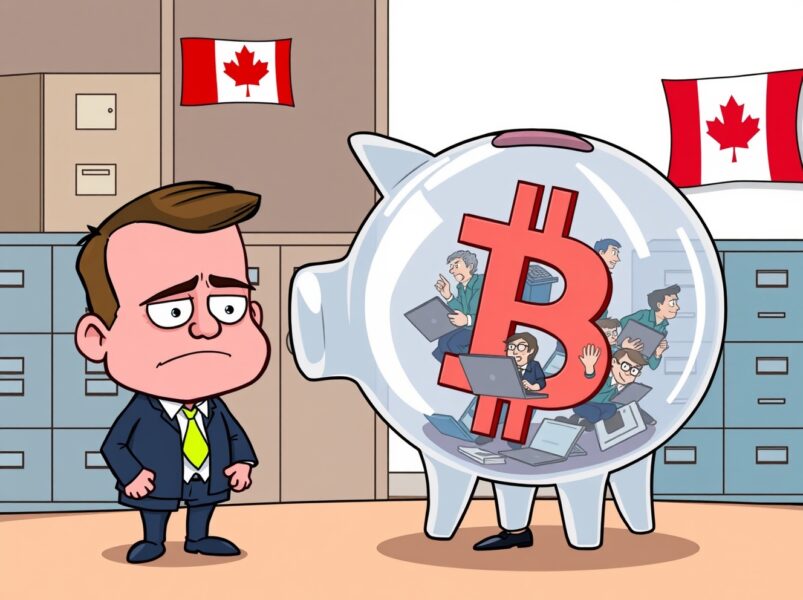
The post Canada Struggles to Track Crypto Taxes as $100M Recovered in Audits appeared on BitcoinEthereumNews.com. The Canadian Revenue Agency (CRA) revealed that 40% of taxpayers who use cryptoasset platforms are evading crypto taxes or are at high risk of non-compliance, the Canadian Press reported December 7. The news outlet said it received an emailed statement from CRA saying it has 35 auditors in its cryptoasset program, working on over 230 files, which have resulted in “significant taxes earned by audit,” including $100 million in the past three years. The CRA acknowledged legal limitations in Canada, stating it believes “there is no way to reliably identify taxpayers operating in the crypto space and assess compliance” with income tax reporting obligations. These challenges drove the CRA’s efforts to compel disclosures from platforms like Dapper Labs. The government had expressed particular concern over taxpayers using the Vancouver-based firm to evade taxes, but due to a lack of clear CRA regulations, the company was not fully held accountable, The Canadian Press said. According to Canadian Press, Dapper Labs did not deny the investigation, although it did not fully comply either; authorities sought information on Dapper’s top 18,000 users, but negotiations between company officials, lawyers, and officials saw the number reduced to only 2,500. CoinDesk contacted Dapper Labs and the CRA for comment but no response was immediately received. In light of the limitations, the country’s Department of Finance announced in late October the introduction of new legislation by Spring 2026. “Fraud and financial crime are evolving rapidly, and so must our response,” François-Philippe Champagne, Minister of Finance and National Revenue, said on October 20, when announcing the new law. “Whether it’s launching a new Federal Anti-Fraud Strategy, establishing a dedicated Financial Crimes Agency to combat financial crimes, or addressing economic abuse, our government is committed to safeguarding the financial security of every Canadian.” Meanwhile, Canada’s financial intelligence unit, FINTRAC,…

Author: BitcoinEthereumNews
Crypto Tax Evasion: CRA Alarms with 40% High-Risk Finding and $73M Recovered

Crypto Tax Evasion: CRA Alarms with 40% High-Risk Finding and $73M Recovered

BitcoinWorld Crypto Tax Evasion: CRA Alarms with 40% High-Risk Finding and $73M Recovered Are you correctly reporting your cryptocurrency transactions? A startling revelation from the Canada Revenue Agency (CRA) suggests many are not. The agency has identified that approximately 40% of cryptocurrency platform users are at a high risk for tax evasion or underreporting. This finding sends a clear message: the era of ambiguous crypto taxation is ending. […] This post Crypto Tax Evasion: CRA Alarms with 40% High-Risk Finding and $73M Recovered first appeared on BitcoinWorld.

Author: bitcoinworld
MegaETH Mainnet Beta Frontier Launch: A Revolutionary Step for Ethereum Developers

MegaETH Mainnet Beta Frontier Launch: A Revolutionary Step for Ethereum Developers

BitcoinWorld MegaETH Mainnet Beta Frontier Launch: A Revolutionary Step for Ethereum Developers The Ethereum ecosystem receives a significant boost as MegaETH prepares to launch its Frontier mainnet beta to developers next week. This crucial milestone represents more than just another technical update—it’s a gateway for builders to finally deploy scalable applications on a production-ready Layer 2 solution. For developers who have been navigating Ethereum’s congestion and high […] This post MegaETH Mainnet Beta Frontier Launch: A Revolutionary Step for Ethereum Developers first appeared on BitcoinWorld.

Author: bitcoinworld
BNB Price Prediction: Expert Eye $1,100 BNB Price This Week

BNB Price Prediction: Expert Eye $1,100 BNB Price This Week

The post BNB Price Prediction: Expert Eye $1,100 BNB Price This Week appeared on BitcoinEthereumNews.com. Key Insights: BNB price prediction turns bullish after a clean 2x breakout from a four-year consolidation zone. Multiple analysts now cluster around a near-term $1,100 target this week, backed by rising BNB Chain volumes. Longer-term charts show the token still has runway inside an ascending channel toward $1,600–$1,970 by early 2026 if momentum holds. BNB price prediction models gained fresh momentum on December 8, 2025, as the token traded at $895.92, up 1% in the prior 24 hours with a market cap of $123 billion, according to CoinMarketCap data. This uptick follows a 2x rally from its recent base, drawing analyst calls for a push toward $1,100 by week’s end amid rising trading volumes that hit $1.98 billion yesterday. Such a move could test the psychological $1,000 barrier, potentially boosting the dominance of Binance coin in the exchange token space, where it commands over 55% of spot volume on its home platform, per Kaiko Research’s November 2025 report. BNB Price Prediction as Four-Year Pattern Breaks The latest BNB price chart tells a story of quiet accumulation paying off. Analyst @AkaBull_ noted on December 7 that the token “pulled a clean 2x after breaking out of its 4-year consolidation.” It has flipped the prior resistance into support around $870, while volume spiked to 8.6 million units during the push past $910. The momentum built steadily. From a low of $801.70 last month, BNB price climbed 13% in the past week alone, outpacing Ethereum’s 8% gain. This isn’t random; Binance’s latest reserve audit on December 8 revealed a BNB reserve ratio of 112.32%, exceeding 100% coverage and signaling robust backing, as detailed in the exchange’s transparency report. For traders eyeing BNB price prediction, this liquidity buffer reduces downside risk, especially with daily fees on BNB Chain topping $510,000 yesterday, up 15% from…

Author: BitcoinEthereumNews
21Shares and Crypto.com Join Forces on New CRO Trust and ETF

21Shares and Crypto.com Join Forces on New CRO Trust and ETF

The post 21Shares and Crypto.com Join Forces on New CRO Trust and ETF appeared on BitcoinEthereumNews.com. 21Shares and Crypto.com partner to establish a CRO private trust and ETF. This provides regulated, transparent access to the Cronos blockchain. 21Shares and Crypto.com have announced a strategic partnership. This initiative aims to launch new investment products tracking the Cronos (CRO) token. The partnership is aimed at setting up a CRO private trust and Exchange Traded Fund (ETF). Partnership Broadens Regulated Access to Cronos Ecosystem This collaboration is a great step. It expands access to regulated investors, such as institutional investors, to Cronos. Cronos is a top-ranked Ethereum-compatible Layer 1 blockchain. Furthermore, it is very much supported by Crypto.com. Related Reading: Sui ETF by 21Shares Secures Listing Approval on Nasdaq | Live Bitcoin News Cronos is an open-source decentralized blockchain protocol. It is built upon Cosmos SDK. It has compatibility with both the Ethereum Virtual Machine (EVM) and the Cosmos ecosystem. Its dual compatibility is a great technical advantage. It helps developers to make use of existing tools. They can also access a booming community of dApps and protocols. In addition, Cronos cares about low transaction costs. It also has a high degree of scalability. This makes it an attractive platform for both developers and users. Federico Brokate, Global Head of Business Development at 21Shares, commented on the venture. He said that they are proud to be in partnership with Crypto.com. This opens up the Cronos ecosystem to many investors. The products are innovative and transparent. Both firms, Brokate added, pave the way for scalable solutions. They both are focusing on highly interoperable blockchain technology. Consequently, this collaboration is key to strengthening commitment to regulated exposure. It aims for the most relevant crypto assets for institutions. Leaders Stress Commitment to Mainstreaming Crypto Eric Anziani, President & COO of Crypto.com, stressed the vision. He said offering more opportunities for traders to…

Author: BitcoinEthereumNews
Ethereum Fees Decline Amid Layer-2 Shift, TVL Remains Stable

Ethereum Fees Decline Amid Layer-2 Shift, TVL Remains Stable

The post Ethereum Fees Decline Amid Layer-2 Shift, TVL Remains Stable appeared on BitcoinEthereumNews.com. Ethereum transaction fees have reached their lowest levels in 2025, dropping to around 289 ETH daily, despite stable total value locked exceeding $70.5 billion. This decline stems from enhanced Layer-2 scaling solutions that shift activity off the mainnet, maintaining network health without reduced usage. Ethereum’s 90-day moving average of transaction fees has steadily fallen since early 2025, from over 1,800 ETH to 289 ETH. Layer-2 migrations and upgrades like Fusaka have reduced mainnet pressure by enabling efficient rollup settlements. Total value locked in Ethereum’s ecosystem remains resilient at over $70.5 billion, signaling sustained DeFi and staking demand amid lower fees, per DeFiLlama data. Ethereum transaction fees hit 2025 lows at 289 ETH, yet TVL holds steady above $70 billion. Discover how scaling upgrades drive this shift and what it means for ETH’s future. Stay informed on blockchain evolution today. What Are the Reasons Behind the Decline in Ethereum Transaction Fees? Ethereum transaction fees have plummeted to their lowest point in 2025, with the 90-day moving average dropping from over 1,800 ETH in early months to approximately 289 ETH as of recent reports. This reduction is primarily driven by structural enhancements in the network, including the Fusaka upgrade, which boosts data capacity and throughput for Layer-2 solutions. Despite this, core network usage remains robust, as evidenced by stable capital deployment across the ecosystem. Glassnode data highlights a persistent downward trend in fee revenue since January 2025, following a sharp decline between January and May. The upgrade facilitates smoother operations for rollups and other scaling layers, alleviating congestion on the base layer. This shift ensures that everyday transactions occur more cost-effectively off the mainnet, while the Ethereum blockchain maintains its role as a secure settlement foundation. How Have Ethereum’s Scaling Upgrades Impacted Mainnet Fees? Ethereum’s recent scaling initiatives, such as the Fusaka…

Author: BitcoinEthereumNews