CEX

CEXs are platforms managed by centralized organizations that facilitate the trading of cryptocurrencies, offering high liquidity and user-friendly fiat on-ramps. Leaders like Binance, OKX, and Coinbase serve as the primary gateways for institutional and retail entry. In 2026, the industry focus is on Proof of Reserves (PoR), enhanced regulatory compliance, and hybrid models that offer self-custody options. This tag provides updates on exchange security, listings, and global market trends.

4179 Articles
Created: 2026/02/02 18:52
Updated: 2026/02/02 18:52

Crypto launchpads have a broken implementation strategy | Opinion

Crypto launchpads have a broken implementation strategy | Opinion

If the crypto industry has to progress, it must bring retail capital into its fold, where launchpads will play a key role in helping crypto come of age.

Author: Crypto.news
Crypto Bloodbath Survivors Spot Light on LINK, XYZ, CRO as Uptober Catalysts

Crypto Bloodbath Survivors Spot Light on LINK, XYZ, CRO as Uptober Catalysts

LINK, XYZ, and CRO emerge as standout survivors of the crypto slump, with traders eyeing them as potential Uptober catalysts for the next market rally.

Author: Blockchainreporter
The Best Crypto To Buy Now Is Remittix, as XRP and WLFI Follow In 2nd and 3rd

The Best Crypto To Buy Now Is Remittix, as XRP and WLFI Follow In 2nd and 3rd

When investors ask what the best crypto to buy is, XRP often comes up for its regulatory gains, and WLFI draws attention for its controversial backing and burn moves. Yet Remittix sits right at the top of that list, offering a sharper case built on real utility, listing momentum, and community trust. XRP: Strengths, Risks, […] The post The Best Crypto To Buy Now Is Remittix, as XRP and WLFI Follow In 2nd and 3rd appeared first on Live Bitcoin News.

Author: LiveBitcoinNews
Chainlink Price Rallied Too Fast, Claims Experts, Whilst Early Investors Of Remittix Could See 100x Gains

Chainlink Price Rallied Too Fast, Claims Experts, Whilst Early Investors Of Remittix Could See 100x Gains

The post Chainlink Price Rallied Too Fast, Claims Experts, Whilst Early Investors Of Remittix Could See 100x Gains appeared on BitcoinEthereumNews.com. Crypto News 28 September 2025 | 12:50 Chainlink’s sharp rally has prompted experts to caution that LINK may have rallied too fast, raising fears of a pullback or exhaustion.  While that debate unfolds, early investors of Remittix could see 100x gains if its momentum holds, especially since it is distinguishing itself with listing execution, utility goals and community buzz. As Chainlink faces scrutiny for pace, Remittix is positioning itself as the high upside altcoin story many are watching. Chainlink Rally Under the Microscope Analysts now say that LINK’s recent ascent may have moved too quickly, leaving the price vulnerable to correction and consolidation. Some chart technicians highlight a triangle consolidation forming over the years, suggesting the price may revisit $16 before any breakout attempt toward $100. Meanwhile, LINK has seen attention from whales accumulating nearly 2 million LINK tokens in recent days, which analysts interpret as a signal of conviction. If zone support fails, LINK could retract before making any sustainable push higher. Why 100x Is on the Radar For Remittix While Chainlink fights to justify its rapid gains, Remittix stands as a contrast: an altcoin building toward listing momentum, utility, and community traction. LINK’s narrative is built on oracle dominance and partnerships; Remittix’s narrative is rooted in payments and infrastructure. That divergence is central to why some say Remittix could outperform in this cycle. Remittix has attained CertiK verification, with the team now ranked number one on CertiK’s Skynet for pre-launch tokens, a rare feat in early-stage crypto. Its wallet is in beta, undergoing real user testing for crypto to bank and multi-chain operations. The token supports a 15 % USDT referral program claimable every 24 hours and Remittix runs a $250,000 giveaway to drive traction. The project has passed two CEX listing thresholds (over $20 million and $22…

Author: BitcoinEthereumNews
The TechBeat: Key aspects of token launches in the current market environment (9/28/2025)

The TechBeat: Key aspects of token launches in the current market environment (9/28/2025)

How are you, hacker? 🪐Want to know what's trending right now?: The Techbeat by HackerNoon has got you covered with fresh content from our trending stories of the day! Set email preference here. ## How Solar Sails, Aerogel Tiles and Engineered Microbes Could Transform the Red Planet By @ezikielemmanuel [ 6 Min read ] Discover how solar sails, aerogel tiles, and engineered microbes could revolutionize Mars exploration and pave the way for future colonization. Read More. How We Built a Professional iOS Onboarding at inDrive By @indrivetech [ 4 Min read ] Discover how inDrive built a structured two-week iOS onboarding program that helps new developers master architectures, navigation, and workflows faster. Read More. How To Add Integrations to Lovable Apps: A Step-By-Step Guide with Membrane By @membrane [ 5 Min read ] Use Membrane (Integration App) to build integrations to any app with AI. Read More. Sia Redefines Cloud Security with Supreme Privacy and Impenetrable Protection By @siafoundation [ 5 Min read ] Sia delivers decentralized cloud security with Supreme Privacy and Impenetrable Protection, eliminating single points of failure and insider threats. Read More. ChatGPT Became the Face of AI—But the Real Battle Is Building Ecosystems, Not Single Models By @hacker53037367 [ 12 Min read ] ChatGPT made AI mainstream, but real transformation comes from ecosystems that embed AI across business, not from relying on a single model. Read More. 12 Best Web Scraping Services in 2025 By @oxylabs [ 11 Min read ] Explore the 12 best web scraping services of 2025. Compare features, pricing, and pros & cons to choose the right tool for your data extraction needs. Read More. The Rise of On‑Orbit Servicing and Satellite Refueling as a New Space Industry By @innocentchuks [ 8 Min read ] Discover how on-orbit servicing and satellite refueling are transforming space operations, extending satellite lifespans, and driving a new space economy. Read More. Why You Shouldn’t Judge by PnL Alone By @ruslan4ezzz [ 9 Min read ] PnL can lie. This hands-on guide shows traders how hypothesis testing separate luck from edge, with a Python example and tips on how not to fool yourself. Read More. Knowledge Graphs Gain Traction as AI Pushes Beyond Traditional Data Models By @linked_do [ 21 Min read ] Is graph really the new star schema? What do graphs like to non-insiders, and what attracts them to the community, methodologies, applications, and innovation? Read More. True Announces $TRUE Token Sale to Build the First AI-Native Perpetuals DEX on Solana By @pressreleases [ 4 Min read ] True, a Solana-based AI decentralized trading platform, has announced the upcoming launch of its $TRUE token sale. Read More. India’s New Bill Puts Esports on Equal Footing with Cricket & Football By @thetechpanda [ 6 Min read ] India’s 2025 Online Gaming Bill recognizes esports as sport, unlocking growth, investment, and legitimacy for players, brands, and fans. Read More. ScyllaDB Powers Low-Latency, Scalable Online Feature Stores for Real-Time ML By @scylladb [ 5 Min read ] Discover how ScyllaDB enables fast, scalable online feature stores, integrating with Feast to deliver low-latency, high-throughput ML predictions. Read More. The Day I Learned My NAS Was Traceable Through TLS Logs By @nfrankel [ 4 Min read ] I recently learned about a new way to leak your privacy, and it's a scary one. Read More. How Science Fiction’s Clarke Belt Became our Geostationary Satellite Reality By @ivyhackwell [ 6 Min read ] Discover how the fictional Clarke Belt in science fiction became the foundation for today's geostationary satellites, revolutionizing global communication. Read More. 12 Best Proxy Service Providers in 2025 By @oxylabs [ 12 Min read ] Discover the top 12 proxy providers of 2025, tested and ranked. Compare pricing, features, and performance to find the perfect proxy service for your needs. Read More. Key aspects of token launches in the current market environment By @andrew-nalichaev [ 9 Min read ] Token launches are broken. CEXs extract, DEXs fragment. CrossCurve offers unified liquidity for memecoins & altcoins in 2025. Read More. Can ChatGPT Outperform the Market? Week 5 By @nathanbsmith729 [ 3 Min read ] Heavy Week… Read More. Spacecoin: Beaming Web3 Access From Space for $2 a Month By @hacker82362998 [ 4 Min read ] Spacecoin beams low-cost, censorship-proof internet from satellites, unlocking Web3 for billions with crypto-first access. Read More. Want AI to Write Code That Doesn’t Break Everything? Follow These 3 Patterns By @ainativedev [ 3 Min read ] Practical patterns from 30 real AI projects - what works, what doesn't, and how to avoid common pitfalls. Read More. Best Test Automation Tools 2025: Complete Comparison Guide By @kashvipandey [ 10 Min read ] Compare BugBug, Selenium, Playwright, Cypress, and Katalon. See setup time, learning curve, costs, and find the best test automation tool for 2025. Read More. 🧑‍💻 What happened in your world this week? It's been said that writing can help consolidate technical knowledge, establish credibility, and contribute to emerging community standards. Feeling stuck? We got you covered ⬇️⬇️⬇️ ANSWER THESE GREATEST INTERVIEW QUESTIONS OF ALL TIME We hope you enjoy this worth of free reading material. Feel free to forward this email to a nerdy friend who'll love you for it. See you on Planet Internet! With love, The HackerNoon Team ✌️

Author: Hackernoon
Tokenization of equity in non-listed companies: Is it possible, how to do it, and what will it look like?

Tokenization of equity in non-listed companies: Is it possible, how to do it, and what will it look like?

Author: Mankiw Over the past few months, the topic of US stock tokenization has surged in popularity, with a flurry of "stock token" platforms targeting international users launching online. Major platforms like Robinhood are making moves, while others like Jarsy and Republic are discussing moving the equity of high-quality, privately held companies like SpaceX, xAI, and Stripe onto blockchains. This has many entrepreneurs and investors eager to capitalize on this trend. Can the equity of non-listed companies be tokenized? How can we do this in compliance? How much do these differ across jurisdictions? What are the paths to implementation? What are the differences in rights and risks of each path? As Party A/Initiator/Investor/Platform, how should I implement it? This article will clarify these questions: whether it can be done, how to do it, and how to achieve it. Can equity in non-listed companies be tokenized? The answer is yes. Securities laws in various jurisdictions do not prohibit the use of more efficient electronic certificates like "tokens" to carry equity or other economic rights; regulators are always concerned with what rights you are selling, how they are transferred, and where they are traded, not whether you use blockchain. Why is it possible? (Core Logic) Carrier neutrality: Equity can be in the form of a paper share certificate, electronic registration, or an on-chain certificate; as long as it meets the information disclosure, investor suitability, and continuous compliance requirements of existing securities laws, the technical form will not be naturally denied. Verifiable efficiency: The chain arranges registration, transfer, and clearing and settlement on an auditable track, reducing human links and counterparty risks, and facilitating cross-border collaboration and automatic performance. Real market demand: Pre-IPO assets are high-quality but low-liquidity. Tokenization can achieve better allocation, pricing, and exit design within the scope of qualified investors. How far can it go? (Realistic boundaries) Start with qualified investors: Most jurisdictions currently support the participation of professional/qualified investors (such as "PI/AI/QIB"). Retail opening will remain limited in the short term due to information asymmetry and suitability requirements. Secondary liquidity has "circles": tokenization does not change the nature of "restricted securities", whitelists (compliance registers) and lock-up periods still exist, and real liquidity mostly occurs in regulated venues. The cooperation of the issuer is key: without the issuer's consent or proper handling of the ROFR (right of first refusal), even if the sale is possible, it will be difficult to fully realize the shareholder rights, and at most they will only be economic rights. When should you not do it? (Red line) Unclear ownership: There is a lack of documentation for the underlying shares of the "1:1 correspondence", no custody/transfer records, or the inability to prove the true source. The commitment is unenforceable: it claims a "1:1 share exchange" but there are no terms for cooperation between the transfer agent and the issuer. Cross-border marketing crosses the line: using "global sellability" as a slogan and ignoring local securities laws and the "active solicitation" red line. Therefore, non-listed company equity can be tokenized, with legal requirements regarding "rights and rules" and technical requirements regarding "verifiability and control." By clarifying ownership, transferability, and compliant venues, tokenization can be both feasible and sustainable. Three types of tokenization 1. Real stock on-chain (moving the “stock entity” directly to the chain) Definition: This type of tokenization is where the token equals the stock itself, and token transfers are synchronized with shareholder register updates. When to choose it: The issuer is willing to cooperate with governance reform and pursue the long-term route of "the most complete rights and the best secondary access". Landing grip (only focus on three things): Articles of Association and Register: The company’s articles of association allow for on-chain registration; they are connected with the transfer agent (a third party responsible for registration and transfer). Venue and delivery: Identify regulated secondary venues (such as ATS (US Alternative Trading System, a secondary market facility regulated by the SEC), MTF (EU Multilateral Trading Facility, a matching venue regulated by MiFID)) and clearing and settlement links. 12(g) Management (Section 12(g) of the U.S. Securities Exchange Act sets thresholds for the number of “record holders” and asset size that trigger public company registration): Control the statistical scope and quantity, and do not turn private equity into a “quasi-public company.” Signals of not choosing it: The issuer does not change its articles of association, does not cooperate with the transfer, or cannot afford the disclosure/audit and holder management costs. 2. Economic Rights/Contractual Exposure (Like Stocks, But Not Stocks) Definition: This type of tokenization means that the token carries economic results such as income/repurchase/event settlement, and legally you are usually not a shareholder. When to choose it: It needs to be launched quickly and tested quickly. The issuer will not open the shareholder list for the time being, but there is strong market demand. Landing grip (only focus on three things): The redemption terms must be enforceable: clearly define the redemption/share redemption triggering events, timetable, responsible parties, and failure protection. Dual-track compliance: The US uses Reg D 506(c) (Section 506(c) of Regulation D of the US Securities Act of 1933, which allows public solicitation but only issuance to qualified investors) + overseas Reg S (Reg S, an overseas safe harbor rule, requires offshore trading and prohibits solicitation targeting the US market); channel segmentation to avoid "integration". Transferability on-chain: Contractualize/proceduralize whitelists, lock-up periods, and restricted resale statements (Legends), avoiding them being confined to the PDF of issuance documents. Signals not to choose it: Marketing implies that "you are a shareholder", or promises "1:1 share exchange" but there are no transfer agent/issuer cooperation terms. Reminder: Tokens with the same name on different platforms are not interchangeable. Differences in price anchors (latest financing/offer/NAV) and redemption paths will lead to shadow market price differences. 3. Tokenization of Fund/SPV Shares (Indirectly Holding Multiple Assets) Definition: This type of tokenization refers to tokenizing fund/LP/SPV shares, with the underlying holdings of multiple Pre-IPOs. When to choose it: For institutions/family offices/high net worth individuals, it pursues institutionalized governance, auditable net worth and more stable secondary compliance docking. Landing grip (only focus on three things): Contract and Disclosure: The fund contract explains the redemption window and side pocket in detail; the valuation scope and revaluation in major events are clearly stated. Fee penetration: Fund fees, platform fees, and channel fees are disclosed layer by layer to ensure investors don’t get confused. Secondary acceptance: Priority access to regulated venues (such as ATS/MTF/RMO), with circulation mainly within the circle. Signals of not choosing it: wanting to only bet on a single hotspot, being very sensitive to lock-in and liquidity windows, or having a low tolerance for "multi-layer fees". How to choose among the above three methods? If you want the strongest rights: Choose 1 and put real stocks on the blockchain (provided that the issuer truly cooperates). If you want speed and flexibility: Choose 2: Economic rights (but engrave "redemption chain" and "restricted transfer" into the code). If you want system and stability: choose 3 fund/SPV shares (use disclosure and net value to gain credibility, and go to a regulated venue for the secondary market). How to comply with regulations: The "bottom line and channel" of the four major legal jurisdictions (1) United States Positioning: Regulators look at "what securities you sell, to whom you sell them, and how you transfer them", not whether you are a chain. The distribution channels you can use (select only one or a combination) Reg D 506(b) (Private offering exemption under the Securities Act of 1933): No public solicitation; can admit a small number of non-qualified but financially sophisticated investors; unlimited amount; Form D (federal filing required within 15 days of offering). Reg D 506(c) (permits public solicitation but only offers to accredited investors): Substantial verification of “accreditation” is required (third-party verification of letter/tax return, etc.). Reg S (Offshore Safe Harbor): Offshore transactions and no directed selling efforts to the US market. Often combined with Reg D to cover both US and offshore markets. How to get secondary liquidity Rule 144/144A (Rule on Restricted Securities Resale; 144A applies to QIBs, Qualified Institutional Buyers): This determines who can transfer securities to whom and when. ATS (Alternative Trading System, a US FINRA/SEC-regulated alternative trading system): If you want a "true secondary," connect to an ATS; otherwise, redemptions are likely to be on-exchange/internal matching. Write restrictions into the code: whitelist (only qualified/KYC addresses can hold/transfer), lock-up period and Legend (restricted resale statement) must be on-chain, not just written in PPM. Don't step into the pit Integration risk: Any public marketing during the 506(b) period, or 506(c)/Reg S using the same domain name/same sales funnel, may be considered the same offering and lose the exemption. 12(g) (Exchange Act, Section 12(g), triggering the “record holder” threshold for public company registration): The statistical caliber of nominal holders/multiple addresses on the chain must be consistent to avoid “multiple wallets = multiple people”. In one sentence: Reg D 506(c) + Reg S dual track is the most commonly used; the attributes of restricted securities remain unchanged, first nail down the whitelist + ATS, and then talk about "liquidity". (2) Hong Kong Positioning: Equity tokens = securities; not the "non-securities VA" that can be accepted by general VATPs (Virtual Asset Trading Platforms). The distribution/sales channels you can take Private placement is only offered to PIs (Professional Investors); solicitation/advertising to the general public is likely to trigger licensing/approval obligations. If you want to match transactions, it usually involves Category 1 (Dealing in Securities) and/or Category 7 (Providing Automated Trading Services), of which the ATS (Automated Trading Services, a Hong Kong term) must be approved by the SFC; don't try to cram security tokens into VATP. How to get secondary liquidity Secondary liquidity should be mainly based on regulated securities venues (matching/settlement provided by licensed corporations); currently it is mainly for PIs, with limited retail space. Don't step into the pit Active marketing vs. passive solicitation: Chinese pages, Hong Kong dollar pricing, Hong Kong media placements/customer service hotlines may all be considered active solicitation of the Hong Kong public. In one sentence: Security tokens in Hong Kong = securities license route + PI only; VATP route is not applicable. (3) Singapore Positioning: Security tokens are capital market products under the SFA (Securities and Futures Act); they are two different systems from the DPT (Digital Payment Token) under the PSA (Payment Services Act). Distribution/Locations You Can Visit AI/II private placement offers (Accredited/Institutional Investor) are exempt from the prospectus requirement but are subject to advertising and transfer restrictions. RMO/AE (Recognized Market Operator / Approved Exchange): If you want to match/trade, you must connect with an RMO/AE or operate under its framework. VCC (Variable Capital Company): A friendly shell for funds/portfolios, suitable for "③ Fund/SPV shares". How to get secondary liquidity It mainly relies on RMO on-site matching, with AI/II as the circle; it can connect with overseas regulated venues for cross-site delivery. Don't step into the pit Entity: Having a team/operation in Singapore, even if the server is overseas, may be considered to be providing regulated activities in Singapore. In one sentence: If you want to implement it safely, SFA private placement + RMO is the main line; PSA/DPT does not solve the problem of security tokens. (4) European Union Positioning: Security tokens are still subject to MiFID II (Markets in Financial Instruments Directive II) and CSDR (Central Securities Depositories Regulation); MiCA (Markets in Crypto-Assets) does not cover security tokens. Distribution/Locations You Can Visit Conventional prospectus regulation or exempt placing; DLT Pilot (Regulation 2022/858, Distributed Ledger Market Infrastructure Pilot): License DLT MTF/SS/TSS (DLT Multilateral Trading Facility/Settlement System/Trading and Settlement Integrated), and pilot transaction + settlement on-chain under scale and category restrictions. How to get secondary liquidity Connect to MTF or DLT MTF to achieve compliant matching and settlement; otherwise, only on-site redemption/agreement transfer is possible. Don't step into the pit Use MiCA as a passport for security tokens; or replace prospectus/key information document standards with "white paper-style" disclosures. In one sentence: To put "real stocks/real bonds" on the chain, DLT Pilot + MTF is the right way; otherwise, follow the traditional MiFID path, and technology is just a medium. summary: How to choose the issuance: US Reg D 506(c) (public solicitation) + Reg S (offshore safe harbor) is the most common combination; Hong Kong/Singapore/European markets follow their own private placement/exemption standards. How to solve the secondary problem: the attributes of restricted securities remain unchanged; the whitelist/lock-up period/Legend must be contractualized and traded in regulated venues (US ATS, EU MTF/DLT MTF, Singapore RMO). How to do marketing: Divide channels by jurisdiction and conduct anti-integration design to avoid "selling to the world through one funnel". How to avoid risks: First, nail down ownership to the issuer’s consent; then write transferability into the code; and finally discuss valuation and liquidity. What we offer Our expertise lies in transforming a compelling story into a product that can be legally issued, circulated compliantly, and redeemed as promised. I'll first thoroughly investigate the underlying risks (whether the equity source is clear, whether the target company agrees, and whether there are any transfer restrictions). Then, I'll provide a one-page decision: whether the project is feasible, which path will save time and money, and what resources and timelines are required. I'll then incorporate the issuance, transfer, disclosure, and risk control rules into the contract and system (not just in a PowerPoint presentation) and connect the product to a regulated secondary market to ensure tradability and settlement. What you ultimately receive isn't a mountain of legalese, but a set of actionable deliverables: a clear roadmap with key milestones, publicly available legal opinions, complete offering documents, coded compliance rules, a secondary liquidity plan and contingency plan, and a set of operational specifications acceptable to banks and regulators. In short, we help you turn uncertainty into certainty, making risks visible, processes controllable, and results verifiable. Conclusion Tokenization isn't just about turning equity into currency. The real challenge lies in codifying three "old-world" concepts: ownership, transferability, and transaction infrastructure, and ensuring their stable operation across multiple jurisdictions. We recommend a consistent approach: first clarify the law, then get the code right: nail down issuer consent/ROFR, 12(g) thresholds, distribution periods and whitelists, and clearing and settlement pathways before addressing valuation, liquidity, and market education. Only with this in place can private company equity tokenization be considered a true product, not just a narrative.

Author: PANews
XRP ETF Updates: BlackRock Weighs In On XRP ETF Push

XRP ETF Updates: BlackRock Weighs In On XRP ETF Push

The post XRP ETF Updates: BlackRock Weighs In On XRP ETF Push appeared on BitcoinEthereumNews.com. XRP ETF is the hot headline. Asset managers  are circling regulatory shifts to bring exchange-traded funds tied to XRP into portfolios. The push for an XRP ETF is gaining traction with BlackRock now openly weighing its strategy. Amid all the noise, Remittix finds its moment: as crypto capital chases legitimacy via ETFs, it positions itself with utility and infrastructure,  not just speculative narrative. XRP ETF Momentum & BlackRock Signals BlackRock is reportedly discussing a spot XRP ETF, triggering chatter in crypto circles and pushing XRP back into institutional focus. Still, Robbie Mitchnick, BlackRock’s head of digital assets, emphasizes that any filing will rest on clear client demand, liquidity depth, and a strong investment thesis. Meanwhile, XRP’s price has held firm near $2.70 support, even as ETF speculation mounts and technical indicators suggest pressure may be building. Remittix Is Rising in Parallel to ETF Hype While XRP rides the ETF news cycle, Remittix offers another narrative, which is rooted in payments utility and listing momentum. Where XRP depends on regulatory affirmation, Remittix is actively building and announcing listing expansion. Remittix’s upcoming third CEX listing announcement competes for investor attention with XRP’s ETF jockeying. Remittix is now CertiK verified and ranks number one on CertiK’s Skynet for pre-launch tokens, sealing trust at the security level. Its wallet is live in beta and being stress tested by community users. The project includes a 15% USDT referral program with claims every 24 hours, and runs a $250,000 giveaway to accelerate adoption. It has already cleared two CEX listing capital thresholds and is now ready for its third major exchange entry. Remittix has sold over 672 million tokens, the token price is $0.113, and the project has raised over $26.7 million. Here is why investors are moving into Remittix: Audited by CertiK, built with trust…

Author: BitcoinEthereumNews
UXLINK: Both CEX and on-chain UXLINK token migration will start next week

UXLINK: Both CEX and on-chain UXLINK token migration will start next week

PANews reported on September 28th that UXLINK released the latest progress on token migration and security upgrades: 1. Security solutions have been upgraded, and the detailed plan has been approved by a third-party security consultant. 2. CEX migration will begin next week. Due to varying regulatory requirements and operational procedures across exchanges, a compensation plan will be implemented in phases through the exchanges. The new token generation process has been completed, ensuring these tokens are only used for exchange with exchanges and on-chain users. For exchanges where migration has not yet completed, these tokens will remain locked until they are transferred to exchanges and market makers (MMs). 3. On-chain user migration will also begin next week, with UXLINK covering the associated gas fees. 4. UXLINK stakers will receive all tokens and the annualized yield (APY) calculated up to October 31, 2025. 5. The token circulation and vesting schedule remains consistent with the UXLINK whitepaper. 6. The new UXLINK contract has a code-locked maximum token supply function.

Author: PANews
Best Crypto Presales to Buy Now Before the Next Crypto Bull Run

Best Crypto Presales to Buy Now Before the Next Crypto Bull Run

Crypto analyst Daan Crypto Trades noted on X that the combined altcoin market cap has technically reached a new all-time high, surpassing its 2021 peak for the first time. He highlighted that Bitcoin is already trading 58% above its 2021 ATH, showing how altcoins continue to compete against each other in the current cycle. A […]

Author: The Cryptonomist
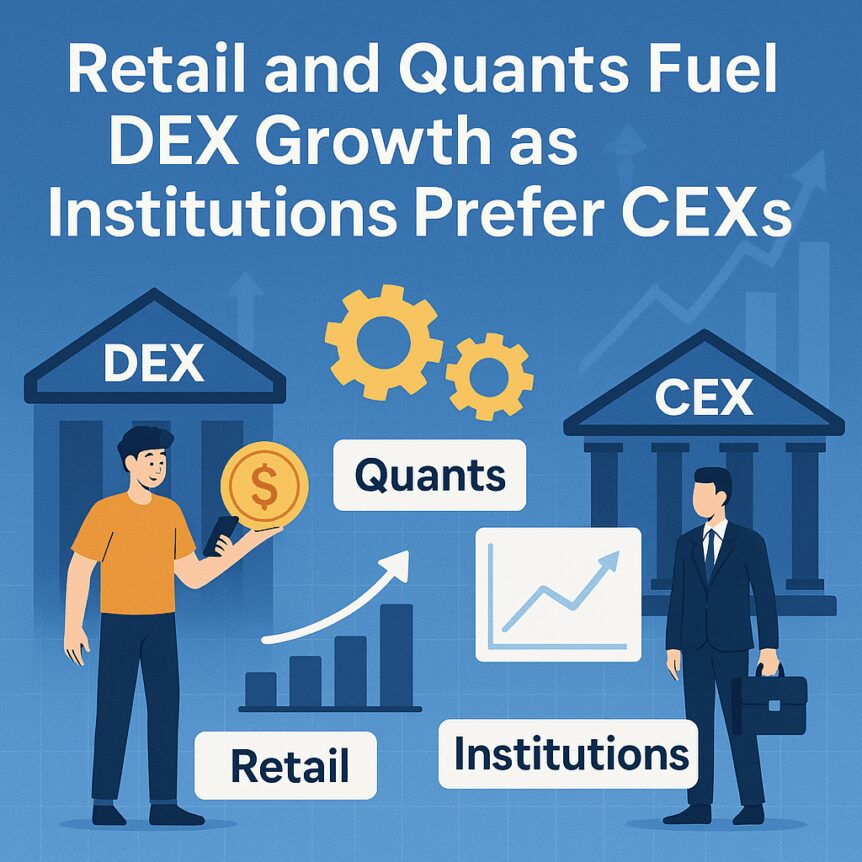
Retail and Quants Fuel DEX Growth as Institutions Prefer CEXs

Retail and Quants Fuel DEX Growth as Institutions Prefer CEXs

Decentralized exchanges (DEXs) are steadily gaining popularity among retail traders and quantitative strategies, challenging the dominance of traditional centralized platforms. As innovations like Hyperliquid push the boundaries of on-chain trading speed and transparency, the landscape of crypto markets is evolving rapidly, with both sectors fueling a competitive yet potentially complementary future for crypto trading. Retail [...]

Author: Crypto Breaking News