Airdrop

An Airdrop is a distribution of free tokens to a community, typically used as a marketing tool or a reward for early protocol adopters and testers. In 2026, the "points-to-airdrop" model has matured into merit-based incentive programs that utilize Sybil-resistance and Proof-of-Humanity to filter out bots. Airdrops remain a primary method for decentralized governance (DAO) bootstrapping. Follow this tag for the latest on retroactive rewards, eligibility criteria, and how to participate in the most anticipated token distributions in the ecosystem.

5511 Articles
Created: 2026/02/02 18:52
Updated: 2026/02/02 18:52
Protect Your Crypto Assets Now

Protect Your Crypto Assets Now

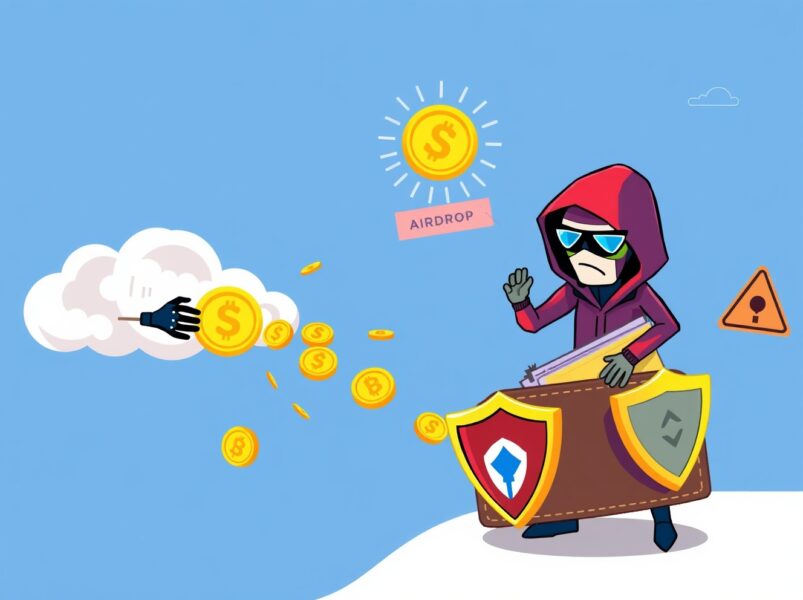
The post Protect Your Crypto Assets Now appeared on BitcoinEthereumNews.com. Cryptocurrency enthusiasts eagerly awaiting the Monad airdrop face a serious security threat that could compromise their digital assets. Recent warnings from blockchain security experts suggest the official claim page may have been compromised, putting users’ funds at risk. What’s Happening with the Monad Airdrop? Cos, founder of renowned blockchain security firm SlowMist, has issued an urgent warning about potential security breaches affecting the Monad airdrop claim process. Multiple users report that wallet addresses displayed on the official claim page differ from those they originally registered. This discrepancy suggests a possible website compromise where hackers may have altered destination addresses to redirect funds. The security expert noted that a white-hat hacker previously identified similar vulnerabilities, indicating this exploit method isn’t new to the crypto space. How Can You Protect Your Assets? While confirmation of active exploitation remains pending, extreme caution is essential during any Monad airdrop application. Here are critical safety measures: Double-check every wallet address before confirming transactions Verify website URLs to ensure you’re on the legitimate platform Use hardware wallets for additional security layers Monitor official channels for security updates Avoid rushing the claim process despite excitement Why Are Airdrops Particularly Vulnerable? Airdrops create perfect conditions for scammers because they generate significant user excitement and involve mass transactions. The Monad airdrop situation highlights how hackers exploit this enthusiasm to bypass security measures. Moreover, the technical nature of cryptocurrency transactions means once funds transfer to wrong addresses, recovery becomes nearly impossible. This makes prevention absolutely crucial for protecting your investments. What Should You Do Immediately? If you plan to participate in the Monad airdrop, take these proactive steps immediately. First, pause any claim attempts until security concerns resolve. Second, monitor official Monad communication channels for updates. Third, consider using alternative verification methods beyond the primary claim page. Finally, report any…

Author: BitcoinEthereumNews
Hyperliquid prepares for $316 mln unlock – Investors split on price reaction

Hyperliquid prepares for $316 mln unlock – Investors split on price reaction

The post Hyperliquid prepares for $316 mln unlock – Investors split on price reaction appeared on BitcoinEthereumNews.com. Key Takeaways  Why did the team unstake 10M tokens?  It’s intended for the token unlock scheduled for the 29th of November.  What are the market expectations?  Mixed. Large players expect a 10% dip to $28, while other analysts projected a rebound at $30.  The team behind Hyperliquid has reportedly unstaked $316 million worth of HYPE ahead of the token unlock scheduled for the 29th of November.  According to a pseudonymous analyst, Avseenko, most players were either farming HYPE through its DeFi ecosystem or shorting it. However, he cautioned that there was no strong bidding from the spot markets.  Tokenomist data showed that about 3.6% of HYPE circulation, or 10 million HYPE, will be unlocked over the weekend to support the founders and team.  It’s one of the major unlocks to be tracked this week, given the project’s success and the FUD it has caused in the past.  Source: Tokenomist  In the next 24 months, Hyperliquid [HYPE] will have monthly unlocks. Even at the current pace of buyback, crypto investor Arthur Hayes warned that it could leave over $400 million of supply overhang, outweighing the HYPE value.   Assessing HYPE market positioning As of writing, HYPE traded at $31.4, down by 47% from its prior all-time high of $59.4. On the incoming unlock, the market was pricing a potential 10% downside move to $28.  Source: Laevitas According to Options data, the $28 level had the highest volume of put activity (hedging against downside moves, red bar).  Put differently, large funds and players expected HYPE not to drop below $28 over the weekend after the unlock.  On the price charts, the level was a breakout point (white zone) during HYPE’s explosive recovery early this year. Perhaps market participants expected it to act as support and potentially trigger a rebound.  Source: HYPE/USDT, TradingView  That…

Author: BitcoinEthereumNews
Talus: Launches LP-based airdrop mechanism; pre-registration portal now live.

Talus: Launches LP-based airdrop mechanism; pre-registration portal now live.

PANews reported on November 25 that the Talus Foundation announced on the X platform that it will launch an LP-based airdrop mechanism. Talus will airdrop yield-generating liquidity positions in the form of yUS tokens. yUS is a fungible token that encapsulates automated liquidity provision strategies for the US-USDC trading pool on Momentum DEX through the NODO AI Vault. The Talus Token Generation Event (TGE) community airdrop participants include Tally NFT holders (snapshot EDT time November 17th, 10:00 AM), Community Center participants (top 500 on the leaderboard in Q1, Q2, and Q3, and holding a Talizen Discord role), participants of Korea Blockchain Week (KBW) events, active Talus Kaito users, and Kaito stakers. The airdrop process is as follows: Phase 1: Pre-registration (November 24th - November 28th). All eligible recipients must complete pre-registration during this period to qualify. The relevant website is now online. Phase 2: Claim (to be announced). All registered recipients must claim their tokens within this three-day window. Late claims will not be accepted. In September, it was reported that TalusNetwork, a decentralized AI agent infrastructure layer, had completed a funding round of over $10 million .

Author: PANews
Important news from last night and this morning (November 24-25)

Important news from last night and this morning (November 24-25)

Irys: IRYS token airdrop applications will begin today at 20:00. Irys, a programmable data chain platform, announced on the Galxe platform that the IRYS token airdrop application link is now live. The application period is from 20:00 Beijing time on November 25th to 20:00 on December 25th, with a snapshot time of November 11th. Furthermore, Irys stated that the top 10,000 participants on Galxe will receive the airdrop; all Genesis NFT holders who have previously registered for the airdrop are eligible. Previously, Irys announced the IRYS token economics: 20% initial circulating supply, with 8% allocated to the airdrop and future incentives. The 40.71 million TRX previously purchased by WLFI have been transferred to HTX in the past 10 hours. According to on-chain analyst @ai_9684xtpa, the 40.71 million TRX previously purchased by WLFI has been deposited into HTX in the past 10 hours, with the purpose unknown. Ten months ago, WLFI purchased $40.17 million worth of TRX at an average price of $0.2415, totaling $9.85 million. Yesterday, WLFI Strategic Reserve conducted a small test transfer of 147 TRX to address 0x6A2...C99c9, which was subsequently deposited into HTX. Ten hours ago, all 40.68 million TRX were transferred and deposited into HTX in batches, worth $11.23 million. WLFI previously purchased a basket of tokens including LINK/AAVE/ENA/MOVE/ONDO, which were also deposited into Coinbase, claiming it was "not a sale, but a reallocation of assets for daily business purposes." However, this is the first time they have deposited into HTX. Vitalik comments on the SitusAMC attack: Privacy is not an option, but a "hygiene habit". According to Decrypt, customer data from major U.S. banks such as JPMorgan Chase, Citigroup, and Morgan Stanley may have been leaked due to a cyberattack on mortgage technology provider SitusAMC. The company confirmed on Saturday that a threat actor stole data related to multiple large financial institutions, including accounting records, legal agreements, and some customer data. The scope, nature, and extent of the leak are still under investigation. Ethereum co-founder Vitalik Buterin commented, "Privacy is not a feature, but a hygiene practice." His response echoes the point emphasized throughout the year that privacy should be considered a fundamental requirement of digital systems, not an add-on feature. SlowMist: Users who haven't received their Monad airdrops are advised to check if the URL linked to their claim page has been changed by hackers. Yu Xian, founder of SlowMist, posted that some users may not have received their Monad airdrops. He suggested checking if the wallet address linked to the airdrop claim page was the intended address. If not, they might have encountered a similar issue to user @Onefly: their wallet address was linked to a hacker's address, and the airdrop was subsequently sent to the hacker's address. He also mentioned that a white-hat hacker had previously shared a vulnerability with him. This vulnerability has a prerequisite: if someone hijacks a user's session on the Monad airdrop claim page, they can change the claiming wallet address without further confirmation. He suggested that Monad investigate @Onefly's issue, such as by checking the wallet address change logs. Multicoin Capital purchased $10.94 million worth of AAVE tokens today. According to on-chain analyst Ember, Multicoin Capital continued to purchase AAVE today through Galaxy Digital. Over the past month and a half, they have acquired 278,000 AAVE (US$49.52 million) at an average price of US$228, resulting in a paper loss of US$13.9 million. After the sharp drop on October 11th, they purchased 210,000 AAVE (US$51.32 million) at US$244; today they purchased 61,637 AAVE (US$10.94 million) at US$177. Coinbase will launch spot trading for Fluid (FLUID) and World Mobile Token (WMTX). According to an official announcement, Coinbase will launch spot trading for Fluid (FLUID) and World Mobile Token (WMTX). In supported trading regions, the FLUID-USD and WMTX-USD trading pairs will open on or after 01:00 Beijing time on November 26, 2025, provided liquidity conditions are met. Fluid (FLUID) and World Mobile Token (WMTX) will be available for trading on the coinbase․.com website, the Coinbase app, and the Coinbase Advanced platform. Institutions can trade Fluid (FLUID) and World Mobile Token (WMTX) directly through the Coinbase exchange. Zhao Changpeng denied that Jackie Chan would portray him in a documentary. In response to rumors that Jackie Chan would play Zhao Changpeng in the upcoming Netflix biographical documentary "The Crypto King," Zhao Changpeng denied the rumors, saying, "That's false. I like Jackie Chan, but he's 71 years old. Let him go! I'm still working hard to finish this book. The last 5% of editing always takes up 95% of the time." Huang Licheng opened long positions in ETH worth $13.35 million and HYPE worth $830,000. According to on-chain analyst Yu Jin, Ma Ji (Huang Licheng), who had been going long and losing money, recharged his account last night and early this morning to go long again: he deposited 1 million USDC and then went long on ETH worth $13.35 million and HYPE worth $830,000. The ETH opening price was $2,883 and the liquidation price was $2,716. Currently, his long position has a floating profit of $280,000. TD Cowen: Strategy's Bitcoin premium is nearing the lows of the "crypto winter," but we maintain our buy rating. According to The Block, a recent report by TD Cowen indicates that Strategy's Bitcoin premium continues to decline and is currently "approaching the lows of the 2021-2022 'crypto winter'." The report includes two updated premium charts (one looking back to 2020 and the other covering the last 12 months), showing that Strategy did not issue new shares or purchase new Bitcoin through an market offering (ATM) yesterday, a move that has drawn renewed attention to its current premium level. The charts show that the current premium has fallen significantly from its peak at the end of last year and is gradually compressing to levels seen in late 2021 and early 2022. Despite this, TD Cowen maintains a bullish stance on MSTR, keeping its buy rating and $535 price target (approximately 200% higher than Strategy's current share price of around $180), believing that "achieving this target within a year is reasonably achievable." The report states, "We have not adjusted our base Bitcoin price forecast. We expect Strategy to hold 815,000 Bitcoins by the end of fiscal year 2027, estimating its holdings value to exceed $185 billion by December 2027, or an intrinsic value of approximately $540 per share. The target price of $535 reflects zero premium to the intrinsic value per share in December 2027." The report also emphasizes that the risk of Strategy being removed from the MSCI index has already put downward pressure on its share price, and it anticipates the company will be removed from the index and continue to face pressure under the shadow of MSCI inclusion. A Bitcoin OG whale has deposited another 10 million USDC into HyperLiquid and leveraged it 5x to go long on ETH. According to Onchain Lens monitoring, a Bitcoin OG whale (1011 short) has deposited another 10 million USDC into HyperLiquid and opened a 5x leveraged long position in ETH. Position details: Quantity: 15,000 ETH; Entry price: $2,946; Liquidation price: $2,326.53; Position value: $44.3 million. Japan's Financial Services Agency is planning new regulations requiring cryptocurrency exchanges to establish liability reserves. According to Cryptobriefing, citing Nikkei, Japan's Financial Services Agency (FSA) will require cryptocurrency exchanges to establish liability reserves to protect customers from potential security vulnerabilities and operational risks. As the country's main financial regulator, the FSA is pushing forward this reserve requirement to bring virtual currencies into a regulatory framework closer to that of traditional securities and to promote a safer market environment. The new regulations emphasize ensuring that exchanges are able to cover operational risks and safeguard customer funds. With these regulatory adjustments, Japanese asset management institutions are actively exploring new cryptocurrency investment products, and these changes are expected to expand trading services in the digital asset sector and stimulate market competition. The U.S. Securities and Exchange Commission (SEC) issued a no-action letter to Fuse Energy regarding the ENERGY token. Fuse Energy posted on the X platform that the U.S. Securities and Exchange Commission (SEC) issued a No-Action Letter today regarding its Energy Dollar (ENERGY) token. ENERGY is a native utility token of The Energy Network, an energy network built on the Solana blockchain. The project white paper, containing full details, was released today. In its announcement, the SEC stated: “Based on the facts stated, if Fuse had issued and sold the token in the manner and circumstances described in your legal counsel’s opinion without registering it under Section 5 of the Securities Act and without registering it as an equity security under Section 12(g) of the Exchange Act, the Division would not recommend enforcement action to the SEC. This position is based on the statements made to the Division in your legal counsel’s opinion. Any different facts or circumstances could lead the Division to a different conclusion. Furthermore, this response only states the Division’s position regarding enforcement action and does not constitute any legal conclusion on the matters stated.” Brevan Howard has reportedly received a $25 million "refund right" on his investment in Berachain. According to The Block, Unchained columnist Jack Kubinec revealed in his latest report that Brevan Howard's venture capital investment in Berachain was virtually "risk-free." Documents released this Monday show that Berachain granted Brevan's crypto investment subsidiary, Nova Digital, a special right—a one-year refund guarantee on its $25 million Series B funding round. This means that although Brevan co-led a $69 million funding round for Berachain at a $1.5 billion valuation, it can still recover its entire investment after the token generation event on February 6th. This right is reportedly valid until February 6th, 2026. Kubinec stated in the report: "This refund clause completely protects Brevan's fund principal from risk, which is very different from traditional venture capital models. If Berachain's BERA token performs well, the fund will obtain excess returns; if the token performs poorly, the fund can exercise its refund right." Currently, the BERA token is trading at approximately $1, a drop of about 67% from Brevan's investment cost of $3. According to The Block data platform, the token's fully diluted valuation is currently $536.7 million. The Series B funding round was led by Framework Ventures, with participation from Arrington Capital, Hack VC, Polychain, and Tribe Capital. Berachain also completed a $42 million Series A funding round in 2023. It is currently unclear whether other investors also have a refund right. Exodus will acquire W3C Corp, the parent company of Baanx and Monavate, for $175 million. According to CoinDesk, crypto wallet company Exodus Movement (NYSE American: EXOD) is acquiring W3C Corp, the parent company of cryptocurrency card and payment companies Baanx and Monavate, for $175 million. The deal is funded by the company's existing cash and financing provided by Galaxy Digital, using Exodus's Bitcoin holdings as collateral. Baanx and Monavate have been working with institutions such as Visa, Mastercard, and MetaMask to develop cryptocurrency cards and user-controlled Web3 payment services. Overall, this transaction will make Exodus one of the few self-custody wallet providers capable of controlling the entire payment experience from wallet to card. Exodus stated that it will take over the underlying card and payment technology stack and gain the ability to issue payment cards through networks such as Visa, Mastercard, and Discover, while expanding its operations to the US, UK, and EU to support new products and partnerships. Exodus also stated that this infrastructure is expected to enhance the capabilities of enterprise clients whose customers transact through Exodus's XO Swap application. The transaction is subject to regular adjustments and approval processes and is expected to be completed in 2026. The US September PCE report has been rescheduled to December 5th, and the preliminary Q3 GDP report has been cancelled. According to Jinshi News, information from the U.S. Bureau of Economic Analysis (BEA) shows the following data release schedules affected by the U.S. government shutdown: ① The preliminary GDP estimate for the third quarter of 2025 has been cancelled; it was originally scheduled for release on October 30. ② The September PCE (Personal Consumption Expenditures) and Personal Income reports will be released on December 5 at 10:00 AM (Beijing time), originally scheduled for October 31. Federal Reserve Bank of Canada President Tom Daly expressed support for a December rate cut, subsequently raising the probability of a December rate cut to 81%. According to a report by the Wall Street Journal cited by Jinshi, San Francisco Federal Reserve President Mary Daly, a 2027 FOMC voting member, stated that she supports a rate cut next month because she believes the possibility of a sudden deterioration in the labor market is greater and more difficult to control than a sudden surge in inflation. In an interview on Monday, she said, "I'm not confident we can get ahead in the labor market. The labor market is fragile enough right now, and the risk lies in non-linear changes." She indicated that the risk of an inflationary surge is lower by comparison because tariff-driven cost increases are much more moderate than expected earlier this year. Daly's views are noteworthy, as although she does not have a vote on monetary policy this year, she rarely disagrees with Fed Chairman Jerome Powell in public. At the December 9-10 meeting, Daly is likely to play a key role in resolving the disagreement within the interest rate-setting committee regarding whether to cut rates or pause rate hikes. Following Daly's remarks, CME's FedWatch tool showed an 81% probability of a 25 basis point rate cut in December (compared to 69.4% yesterday), and a 19% probability of keeping rates unchanged. The probability of the Federal Reserve cutting interest rates by a cumulative 25 basis points by January next year is 65.2%, the probability of keeping interest rates unchanged is 14.1%, and the probability of cutting interest rates by a cumulative 50 basis points is 20.6%. Machi deposited approximately 499,700 USDC into HyperLiquid to open long positions in ETH and HYPE. According to Onchain Lens, Machi has deposited another 499,680 USDC into the HyperLiquid platform and opened 25x leveraged long positions in ETH and 10x leveraged long positions in HYPE. Coinbase is about to launch MON-PERP perpetual contracts. According to a Coinbase Markets announcement, the MON-PERP perpetual contract trading pair will officially open in supported regions at 17:00 UTC on November 24, 2025 (01:00 Beijing time on November 25). Retail users can participate in trading through Coinbase Advanced, while institutional clients can access it through Coinbase International Exchange. USDC Treasury mints 100 million new USDC on the Ethereum blockchain. According to Whale Alert, Circle, the issuer of USDC, has just minted 100 million USDC (approximately $99,970,100) on the Ethereum blockchain. Sky Protocol bought back 40.5 million SKY tokens in the past week, bringing the total buyback amount to over 86 million USDS. According to Sky's official disclosure, Sky Protocol used $1.9 million USDS to repurchase 40.5 million SKY tokens last week through its decentralized buyback mechanism. Since its launch, the program has used over $86 million USDS for buybacks in total. Monad (MON) is now fully listed on Bybit Alpha and the spot market. According to a Bybit announcement, Monad (MON) has been listed on the Bybit Alpha platform. Bybit also launched MON spot trading on November 24th at 23:00 (UTC+8), opening the MON/USDT trading pair. Users can trade directly through Bybit Alpha without a wallet and participate in reward activities. Monad is a high-performance Layer 1 scaling solution compatible with the EVM, aiming to overcome Ethereum's scalability bottleneck. Chinese President Xi Jinping speaks with US President Donald Trump by phone According to Xinhua News Agency, Chinese President Xi Jinping spoke by phone with US President Donald Trump. Monad mainnet has officially launched, and MON is currently trading at approximately $0.025. The Monad mainnet has officially launched. Coinbase data shows that the native token MON is currently trading at approximately $0.025, with a circulating market capitalization of approximately $270 million and a fully diluted valuation (FDV) of nearly $2.5 billion. Binance will delist Ponke, Swell, and Quick U-margined perpetual contracts. Binance Futures will automatically liquidate the U-margined perpetual contracts of PONKEUSDT, SWELLUSDT, and QUICKUSDT at 17:00 (UTC+8) on November 28, 2025, and will delist the above perpetual contract trading pairs after the liquidation is completed. Strategy has not yet disclosed relevant data, and may not have increased its BTC holdings last week. Michael Saylor, founder and executive chairman of Strategy (formerly MicroStrategy), posted a chart with the caption "Probably Nothing," showing that Bitcoin-backed credit market trading volume has been steadily increasing since mid-September, reaching nearly $20 million in the week ending November 17-21, a 50.8% increase from the previous week. $STRC (Strike) was the main contributor, exceeding $10.51 million, followed by $STRD, $STRF, and $STRK. Historically, Strategy typically discloses its Bitcoin holdings data for the previous week on Mondays. As of now, Strategy's official website has not released any relevant data, suggesting that it may not have increased its BTC holdings last week. BitMine increased its holdings by nearly 70,000 ETH last week, bringing its total holdings to 3,629,701 ETH, representing 3% of the total ETH supply. BitMine Immersion Technologies (NYSE: BMNR) added 69,822 ETH to its holdings last week, bringing its total holdings to 3,629,701 ETH, worth approximately $10.2 billion, representing 3% of the total ETH supply. Enlivex plans to raise $212 million to purchase Rain tokens, aiming to create a digital asset vault for prediction markets. According to The Block, Nasdaq-listed biopharmaceutical company Enlivex Therapeutics announced it will raise $212 million through a PIPE private placement to purchase Rain tokens as the core reserve for its Digital Asset Vault (DAT), claiming the project is the first DAT built around a prediction market token. Rain is a decentralized prediction market protocol on the Arbitrum blockchain. Following the completion of this fundraising, former Italian Prime Minister Matteo Renzi will join the Enlivex board of directors. The crypto industry lobbying group "Stand With Crypto" has launched a questionnaire survey for candidates in the 2026 midterm elections. According to Crypto In America, Coinbase-backed crypto advocacy group Stand With Crypto has sent questionnaires to federal and state candidates to assess their stances on issues such as digital asset custody, innovation, debanking, crypto mining, and consumer protection. The results will be used to update its A-to-F crypto-friendly rating tool in preparation for the 2026 midterm elections. SWC previously invested over $130 million in 2024 to help over 250 pro-crypto candidates win elections and plans to continue its influence. Federal Reserve Governor Waller: I advocate for a rate cut in December. Federal Reserve Governor Waller: My focus is on the labor market, and I advocate for a rate cut in December. He stated that most private sector data indicates a weak job market. Since the Fed's last meeting, existing data shows little change, and inflation is not a major issue. January will be challenging, with a large amount of data to be released to determine whether another rate cut is needed; we need to assess each meeting individually. If the data shows a rebound, we can be more cautious. I still don't believe the labor market will turn around in the coming weeks. September employment data may be revised downwards; a concentrated release of data is not a good sign. There are no signs that companies are about to launch a hiring spree. Inflation has risen, but I think it will begin to decline. The inflation rate, excluding tariffs, is about 2.4% or 2.5%. He also mentioned that he spoke with Treasury Secretary Bessant about 10 days ago, and the meeting went very well. BlackRock transferred another 900 bitcoins to Coinbase, worth approximately $77.59 million. On-chain data shows that BlackRock transferred another 900 bitcoins to a Coinbase address today, with a total value of approximately $77.59 million. The total amount transferred throughout the day reached 3,722 BTC (approximately $321 million) and 36,283 ETH (approximately $102 million). BlackRock deposited 2,822 BTC and 36,283 ETH into Coinbase Prime. According to Lookonchain, BlackRock has just deposited 2,822 BTC (approximately $244 million) and 36,283 ETH (approximately $102 million) into Coinbase Prime. Citigroup: Every $1 billion in ETF outflows will cause Bitcoin to fall by approximately 3.4%. According to Bloomberg, US-listed Bitcoin ETFs saw outflows of $3.5 billion this month, approaching the previous monthly record of $3.6 billion set in February 2024. BlackRock's IBIT fund saw redemptions of $2.2 billion, accounting for 60% of the total, potentially marking its worst monthly performance since its inception. This capital outflow exacerbated downward pressure on Bitcoin, with the price briefly falling to $80,553. Citi Research estimates that every $1 billion in redemptions will drag down the (spot) price by approximately 3.4%, and vice versa. CoinShares: Digital asset investment products saw a net outflow of $1.94 billion last week. According to CoinShares' latest weekly report, digital asset investment products recorded a net outflow of $1.94 billion in the week ending November 22, marking the third largest weekly outflow since 2025. The cumulative outflow over four weeks reached $4.92 billion, representing 2.9% of total assets under management. Bitcoin and Ethereum saw outflows of $1.27 billion and $589 million respectively, but showed signs of recovery on Friday, recording net inflows of $225 million and $57.5 million respectively. Shorting Bitcoin products attracted funds for the third consecutive week, with asset size increasing by 119% year-to-date. XRP bucked the trend, recording an inflow of $89.3 million. Binance recovers illegally obtained Alpha airdrop proceeds and freezes user assets. According to @cryptobraveHQ, Binance appears to have initiated an investigation into alleged arbitrage activities during the Alpha airdrop, resulting in the freezing of multiple user accounts. One account had 14,457 USDT frozen, with an outstanding balance of 10,525.77 USDT. Screenshots show Binance stating that users "violated regulations on the Alpha platform and improperly obtained airdrops." Binance co-founder He Yi subsequently responded that "ordinary users are not affected." The European Central Bank has warned of the risks of cross-border regulatory arbitrage involving stablecoins and called for a unified regulatory framework globally. The European Central Bank's (ECB) Financial Stability Review preview, released today (with the full report due on Wednesday), shows that as of November 2025, the total market capitalization of stablecoins has exceeded $280 billion, representing approximately 8% of the entire crypto market. USDT and USDC together account for nearly 90% of this, and their reserve assets are equivalent to those of the world's top 20 money market funds. The ECB report points out that widespread adoption of stablecoins could lead to households converting some of their bank deposits into stablecoins, weakening banks' retail funding sources and increasing funding volatility. While MiCAR has prohibited European issuers from paying interest to curb such transfers, banks are still calling for similar restrictions in the United States. Furthermore, the rapid growth of stablecoins and their connection to the banking system could trigger concentrated capital outflows during crises. The report emphasizes the risks of cross-border "multi-issuance mechanisms," warning that EU issuers may struggle to meet global redemption requests, calling for pre-access safeguards, and promoting global regulatory alignment.

Author: PANews
Monad’s $105 Million Airdrop Underwhelms Speculators as Token Debuts Near Sale Price

Monad’s $105 Million Airdrop Underwhelms Speculators as Token Debuts Near Sale Price

The post Monad’s $105 Million Airdrop Underwhelms Speculators as Token Debuts Near Sale Price appeared on BitcoinEthereumNews.com. In brief A long-awaited airdrop of MON tokens was completed on Monday. Monad’s airdrop was valued around $105 million. The token’s price was close to that of a recently conducted public offering. Monad completed its long-awaited airdrop of MON tokens on Monday, giving recipients access to millions of dollars worth of cryptocurrency alongside its blockchain’s debut. Earlier this month, the much-hyped competitor to Ethereum and Solana saw around 76,000 wallets claim MON for free, but people couldn’t touch their holdings immediately because the network hadn’t yet launched. At the time, Monad said 3.33 billion MON tokens were claimed by the network’s users, builders, and members of Monad’s community, among others. That group included owners of several NFT projects, as well as traders on platforms like Hyperliquid and Pump.fun.  With MON recently changing hands around $0.0316, the airdrop was collectively valued around $105.2 million, according to crypto data provider CoinGecko. The airdrop’s size represents around 3% of MON’s total supply and 30% of the asset’s circulating supply. Within Monad’s official discord server, some onlookers expressed shock that MON was changing hands around the same price as previous token sales, including an offering conducted on a platform that Coinbase recently introduced for nascent tokens. Around 85,800 people participated in the offering, which saw $269 million in commitments, Monad said on X last week. The tokens, totaling 7.5 billion MON, were offered at $0.025 per token and sold for a total of $187 million. They were also distributed to buyers on Monday. An individual who goes by Barnabas on X expressed some disappointment toward their allotment of MON, saying they “expected a bit more” after consistently contributing to the project’s community by creating Monad-themed comics for six-plus months. “It might not be a huge amount, but it’s honest work,” they said, while…

Author: BitcoinEthereumNews
Plama [XPL] loses steam after airdrop surge – Is the ‘new chain’ buzz over?

Plama [XPL] loses steam after airdrop surge – Is the ‘new chain’ buzz over?

The post Plama [XPL] loses steam after airdrop surge – Is the ‘new chain’ buzz over? appeared on BitcoinEthereumNews.com. Key Takeaways Why is Plasma’s price sliding despite a green market? Upcoming unlocks, collapsing activity, and a sharp drop in stablecoin TVL weakened XPL’s short-term structure. What on-chain signals showed XPL’s momentum fading? DEX volume, daily users, and transaction counts fell steadily through November, aligning with a bearish technical setup. Plasma dropped more than 11% in recent hours, even as the broader market traded green for most of the day. The decline put Plasma [XPL] alongside Starknet [STRK], which also posted double-digit losses during the same window. XPL extended its downtrend after the post-launch hype faded. That early rally had been supported by an airdrop worth about 10,000 XPL for initial users. As price cooled, on-chain activity followed the same path, weakening the token’s momentum. What’s driving Plasma token down? The first wave of selling stemmed from the upcoming unlock on the 25th of November. About 88.88 million XPL, valued at $18.13 million, was set to unlock, leaving over 80% of the supply still locked. It was the largest of the roughly $80 million in weekly token unlocks across the sector. Source: DefiLlama Even so, long-term traction struggled elsewhere. Stablecoin TVL fell 68% since October and declined 8.24% on a weekly basis. Stablecoin Market Cap rested near $1.82 billion, while overall TVL slipped to $6.695 billion, with bridges contributing $5.79 billion of that total. Source: Dune Cumulative Transactions hit a new high, but daily activity cooled. Transaction Count slipped from 42,398 to 39,725. Daily New Users were only 137, and returning users totaled 1,831. DEX Volume dropped to $8.39 million at press time from its high of $47.81 million on the 19th of November. Most usage metrics trended lower since late October, a slide reflected in price charts. Bears extend control On the charts, XPL price showed that the altcoin…

Author: BitcoinEthereumNews
Critical Monad Airdrop Security Alert: Protect Your Crypto Assets Now

Critical Monad Airdrop Security Alert: Protect Your Crypto Assets Now

BitcoinWorld Critical Monad Airdrop Security Alert: Protect Your Crypto Assets Now Cryptocurrency enthusiasts eagerly awaiting the Monad airdrop face a serious security threat that could compromise their digital assets. Recent warnings from blockchain security experts suggest the official claim page may have been compromised, putting users’ funds at risk. What’s Happening with the Monad Airdrop? Cos, founder of renowned blockchain security firm SlowMist, has issued an […] This post Critical Monad Airdrop Security Alert: Protect Your Crypto Assets Now first appeared on BitcoinWorld.

Author: bitcoinworld
A Conversation with Aster, Lighter, and Helix: Perp DEX's Business Strategy and Future Landscape?

A Conversation with Aster, Lighter, and Helix: Perp DEX's Business Strategy and Future Landscape?

On November 14th, members of the Lighter, Aster, and Helix teams jointly hosted an online roundtable discussion on the future landscape of the on-chain perpetual contract market. During the discussion, the guests shared their operational strategies, characteristics, and future plans for different PerpDEXs, and also offered their outlook on the development of the Perp market. This article is a transcript of the roundtable discussion, packed with valuable information, and is highly recommended for reading and sharing. Host: Tonight we'll be discussing a very important topic: PerpDEX's operational strategy and future landscape. We'll focus on several core issues, such as the current structural challenges facing the PerpDEX sector, how to map on-chain Perp and on-chain finance to the real-world market, and how various projects are addressing user growth, liquidity, and long-term user retention. Today's guests are: 1. Ken—Helix core contributor 2. Amber—Aster BD Manager 3. Mr.block—Lighter core contributor Let's move on to our first topic today: What are the core advantages of the on-chain PerpDEX that are most difficult for competitors to replicate? Why? Amber – Head of Business Development at Aster This is a very interesting question. Looking at the essence of PerpDex's product, everyone is essentially building trading infrastructure, and liquidity is undoubtedly the most crucial element. PerpDex's so-called advantage lies primarily in the smoothness of trading and the depth of its liquidity pools. For Aster, we hope to excel in several areas. First, we adopted an order book and a transaction model across the entire chain, allowing users to choose according to their own needs—do you want to execute complex strategies like a professional trader, or do you want to easily perform simple operations? For the latter, they can use Aster's trading mode with leverage up to 1001x and easy operation. This is our first unique feature: providing two trading models so users can choose the right product based on their desired experience. Secondly, we took early steps in protecting privacy. We launched a feature called "Hide Orders," which is very useful for many high-net-worth individuals who don't want their order information to be completely disclosed. Of course, the hidden order book hasn't fully realized its potential yet, as our own public blockchain hasn't officially launched. A key future direction is launching a dedicated public blockchain for order book services. At that time, transaction information will be transparent and auditable while maintaining privacy. Whether you're a large investor or a regular user, if you don't want your positions or order information to be readily available to others, you can trade while protecting your privacy, and the entire system will still be auditable. Therefore, allowing users to trade in a private environment is, at present, Aster's most significant difference and advantage compared to other PerpDEXs. Mr. Block (Chris) – Lighter Core Contributor : If we're only talking about technological differences, each company has its unique aspects, such as the dark pool I just mentioned. But I think the most crucial thing is to look at each project's "DNA." Aster's DNA is Binance; without Binance, Aster wouldn't be as big as it is today. Hyperliquid's DNA is the community that supports it; while Lighter's DNA is Peter Thiel's Founders Fund and Ribbit Capital, as well as Haun Ventures and Robinhood. Therefore, when retail investors choose which PerpDex to participate in, in addition to the product itself, the most important thing is to look at its DNA, which is also the biggest difference between these three DEXs. Another significant difference lies in whether or not a token has been issued. Currently, among the core players, only Edgex and Lightner haven't issued their own tokens. Therefore, retail investors tend to choose platforms that haven't yet issued tokens when selecting "mining" targets. Current trading volume data may also be inflated, as everyone is frantically inflating trading volumes. In comparison, the data from Aster and Hyperliquid is more realistic because they have already gone through the transaction mining and token issuance stages. Therefore, to truly predict who will ultimately win, I think we'll have to wait until June or July next year, taking into account changes in the market cycle, to see a clearer picture. I personally experienced the entire DeFi Summer and witnessed the competition among all DEXs at the time, including Uniswap, Balancer, Curve, and numerous Uniswap forks such as Pancakeswap. I feel that the competitive landscape of PerpDex now is similar to that of DeFi Summer. Hyperliquid succeeded, and everyone wanted to follow suit. If Hyperliquid hadn't succeeded, and Polymarket had taken off instead, then everyone here today might be involved in prediction markets, not PerpDex. This again illustrates the importance of timing, location, and people. Ken — Helix core contributor: I am a core contributor to Helix, which is PerpDEX deployed on the Injective chain. Returning to the original question, if we were to pinpoint Helix's most difficult-to-replicate core advantage, I believe the key lies in the fact that Helix is not simply a perpetual contract DEX, but rather built upon the high-performance and modular Injective public blockchain. On Helix, in addition to cryptocurrencies, stocks, commodities, forex, and various RWA assets can all be traded, providing a truly unified multi-asset trading experience. Furthermore, Helix leverages Injective's RWA module to support the listing of various innovative financial derivatives. For example, we recently opened up trading exposure for pre-IPO and private markets, including OpenAI and SpaceX. This is virtually unique among current on-chain trading platforms, and even in some centralized platform systems, such products are scarce. Helix fills this gap. In contrast, other DEXs or trading platforms may still focus on a single vertical market. To truly replicate a system like Helix—which combines the matching speed, depth, and liquidity of a centralized trading platform with a transparent multi-asset trading engine across the entire chain—it not only requires a high-performance blockchain as the underlying architecture but also a modular design to support rapid iteration and flexible on-chain deployment of diverse assets. This model, which deeply integrates the ultimate trading experience with the breadth of assets, combined with a near-CEX level experience and end-to-end transparency, constitutes Helix's long-term advantages that are difficult to replicate. It also gives us confidence that Helix has the ability to lead the evolution of the next generation of on-chain financial systems. Host Moonlight: Thank you to our three guests for their insightful discussion. I see a clear consensus here: the competitive barriers for on-chain perpetual contract platforms are no longer limited to product features themselves, but also include the comprehensive advantages formed by multiple factors such as mechanism design, liquidity, market structure, and continuous listening to the community and iterative optimization. Next, we'd like to delve deeper into a topic: Have major projects begun supporting RWA assets? As we all know, RWA is a very hot sector in this cycle. What are your views on the role and importance of RWA in reshaping the DeFi ecosystem? Ken — Helix : Helix currently supports various RWA-related trading markets, covering stocks, commodities, forex, and other non-cryptocurrency assets. On Helix, stock and commodity perpetual contracts are typical examples of natively migrating traditional financial markets on-chain. Helix maintains good liquidity and depth in these RWA markets, making it one of the few multi-asset trading platforms currently available on-chain. From Helix's perspective, the RWA (Retail Asset Trading) sector has considerable long-term growth potential. Globally, there are a large number of users who wish to trade traditional financial assets but are limited by regulatory or geographical constraints—such as investors who want to trade Apple and Tesla stocks, or users interested in pre-IPO assets like OpenAI and SpaceX. They all hope to participate through the RWA market. Another example is Helix's launch a few months ago of the first derivatives market tracking the rental price index of the NVIDIA H100 graphics card. This fully embodies Helix's philosophy of "putting all assets on-chain." We don't want RWA to be limited to stocks, but rather to expand it to more diversified forms of financial derivatives. Looking ahead, we hope Helix can become the preferred platform for decentralized commodities or forex trading. Amber — Aster​ For Aster, we have already launched tokenized stocks, including several mainstream assets such as Apple and Tesla, as well as assets such as gold (XAU). We are constantly trying to list more traditional financial assets because, for Aster, it is not just a PerpDEX, but a one-stop trading platform across the entire blockchain. Therefore, asset diversity is crucial, and RWA is a core cornerstone. From my personal perspective, on-chain stocks and RWA assets significantly lower the barrier to entry for users. Once these assets are on-chain, their accessibility will be greatly improved, and both the assets themselves and the markets they target will gain broader liquidity. Furthermore, certain RWA assets possess genuine interest-bearing capabilities. This is particularly important in DeFi—what we often refer to as "real yield." Users who experienced the DeFi Summer may remember the frenzy for high returns, only to later discover that it came at the cost of overdrawing token value. Assets like RWA, backed by real underlying interest, can inject real yield sources into the DeFi sector after being put on-chain, and are expected to become incremental assets for the next phase of DeFi. From Aster's perspective, we have been actively seeking and promoting the integration of various RWA assets. At the same time, we place great emphasis on the compliance and security of asset listings to ensure that user transactions proceed smoothly. Therefore, we continue to explore diverse RWA and equity asset listings, striving to expand the boundaries of on-chain finance in a stable manner. Host Moonlight : Thank you for sharing, that's fantastic! Building a one-stop trading platform undoubtedly brings great convenience to users. RWA assets, especially US stocks and gold mentioned by the speakers, are becoming new traffic entry points and differentiated growth points in the Perp DEX field. Next, we'd like to explore a question in more depth: Liquidity is the lifeblood of all trading platforms. In the current market environment, many believe the pace of this bull market is difficult to predict. We would like to ask the experts here: what specific strategies or mechanisms do you have to share with our audience regarding attracting and retaining deep liquidity in the long term? Ken — Helix : For any trading platform, liquidity is absolutely crucial. Helix's approach is to combine ecosystem-level liquidity depth with the platform's own liquidity mechanism to build a relatively complete system, thereby maintaining liquidity depth in the long term. From an infrastructure perspective, Injective has a built-in exchange module, and Helix is technically deeply integrated with this module. This module comes with a full-chain order book matching system, giving Helix a natural advantage in liquidity matching. When users trade on Helix Markets, they can interact with Injective's Exchange module to allow all INJ-based DeFi projects to share liquidity. In addition, Injective provides other incentives to support liquidity. For example, Helix directly provides Injective with an "Open Liquidity Program," which introduces deep, programmatically incentivized liquidity to multiple trading platforms. This mechanism allows Helix to maintain high trading volume and tight spreads in various market environments, providing traders with a stable trading experience even during periods of heightened market volatility. Building upon its ecosystem liquidity, Helix has also launched its own market-making robot incentive mechanism, designed to reward market-making robots that maintain liquidity and stability. These robots provide a relatively stable algorithmic liquidity foundation for the platform, and their behavior patterns are similar to incentivizing a group of small, professional market makers, keeping them committed to the Helix platform long-term, thus helping to maintain overall health. It's worth noting that ordinary users can also participate in the program without any barriers. Simply visit the "Liquid Pool" BOT page on the Helix website or app, hold the corresponding assets, or even just one asset, to join and earn incentives in real time. Finally, in its future product roadmap, Helix will launch a significant liquidity upgrade program – which we call the "Mega Vault". This mechanism will integrate existing liquidity incentives to build a more structured and transparent reward system, emphasizing returns based on genuine contributions and utility. Amber — Aster​ Regarding liquidity, there is a core concept: it cannot be generated solely through short-term subsidies, but needs to be naturally attracted by building a healthy and positive market structure. Let me give you an example: Aster currently uses an order book model, relying on professional market makers to provide liquidity. But this is essentially a chicken-and-egg problem—without sufficient user trading volume, even professional market makers will have reservations about providing liquidity. Therefore, our core strategy can be divided into several levels: First, we initiate a "flywheel effect" through early incentives. We provide liquidity incentives to early market makers to help them reduce initial costs, thereby building a basic liquidity environment for users. As users are attracted by a good trading experience and trading volume increases, market makers will naturally be more willing to provide better liquidity depth, thus forming a positive cycle. Secondly, we provide robust trading infrastructure for professional teams. We continuously optimize our native API interfaces and various trading parameters to ensure that our partner market makers can quote prices and place orders more efficiently and accurately, thereby providing users with deeper order books and a more stable trading environment. Third, we will design a long-term ecosystem binding and incentive system. We hope that professional liquidity providers will not only come to trade, but also stay in the ecosystem long-term. This will be related to our upcoming independent public chain—we will design mechanisms that allow professional liquidity providers and even all token holders to participate more deeply in ecosystem building. This effectively completes a transformation from "simple liquidity providers" to "ecosystem identity binders." Once this identity binding is achieved, as Mr. Block mentioned before, users will recognize the platform's "DNA," and they will stay here for longer. Finally, while our current order book liquidity is still dominated by professional market makers, we are also developing a liquidity solution that doesn't rely entirely on a professional team, as we explore listing new assets. Please follow our official Twitter account; we will be launching this new solution to the market as soon as possible. Host Moonlight : Overall, PerpDEX's liquidity development has clearly evolved from an early short-term reward model to a more structured and sophisticated system design. Next, we'd like to ask the experts to elaborate further from a product perspective: Could you elaborate on what new features will be launched in the future to help traders operate more conveniently? For example: Will you launch trading robots, especially intelligent tools that incorporate AI technology? Are there any plans to develop a copy trading system or portfolio analysis functionality? Will there be a major upgrade in the mobile experience? After all, many users are now "smartphone addicts" and it's not convenient for them to sit in front of a computer for long periods of time. Could the teachers please share what new features will be launched soon? Ken — Helix : Currently, Helix is simultaneously developing multiple products, with the core goal of providing traders with a more complete and seamless trading experience. For example, our data dashboards, trading robot integration, and portfolio analysis capabilities have become important components of the Helix ecosystem. We will continue to iterate and optimize these existing modules. Currently, one of Helix's key development directions is to comprehensively improve the mobile experience—as the host just mentioned. We've noticed that more and more users are accustomed to trading anytime, anywhere. Therefore, we've recently invested heavily in mobile development, including optimizing page loading and interaction speed, simplifying interface hierarchy, and ensuring that multi-asset trading scenarios are clearly presented even on mobile phones, allowing users to quickly complete opening positions, adding or reducing positions, and various risk control operations on a small screen. Our goal is very clear: users can manage all their positions, track markets, and execute orders on their mobile devices without relying on a PC. In the future, Helix will also introduce AI technology to enable the platform to support more efficient AI trading robots and user-defined strategies, providing users with an experience comparable to any centralized trading platform. In summary, our primary principle remains consistent: to enable traders to enjoy a high-performance, information-dense, and convenient on-chain trading experience, anytime, anywhere, on any device. Amber — Aster​ First of all, our mobile application is now available for download and use. Mobile has always been a key focus for us. Secondly, we recently launched the AI Arena campaign. Many developers and teams are already building various trading tools on Aster, especially given the current focus on AI trading strategies. Through AI Arena, we've collaborated with ecosystem partners to select and introduce a number of high-quality AI strategy tools, which users can now use for trading on the Aster platform. We hope that through such collaborations, we can continuously introduce more mature and excellent products from the ecosystem to traders. Third, at the product level, our top priority is our independent public blockchain. It's important to note that this blockchain is not a complete ecosystem blockchain, but rather designed specifically to serve the order book system. Our goal is to achieve a high-performance trading experience comparable to centralized exchanges, while ensuring full transparency and verifiability of on-chain data. For traders, this means you can enjoy performance and smoothness on par with CEXs while maintaining complete control over your own data. This will be the core focus of our next step. Host Moonlight : Currently, a large number of traders still primarily use centralized trading platforms. However, as Amber emphasized, PerpDex's smoothness is now comparable to that of CEXs. So, what are the reasons that are prompting a wider range of users to shift to on-chain trading, or at least allocate a portion of their assets on-chain? Ken — Helix : I believe that for traders who are already accustomed to using CEXs for high-frequency trading, switching to Helix or other decentralized perpetual contract platforms means that they can obtain full self-custody and transparent security without sacrificing the trading experience. All order placement, position updates, and liquidation related to perpetual contracts must be completed publicly on-chain. This is crucial because it means there is no "black box" matching process, no unseen internal counterparties, and no additional risks. Black swan risks that have existed in some centralized trading platforms or institutions in the past—such as unilaterally frozen withdrawals, platform service interruptions due to regulatory or compliance issues, or operational failures—even some large platforms have experienced similar situations—may be tolerable for spot trading, but for contract trading, such risks are completely unacceptable. Looking back at the market over the past year, it's easy to find relevant cases, whether it's hacking attacks or so-called "network outages"—such incidents are commonplace. Even if some platforms offer compensation afterward, the process is extremely lengthy and rarely covers all losses. For perpetual contract traders, a single price spike can wipe out months or even years of accumulated profits. For high-frequency or heavy traders, these risks constitute real, albeit invisible, counterparty risk. The core value of on-chain transactions lies in solving this problem by eliminating single points of trust and single points of failure: users' assets are always kept in wallets under their own control, the trading and settlement logic is clearly defined by smart contracts and is publicly verifiable, and the platform cannot arbitrarily change users' positions or restrict asset withdrawals. Furthermore, the on-chain ecosystem's airdrops and other benefit mechanisms provide traders with additional returns that are difficult to obtain on centralized platforms. On Helix, users can enjoy transparent and self-custodied security, as well as share in the potential rewards brought about by the growth of Helix and the entire Injective ecosystem. I believe that the combination of these two aspects—a trading experience comparable to CEXs and the unique security and profit opportunities on-chain—is the most attractive advantage of on-chain trading at present, and it is also the core reason and vision for encouraging everyone to gradually migrate to on-chain. Amber — Aster​ Ken has already covered many key points, and I would like to add a few more: First, from Aster's perspective, we are committed to providing an experience virtually indistinguishable from centralized exchanges. The logic behind this is clear: CEX trading processes are already highly optimized for user experience, and most users are already accustomed to them. What we are doing is providing users with a one-stop, KYC-free on-chain trading platform without sacrificing this smoothness. We hope that users will not have to sacrifice trading efficiency when they switch to on-chain. Secondly, why should users shift from centralized to decentralized exchanges? Besides the fundamental advantages such as no KYC, self-custody of assets, free deposits and withdrawals, and trading transparency, a key point lies in the speed and flexibility of listing new assets. For centralized exchanges, listing new assets typically involves a lengthy and cumbersome approval process. Decentralized exchanges, on the other hand, are different—as we've seen, the reason why DEXs like Uniswap and PancakeSwap have seen continuous growth in trading volume and attracted more and more users is precisely because they can list new assets much faster. The same applies to Aster. We continuously explore ways to accelerate the listing process of new assets, enabling users to trade some assets on our platform even before they are listed on centralized platforms. This is one of the reasons why more and more users are starting to pay attention to and use on-chain perpetual contract platforms: you can access emerging assets earlier, and the earlier you participate, the greater the potential opportunities often are. Host Moonlight: In my view, the future trend isn't necessarily a choice between "on-chain" or "centralized," but rather a parallel approach. More and more users will gradually migrate their financial exposure to on-chain. For example, when I first entered the industry, I mainly used centralized trading platforms, but after this cycle, I started trying decentralized platforms, and the experience was excellent. Now I use both. This may be a viable path for PerpDEX to achieve user growth. Since we're discussing growth paths, we must address how to attract users. In the last cycle, many people achieved considerable profits by participating in airdrops, attracting a large number of users and even giving rise to professional studios and "airdrop hunters." However, users inevitably experience fatigue, especially when they encounter situations where they are "airdropped" themselves. I'm curious how the teachers designed the airdrop mechanism to avoid attracting only short-term users who just want to grab freebies, and instead truly convert the rewards and activities into high-quality, highly loyal users who stay long-term? Ken — Helix : This is indeed a perennial topic in blockchain projects—how to ensure the fairness of airdrops and incentives. I would like to introduce Helix's current approach to incentive design from two aspects. First, there's the open liquidity incentive program built on the Injective blockchain. Anyone who provides liquidity on Helix through a liquidity pool bot can earn corresponding trading incentives. Users can view their available incentive amounts in real-time on Helix's liquidity rewards dashboard, based on the activity and market depth of the supported trading pairs. Secondly, Helix has also established its own points system, but it is fundamentally different from the common "get it and go" model in the market. We adopt a multi-round, continuous accumulation "hidden accumulation" mechanism, which has several common characteristics: it encourages users to conduct real transactions on Helix, maintain continuous interaction, and even if some perpetual trading positions are liquidated, users can still earn points as long as they remain active during market fluctuations. For Helix, genuine engagement is far more important than artificially inflated transaction volume. Therefore, we haven't deliberately created overly quantifiable rules for inflating transaction volume. Overly explicit rules can easily lead to strategic arbitrage, resulting in industrialized volume manipulation and monetization. While the data may appear impressive on the surface, it actually damages the long-term value of the product and ecosystem—users are merely "pretending to use the product," not truly remaining engaged. At Helix, we assess the effectiveness of our points program by comprehensively evaluating user activity and actual trading behavior, focusing more on the quality of participation rather than simply piling up TVL or trading data. Therefore, Helix's points system is designed around real trading and real behavior, aiming to incentivize, align, and reward genuine traders, not short-term arbitrageurs. Amber — Aster​ Regarding incentive design, Aster focuses on two core aspects: behavioral quality and identity binding. Firstly, regarding the quality of behavior, unlike many trading platforms that rely solely on trading volume for rewards, we don't just focus on volume as a single metric. We comprehensively evaluate multiple dimensions, such as whether users maintain stable positions and whether they engage in continuous trading. Essentially, we observe and recognize each trader's genuine participation on the platform from a more holistic perspective. The quality of behavior itself is the core basis of our incentive system. Secondly, we emphasize identity binding. We aim to build a value-driven incentive ecosystem, rather than a one-off event. Aster's goal is not only to attract users through events, but also to transform users into long-term, high-quality participants through close interaction and cooperation with the community. The logic behind this is clear: as you've probably noticed, Aster's product iteration speed has been incredibly fast since TGE, and we're constantly optimizing and updating. Users may initially learn about us through events like airdrops, but we want them to feel that we truly value their voices after they actually trade and provide feedback. By actively responding to user feedback and rapidly iterating on the product, we hope users can grow alongside Aster. In fact, some early airdrop holders have already felt this over the past two or three months. I also hope that new users, through this close interaction during their participation in the community and activities, can feel that we genuinely want to retain everyone and work together to build a truly complete and mature on-chain trading platform with an experience comparable to CEXs.

Author: PANews
Irys: The IRYS token airdrop application will begin at 20:00 today.

Irys: The IRYS token airdrop application will begin at 20:00 today.

PANews reported on November 25th that Irys, a programmable data chain platform, announced on the X platform that the IRYS token airdrop application link is now live. The application period is from 20:00 Beijing time on November 25th to 20:00 on December 25th, with a snapshot time of November 11th. Furthermore, Irys stated that the top 10,000 participants on Galxe will receive the airdrop; all Genesis NFT holders who have previously registered for the airdrop are eligible for it. Previously, Irys announced the IRYS token economics: 20% of the initial circulating supply will be allocated to airdrops and future incentives .

Author: PANews
Monad Airdrop Distributes $105 Million in MON Tokens on Network Debut

Monad Airdrop Distributes $105 Million in MON Tokens on Network Debut

The post Monad Airdrop Distributes $105 Million in MON Tokens on Network Debut appeared on BitcoinEthereumNews.com. The Monad airdrop distributed over 3.33 billion MON tokens to 76,000 wallets on Monday, coinciding with the blockchain’s launch and valued at approximately $105 million based on current market prices, rewarding early users and community contributors in the crypto ecosystem. Monad airdrop claims: Around 76,000 wallets secured free MON tokens earlier this month, but access […] Source: https://en.coinotag.com/monad-airdrop-distributes-105-million-in-mon-tokens-on-network-debut

Author: BitcoinEthereumNews