Bitcoin’s bear-market turn can be traced to Oct. 10, 2025, a session widely described as the largest crypto derivatives liquidation event on record, with roughlyBitcoin’s bear-market turn can be traced to Oct. 10, 2025, a session widely described as the largest crypto derivatives liquidation event on record, with roughly

Oct. 10 Started The Bitcoin Bear Market, On-Chain Data Shows

2026/02/03 21:30
3 min read

Bitcoin’s bear-market turn can be traced to Oct. 10, 2025, a session widely described as the largest crypto derivatives liquidation event on record, with roughly $19 billion in futures positions forcibly unwound as prices slid sharply off their highs.

CryptoQuant contributor Darkfost argues the damage was structural as much as directional: open interest fell by about 70,000 BTC in a single day, wiping out months of leverage build-up and leaving speculation struggling to re-form. He claims that the Oct. 10 flush was “really the one that pushed BTC into a bear market” because of the speed and magnitude of liquidity destruction in futures.

Why October 10 Was The Bitcoin Bear Market Beginning

Darkfost pointed to a collapse in open interest measured in BTC terms. “In a single day, around 70,000 BTC were wiped out from Open Interest, bringing it back to its April 2025 levels,” he wrote. “That’s the equivalent of more than six months of Open Interest accumulation erased in one session. Since then, Open Interest has been stagnating and struggling to rebuild.”

The implication is less about the specific catalyst for the selloff and more about market structure after it. In Darkfost’s telling, the Oct. 10 event wasn’t just a price move; it was a sudden reduction in the market’s capacity to carry leverage, which tends to compress speculative activity across the complex.

“Liquidity destruction in an already uncertain crypto market environment is not conducive to a return of speculation, which is nonetheless a key component of the crypto market,” he added.

That view resonated with Bitcoin Capital, which replied that “nothing has been the same after 10/10,” adding that “it actually feels like something broke.” Darkfost’s response was blunt about the path back: “It needs to be rebuilt and it can takes months …”
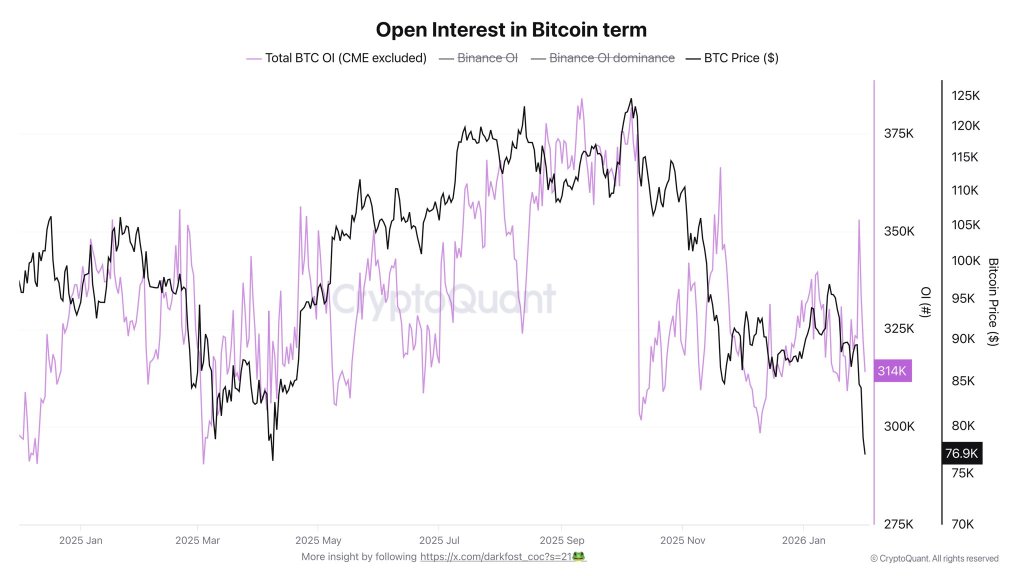
Open interest in Bitcoin

In a follow-up post, Darkfost widened the lens beyond derivatives, describing an environment where spot participation has also cooled. He said Bitcoin is entering a fifth consecutive month of correction, with the October 10 event as a major driver due to its impact on futures liquidity, but “not the only factor at play.”

He flagged broader liquidity pressure via stablecoin flows and supply. According to his figures, stablecoin outflows from exchanges have coincided with an approximate $10 billion decline in aggregate stablecoin market capitalization over the same period, an additional headwind for risk-taking, particularly when leverage is already being de-risked.

Spot volumes, he argued, tell a similar story of disengagement. Since October, BTC spot volumes have been cut roughly in half, with Binance still holding the largest share at $104 billion. He contrasted that with October levels when Binance volume “had nearly reached $200B,” alongside $53 billion on Gate.io and $47 billion on Bybit.
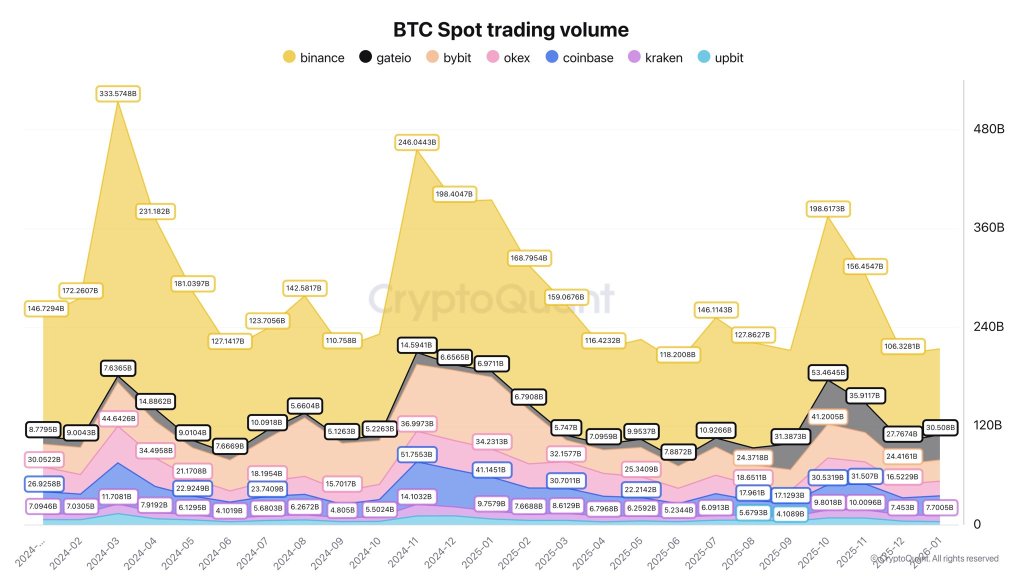
Bitcoin spot trading volume

Darkfost characterized the contraction as a return to “levels among the lowest observed since 2024,” and read it as weaker demand rather than simply a lull in activity. The current setup, he wrote, “remains uncertain and does not encourage risk-taking,” arguing that a durable recovery would require monitoring liquidity conditions and, “above all,” seeing spot trading volumes return.

At press time, Bitcoin traded at $78,723.
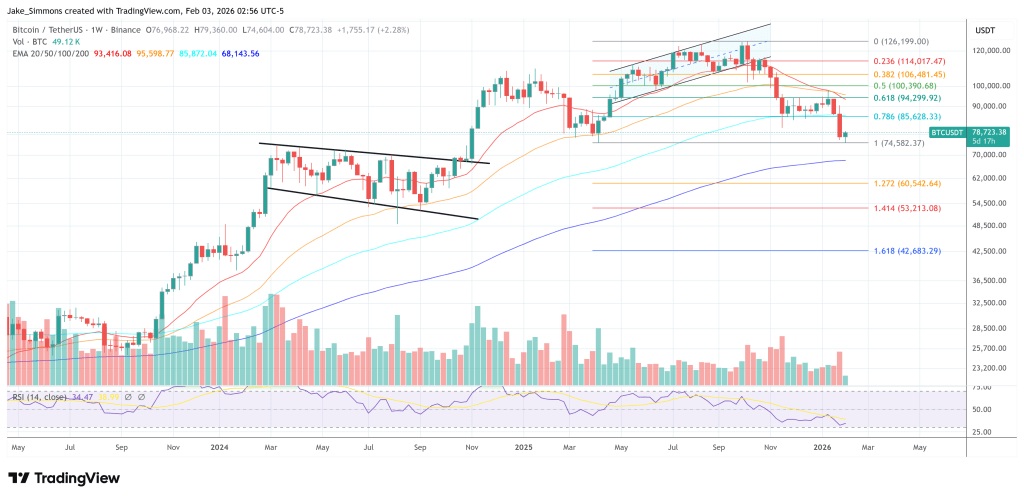
Bitcoin price chart
Disclaimer: The articles reposted on this site are sourced from public platforms and are provided for informational purposes only. They do not necessarily reflect the views of MEXC. All rights remain with the original authors. If you believe any content infringes on third-party rights, please contact service@support.mexc.com for removal. MEXC makes no guarantees regarding the accuracy, completeness, or timeliness of the content and is not responsible for any actions taken based on the information provided. The content does not constitute financial, legal, or other professional advice, nor should it be considered a recommendation or endorsement by MEXC.

You May Also Like

FCA komt in 2026 met aangepaste cryptoregels voor Britse markt

FCA komt in 2026 met aangepaste cryptoregels voor Britse markt

De Britse financiële waakhond, de FCA, komt in 2026 met nieuwe regels speciaal voor crypto bedrijven. Wat direct opvalt: de toezichthouder laat enkele klassieke financiële verplichtingen los om beter aan te sluiten op de snelle en grillige wereld van digitale activa. Tegelijkertijd wordt er extra nadruk gelegd op digitale beveiliging,... Het bericht FCA komt in 2026 met aangepaste cryptoregels voor Britse markt verscheen het eerst op Blockchain Stories.
Share
Coinstats2025/09/18 00:33
Cashing In On University Patents Means Giving Up On Our Innovation Future
Cashing In On University Patents Means Giving Up On Our Innovation Future

The post Cashing In On University Patents Means Giving Up On Our Innovation Future appeared on BitcoinEthereumNews.com. “It’s a raid on American innovation that would deliver pennies to the Treasury while kneecapping the very engine of our economic and medical progress,” writes Pipes. Getty Images Washington is addicted to taxing success. Now, Commerce Secretary Howard Lutnick is floating a plan to skim half the patent earnings from inventions developed at universities with federal funding. It’s being sold as a way to shore up programs like Social Security. In reality, it’s a raid on American innovation that would deliver pennies to the Treasury while kneecapping the very engine of our economic and medical progress. Yes, taxpayer dollars support early-stage research. But the real payoff comes later—in the jobs created, cures discovered, and industries launched when universities and private industry turn those discoveries into real products. By comparison, the sums at stake in patent licensing are trivial. Universities collectively earn only about $3.6 billion annually in patent income—less than the federal government spends on Social Security in a single day. Even confiscating half would barely register against a $6 trillion federal budget. And yet the damage from such a policy would be anything but trivial. The true return on taxpayer investment isn’t in licensing checks sent to Washington, but in the downstream economic activity that federally supported research unleashes. Thanks to the bipartisan Bayh-Dole Act of 1980, universities and private industry have powerful incentives to translate early-stage discoveries into real-world products. Before Bayh-Dole, the government hoarded patents from federally funded research, and fewer than 5% were ever licensed. Once universities could own and license their own inventions, innovation exploded. The result has been one of the best returns on investment in government history. Since 1996, university research has added nearly $2 trillion to U.S. industrial output, supported 6.5 million jobs, and launched more than 19,000 startups. Those companies pay…
Share
BitcoinEthereumNews2025/09/18 03:26
Trump foe devises plan to starve him of what he 'craves' most

Trump foe devises plan to starve him of what he 'craves' most

A longtime adversary of President Donald Trump has a plan for a key group to take away what Trump craves the most — attention. EX-CNN journalist Jim Acosta, who
Share
Rawstory2026/02/04 01:19