Ethereum Price Forecast: ETH maintains downtrend despite SharpLink's $463 million purchase
- SharpLink announced it purchased 176,270.69 ETH for a total of $462.9 million.
- The company has become the largest public company holding ETH, with 95% of its reserves deployed into staking.
- Ethereum could fall to $2,260 if it fails to hold the lower boundary of a key channel and the 50-day SMA.
Ethereum (ETH) maintained its decline on Friday, down 6%, despite SharpLink Gaming’s (SBET) announcement that it purchased 176,270.69 ETH for $462.9 million. The decline follows broiling Middle East war tensions after Israel struck strategic sites in Iran.
ETH slides amid SharpLink's $463 million purchase
Nasdaq-listed company SharpLink Gaming revealed in a press release on Friday that it has acquired 176,270.69 ETH for approximately $462.9 million, making it the world's largest publicly traded holder of ETH. The company made the purchase at an average price of $2,626 per ETH.
The acquisition comes from a mix of private placements and at-the-market (ATM) equity offerings.
SharpLink noted it has already staked over 95% of its acquired ETH, allowing it to earn yield while simultaneously contributing to the Ethereum network's security and decentralization.
"By allocating significant capital to ETH and deploying it in network activities such as staking, SharpLink is both contributing to Ethereum's long-term security and trust properties while earning additional ETH for that work," said SharpLink Chairman and Consensys CEO Joseph Lubin in the press release.
The purchase follows SharpLink's filing with the Securities and Exchange Commission (SEC) on Wednesday for the potential resale of over 58 million shares after a $1 billion offering in May.
Lubin stated in an X post on Thursday that many had misinterpreted the filing and that the company had sold no shares. He added that the filing was an "standard post-PIPE procedure" and not an indicator of actual sales.
SharpLink's stock is down 66% on Friday despite the ETH purchase.
The shift to an ETH treasury strategy occurs at a time of transition for the Ethereum network, with several recent developments in the cryptocurrency market directly impacting its ecosystem. Advancements in crypto regulations, real-world asset tokenization, and the SEC's positive stance towards decentralized finance (DeFi) all play a key role in this transformative process.
"Ethereum appears to be having its AWS moment — quietly but decisively establishing itself as the foundational settlement layer for on-chain financial infrastructure," Sui Chung, CEO of CF Benchmarks, told FXStreet.
Chung stated that the SEC's recent stance on DeFi could act as a catalyst for institutions to begin gaining DeFi exposure. He added that these developments are transforming Ethereum into an "indispensable infrastructure," paving the way for on-chain financial systems.
"Ethereum is no longer just a 'crypto' story [...] It's about industrial-grade, programmable money systems. And Ethereum is leading the charge," Chung noted.
Despite the recent positive developments surrounding Ethereum and SharpLink's purchase announcement, ETH is still down on Friday as Middle East war tensions continue to weigh on the crypto market.
Ethereum Price Forecast: ETH could fall to $2,260 if it loses key support levels
Ethereum experienced $296 million in futures liquidations, comprising long and short liquidations totaling $239.09 million and $57.77 million over the past 24 hours, according to Coinglass data.
Since seeing a rejection near the $2,850 resistance, ETH has declined by about 12%, briefly moving below the $2,500 key level before finding support at the 38.2% Fibonacci retracement level near $2,450 on Friday.
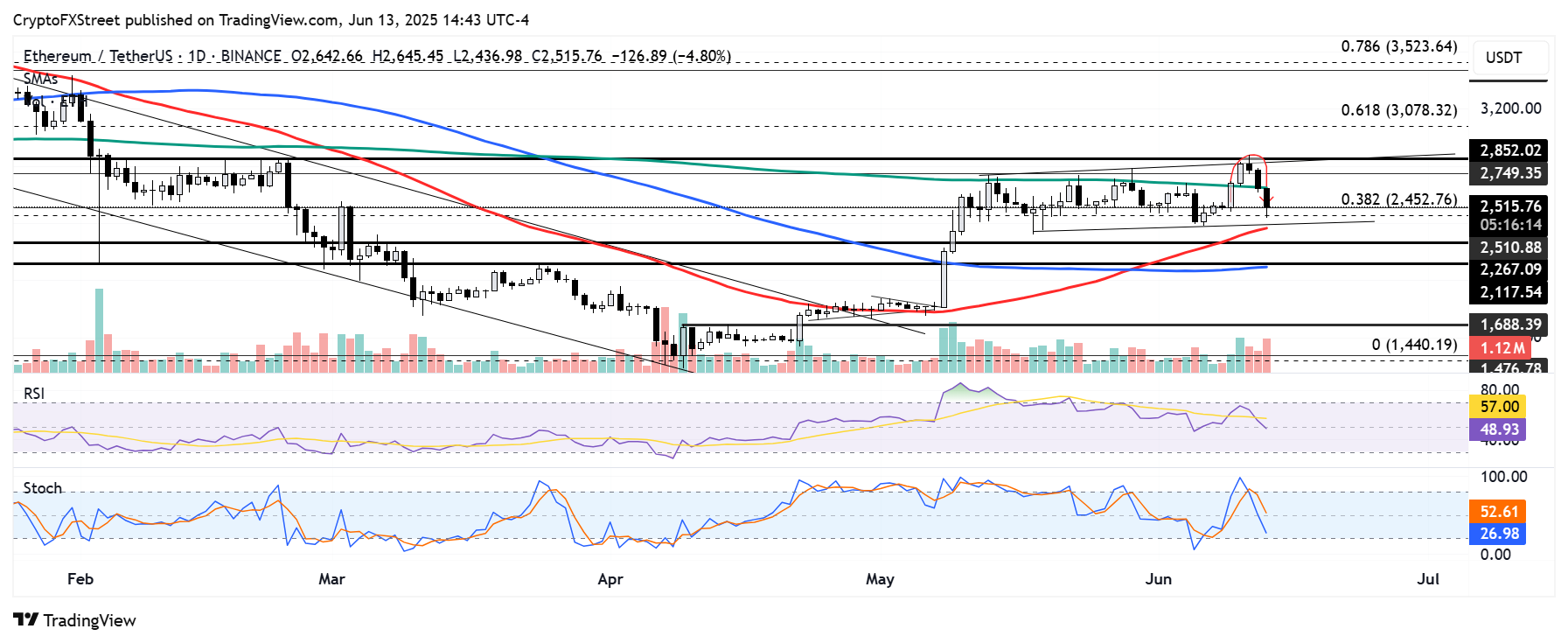
ETH/USDT daily chart
If ETH fails to hold the $2,500 and 38.2% Fib retracement level, it could find support near the lower boundary of a key channel, strengthened by the 50-day Simple Moving Average (SMA). A decline below this level will send its price into the key range between $2,110 and $2,260, with the 100-day SMA just below it.
On the upside, ETH must move above the $2,850 resistance to begin an uptrend toward the $3,400 level.
The Relative Strength Index (RSI) declined below its moving average line and is testing its neutral level. Meanwhile, the Stochastic Oscillator (Stoch) is below its neutral level and trending toward its oversold region. A successful decline below these key levels in both indicators will fuel the bearish momentum.
You May Also Like

FCA komt in 2026 met aangepaste cryptoregels voor Britse markt

Cashing In On University Patents Means Giving Up On Our Innovation Future