

Best Crypto to Buy Now – Dogecoin Price Prediction

After a grueling year of bearish dominance, Dogecoin is finally showing modest signs of life. While the broader market remains cautious, DOGE’s market structure is starting to shift, prompting a fresh evaluation of its near-term outlook.
Despite continued pressure from weak long-term fundamentals, such as its unlimited supply and slowing utility growth, recent price action has revealed a subtle but meaningful bullish divergence on the daily charts.
With the RSI forming higher lows while price tests the $0.13 support, the stage appears set for a potential year-end relief rally. As Dogecoin attempts to regain momentum, smart money is increasingly rotating into utility-driven projects that offer more than social hype.
For investors searching for the best crypto to buy to balance a DOGE-heavy portfolio, Maxi Doge (MAXI) is emerging as a standout ahead of 2026.
This new meme-utility hybrid is gaining attention by blending the viral appeal of the Doge narrative with an ambitious roadmap focused on high-leverage trading and gamified staking.
Source – Cilinix Crypto YouTube Channel
Dogecoin Price Prediction
Dogecoin has made an important bullish reclaim above the 7-day rolling VWAP and a key horizontal level at $0.13.
This move marks a meaningful technical improvement, as it aligns with stronger order flow and a recovery above several previously lost structural levels. While it does not confirm a full trend reversal, it does signal a shift away from clearly bearish conditions.
In the previous update, Dogecoin remained structurally bearish after breaking below intraday support near $0.135-$0.136. At that time, $0.13 stood out as the most critical level, with expectations favoring a downside liquidity sweep toward the prior value area low around $0.123.
That scenario unfolded as expected, followed by a rebound as broader market conditions began to improve. Equities strengthened, Bitcoin showed early signs of recovery, and overall risk sentiment stabilized.
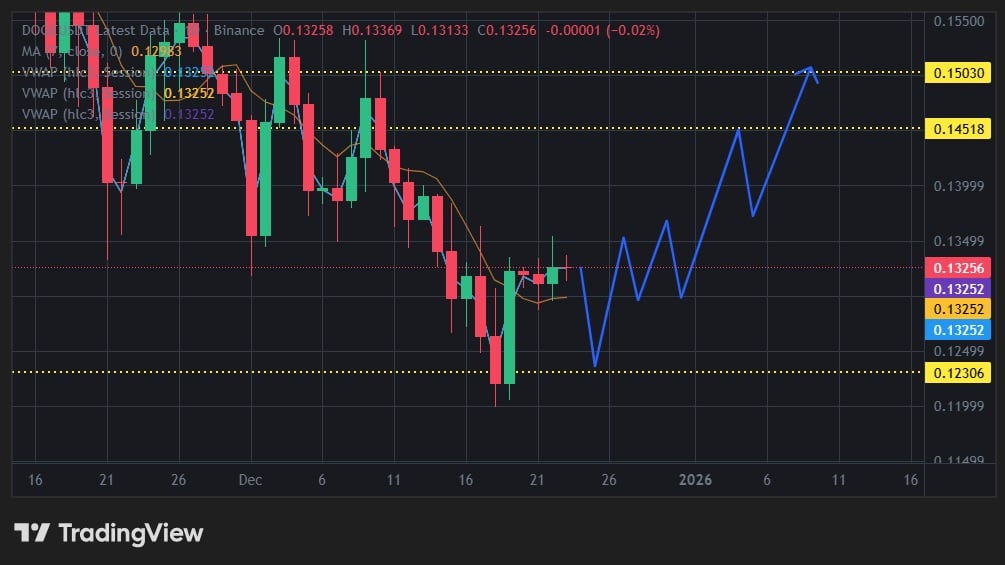
As a result, Dogecoin reclaimed several important technical areas, including the $0.13 level, the 7-day rolling VWAP, a well-respected descending trend line, and the monthly value area low. Although the broader structure has not fully returned to balance, price action now appears closer to neutral rather than decisively bearish.
Given the current environment, which includes firmer equity markets, a more constructive Bitcoin setup, and Dogecoin’s recent technical recovery, some continued bullish follow-through looks reasonable unless negative catalysts emerge.
In the near term, price may drift toward resistance around $0.14, where a rejection would remain consistent with Dogecoin’s still-weak broader strength.
Looking further ahead, a gradual move toward the confluence of the prior monthly value area low, the quarterly value area low, and the monthly value area high, roughly between $0.145 and $0.15, appears plausible.
A decisive breakout above this zone would likely require much stronger market conditions or Dogecoin-specific bullish developments, neither of which are currently in place.
Dogecoin Lags on Fundamentals as Traders Look Ahead to the 2026 Cycle
From a fundamental perspective, Dogecoin continues to lag behind the broader market. While assets such as XRP and Solana have benefited from strong institutional tailwinds in late 2025, Dogecoin’s ETF-related data offers little encouragement.
Cumulative inflows into the REX-Osprey DOGE ETF (DOJE) remain minimal, estimated at roughly $2 million, with December data even showing net outflows.
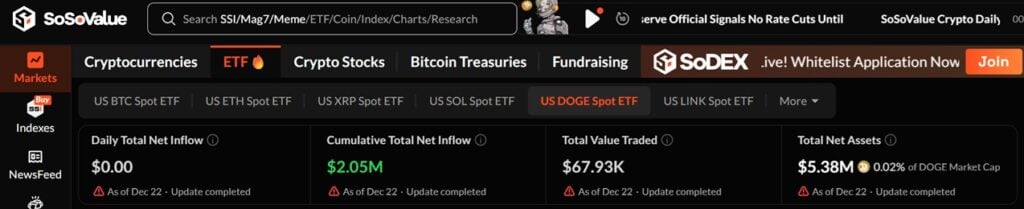
This contrast is especially striking when compared with other high-cap altcoin ETFs, which continue to attract steady capital despite broader market volatility.
The outlook is further weakened by a clear lack of catalysts. The speculative drivers that once fueled DOGE rallies, including high-profile endorsements from Elon Musk and political “D.O.G.E” narratives, have largely faded.
This cooling of attention has left Dogecoin in a state of narrative exhaustion. As a result, even as the broader market stabilizes, Dogecoin’s fundamental backdrop remains weak.
That said, experienced traders know that weak fundamentals have rarely stopped Dogecoin from posting sharp rallies. Throughout the summer of 2025, the asset recorded several aggressive price spikes despite similarly uninspiring on-chain metrics.
This pattern reinforces the idea that Dogecoin functions primarily as a momentum-driven asset rather than a fundamentally driven one. If risk appetite continues to improve across equity markets and Bitcoin, DOGE could once again sidestep its heavy fundamentals in favor of a short-term, liquidity-driven move.
With Dogecoin now firmly in a “show-me” phase, many investors are diversifying into projects with clearer catalysts and stronger upside asymmetry.
For those searching for the best crypto to buy ahead of the 2026 technical cycle, smart money is increasingly concentrating on a few key narratives, with Maxi Doge (MAXI) emerging as a notable contender within the meme-utility space.
Dogecoin Investors Turn to Maxi Doge (MAXI) as Presale Approaches $5M
Maxi Doge (MAXI) is starting to stand out as a meme coin that many traders have not noticed yet.
The project is gaining traction across the meme coin market, with its presale raising around $4.3 million so far. As the current presale round nears its end, more traders are paying attention to what Maxi Doge plans to build and how it sets itself apart from other meme coins.
Much of the growing interest comes from Maxi Doge’s bold “full send” branding and its focus on fast-paced trading culture. The project leans heavily into themes of maximum gains, leverage, and constant market action, which strongly appeals to high-risk, high-reward traders.
Maxi Doge offers more than meme appeal. The team plans to roll out several utility features, including staking, competitive Maxi challenges, partner events, platform integrations, and gamified trading tournaments. These features aim to keep users active and rewarded instead of relying only on speculation.
Tokenomics play a key role in the project’s design. The supply breakdown assigns 40% to marketing, 25% to the Maxi Fund, 15% to development, 15% to liquidity, and 5% to staking rewards, which are already live.
This setup prioritizes growth, visibility, and early community participation. Crypto outlet 2Bit Crypto has already highlighted Maxi Doge as one of the best cryptos to buy now.
Joining the presale is simple. Users can connect a supported wallet and purchase $MAXI tokens directly through the Maxi Doge website. Staking is already live and plays a major role in the ecosystem, with current rewards around 71% APY.
Visit Maxi Doge
This article has been provided by one of our commercial partners and does not reflect Cryptonomist’s opinion. Please be aware our commercial partners may use affiliate programs to generate revenues through the links on this article.
You May Also Like

Cashing In On University Patents Means Giving Up On Our Innovation Future

Spur Protocol Daily Quiz 21 February 2026: Claim Free Tokens and Boost Your Crypto Wallet
