

XRP price weathers market-wide volatility as Ripple-SEC file motion to release $125 million held in escrow
- XRP comes under immense pressure, falling toward $2.09 as Israel and Iran escalate conflict.
- Ripple and the SEC file a joint motion requesting the release of $125 million held in escrow.
- The SEC would be paid $50 million as a settlement, with the remaining funds returned to Ripple.
Ripple’s (XRP) price is currently trading at around $2.14 at the time of writing on Friday as investors in the crypto market navigate the sudden spike in volatility triggered by geopolitical tensions in the Middle East. The sudden price drop, which saw the price of XRP slide below support at $2.20, caused massive liquidations, exceeding $23 million over the past 24 hours.
The decline in the XRP price comes hot on the heels of the conflict between Israel and Iran. Israel launched an attack on Iran, targeting the country’s nuclear facilities, ballistic missile factories and military commanders on Friday, according to a report by Reuters.
Iran immediately responded to the attack, launching drone strikes on Israeli territory, prompting Israel to declare a state of emergency.
Ripple, SEC file joint motion to release $125 million held in escrow
Ripple and the United States (US) Securities and Exchange Commission (SEC) have jointly filed a motion in the US District Court Southern District of New York, requesting Judge Analisa Torres to dissolve the injunction in their ongoing case and move to release $125 million civil penalty held in escrow.
The two parties proposed in the motion that $50 million be paid to the SEC, with the remaining funds returned to Ripple, reflecting the settlement reached in early May. According to the filing, “if the Court issues the requested indicative ruling, the SEC and Ripple will move to the US Court of Appeals for the Second Circuit, for a limited remand to seek relief.”
The Court previously denied a Ripple-SEC joint motion on May 8, citing the failure of the two parties to address whether “exceptional circumstances” warrant a modification of the final Judgement, which had penalized Ripple $125 million for violating securities laws when the company sold XRP directly to institutional investors.
Meanwhile, institutional interest in XRP and related financial products continues to rise, as reported by FXStreet. Publicly listed companies, including VivoEnergy, Trident Digital Tech Holdings, Wellgistics Health, Inc., Webus International Limited, and Hyperscale Data Inc., have recently announced XRP-focused treasury fund strategies.
The cryptocurrency project, Ondo Finance, announced earlier this week the launch of its flagship Ondo Short-Term US Government Treasuries (OUSG) on the XRP Ledger (XRPL).
OUSG bridges the gap between Decentralized Finance (DeFi) and the traditional finance sector, allowing institutional investors on XRPL to seek exposure to short-term US Treasuries.
Technical outlook: XRP holds above critical support
XRP’s price hovers at around $2.14 at the time of writing after a slight recovery from support at around $2.09, reinforced by the 200-day Exponential Moving Average (EMA).
This rebound remains uncertain, especially with the Relative Strength Index (RSI) falling below the 50 midline while remaining below the descending trendline, as shown on the daily chart below.
Key levels of interest likely to be relevant in upcoming sessions and going into the weekend include the descending channel’s middle boundary, currently acting as immediate support, and the 200-day EMA at $2.09, which could prevent losses from extending below the critical $2.00 level.
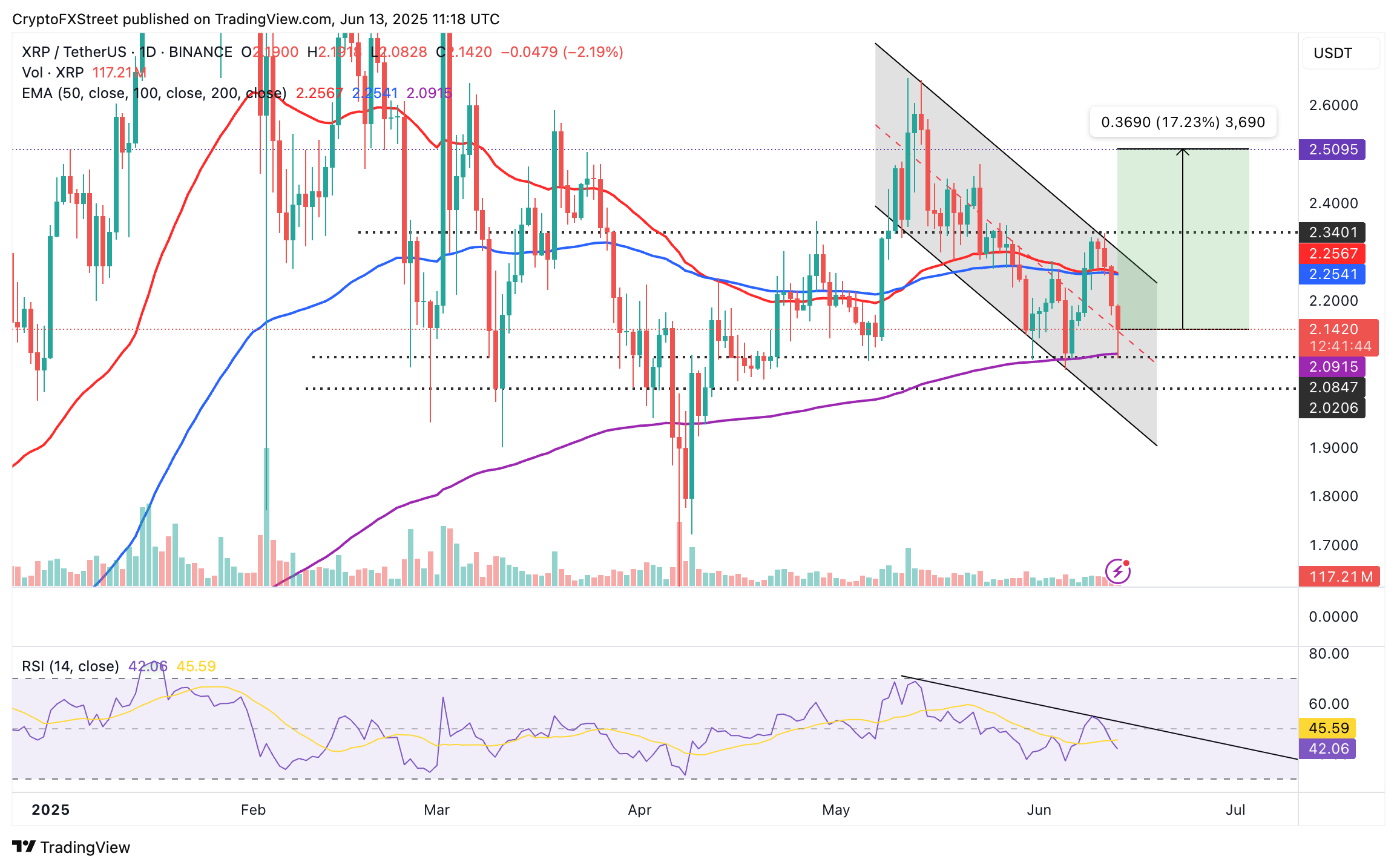
XRP/USDT daily chart
If the geopolitical situation in the Middle East improves and sentiment in the broader cryptocurrency market shifts, traders may consider buying XRP and contributing to the tailwind. A rebound from the current price level of $2.14 could reinstate the goal of a recovery targeting the hurdle at $2.34 and the seller congestion at $2.50, representing a 17% move from the prevailing market value.
Ripple FAQs
Ripple is a payments company that specializes in cross-border remittance. The company does this by leveraging blockchain technology. RippleNet is a network used for payments transfer created by Ripple Labs Inc. and is open to financial institutions worldwide. The company also leverages the XRP token.
XRP is the native token of the decentralized blockchain XRPLedger. The token is used by Ripple Labs to facilitate transactions on the XRPLedger, helping financial institutions transfer value in a borderless manner. XRP therefore facilitates trustless and instant payments on the XRPLedger chain, helping financial firms save on the cost of transacting worldwide.
XRPLedger is based on a distributed ledger technology and the blockchain using XRP to power transactions. The ledger is different from other blockchains as it has a built-in inflammatory protocol that helps fight spam and distributed denial-of-service (DDOS) attacks. The XRPL is maintained by a peer-to-peer network known as the global XRP Ledger community.
XRP uses the interledger standard. This is a blockchain protocol that aids payments across different networks. For instance, XRP’s blockchain can connect the ledgers of two or more banks. This effectively removes intermediaries and the need for centralization in the system. XRP acts as the native token of the XRPLedger blockchain engineered by Jed McCaleb, Arthur Britto and David Schwartz.


You May Also Like

Trump-linked World Liberty Financial questioned over partner’s prior links to sanctioned network

Pacquiao insists Mayweather fight for real, shuns exhibition insinuation




