

Bitcoin Hormuz payments for ship insurance will test crypto’s neutral money thesis
IRGC-affiliated Fars News reported on May 16 that Iran launched a platform called Hormuz Safe, offering digital insurance for vessels transiting the Strait of Hormuz with premiums settled in Bitcoin.
A document cited by Fars's reporter indicated Iran's Economy Ministry had been developing the mechanism since early May, with projected revenue above $10 billion.
The platform's website features a “Coming Soon” page, along with text describing fast, cryptographically verifiable insurance settled via Bitcoin. No official press release from the Economy Ministry, government gazette, or regulator has confirmed the launch.
| Claim | Current status | Why it matters |
|---|---|---|
| Fars reported Hormuz Safe launch | Reported by IRGC-affiliated Fars | Strongest source, but not official confirmation |
| Website text references Bitcoin insurance | Indexed / “Coming Soon” page | Supports existence of a public-facing web asset, not operation |
| Economy Ministry link | Claimed via document cited by Fars | Not the same as a ministry announcement |
| Bitcoin / USDT Hormuz messages | MARISKS called prior messages a scam | Creates caution around all crypto-safe-passage claims |
| Official government confirmation | Not found | Article must stay conditional |
In April, Greek maritime risk firm MARISKS warned shipping companies that fraudulent messages impersonating Iranian authorities had demanded Bitcoin or USDT payments for Hormuz clearance and declared them a scam.
Iranian forces reportedly fired on the Epaminondas, a vessel owned by Greek company Technomar, when it apparently acted on a fraudulent safe-passage message. The scam backdrop makes caution essential before treating any unverified claim about crypto Hormuz payments as operational.
Yet, a verified mechanism would test Bitcoin's institutional position in ways that extend well beyond the strait itself.
Bitcoin at the world's most important chokepoint
Hormuz handles about 20% of the world's oil and liquefied natural gas under normal conditions.
As the conflict with the US and Israel has continued since late February 2026, Iran has blocked or restricted transit, war-risk insurance premiums have surged from roughly 0.25% to as high as 10% of a vessel's value for a single passage, and average daily ship transits have dropped by about 95%.
A Bitcoin-settled insurance mechanism in that environment would be Bitcoin operating as settlement infrastructure for a live conflict zone, a use case with no precedent in the asset's history.
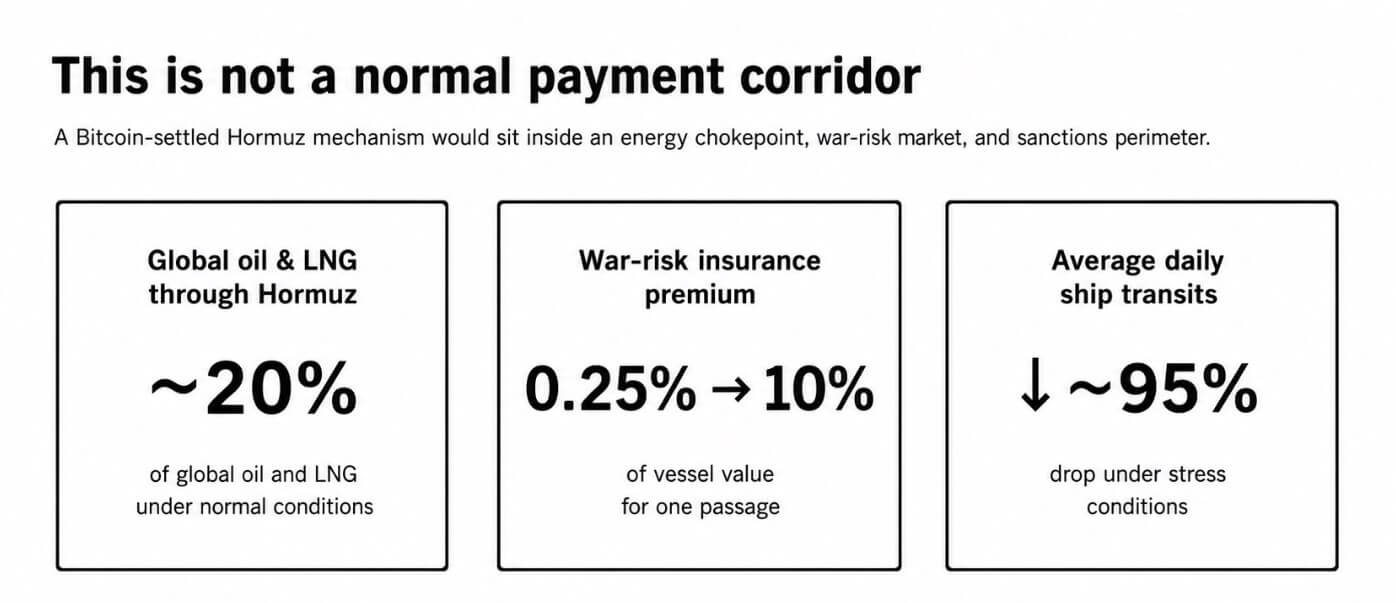 An infographic showing three Hormuz stress metrics: 20% of global oil and LNG at stake, insurance premiums up to 10%, and ship transits down 95%.
OFAC issued an alert on May 1, warning that paying any Hormuz toll to Iran creates sanctions exposure regardless of payment method.
In a related FAQ published the same day, OFAC confirmed that Iranian digital asset exchanges qualify as Iranian financial institutions under existing sanctions regulations, and that Executive Order 13599 blocks their assets held by US persons or located within the US.
FinCEN's May 11 alert cited a Chainalysis analysis putting Iran's crypto economy at $7.8 billion, noting IRGC dominance and a documented move toward Bitcoin, and explicitly cited press reporting that Iran had stated its intent to use digital assets to collect payments from oil tankers seeking Hormuz passage.
FinCEN listed petroleum and shipping companies that deviate from normal business practices by sending or receiving digital asset payments related to Iranian oil as a compliance red flag.
If enforcement becomes structural
If Hormuz Safe becomes operational and draws enough shipping participants to generate a traceable pattern of Bitcoin payments, every address associated with the mechanism becomes a potential OFAC target.
Through Operation Economic Fury, Treasury has already frozen nearly $500 million in regime-linked cryptocurrency.
If OFAC identified Hormuz-linked wallet addresses, enforcement actions would target exchanges, OTC desks, and brokers that face deposit screening requirements for any BTC in the payment chain.
Bitcoin's base-layer transactions are public, but connecting an on-chain address to a specific Hormuz insurance payment requires off-chain attribution.
Exchanges can screen addresses only once off-chain attribution links them to a specific Hormuz payment; that attribution then forces regulated venues to choose between blocking tainted flows and accepting downstream liability.
FATF's October 2025 update classified Iran as a high-risk jurisdiction, noting no material progress on its action plan, recommending countermeasures against proliferation-financing risks, and giving regulators across jurisdictions legal cover to act aggressively against intermediaries that handle Iranian crypto flows.
Institutional investors and ETF holders who spent 2024 and 2025 framing Bitcoin as digital gold would see Bitcoin as a conflict-zone payment rail that regulators are actively attempting to degrade.
If the design brief holds
Bitcoin's original design brief was to enable peer-to-peer value transfer between parties, bypassing financial institutions.
A Hormuz-linked payment mechanism would be the most demanding real-world test of that design ever staged: a sanctioned state, locked out of correspondent banking, settling maritime insurance at a geopolitical chokepoint.
Iran's position, cut off from correspondent banking, SWIFT, and Western maritime insurers, is the environment in which Bitcoin's peer-to-peer settlement operates. For Bitcoin advocates, a verified Hormuz Safe mechanism would be concrete proof of concept for a live, unilaterally functional settlement rail operating in a jurisdiction where regulators foreclosed every conventional option.
If the platform processed even a small volume of verifiable payments, it would give supporters an example no whitepaper simulation could replicate.
Iran has already settled billions in oil trade through Chinese yuan, Russian rubles, and crypto intermediaries. A formalized Bitcoin-settled maritime insurance mechanism would add a publicly verifiable, globally accessible layer to that infrastructure.
Countries under partial or threatened sanctions who are watching the Hormuz case would draw their own conclusions.
The neutral money thesis, tested
Bitcoin's advocates have long argued the network is politically neutral, and that the protocol operates identically for dissidents in authoritarian states and for institutional treasuries in financial centers.
A verified Hormuz Safe would force a confrontation with what that neutrality looks like when a state actor deploys it at an energy corridor.
OFAC, FinCEN, and FATF have pre-determined the regulatory answer, showing that neutrality at the base layer leaves counterparties, intermediaries, and off-ramps fully exposed to sanctions law.
| Scenario | What happens | Bitcoin meaning | Regulatory result |
|---|---|---|---|
| Scam / no launch | No verified payments emerge | Bitcoin remains a narrative prop | Exchanges monitor fraud risk |
| Limited pilot | Small number of verifiable BTC payments appear | Proof of censorship-resistant settlement | Wallets and intermediaries face scrutiny |
| Operational system | Repeated payments create identifiable flows | Bitcoin becomes maritime-risk infrastructure | OFAC / FinCEN pressure expands |
| Enforcement escalation | Wallets, brokers, or exchanges are targeted | Neutral-money thesis collides with sanctions law | Liquidity fragments around tainted flows |
The base layer continues settling while the regulated perimeter tightens around it. That window between what Bitcoin can technically do and what the institutions that price it, hold it, and provide liquidity for it are permitted to support is where the Hormuz case would land.
Verified or not, it has forced that question from theory into practice
The post Bitcoin Hormuz payments for ship insurance will test crypto’s neutral money thesis appeared first on CryptoSlate.


You May Also Like
Goldman Sachs crypto ETF holdings drop XRP and Solana in Q1 2026 filing

US Dollar Index Slides Toward 99.15 as Hopes for Hormuz Stability Weigh on Safe-Haven Demand




