Zcash (ZEC) surged over 1,200% in 12 months. From a halving to an SEC clearance, Multicoin Capital's accumulation, and a Grayscale ETF filing — here's exactly why ZEC exploded in 2026.
Overview
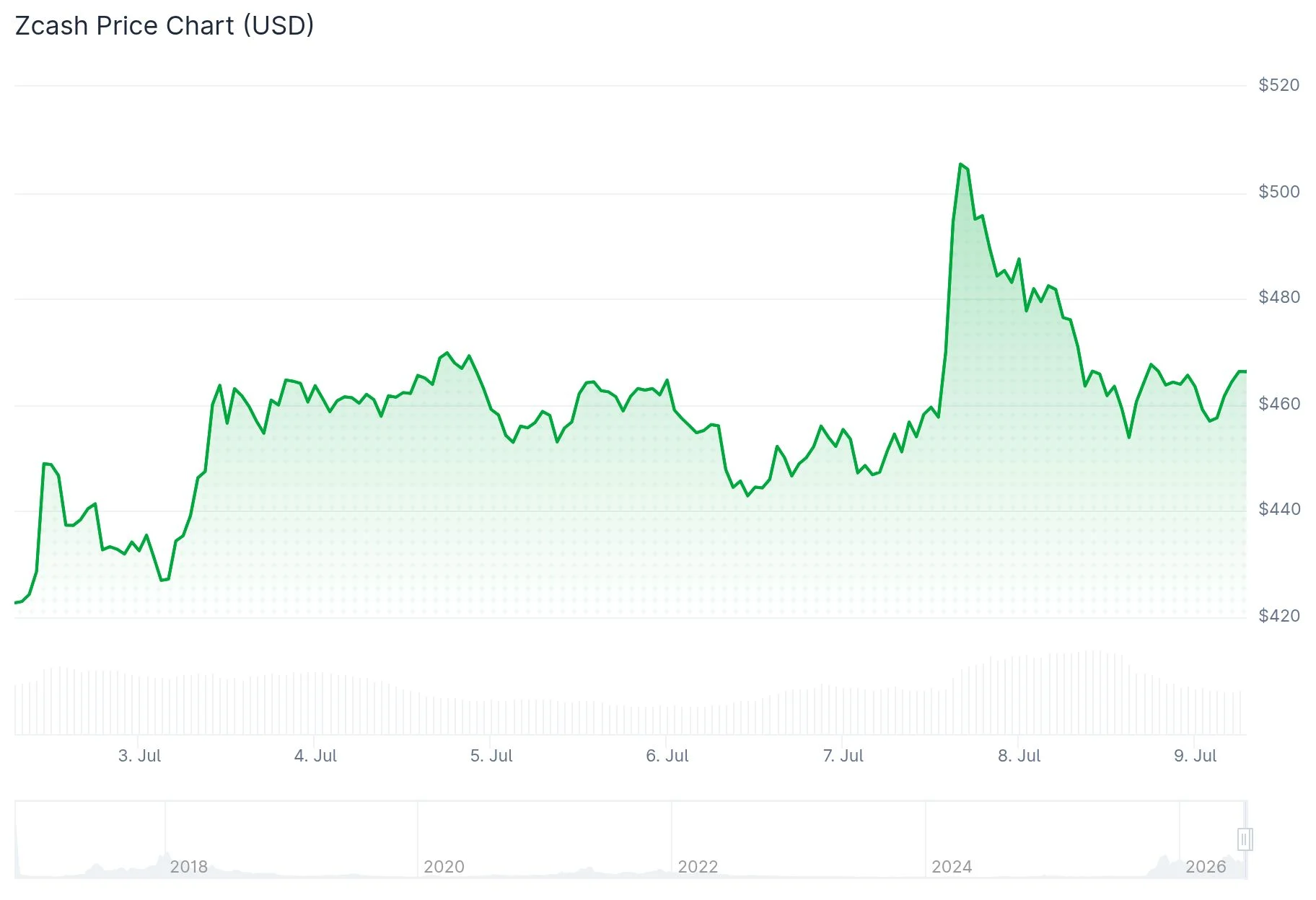
While most altcoins spent 2026 grinding sideways, Zcash (ZEC) delivered one of the most striking rallies in the entire crypto market. From a pre-halving low below $40 in 2024 to a high near $750 in November 2025, then a sharp correction, and a fresh 2026 high of $543 after a single-day 30% surge in early May — ZEC recorded gains exceeding 1,200% over a twelve-month period.
This was not a random pump. A tightening supply schedule, the removal of a years-long regulatory overhang, coordinated institutional accumulation, and a fundamental repricing of financial privacy in an era of AI-powered surveillance all converged. This article breaks down each driver in detail.
Key Takeaways
The November 2024 halving cut daily ZEC issuance to approximately 1,800 coins, establishing a persistent supply constraint at a moment when demand catalysts were stacking
On January 15, 2026, the SEC officially closed its investigation into the Zcash Foundation without enforcement action, removing the single largest regulatory uncertainty facing the token
Multicoin Capital disclosed a significant ZEC position accumulated since February 2026; Cypherpunk Technologies holds over 314,000 ZEC on its public balance sheet
Grayscale filed to convert its Zcash Trust into a US-listed spot ETF — the first such filing for any privacy-focused cryptocurrency
30% of ZEC's circulating supply now sits in shielded addresses, an all-time high, signaling real usage growth rather than pure speculation
Robinhood listed ZEC, significantly broadening retail access
ZEC/USDT is available for spot and futures trading on
MEXC
1. The Halving: Where the Rally Began
Zcash completed its
fourth halving on November 18, 2024, reducing the block reward from 3.125 ZEC to 1.5625 ZEC. Daily new issuance dropped from approximately 3,600 coins to around 1,800, cutting the annual inflation rate from roughly 4% to 2%.
Like Bitcoin, Zcash has a hard cap of 21 million coins. With approximately 16.67 million already in circulation, the halving tightened the issuance curve at precisely the moment when a series of demand catalysts were about to arrive.
ZEC was trading between $40 and $50 before the halving. Within three months it had tripled in price, and by November 2025 it reached approximately $750 — an all-time high representing over 1,200% gains from the pre-halving low. A correction followed, pulling ZEC back to the $230–$270 range by early 2026, setting up the next leg.
2. The SEC Closes Its Investigation: The Most Important Regulatory Pivot
A persistent regulatory cloud had kept institutional investors at arm's length for years. The SEC had been investigating the Zcash Foundation since early 2024, contributing to exchange delistings and making custody providers hesitant to engage.
On January 15, 2026, the SEC formally
closed its investigation without recommending any enforcement action. ZEC rallied more than 4% on the day, briefly exceeding $427. The market reaction understated the significance of the event.
The closure removed the single largest compliance barrier for institutional participants. Grayscale's subsequent ETF filing arrived within weeks. The timing was deliberate: regulatory clarity enabled institutional infrastructure that would not have been feasible under an open investigation.
3. Institutional Accumulation: Multicoin, Cypherpunk, and Grayscale
The institutional story in 2026 unfolded on multiple fronts simultaneously.
Multicoin Capital disclosed in early May 2026 that it had been building a significant ZEC position since February. Co-founder Tushar Jain described the investment thesis publicly: Zcash represents the clearest way to hold a private, scarce store of value in an environment where governments are increasingly able to identify and tax visible crypto holdings. "Bitcoin is censorship-resistant," Jain wrote, "but that doesn't stop the state from seizing known holdings through wealth taxes." ZEC's shielded transaction architecture addresses that specific vulnerability.
Cypherpunk Technologies, a Nasdaq-listed company backed by the Winklevoss family, took an even more direct position. The company disclosed it holds 314,185 ZEC as of Q1 2026 — approximately 1.88% of circulating supply — and committed an additional $5 million to the
Zcash Open Development Labs (ZODL), alongside a16z and Coinbase Ventures.
Grayscale filed in late 2025 to convert its Zcash Trust (ticker: ZCSH) into a US-listed spot ETF on NYSE Arca — the first ETF filing for any privacy-focused cryptocurrency. According to
MEXC's analysis, Grayscale has successfully converted 10 crypto trusts into ETFs since January 2024. An approval would create a regulated institutional onramp without requiring direct token custody.
Combined, these three institutions control a meaningful portion of ZEC's circulating supply. Concentrated institutional ownership reduces the available float and amplifies price sensitivity to incremental demand.
4. The Privacy Repricing: AI Surveillance, Wealth Taxes, and a New Narrative
The deepest driver of the 2026 ZEC rally is a fundamental repricing of financial privacy as a macro-political asset class, not merely a technical cryptocurrency feature.
AI de-anonymization of transparent blockchains has moved from theoretical concern to documented reality. A CoinDesk Research
report published in March 2026 identified "encryption supremacy" — the point at which privacy-preserving networks become dominant — as a condition Zcash has already reached, driven by three converging forces: AI tools capable of de-anonymizing users on transparent chains, the emergence of quantum computing as a credible cryptographic threat, and quarterly privacy coin trading volumes exceeding $100 billion.
Wealth tax pressures have given the thesis real political teeth. California's Initiative 25-0024 proposes a one-time 5% tax on residents with net worth above $1 billion, including unrealized gains. Multicoin Capital explicitly cited this as a signal of where government policy is heading globally. Assets that are publicly visible on a blockchain are, by definition, assets that can be assessed and taxed.
Zcash's compliance architecture distinguishes it sharply from Monero and other mandatory-privacy alternatives. The viewing key system allows selective disclosure of transaction details to authorized parties — a feature that makes ZEC compatible with regulated exchanges, custodians like Coinbase Custody, and now potentially a US-listed ETF. The EU's Anti-Money Laundering Regulation (AMLR), taking effect in July 2027, will require licensed exchanges to delist privacy coins — but Zcash's selective disclosure design positions it on the compliant side of that regulatory line, while 73 exchanges have already delisted Monero.
5. On-Chain Data and Technical Structure Confirm the Move
Price action was supported by genuine on-chain activity, not purely by derivative speculation.
According to
CoinDesk data, the percentage of ZEC held in shielded addresses reached approximately 30% of circulating supply, an all-time high. This compares to roughly 8% at the start of 2024 — a near-quadrupling that reflects growing actual usage of Zcash's privacy features, not merely speculative positioning.
From a technical standpoint,
MEXC's chart analysis showed that ZEC was compressing inside a falling wedge pattern for months before the breakout, with market cap climbing in a stepwise fashion from approximately $5.4 billion to roughly $8.6 billion during the accumulation phase. That kind of gradual progression typically reflects institutional positioning ahead of a catalyst-driven move.
The May 6, 2026 single-day surge also triggered approximately $62 million in futures short liquidations. The short squeeze amplified an already momentum-driven move, with short sellers forced to buy back positions into rising prices.
6. Robinhood Listing: Retail Access Opens Up
Beyond institutional channels, Robinhood's listing of ZEC meaningfully expanded retail participation. For a token that had been associated primarily with technical privacy users and professional traders, the Robinhood listing signaled mainstream platform validation and brought a new pool of retail capital within reach.
MEXC Crypto Pulse Research Team: Exclusive Analysis
The 2026 ZEC rally is the product of a rare alignment: a supply shock from the halving, the removal of regulatory uncertainty, coordinated institutional accumulation, and a macro-political narrative that reframes financial privacy as a portfolio necessity rather than a niche preference.
The durability of this move depends on several variables that remain unresolved. The Grayscale spot ETF application has yet to be decided. The EU's AMLR implementation in mid-2027 will test whether Zcash's compliance architecture is sufficient to preserve European market access. And the broader altcoin liquidity environment remains fragile.
What makes ZEC structurally different from most altcoins is that its fundamental thesis — compliant privacy infrastructure in an era of expanding financial surveillance — does not require a generalized bull market to be valid. The demand for genuinely private, auditable financial transactions exists independent of Bitcoin's price cycle.
MEXC supports
ZEC/USDT spot and futures trading with deep liquidity. Traders can access ZEC alongside over 2,000 other trading pairs on the platform.
Risk Factors and Forward Outlook
Despite a compelling fundamental narrative, Zcash carries real and specific risks:
Governance execution risk: The departure of the Electric Coin Company's core development team in January 2026 introduced uncertainty around protocol execution
EU regulatory pressure: The 2027 AMLR may fragment liquidity across global markets and reduce European exchange access
Technical competition: The mainstreaming of zk-SNARK technology in Ethereum Layer-2 networks could dilute Zcash's differentiation as a privacy-first chain
Concentration risk: High institutional ownership means large position changes can trigger outsized price moves in either direction
Analyst price targets for ZEC vary widely.
Changelly projects a target near $660 by year-end 2026, while more bullish models cited by
Coinpedia place a potential high above $1,394 under favorable conditions. The wide range reflects the degree of uncertainty that remains around ETF approval timing and regulatory outcomes.
How to Trade ZEC on MEXC
Visit
MEXC and complete account registration and identity verification
Deposit USDT or supported fiat currency
Search for the ZEC/USDT trading pair in the spot market
For leveraged exposure, use the futures trading section — always set stop-loss levels before entering a position
Frequently Asked Questions
Q: What is Zcash and how does it differ from Bitcoin?
A: Zcash is a cryptocurrency launched in 2016 that adds optional transaction privacy to a Bitcoin-derived architecture. Bitcoin transactions are fully visible on a public ledger. Zcash offers two address types: transparent addresses (similar to Bitcoin) and shielded addresses (which encrypt sender, receiver, and transaction amount using zk-SNARK cryptography). Users choose their privacy level, and viewing keys allow selective disclosure to authorized parties.
Q: Is Zcash's privacy technology the same as Monero's?
A: No. Monero applies mandatory privacy to all transactions, making it stronger in absolute privacy terms but incompatible with most regulated exchanges and institutional custodians. Zcash's optional privacy model — with selective disclosure via viewing keys — makes it auditable for compliance purposes. This architectural difference is why Zcash retains listings on major regulated platforms while Monero has been delisted from over 73 exchanges.
Q: What is the status of Grayscale's Zcash ETF filing?
A: Grayscale filed to convert its Zcash Trust (ticker: ZCSH) into a US-listed spot ETF on NYSE Arca in late 2025 — the first such filing for a privacy-focused cryptocurrency. A decision has not yet been issued. If approved, the ETF would create a regulated institutional access point for ZEC exposure without direct token custody.
Q: Why is 30% of ZEC in shielded addresses significant?
A: Shielded ZEC is functionally removed from the circulating tradeable supply. With 30% of supply locked in private addresses — up from 8% two years ago — the effective market float is significantly smaller than the nominal circulating supply figure suggests. This supply reduction, combined with growing privacy usage, is one of the core arguments for the bullish thesis.
Q: What are the main risks of holding ZEC in 2026?
A: The primary risks are governance uncertainty following the departure of core developers, EU regulatory actions under the 2027 AMLR, and the inherent volatility of a relatively small-cap asset with concentrated institutional ownership. None of these are resolved, and the price has already reflected significant optimism.
Q: Where can I buy or trade ZEC?
A: ZEC/USDT spot and futures pairs are available on
MEXC, one of the world's largest cryptocurrency exchanges by trading pair count.
Disclaimer
This article is for informational purposes only and does not constitute investment advice. Cryptocurrency markets are highly volatile and past price performance is not indicative of future results. Always conduct your own research (DYOR) and consult a qualified financial advisor before making any investment decision.
About the Author
This article was produced by the MEXC Crypto Pulse Research Team. The team focuses on cryptocurrency market analysis, on-chain data interpretation, and macro trend research, drawing on MEXC's market data and industry resources to deliver timely, in-depth market insights for traders and investors globally.
Sources