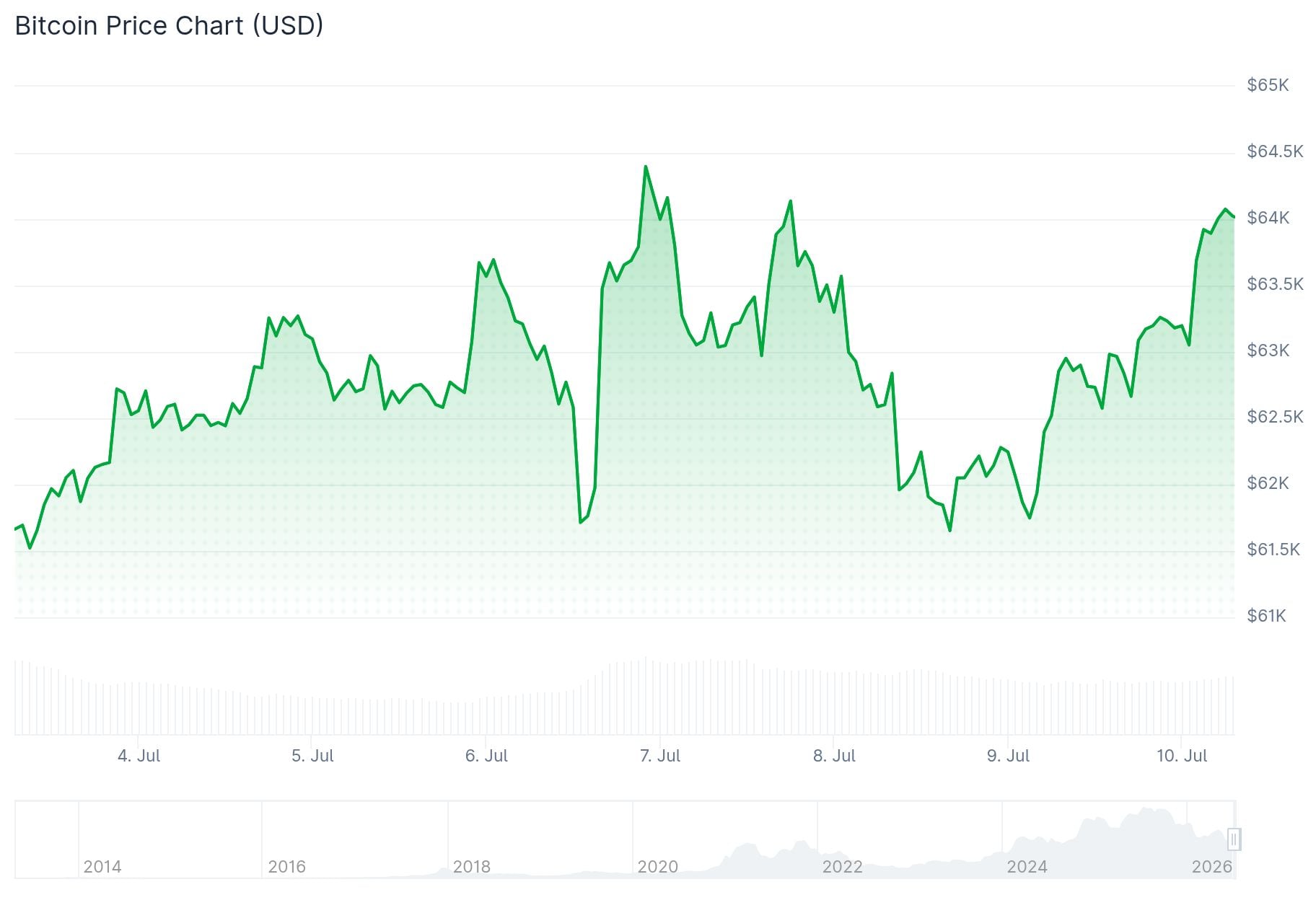
Since then, the market has clawed back ground, with Bitcoin trading around $81,000 in May 2026 and institutional buyers quietly returning through ETF channels.
But plenty of investors are still asking the same hard question: is Bitcoin going to crash again from here?
This article breaks down where Bitcoin actually stands right now, what history says about crashes of this size, how low prices could realistically go, and what practical steps make sense while the dust is still settling.
For Bitcoin fundamentals and market history, see our comprehensive investment guide.
Key Takeaways
Bitcoin crashed more than 52% from its October 2025 peak of $126,000, hitting a low of $60,001 in February 2026 before recovering to around $81,000 in May 2026.
The most credible worst-case forecast for 2026 puts Bitcoin's floor at $55,000–$65,000 if key support levels fail, with most analysts projecting a trading range of $70,000–$110,000 through year-end.
Bitcoin has now crashed more than 80% from a cycle peak four times in its history — and recovered to new all-time highs every single time.
Institutional buyers are returning: U.S. spot Bitcoin ETFs recorded over $1 billion in weekly inflows in early May 2026, the first such week since January.
BlackRock's Bitcoin ETF alone holds over $65 billion in assets, a structural support mechanism that didn't exist in previous crypto winters.
Investors should use dollar-cost averaging and limit Bitcoin to 5–10% of their portfolios — managing volatility through strategy, not emotion.
Bitcoin now responds directly to Federal Reserve policy, making macro signals like rate decisions and liquidity conditions just as important to watch as crypto-specific news.
Bitcoin's sharp decline reflects several market factors including Federal Reserve policy uncertainty and institutional investor withdrawal. The Federal Reserve's shifting stance on interest rate cuts has disappointed traders who expected easier monetary policy to support risk assets like Bitcoin.
Between October 2025 and February 2026, institutional investors pulled an estimated $3.7 billion from Bitcoin ETFs, according to Morningstar data — a retreat that reversed sharply in the months that followed.
The October crash that triggered $19 billion in liquidations left lasting psychological damage, making traders more cautious and quick to sell at the first sign of weakness.
Bitcoin's concentrated ownership among large "whale" holders means a single major sale can trigger cascading price drops, especially when market liquidity is thin.
Unlike traditional assets, cryptocurrency markets operate 24/7 without circuit breakers or cooling-off periods, allowing panic selling to accelerate without pause.
The asset that proponents called "digital gold" is behaving more like a high-risk tech stock, falling when broader markets show signs of stress rather than providing the safe haven investors expected.
Since the article was first written, the story has continued to develop.
Bitcoin fell further than the $85,000–$90,000 level flagged as the danger zone, eventually bottoming at $60,001 in early February 2026 before institutional buyers started stepping back in.
That recovery doesn't mean the risk is gone, but it does reframe the question from "is Bitcoin about to crash?" to "is the worst already behind us?"
A drop to $50,000 from current levels would represent a further 38% decline from where Bitcoin trades today — and would require a major negative catalyst that has not yet materialized.
Four leading AI chatbots assessed this scenario, with ChatGPT estimating only a 5-15% probability of Bitcoin reaching $50,000 before year-end.
Most forecasts point to Bitcoin trading between $70,000 and $110,000 through December, with the extreme downside requiring events like a recession, major exchange collapse, or severe regulatory crackdown.
The worst-case technical scenarios, applying historical 70–76% drawdown patterns to the $126,000 peak, suggest a floor somewhere between $30,000 and $38,000 — but with Bitcoin already recovering from $60,001, most analysts consider that extreme scenario increasingly unlikely.
Bitcoin's February 2026 low of $60,001 already answered part of this question — the market was willing to push prices down more than 52% from the October peak before buyers stepped back in.
The real question now is whether that $60,000 level holds as a floor, or whether a fresh round of selling could crack it.
An extreme scenario — a full crypto winter similar to 2018 — could theoretically push Bitcoin down 70–76% from its October peak, which would land somewhere between $30,000 and $38,000.
The more realistic range that keeps surfacing from multiple analyst camps is $70,000 to $110,000 through the rest of 2026, with $75,000 acting as the key support level to watch.
If Bitcoin loses $75,000 on strong volume, that's when the conversation shifts from "correction" to something more serious.
For now, the February low at $60,000 is the line in the sand — and the recovery since then suggests the market found what it needed at that level.
In traditional Bitcoin crashes, the asset typically loses more than 50% from its peak — and this cycle's February 2026 low of $60,001 landed almost exactly at that threshold.
- Learn from past cycles in our complete Bitcoin history guide.
- Is Bitcoin dead? The truth about its survival.
Bitcoin has now crashed more than 80% from a cycle peak four times in its history — and every single time, it eventually recovered to set a new all-time high.
Here's what each of those crashes actually looked like:
2011: Bitcoin fell 93% from $32 to around $2. It was the asset's first major crash and lasted several months before recovery began.
2013–2015: After hitting $1,150, Bitcoin dropped 86% to around $150 over roughly 14 months.
2017–2018 (Crypto Winter): Bitcoin peaked near $20,000 in December 2017, then crashed 84% to approximately $3,200 by December 2018 — a full year of pain.
2021–2022: After an all-time high of $69,000 in November 2021, Bitcoin fell 77% to around $15,460 by November 2022, partly triggered by the collapse of FTX.
The pattern worth noting: each successive crash has been slightly less severe than the last. The 2022 drawdown of 77% was shallower than 2018's 84%, which was shallower than 2015's 86%.
If that trend continues, the current cycle's worst-case drawdown would land somewhere between 50% and 70% from the $126,000 peak — which maps to a range of roughly $38,000 to $63,000 at the absolute bottom.
Bitcoin is already trading significantly above the lower end of that range, which is part of why many analysts are calling the February 2026 low a potential cycle bottom rather than just a pit stop on the way down.
Chart analysis from some market observers drew early comparisons to the 2018 cycle, though the February 2026 low at $60,001 — and the recovery that followed — suggests the market may have already found its cycle bottom.
However, this cycle has fundamental differences that could prevent an 80% crash from materializing.
Institutional adoption through spot Bitcoin ETFs has brought billions in traditional investment capital that wasn't present in previous cycles.
Major corporations now hold Bitcoin on their balance sheets, with companies collectively controlling 4% of all Bitcoin in circulation according to Standard Chartered Bank.
Bitcoin now reacts more to Federal Reserve policy, dollar strength, and broader liquidity conditions rather than just crypto-specific news events.
This shift means Bitcoin behaves like a macro asset that correlates with risk appetite across all markets, making it less likely to crash independently but also less able to rally when traditional markets struggle.
Bitcoin's price swings are not accidents but fundamental characteristics driven by limited supply meeting speculative demand.
The 24/7 trading schedule with no circuit breakers allows price movements to accelerate without the cooling-off periods that exist in traditional stock markets.
Bitcoin is classified as a "risk-on" asset, meaning investors dump it first when fear spreads through financial markets.
Review your original investment thesis and time horizon before making panic decisions during price declines.
Dollar-cost averaging strategies, where you invest fixed amounts at regular intervals regardless of price, can smooth out volatility over time.
Position sizing matters enormously—limiting Bitcoin to 5-10% of your total portfolio prevents a crash from devastating your overall financial picture.
Bitcoin has historically recovered from major price declines, though past performance doesn't guarantee future results.
A break below $75,000 on strong volume would signal the correction is resuming and could open the door to a retest of the February 2026 low near $60,000.
Rising liquidation events and forced selling suggest overleveraged positions are unwinding, which typically precedes further downside.
Watch for Fed policy announcements, as Bitcoin now responds directly to changes in monetary policy and liquidity conditions.
Federal Reserve liquidity injections could reverse the decline quickly, as Bitcoin tends to rally when easy money flows into financial markets.
A return of institutional buying through ETFs would provide stable demand that could establish a price floor.
Stabilization in global trade tensions or improvement in broader market sentiment could lift Bitcoin along with other risk assets.
Is Bitcoin going to crash?
Bitcoin has already crashed more than 52% from its $126,000 peak, hitting $60,001 in February 2026, and has since recovered to around $81,000 — suggesting the worst of this correction cycle may already be priced in.
When is Bitcoin going to crash?
Bitcoin completed its major correction phase in February 2026 and is now in recovery, with analysts watching $75,000 as the key support level — a break below it would raise fresh concerns about further downside.
How often does Bitcoin crash?
Bitcoin has crashed more than 80% from cycle peaks four separate times in its history, so future crashes and deep corrections are part of the asset's normal pattern, not rare exceptions.
Is Bitcoin ever going to crash?
Bitcoin has crashed multiple times in its history, losing over 80% in the 2018 crypto winter, and volatility remains inherent to the asset.
Is Bitcoin going to crash soon?
As of May 2026, Bitcoin has already completed its major correction — dropping from $126,000 to $60,001 — and is now in a recovery phase, though further volatility in either direction remains possible.
Is Bitcoin going to crash today?
Bitcoin's daily price can swing 5–10% without warning, so single-day crashes are always possible, but a sudden collapse to dramatically lower levels typically requires a major unexpected catalyst like a regulatory crackdown or exchange failure.
What are the chances of Bitcoin crashing to zero?
Bitcoin going to zero would require a coordinated global ban, a fundamental technical failure of the blockchain, or the complete collapse of institutional demand — none of which analysts consider likely given the $65+ billion now held in regulated U.S. ETFs alone.
Bitcoin's crash from its October 2025 peak — erasing well over a trillion dollars in market value before the February 2026 low — was severe by any measure, but still shallower than the 80%-plus collapses seen in previous cycles.
Bitcoin already broke below the $85,000 danger zone and found its floor at $60,001 in February 2026 — the recovery since then suggests the worst of this cycle's correction may be behind us, though $75,000 remains the key support level to defend.
Institutional adoption through ETFs and corporate treasury holdings provides new support mechanisms that didn't exist in previous crashes.
Investors should maintain clear strategies based on their risk tolerance and time horizon rather than making emotional decisions during volatile periods.
While Bitcoin's short-term path remains uncertain, its long-term trajectory continues to be shaped by growing institutional acceptance and its evolving role as a macro asset.
- Learn long-term Bitcoin strategies in our ultimate BTC beginner's guide.
- When will Bitcoin bounce back? Expert timeline analysis.