

How should a beginner start trading?
How should a beginner start trading?
If you’ve asked yourself “how should a beginner start trading?” you’re not alone – and that’s a great place to begin. Trading feels exciting and confusing at the same time. This guide cuts through the noise with clear, practical steps to learn markets, practice without risk, and move to live trading without unnecessary surprises.
Why a gentle plan matters
Before you place your first live trade, knowledge matters more than anything you can buy. Asking “how should a beginner start trading?” means focusing on learning first, avoiding common traps, and building repeatable habits. Read the sections below as a step-by-step map: market basics, account choices, paper trading, risk controls, and the behavioral habits that protect capital while you learn.
Tip: If you want a quiet, plain-spoken companion to these steps, consider FinancePolice’s beginner trading resources — practical checklists and clear explanations written for newcomers.
Step 1 – Learn the vocabulary: what markets and instruments do
To answer “how should a beginner start trading?” begin with basic vocabulary. A market is a place where people buy and sell assets. Stocks are shares in businesses; bonds are loans to governments or companies; exchange-traded funds (ETFs) package many securities together; options and futures are contracts that fix prices for future trades. Each of these behaves differently and carries different risk. Matching the instrument to your purpose – long-term growth, short-term speculation, income, or hedging – is the first practical move. Research shows investor attention can influence broader performance, as studies note how attention to individual stocks can help predict marketwide moves (investor attention study).
Quick glossary
Stock: ownership in a company.
Bond: a loan to an issuer that pays interest.
ETF: a basket of assets traded like a stock.
Option: a contract that gives the right to buy or sell later.
Margin: borrowed money in a trading account.
Step 2 – Choose the right account and understand fees
Part of answering “how should a beginner start trading?” is picking an account that fits your goals and taxes. Brokerage accounts vary: taxable accounts for general trading, retirement-style accounts in many countries with tax advantages and restrictions, and margin accounts that allow borrowing. Look past flashy apps and check fee schedules: options fees, wire fees, inactivity fees and spreads can quietly erode returns. Also confirm how the broker executes orders – execution quality and transparency matter. If you want internal reading about account types and basic investing guidance, see our investing hub.

Step 3 – Regulation, safety and custody
When you wonder “how should a beginner start trading?” remember that safety is non-negotiable. A regulated broker separates customer funds from the firm’s assets and participates in investor-protection schemes in many countries. Verify registration with local regulators and read the custody disclosures. These checks protect you from rare but serious problems.
Step 4 – Understand orders and execution
Knowing order types is central to “how should a beginner start trading?” Common orders include market orders (buy or sell immediately at the best available price) and limit orders (buy or sell at a fixed price or better). Stop orders and stop-limit orders automate exits but aren’t guarantees, especially in fast markets where price gaps occur. Practice using these in a simulator to avoid surprises like unexpected fills or wide spreads.
Step 5 – Use paper trading the right way
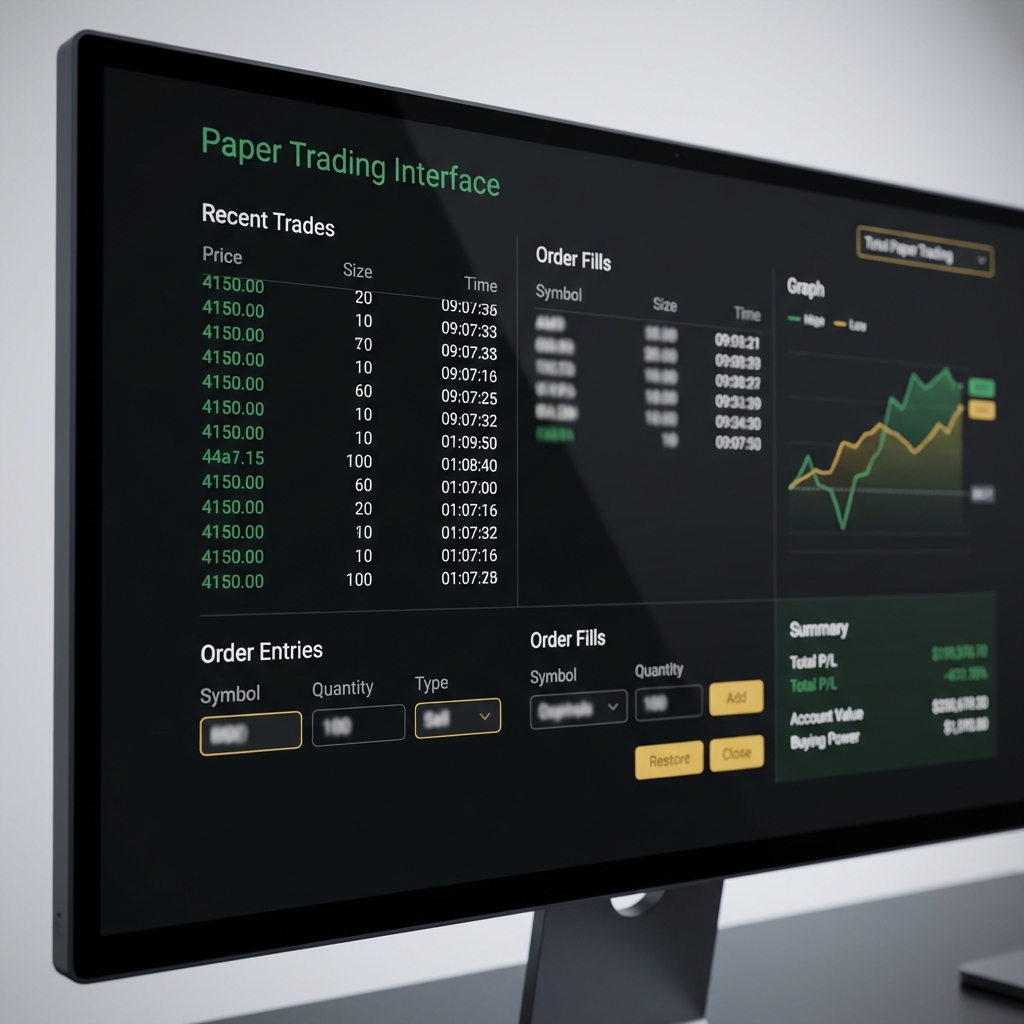
Paper trading lets you test strategies and platform mechanics with virtual money. Many beginners ask “how should a beginner start trading?” and jump straight to the demo – which is smart, but demos are imperfect. Simulators often miss slippage, partial fills and the emotional reality of losing money.
How to make paper trading useful
Simulate friction: subtract a few cents or a percentage from ideal fills, delay fills sometimes, and record emotional reactions in a trading journal. Treat the simulator like real money to build disciplined habits. If you want to know exactly how to start trading, make paper trading part of a documented learning plan with measurable goals and a timeline for moving live.
Paper trading has prepared you when your simulator includes realistic friction, you’ve traded consistently across market conditions, and you can follow your rules for dozens of trades without emotional deviations — that behavioral consistency is the key sign you’re ready.
Paper trading has prepared you when your simulator results include realistic friction, you’ve traded across different market conditions, and you can follow your rules consistently for dozens of trades without emotional deviations. The goal is behavioral consistency, not a perfect profit number.
Step 6 – Risk management: position sizing and stops
Risk management answers the heart of “how should a beginner start trading?” Position sizing decides how much of your capital you’ll risk on any one trade. Many traders follow the simple rule of risking 1% or less of total capital on a single idea. For example, with a $10,000 account and a 1% risk, you accept losing $100 on a trade. Set your stop loss level accordingly and calculate shares so that the worst-case loss equals your chosen dollar risk.
Stop losses: a stop loss limits downside but must reflect normal volatility. Placing stops based on recent price behavior or volatility (rather than arbitrary dollar amounts) often works better. The logic is simple: protect capital first; small, planned losses beat surprise large ones.
Step 7 – Leverage and margin: a caution
When people ask “how should a beginner start trading?” a strongly conservative answer is to avoid leverage until you have a proven, consistent strategy in simulation. Margin magnifies both gains and losses and carries borrowing costs. Many retail traders underperform broad benchmarks; leverage accelerates that underperformance. Start small and avoid margin until your approach reliably makes sense on paper and in low-risk live conditions.
Step 8 – Diversification and allocation
Diversification reduces the chance a single event ruins your account. For beginners, diversification means limiting capital in highly speculative short-term trades and keeping some allocation for longer-term holdings or cash. Also avoid putting too much faith in a single strategy until it has a track record across market regimes.
Step 9 – Realistic expectations and common outcomes
A key part of answering “how should a beginner start trading?” is understanding likely outcomes. Research consistently shows many active retail traders trade too often, accept more risk than they realize, and often underperform passive strategies after fees and slippage. That’s not to discourage you; it’s to emphasize caution: learn, simulate, keep strict risk rules, and treat early live trades as practice rather than profit-making attempts. Reporting from Reuters highlights how much retail flows changed markets in 2025, and surveys such as Schwab’s trader sentiment help show retail attitudes that influence behavior.
Common behavioural pitfalls
Overconfidence after a short winning streak, revenge trading after a loss, and size creep (increasing position size after gains) are frequent causes of ruin. A trading journal that logs emotions as well as trade mechanics is a powerful corrective.
Step 10 – How to open and fund an account
Practical steps: choose the right account type for your tax situation and goals, pick a regulated broker that’s transparent on fees and execution, and test the broker’s demo or educational materials before funding. Fund only an amount you can afford to lose, and keep emergency savings separate from trading capital.
Step 11 – Taxes and record keeping
Taxes can change net returns. Some countries tax short-term gains as ordinary income, others prefer long-term gains. Keep clear trade records, account statements, and notes about each trade’s purpose. If you expect to trade frequently, consult a tax professional early – taxes can affect strategy and record practices.
Step 12 – Moving from paper to live trading
Transition carefully. If your paper plan used a 1% risk per trade, consider reducing that to 0.5% or less when you first go live. Scale up only after you have documented consistency and preserved capital. Continue journaling: reasons for entry, stop placement, time horizon and emotional state. Use the journal to refine rules and spot biases.
Practical platform tips
Practice order entry until it’s second nature, double-check symbols and order types before submitting, and watch liquidity and market hours. Avoid market orders in thinly traded securities. Understand how your broker displays margin and heed their warnings. For broker comparisons, our M1 Finance vs Robinhood piece is a helpful read on features and tradeoffs.
Concrete examples that answer “how should a beginner start trading?”
Example 1: You have $5,000 and are willing to risk 1% on a trade. You find a stock at $50 and set a stop at $45 (a $5 drop). Buying 10 shares means the worst-case loss is $50, which equals 1% of your account. If you used margin to buy 100 shares, that same $5 move would cost $500 – far more risk than planned.
Example 2: Use paper trading to rehearse this same scenario, then add slippage of $0.10 per share and occasionally delay fills. That rehearsal helps you anticipate execution surprises.
Sample beginner trading checklist
Use this checklist before every live trade:
1) Verify the idea fits your written strategy.
2) Confirm position size keeps risk ≤ chosen percent of capital.
3) Set a stop and target before entering.
4) Check liquidity and market hours.
5) Double-check the symbol and order type.
6) Log the trade in your journal immediately (reason, stop, time horizon).
Journaling prompts that help
Write down: Why did I enter? What do I expect to happen and by when? Where is my stop and why? How do I feel right now? Reviewing these notes weekly reveals patterns and emotional triggers.
Strategies beginners should avoid
Avoid high-frequency strategies, heavy margin use, and complex derivatives until you’ve built skill and capital. These approaches require advanced technology and expertise. Instead, focus on simple, repeatable ideas and disciplined execution.
Real stories – lessons you can borrow
Many traders learn fastest from others’ mistakes. One novice increased size after a few wins and then lost two months of gains on a sudden reversal. His recovery came when he returned to paper trading, relearned position sizing, and only scaled after consistent discipline. Stories like this illustrate that rules are written to be broken – and therefore must be respected even more.
Tools and resources to get started
Good starting points include regulator education pages (SEC, FINRA, FCA depending on jurisdiction), broker demos, and plain-language sites that focus on basics rather than hype. If you want a structured checklist and readable lessons, FinancePolice’s guides are created for readers who prefer clear, practical steps without industry jargon. Keep an eye out for the FinancePolice logo when you return to those resources.
How much capital should you risk at the beginning?
No single correct answer exists. A conservative rule is to risk a small, fixed percent – often 1% or less – and treat early live trades as advanced practice. If trading capital would strain your finances, delay live trading. The goal is learning and emotional calibration, not early profits.
Measuring progress
Track process metrics more than profit metrics at first: number of rule-followed trades, consistency of stops, journaling discipline, and how well you follow position sizing. Profits may follow later; the right metric early on is repeatable behavior.
Common questions, answered simply
Will paper trading prepare me fully for live trading?
Paper trading helps with mechanics and timing but often underestimates emotion. To narrow the gap, simulate slippage and treat the demo like real money. If you can follow rules in a realistic simulator across many trades, you are closer to readiness.
How soon should I expect profit?
There are no guarantees. Many traders take months or years to develop consistent profitability; some never do. Treat early trades as experiments and focus on the process of learning.
When should I increase position sizes?
Increase size only after a documented record of success across market conditions and while keeping per-trade risk small relative to account size.
Checklist for choosing a broker
Regulation and custody, fee transparency, execution quality, educational materials and demo accounts, account types and tax reporting, and responsive customer service. Test deposit and withdrawal methods before committing a large sum. For a broker app review and award context, see this write-up on ThinkTrader.
Notes on taxes
Tax rules differ widely. Keep clean records and consult a tax professional when needed. Knowing tax rules early avoids surprises that can change strategy.
Final, practical steps to begin
1) Read and internalize basic market vocabulary.
2) Open a demo account and practice for weeks with realistic friction.
3) Write a one-page trading plan with position sizing and stop rules.
4) Fund a live account with only what you can afford to lose and start with smaller risk than in simulation.
5) Keep a journal and review weekly.
Extra tips for long-term learning
Keep learning but avoid overwhelm. Choose a single simple strategy and refine it. Read reputable investor education (regulators and trusted outlets), and treat each trade as a lesson. If you keep capital protection central, you’ll be in the game long enough to learn real skill.
Resources and next steps
Learning to trade is a marathon, not a sprint. Use checklists, practice with realistic demos, and keep strict risk control. For structured, plain-language materials that match the cautious, practical steps here, see the beginner resources at FinancePolice.
Get organized beginner resources to start trading safely
Ready for organized help? Discover practical checklists and beginner-friendly guides to support your next steps at FinancePolice — clear resources to help you practice safely and learn steadily.
Explore FinancePolice Guides
Short summary and encouragement
Answering the question “how should a beginner start trading?” comes down to learning, practicing, risk-managing, and moving to live trading slowly. Protect capital, practice with realistic friction, and make process the priority – profits may follow later.
Paper trading prepares you for platform mechanics, order types and basic timing, but it often underestimates emotional pressures and execution friction. To close the gap, intentionally simulate slippage, add delayed fills, follow your rules for dozens of trades and treat the demo like real money before moving live.
There’s no single correct amount. A commonly recommended rule is to risk 1% or less of your trading capital per trade; when first going live, consider reducing that further to 0.5% to account for emotional differences. Only use money you can afford to lose and keep emergency savings separate.
Choose a broker that’s regulated in your jurisdiction, separates customer funds from company assets, and discloses fees and execution practices. Test their demo account, confirm deposit and withdrawal methods, and check customer service responsiveness before funding significant sums.
References
- https://financepolice.com/
- https://financepolice.com/advertise/
- https://news.nd.edu/news/investor-attention-on-individual-stocks-can-predict-marketwide-performance/
- https://www.reuters.com/business/retail-investors-have-more-sway-over-wall-street-after-record-year-2025-12-23/
- https://www.aboutschwab.com/schwab-trader-client-sentiment-survey-q4-2025
- https://financepolice.com/category/investing/
- https://financepolice.com/best-micro-investment-apps/
- https://financepolice.com/m1-finance-vs-robinhood/
- https://financepolice.com/thinkmarkets-thinktrader-platform-wins-best-trading-app-award/
Ayrıca Şunları da Beğenebilirsiniz

Trading time: Tonight, the US GDP and the upcoming non-farm data will become the market focus. Institutions are bullish on BTC to $120,000 in the second quarter.

Polygon Tops RWA Rankings With $1.1B in Tokenized Assets
