DeFi protocols must move beyond “patch-after-the-hack” security and hard-code safety guarantees into their software if the $168 billion sector is to mature, accordingDeFi protocols must move beyond “patch-after-the-hack” security and hard-code safety guarantees into their software if the $168 billion sector is to mature, according

A16z Crypto wants DeFi to ditch ‘code is law’ for ‘spec is law’ to combat $649m exploit problem

2026/01/20 02:13

DeFi protocols must move beyond “patch-after-the-hack” security and hard-code safety guarantees into their software if the $168 billion sector is to mature, according to a16z Crypto.

In a January 11 post, Daejun Park, a senior security researcher at the firm, argued that DeFi developers should adopt a more principled approach to security instead of relying on trial and error.

At the core of that shift, Park said, is the use of standardised specifications that constrain what a protocol is allowed to do, and automatically revert any transaction that violates those predefined assumptions about correct behaviour.

“Almost every exploit to date would have tripped one of these checks during execution, potentially halting the hack,” Park said. “So the once-popular idea of ‘code is law’ evolves into ‘spec is law.’”

Such an idea, sometimes referred to as runtime enforcement or invariant checks, isn’t new. But it’s getting a fresh look as DeFi protocols struggle to defend against hackers exploiting bugs in their code.

Last year, hackers swiped over $649 million through code exploits according to a report from Slowmist, a blockchain security firm.

Even battle-tested protocols like Balancer, whose code had been live on the Ethereum blockchain since 2021, were not immune. It lost $128 million in November after a hacker exploited a code bug.

In recent months, DeFi developers fear hackers are increasingly using artificial intelligence to find DeFi protocol vulnerabilities and exploit them.

‘Not the silver bullet’

Park’s suggestions, if widely adopted, could go a long way in preventing exploits. But they’re not without downsides.

DeFi protocols often gain an edge over their competitors by having the cheapest fees. Adding extra checks on transactions would increase gas costs, potentially losing them users, Gonçalo Magalhães, head of security at Immunefi, told DL News.

Magalhães said invariant checks are a great security strategy, but they can’t account for everything — especially exploits that a protocol’s developers can’t reasonably anticipate. “It’s not the silver bullet,” he said.

It’s also tricky to get the checks to work properly, Felix Wilhelm, co-founder of Asymmetric Research, a crypto security firm, told DL News.

“For many vulnerabilities and real-life hacks, it is difficult or even impossible to write an invariant that detects the hack without also triggering under normal circumstances,” he said.

Wilhelm said runtime enforcement is an important part of protocol security. But it is typically used to detect anomalies, like an unusual flow of funds in a short timeframe.

“While helpful, this often serves only to limit impact or alert the team, rather than stopping the attack outright,” he said.

Many protocols are already adopting invariant checks.

Kamino, a Solana-based lending protocol, began checking for critical invariants using Certora Prover in March last year.

The XRP Ledger, the blockchain behind the $120 billion XRP token, has also implemented invariant checking. The blockchain’s developers said the checks are necessary because XRP Ledger is complicated, and there is a high potential for code to execute incorrectly.

“Invariants should not trigger, but they ensure the XRP Ledger’s integrity from bugs yet to be discovered or even created,” XRP Ledger developers said.

Tim Craig is DL News’ Edinburgh-based DeFi Correspondent. Reach out with tips at tim@dlnews.com.

Piyasa Fırsatı
DeFi Logosu
DeFi Fiyatı(DEFI)
$0.000498
$0.000498$0.000498
-2.16%
USD
DeFi (DEFI) Canlı Fiyat Grafiği
Sorumluluk Reddi: Bu sitede yeniden yayınlanan makaleler, halka açık platformlardan alınmıştır ve yalnızca bilgilendirme amaçlıdır. MEXC'nin görüşlerini yansıtmayabilir. Tüm hakları telif sahiplerine aittir. Herhangi bir içeriğin üçüncü taraf haklarını ihlal ettiğini düşünüyorsanız, kaldırılması için lütfen service@support.mexc.com ile iletişime geçin. MEXC, içeriğin doğruluğu, eksiksizliği veya güncelliği konusunda hiçbir garanti vermez ve sağlanan bilgilere dayalı olarak alınan herhangi bir eylemden sorumlu değildir. İçerik, finansal, yasal veya diğer profesyonel tavsiye niteliğinde değildir ve MEXC tarafından bir tavsiye veya onay olarak değerlendirilmemelidir.

Ayrıca Şunları da Beğenebilirsiniz

The Channel Factories We’ve Been Waiting For

The Channel Factories We’ve Been Waiting For

The post The Channel Factories We’ve Been Waiting For appeared on BitcoinEthereumNews.com. Visions of future technology are often prescient about the broad strokes while flubbing the details. The tablets in “2001: A Space Odyssey” do indeed look like iPads, but you never see the astronauts paying for subscriptions or wasting hours on Candy Crush.  Channel factories are one vision that arose early in the history of the Lightning Network to address some challenges that Lightning has faced from the beginning. Despite having grown to become Bitcoin’s most successful layer-2 scaling solution, with instant and low-fee payments, Lightning’s scale is limited by its reliance on payment channels. Although Lightning shifts most transactions off-chain, each payment channel still requires an on-chain transaction to open and (usually) another to close. As adoption grows, pressure on the blockchain grows with it. The need for a more scalable approach to managing channels is clear. Channel factories were supposed to meet this need, but where are they? In 2025, subnetworks are emerging that revive the impetus of channel factories with some new details that vastly increase their potential. They are natively interoperable with Lightning and achieve greater scale by allowing a group of participants to open a shared multisig UTXO and create multiple bilateral channels, which reduces the number of on-chain transactions and improves capital efficiency. Achieving greater scale by reducing complexity, Ark and Spark perform the same function as traditional channel factories with new designs and additional capabilities based on shared UTXOs.  Channel Factories 101 Channel factories have been around since the inception of Lightning. A factory is a multiparty contract where multiple users (not just two, as in a Dryja-Poon channel) cooperatively lock funds in a single multisig UTXO. They can open, close and update channels off-chain without updating the blockchain for each operation. Only when participants leave or the factory dissolves is an on-chain transaction…
Paylaş
BitcoinEthereumNews2025/09/18 00:09
Franklin Templeton CEO Dismisses 50bps Rate Cut Ahead FOMC
Franklin Templeton CEO Dismisses 50bps Rate Cut Ahead FOMC

The post Franklin Templeton CEO Dismisses 50bps Rate Cut Ahead FOMC appeared on BitcoinEthereumNews.com. Franklin Templeton CEO Jenny Johnson has weighed in on whether the Federal Reserve should make a 25 basis points (bps) Fed rate cut or 50 bps cut. This comes ahead of the Fed decision today at today’s FOMC meeting, with the market pricing in a 25 bps cut. Bitcoin and the broader crypto market are currently trading flat ahead of the rate cut decision. Franklin Templeton CEO Weighs In On Potential FOMC Decision In a CNBC interview, Jenny Johnson said that she expects the Fed to make a 25 bps cut today instead of a 50 bps cut. She acknowledged the jobs data, which suggested that the labor market is weakening. However, she noted that this data is backward-looking, indicating that it doesn’t show the current state of the economy. She alluded to the wage growth, which she remarked is an indication of a robust labor market. She added that retail sales are up and that consumers are still spending, despite inflation being sticky at 3%, which makes a case for why the FOMC should opt against a 50-basis-point Fed rate cut. In line with this, the Franklin Templeton CEO said that she would go with a 25 bps rate cut if she were Jerome Powell. She remarked that the Fed still has the October and December FOMC meetings to make further cuts if the incoming data warrants it. Johnson also asserted that the data show a robust economy. However, she noted that there can’t be an argument for no Fed rate cut since Powell already signaled at Jackson Hole that they were likely to lower interest rates at this meeting due to concerns over a weakening labor market. Notably, her comment comes as experts argue for both sides on why the Fed should make a 25 bps cut or…
Paylaş
BitcoinEthereumNews2025/09/18 00:36
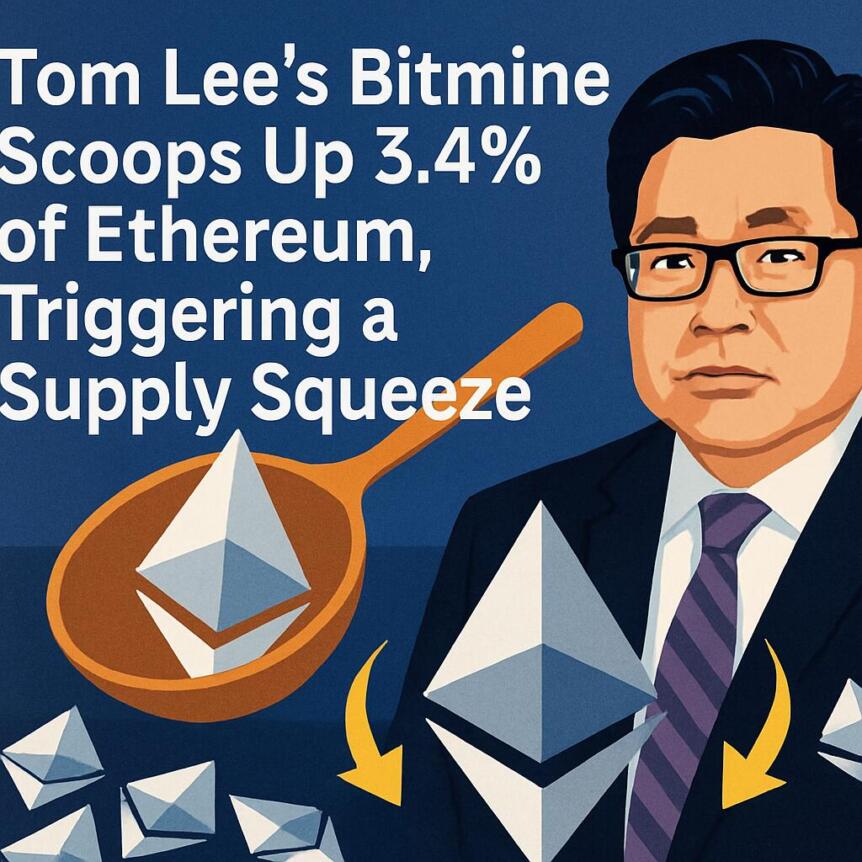
Tom Lee’s Bitmine Scoops Up 3.4% of Ethereum, Triggering a Supply Squeeze

Tom Lee’s Bitmine Scoops Up 3.4% of Ethereum, Triggering a Supply Squeeze

Bitmine Immersion now controls 3.4% of Ethereum amid shrinking exchange supply and rising institutional accumulation.
Paylaş
Crypto Breaking News2026/01/20 16:27