The Bitcoin price edged down a fraction of a percent in the past 24 hours to trade at $90,293 as of 11:11 a.m. EST on [...]The Bitcoin price edged down a fraction of a percent in the past 24 hours to trade at $90,293 as of 11:11 a.m. EST on [...]

Bitcoin Price Edges Down As Traders Brace For Bank Of Japan To Hike Interest Rates To 30-Year High

2025/12/14 17:31

The Bitcoin price edged down a fraction of a percent in the past 24 hours to trade at $90,293 as of 11:11 a.m. EST on trading volume that dropped 28% to $50.8 billion.

BTC has been trading in a tight $91,000 zone as traders brace for the Bank of Japan (BoJ) to hike interest rates this week. Nikkei Asia reported that the BoJ will hike rates by 25 basis points to 0.75% on Dec. 19, the highest level in about 30 years.

That’s driving renewed concerns over the potential impact on risk assets worldwide.

The yield on Japan’s benchmark 10-year bond surged to 1.917% on Thursday, the highest since 2007, impacting investor sentiment across the globe.

In the past, the country’s low interest rates have acted as a base for cheap global liquidity, allowing funds to deploy capital into higher-risk assets such as equities and crypto.

Bitcoin Price In A Consolidation Phase, Holds Key Support

The BTC price has corrected after reaching an all-time high of $126,230, marked by a sequence of lower highs and increasing selling pressure on the 3-day timeframe.

The decline accelerated once the Bitcoin price lost the $105,000–$110,000 region, an area that previously acted as strong support around the 50-day Simple Moving Average (SMA).

The 50-day SMA (currently near $108,640) is now acting as the long-term resistance level, capping any upside attempts.

BTC eventually found demand in the $85,000 zone, which closely aligns with the 200-day SMA ($88,975), a key long-term trend indicator that often acts as a bull-market support level.

Following the selloff, Bitcoin has staged a recovery, pushing its price above the $90,000. However, the price of BTC now trades in a consolidation phase between $89,000 and $94,000.

Recent candles suggest selling pressure is easing, as downside momentum slows and BTC begins to stabilize above the recent swing low.

Meanwhile, the Relative Strength Index (RSI) is hovering around 36–37, remaining below the neutral 50 level, which indicates weak momentum.
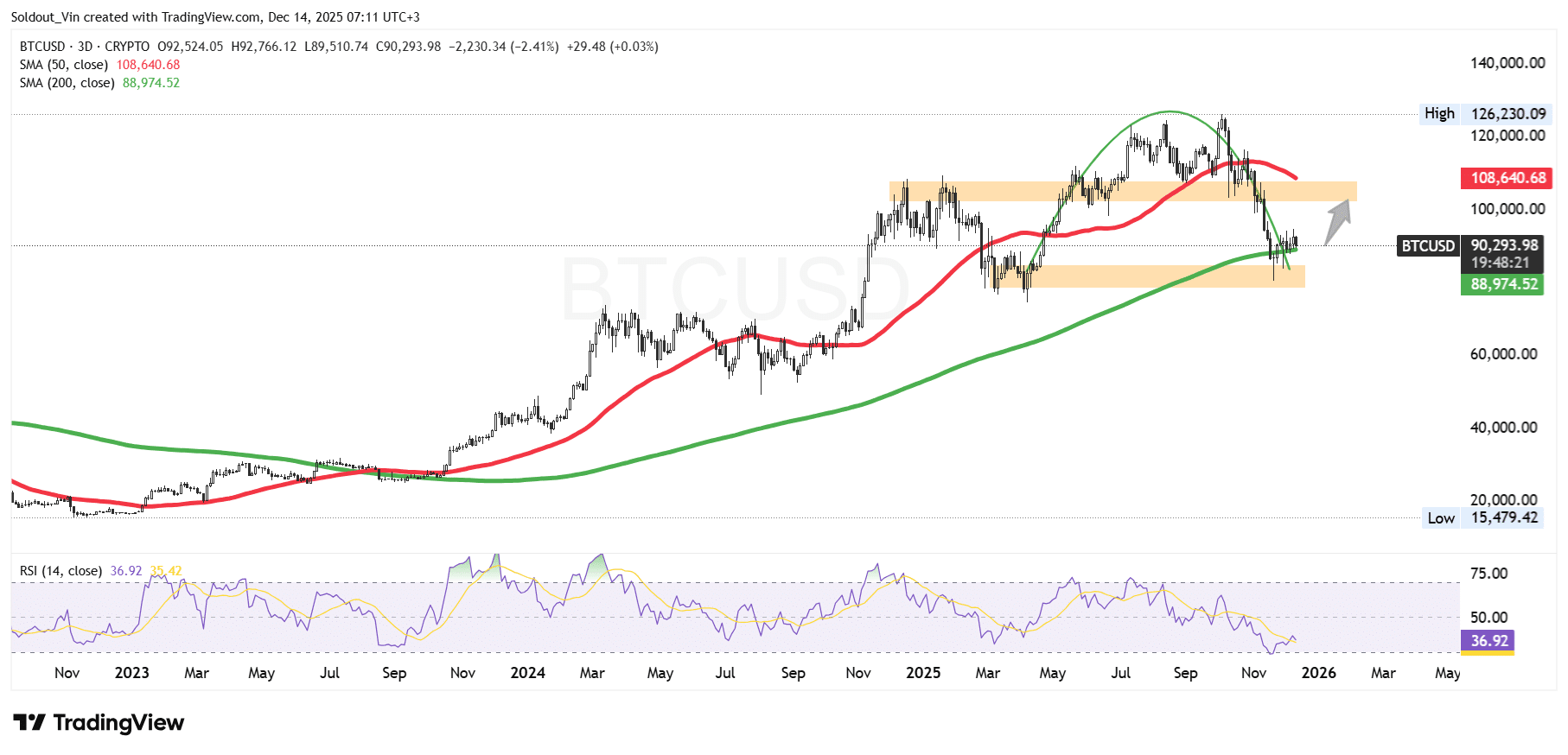
BTC/USD Chart Analysis Source: TradingViewBTC/USD Chart Analysis Source: TradingView

BTC Price Prediction

According to the BTC/USD chart analysis, the BTC price appears to be consolidating above a major long-term support zone after a sharp corrective move from the $126,230 cycle high.

If Bitcoin manages to maintain support above the current demand zone and reclaim the $100,000 psychological level, the price could attempt a recovery toward the $105,000–$108,000 region, where the 50-period SMA and prior support-turned-resistance are located.

On the downside, if BTC fails to hold the $85,000 support zone and sellers regain control, the price could resume its corrective trend, with the next downside target sitting near the $75,000–$78,000 region.

Piyasa Fırsatı
Lorenzo Protocol Logosu
Lorenzo Protocol Fiyatı(BANK)
$0.03779
$0.03779$0.03779
+1.64%
USD
Lorenzo Protocol (BANK) Canlı Fiyat Grafiği
Sorumluluk Reddi: Bu sitede yeniden yayınlanan makaleler, halka açık platformlardan alınmıştır ve yalnızca bilgilendirme amaçlıdır. MEXC'nin görüşlerini yansıtmayabilir. Tüm hakları telif sahiplerine aittir. Herhangi bir içeriğin üçüncü taraf haklarını ihlal ettiğini düşünüyorsanız, kaldırılması için lütfen service@support.mexc.com ile iletişime geçin. MEXC, içeriğin doğruluğu, eksiksizliği veya güncelliği konusunda hiçbir garanti vermez ve sağlanan bilgilere dayalı olarak alınan herhangi bir eylemden sorumlu değildir. İçerik, finansal, yasal veya diğer profesyonel tavsiye niteliğinde değildir ve MEXC tarafından bir tavsiye veya onay olarak değerlendirilmemelidir.

Ayrıca Şunları da Beğenebilirsiniz

Son of filmmaker Rob Reiner charged with homicide for death of his parents

Son of filmmaker Rob Reiner charged with homicide for death of his parents

FILE PHOTO: Rob Reiner, director of "The Princess Bride," arrives for a special 25th anniversary viewing of the film during the New York Film Festival in New York
Paylaş
Rappler2025/12/16 09:59
Addressing the sustainability question: The Web3 energy narrative

Addressing the sustainability question: The Web3 energy narrative

The post Addressing the sustainability question: The Web3 energy narrative appeared on BitcoinEthereumNews.com. contributor Posted: September 22, 2025 The environmental impact of blockchain technology remains a significant public concern in September 2025. For Web3 to achieve widespread legitimacy, it must present a credible narrative and technological path towards sustainability. The models pioneered by Oraichain, Pinlink, and RSS3 showcase how decentralized networks can be designed for efficiency and can contribute to a more sustainable digital economy. Oraichain, as a sovereign Layer 1, is built on a Delegated Proof-of-Stake (DPoS) consensus mechanism. This is inherently more energy-efficient than the Proof-of-Work systems that drew early criticism. By design, its security model relies on economic staking rather than raw computational power, allowing the network to process complex AI computations with a minimal energy footprint compared to its predecessors, aligning its operations with a greener Web3. Pinlink’s DePIN model promotes a more efficient use of existing hardware resources. The relentless construction of massive, power-hungry data centers by tech giants is a major source of energy consumption. Pinlink’s approach is to unlock the value in dormant or underutilized GPUs already in circulation around the world. This “recycling” of computing capacity reduces the need for new hardware manufacturing and makes the overall digital infrastructure ecosystem more resource-efficient. RSS3 contributes to sustainability through its distributed and lightweight design. Unlike a centralized data indexer that requires massive, concentrated server farms, the RSS3 network is run by a global collection of independent nodes. These nodes can be operated on low-power, consumer-grade hardware, distributing the energy load and avoiding the inefficiencies of large-scale, centralized data centers. This architectural choice makes its information layer inherently more sustainable and resilient. Disclaimer: This is a paid post and should not be treated as news/advice. Next: As Bitcoin’s sell pressure grows, are investors seeking safety in altcoins? Source: https://ambcrypto.com/addressing-the-sustainability-question-the-web3-energy-narrative/
Paylaş
BitcoinEthereumNews2025/09/23 09:02
Alcohol Still Leads Restaurant Beverage Orders, According To Harris Poll

Alcohol Still Leads Restaurant Beverage Orders, According To Harris Poll

The post Alcohol Still Leads Restaurant Beverage Orders, According To Harris Poll appeared on BitcoinEthereumNews.com. A new Harris Poll reveals millennials and Gen X still drive alcohol sales in restaurants, while Gen Z mixes drinks, formats, and expectations. Alcohol may still be the default for many American diners, but the latest Harris Poll suggests drinking habits are shifting. While older generations continue to reach for beer, wine, and cocktails, Gen Z is redefining what it means to drink out, focusing more on flexibility, aesthetics, and mood than tradition. Millennials are still loyal alcohol buyers when dining out, but Gen Z’s beverage habits are harder to pin down, according to new Harris Poll data. getty What the new Harris Poll reveals about U.S. beverage behavior In a nationally representative survey conducted by Harris in partnership with eMarketer, 36 percent of Americans reported that alcohol is their preferred restaurant beverage, slightly ahead of soda at 29 percent and water at 21 percent. But in practice, the most commonly ordered items are still non-alcoholic: 89 percent said they ordered water in the past 30 days, and 78 percent ordered soda. Alcohol remains a strong presence, with 69 percent of diners saying they ordered at least one alcoholic drink recently. Cocktails topped the alcohol category, followed by beer, spirits, and wine. While the overall preference is clear, the details begin to diverge once you look at generational breakdowns. Millennials still drive alcohol sales, especially with repeat orders Millennials continue to be the most reliable customers for restaurants selling alcohol. Fifty percent say alcohol is their default drink when dining out, compared to just 25 percent of Gen Z. They also reported significantly more repeat orders over the past month—especially for beer, spirits, and wine. This makes millennials a priority for alcohol brands and on-premise sales strategies. Libby Rodney, the Chief Strategy Officer at The Harris Poll, explained it this…
Paylaş
BitcoinEthereumNews2025/09/24 02:21