World Liberty Financial (WLFI), the Trump-linked DeFi project, is scrambling to stop a market collapse after its token lost over 50% of its value in September. On Friday, the project unveiled a full buyback-and-burn program, directing all treasury liquidity fees to absorb selling pressure. According to a governance post on X, the community approved the plan overwhelmingly, with WLFI pledging full transparency for every burn. The urgency of the move reflects WLFI’s steep losses in recent weeks. WLFI is trading Friday at $0.19, down from its September 1 peak of $0.46, according to CoinMarketCap, a 58% drop in less than a month. Weekly losses stand at 12.85%, with a 15.45% decline for the month. This isn’t the project’s first attempt at intervention. Just days after launch, WLFI burned 47 million tokens on September 3 to counter a 31% sell-off, sending the supply to a verified burn address. For World Liberty Financial, the buyback-and-burn program represents both a damage-control measure and a test of community faith. While tokenomics adjustments can provide short-term relief, the project will need to convince investors that WLFI has staying power beyond interventions. WLFI Launches Buyback-and-Burn Plan, Linking Token Scarcity to Platform Growth According to the governance proposal, WLFI will use fees generated from its protocol-owned liquidity (POL) pools on Ethereum, BNB Chain, and Solana to repurchase tokens from the open market. Once bought back, the tokens will be sent to a burn address, permanently removing them from circulation.WLFI Proposal Source: WLFI The project stressed that this system ties supply reduction directly to platform growth. As trading activity rises, more liquidity fees are generated, fueling larger buybacks and burns. This seeks to create a feedback loop where adoption drives scarcity, and scarcity strengthens token value. Importantly, the plan applies only to WLFI’s protocol-controlled liquidity pools. Community and third-party liquidity pools remain unaffected, ensuring the mechanism doesn’t interfere with external ecosystem contributions. In its proposal, the WLFI team argued that the strategy aligns long-term holders with the project’s future by systematically reducing supply and discouraging short-term speculation. Each burn increases the relative stake of committed investors, reinforcing confidence in WLFI’s tokenomics. To bolster credibility, WLFI has pledged full transparency: every buyback and burn will be verifiable on-chain and reported to the community in real time. WLFI Joins Hyperliquid, Jupiter, and Sky as Buyback Craze Spills Into Wall Street WLFI’s decision to adopt a full buyback-and-burn strategy places it among the most ambitious tokenomic models in crypto. While partly a response to its sharp September price decline, the move also reflects a trend of DeFi protocols leveraging revenue streams to cut supply, align incentives, and strengthen token value. Hyperliquid illustrates the model at scale. Nearly all of its platform fees are funneled into automated $HYPE buybacks via its Assistance Fund, creating sustained demand. By mid-2025, more than 20 million tokens had been repurchased, with nearly 30 million held by Q3, worth over $1.5 billion. This consistency both increased scarcity and cemented Hyperliquid’s dominance in decentralized derivatives. Other protocols have adopted variations. Jupiter directs half its fees into $JUP repurchases, locking tokens for three years. Raydium earmarks 12% of fees for $RAY buybacks, already removing 71 million tokens, roughly a quarter of the circulating supply. Burn-based models push further, as seen with Sky, which has spent $75 million since February 2025 to permanently erase $SKY tokens, boosting scarcity and governance influence. But the buyback phenomenon isn’t limited to DeFi. Increasingly, listed companies with crypto treasuries are adopting aggressive repurchase programs, sometimes to offset losses as their digital assets decline. According to a report, at least seven firms, ranging from gaming to biotech, have turned to buybacks, often funded by debt, to prop up falling stock prices. One of the latest is Thumzup Media, a digital advertising company with a growing Web3 footprint. On Thursday, it launched a $10 million share repurchase plan, extending its capital return strategy through 2026, after completing a $1 million program that saw 212,432 shares bought at an average of $4.71. DeFi Development Corp, the first public company built around a Solana-based treasury strategy, also recently expanded its buyback program to $100 million, up from $1 million, making it one of the largest stock repurchase initiatives in the digital asset sector. Together, these cases show how buybacks, whether in tokenomics or equities, are emerging as a key mechanism for stabilizing value and signaling confidence, even as motivations and execution vary widelyWorld Liberty Financial (WLFI), the Trump-linked DeFi project, is scrambling to stop a market collapse after its token lost over 50% of its value in September. On Friday, the project unveiled a full buyback-and-burn program, directing all treasury liquidity fees to absorb selling pressure. According to a governance post on X, the community approved the plan overwhelmingly, with WLFI pledging full transparency for every burn. The urgency of the move reflects WLFI’s steep losses in recent weeks. WLFI is trading Friday at $0.19, down from its September 1 peak of $0.46, according to CoinMarketCap, a 58% drop in less than a month. Weekly losses stand at 12.85%, with a 15.45% decline for the month. This isn’t the project’s first attempt at intervention. Just days after launch, WLFI burned 47 million tokens on September 3 to counter a 31% sell-off, sending the supply to a verified burn address. For World Liberty Financial, the buyback-and-burn program represents both a damage-control measure and a test of community faith. While tokenomics adjustments can provide short-term relief, the project will need to convince investors that WLFI has staying power beyond interventions. WLFI Launches Buyback-and-Burn Plan, Linking Token Scarcity to Platform Growth According to the governance proposal, WLFI will use fees generated from its protocol-owned liquidity (POL) pools on Ethereum, BNB Chain, and Solana to repurchase tokens from the open market. Once bought back, the tokens will be sent to a burn address, permanently removing them from circulation.WLFI Proposal Source: WLFI The project stressed that this system ties supply reduction directly to platform growth. As trading activity rises, more liquidity fees are generated, fueling larger buybacks and burns. This seeks to create a feedback loop where adoption drives scarcity, and scarcity strengthens token value. Importantly, the plan applies only to WLFI’s protocol-controlled liquidity pools. Community and third-party liquidity pools remain unaffected, ensuring the mechanism doesn’t interfere with external ecosystem contributions. In its proposal, the WLFI team argued that the strategy aligns long-term holders with the project’s future by systematically reducing supply and discouraging short-term speculation. Each burn increases the relative stake of committed investors, reinforcing confidence in WLFI’s tokenomics. To bolster credibility, WLFI has pledged full transparency: every buyback and burn will be verifiable on-chain and reported to the community in real time. WLFI Joins Hyperliquid, Jupiter, and Sky as Buyback Craze Spills Into Wall Street WLFI’s decision to adopt a full buyback-and-burn strategy places it among the most ambitious tokenomic models in crypto. While partly a response to its sharp September price decline, the move also reflects a trend of DeFi protocols leveraging revenue streams to cut supply, align incentives, and strengthen token value. Hyperliquid illustrates the model at scale. Nearly all of its platform fees are funneled into automated $HYPE buybacks via its Assistance Fund, creating sustained demand. By mid-2025, more than 20 million tokens had been repurchased, with nearly 30 million held by Q3, worth over $1.5 billion. This consistency both increased scarcity and cemented Hyperliquid’s dominance in decentralized derivatives. Other protocols have adopted variations. Jupiter directs half its fees into $JUP repurchases, locking tokens for three years. Raydium earmarks 12% of fees for $RAY buybacks, already removing 71 million tokens, roughly a quarter of the circulating supply. Burn-based models push further, as seen with Sky, which has spent $75 million since February 2025 to permanently erase $SKY tokens, boosting scarcity and governance influence. But the buyback phenomenon isn’t limited to DeFi. Increasingly, listed companies with crypto treasuries are adopting aggressive repurchase programs, sometimes to offset losses as their digital assets decline. According to a report, at least seven firms, ranging from gaming to biotech, have turned to buybacks, often funded by debt, to prop up falling stock prices. One of the latest is Thumzup Media, a digital advertising company with a growing Web3 footprint. On Thursday, it launched a $10 million share repurchase plan, extending its capital return strategy through 2026, after completing a $1 million program that saw 212,432 shares bought at an average of $4.71. DeFi Development Corp, the first public company built around a Solana-based treasury strategy, also recently expanded its buyback program to $100 million, up from $1 million, making it one of the largest stock repurchase initiatives in the digital asset sector. Together, these cases show how buybacks, whether in tokenomics or equities, are emerging as a key mechanism for stabilizing value and signaling confidence, even as motivations and execution vary widely

Trump-Backed WLFI Plunges 58% – Buyback Plan Announced to Halt Freefall

2025/09/26 19:12

World Liberty Financial (WLFI), the Trump-linked DeFi project, is scrambling to stop a market collapse after its token lost over 50% of its value in September.

On Friday, the project unveiled a full buyback-and-burn program, directing all treasury liquidity fees to absorb selling pressure. According to a governance post on X, the community approved the plan overwhelmingly, with WLFI pledging full transparency for every burn.

The urgency of the move reflects WLFI’s steep losses in recent weeks. WLFI is trading Friday at $0.19, down from its September 1 peak of $0.46, according to CoinMarketCap, a 58% drop in less than a month. Weekly losses stand at 12.85%, with a 15.45% decline for the month.

This isn’t the project’s first attempt at intervention. Just days after launch, WLFI burned 47 million tokens on September 3 to counter a 31% sell-off, sending the supply to a verified burn address.

For World Liberty Financial, the buyback-and-burn program represents both a damage-control measure and a test of community faith. While tokenomics adjustments can provide short-term relief, the project will need to convince investors that WLFI has staying power beyond interventions.

WLFI Launches Buyback-and-Burn Plan, Linking Token Scarcity to Platform Growth

According to the governance proposal, WLFI will use fees generated from its protocol-owned liquidity (POL) pools on Ethereum, BNB Chain, and Solana to repurchase tokens from the open market. Once bought back, the tokens will be sent to a burn address, permanently removing them from circulation.
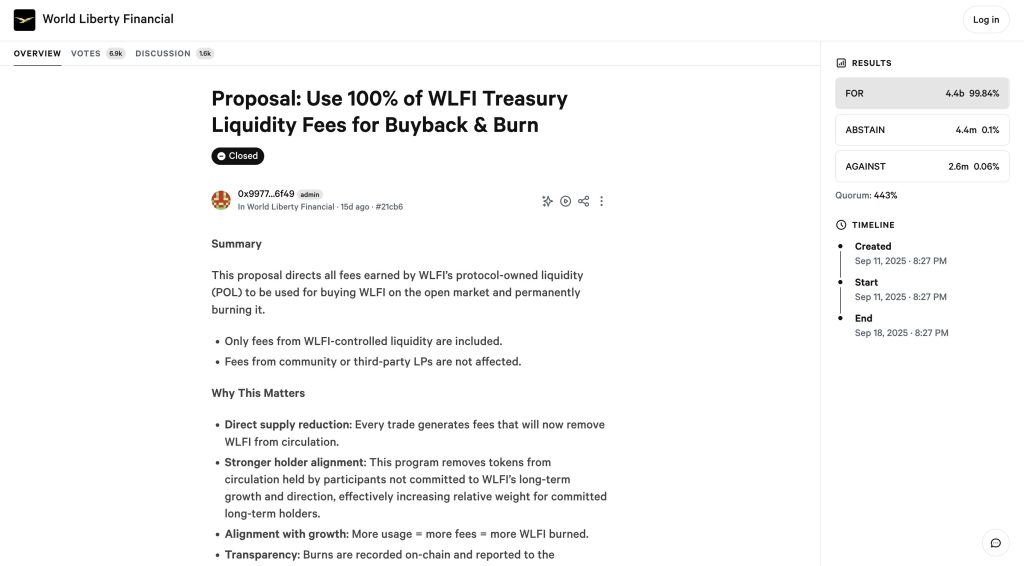
WLFI Proposal Source: WLFI

The project stressed that this system ties supply reduction directly to platform growth. As trading activity rises, more liquidity fees are generated, fueling larger buybacks and burns. This seeks to create a feedback loop where adoption drives scarcity, and scarcity strengthens token value.

Importantly, the plan applies only to WLFI’s protocol-controlled liquidity pools. Community and third-party liquidity pools remain unaffected, ensuring the mechanism doesn’t interfere with external ecosystem contributions.

In its proposal, the WLFI team argued that the strategy aligns long-term holders with the project’s future by systematically reducing supply and discouraging short-term speculation. Each burn increases the relative stake of committed investors, reinforcing confidence in WLFI’s tokenomics.

To bolster credibility, WLFI has pledged full transparency: every buyback and burn will be verifiable on-chain and reported to the community in real time.

WLFI Joins Hyperliquid, Jupiter, and Sky as Buyback Craze Spills Into Wall Street

WLFI’s decision to adopt a full buyback-and-burn strategy places it among the most ambitious tokenomic models in crypto. While partly a response to its sharp September price decline, the move also reflects a trend of DeFi protocols leveraging revenue streams to cut supply, align incentives, and strengthen token value.

Hyperliquid illustrates the model at scale. Nearly all of its platform fees are funneled into automated $HYPE buybacks via its Assistance Fund, creating sustained demand.

By mid-2025, more than 20 million tokens had been repurchased, with nearly 30 million held by Q3, worth over $1.5 billion. This consistency both increased scarcity and cemented Hyperliquid’s dominance in decentralized derivatives.

Other protocols have adopted variations. Jupiter directs half its fees into $JUP repurchases, locking tokens for three years.

Raydium earmarks 12% of fees for $RAY buybacks, already removing 71 million tokens, roughly a quarter of the circulating supply.

Burn-based models push further, as seen with Sky, which has spent $75 million since February 2025 to permanently erase $SKY tokens, boosting scarcity and governance influence.

But the buyback phenomenon isn’t limited to DeFi. Increasingly, listed companies with crypto treasuries are adopting aggressive repurchase programs, sometimes to offset losses as their digital assets decline.

According to a report, at least seven firms, ranging from gaming to biotech, have turned to buybacks, often funded by debt, to prop up falling stock prices.

One of the latest is Thumzup Media, a digital advertising company with a growing Web3 footprint. On Thursday, it launched a $10 million share repurchase plan, extending its capital return strategy through 2026, after completing a $1 million program that saw 212,432 shares bought at an average of $4.71.

DeFi Development Corp, the first public company built around a Solana-based treasury strategy, also recently expanded its buyback program to $100 million, up from $1 million, making it one of the largest stock repurchase initiatives in the digital asset sector.

Together, these cases show how buybacks, whether in tokenomics or equities, are emerging as a key mechanism for stabilizing value and signaling confidence, even as motivations and execution vary widely.

Piyasa Fırsatı
OFFICIAL TRUMP Logosu
OFFICIAL TRUMP Fiyatı(TRUMP)
$5.22
$5.22$5.22
-2.39%
USD
OFFICIAL TRUMP (TRUMP) Canlı Fiyat Grafiği
Sorumluluk Reddi: Bu sitede yeniden yayınlanan makaleler, halka açık platformlardan alınmıştır ve yalnızca bilgilendirme amaçlıdır. MEXC'nin görüşlerini yansıtmayabilir. Tüm hakları telif sahiplerine aittir. Herhangi bir içeriğin üçüncü taraf haklarını ihlal ettiğini düşünüyorsanız, kaldırılması için lütfen service@support.mexc.com ile iletişime geçin. MEXC, içeriğin doğruluğu, eksiksizliği veya güncelliği konusunda hiçbir garanti vermez ve sağlanan bilgilere dayalı olarak alınan herhangi bir eylemden sorumlu değildir. İçerik, finansal, yasal veya diğer profesyonel tavsiye niteliğinde değildir ve MEXC tarafından bir tavsiye veya onay olarak değerlendirilmemelidir.

Ayrıca Şunları da Beğenebilirsiniz

The Channel Factories We’ve Been Waiting For

The Channel Factories We’ve Been Waiting For

The post The Channel Factories We’ve Been Waiting For appeared on BitcoinEthereumNews.com. Visions of future technology are often prescient about the broad strokes while flubbing the details. The tablets in “2001: A Space Odyssey” do indeed look like iPads, but you never see the astronauts paying for subscriptions or wasting hours on Candy Crush.  Channel factories are one vision that arose early in the history of the Lightning Network to address some challenges that Lightning has faced from the beginning. Despite having grown to become Bitcoin’s most successful layer-2 scaling solution, with instant and low-fee payments, Lightning’s scale is limited by its reliance on payment channels. Although Lightning shifts most transactions off-chain, each payment channel still requires an on-chain transaction to open and (usually) another to close. As adoption grows, pressure on the blockchain grows with it. The need for a more scalable approach to managing channels is clear. Channel factories were supposed to meet this need, but where are they? In 2025, subnetworks are emerging that revive the impetus of channel factories with some new details that vastly increase their potential. They are natively interoperable with Lightning and achieve greater scale by allowing a group of participants to open a shared multisig UTXO and create multiple bilateral channels, which reduces the number of on-chain transactions and improves capital efficiency. Achieving greater scale by reducing complexity, Ark and Spark perform the same function as traditional channel factories with new designs and additional capabilities based on shared UTXOs.  Channel Factories 101 Channel factories have been around since the inception of Lightning. A factory is a multiparty contract where multiple users (not just two, as in a Dryja-Poon channel) cooperatively lock funds in a single multisig UTXO. They can open, close and update channels off-chain without updating the blockchain for each operation. Only when participants leave or the factory dissolves is an on-chain transaction…
Paylaş
BitcoinEthereumNews2025/09/18 00:09
SOLANA NETWORK Withstands 6 Tbps DDoS Without Downtime

SOLANA NETWORK Withstands 6 Tbps DDoS Without Downtime

The post SOLANA NETWORK Withstands 6 Tbps DDoS Without Downtime appeared on BitcoinEthereumNews.com. In a pivotal week for crypto infrastructure, the Solana network
Paylaş
BitcoinEthereumNews2025/12/16 20:44
Crucial Fed Rate Cut: October Probability Surges to 94%

Crucial Fed Rate Cut: October Probability Surges to 94%

BitcoinWorld Crucial Fed Rate Cut: October Probability Surges to 94% The financial world is buzzing with a significant development: the probability of a Fed rate cut in October has just seen a dramatic increase. This isn’t just a minor shift; it’s a monumental change that could ripple through global markets, including the dynamic cryptocurrency space. For anyone tracking economic indicators and their impact on investments, this update from the U.S. interest rate futures market is absolutely crucial. What Just Happened? Unpacking the FOMC Statement’s Impact Following the latest Federal Open Market Committee (FOMC) statement, market sentiment has decisively shifted. Before the announcement, the U.S. interest rate futures market had priced in a 71.6% chance of an October rate cut. However, after the statement, this figure surged to an astounding 94%. This jump indicates that traders and analysts are now overwhelmingly confident that the Federal Reserve will lower interest rates next month. Such a high probability suggests a strong consensus emerging from the Fed’s latest communications and economic outlook. A Fed rate cut typically means cheaper borrowing costs for businesses and consumers, which can stimulate economic activity. But what does this really signify for investors, especially those in the digital asset realm? Why is a Fed Rate Cut So Significant for Markets? When the Federal Reserve adjusts interest rates, it sends powerful signals across the entire financial ecosystem. A rate cut generally implies a more accommodative monetary policy, often enacted to boost economic growth or combat deflationary pressures. Impact on Traditional Markets: Stocks: Lower interest rates can make borrowing cheaper for companies, potentially boosting earnings and making stocks more attractive compared to bonds. Bonds: Existing bonds with higher yields might become more valuable, but new bonds will likely offer lower returns. Dollar Strength: A rate cut can weaken the U.S. dollar, making exports cheaper and potentially benefiting multinational corporations. Potential for Cryptocurrency Markets: The cryptocurrency market, while often seen as uncorrelated, can still react significantly to macro-economic shifts. A Fed rate cut could be interpreted as: Increased Risk Appetite: With traditional investments offering lower returns, investors might seek higher-yielding or more volatile assets like cryptocurrencies. Inflation Hedge Narrative: If rate cuts are perceived as a precursor to inflation, assets like Bitcoin, often dubbed “digital gold,” could gain traction as an inflation hedge. Liquidity Influx: A more accommodative monetary environment generally means more liquidity in the financial system, some of which could flow into digital assets. Looking Ahead: What Could This Mean for Your Portfolio? While the 94% probability for a Fed rate cut in October is compelling, it’s essential to consider the nuances. Market probabilities can shift, and the Fed’s ultimate decision will depend on incoming economic data. Actionable Insights: Stay Informed: Continue to monitor economic reports, inflation data, and future Fed statements. Diversify: A diversified portfolio can help mitigate risks associated with sudden market shifts. Assess Risk Tolerance: Understand how a potential rate cut might affect your specific investments and adjust your strategy accordingly. This increased likelihood of a Fed rate cut presents both opportunities and challenges. It underscores the interconnectedness of traditional finance and the emerging digital asset space. Investors should remain vigilant and prepared for potential volatility. The financial landscape is always evolving, and the significant surge in the probability of an October Fed rate cut is a clear signal of impending change. From stimulating economic growth to potentially fueling interest in digital assets, the implications are vast. Staying informed and strategically positioned will be key as we approach this crucial decision point. The market is now almost certain of a rate cut, and understanding its potential ripple effects is paramount for every investor. Frequently Asked Questions (FAQs) Q1: What is the Federal Open Market Committee (FOMC)? A1: The FOMC is the monetary policymaking body of the Federal Reserve System. It sets the federal funds rate, which influences other interest rates and economic conditions. Q2: How does a Fed rate cut impact the U.S. dollar? A2: A rate cut typically makes the U.S. dollar less attractive to foreign investors seeking higher returns, potentially leading to a weakening of the dollar against other currencies. Q3: Why might a Fed rate cut be good for cryptocurrency? A3: Lower interest rates can reduce the appeal of traditional investments, encouraging investors to seek higher returns in alternative assets like cryptocurrencies. It can also be seen as a sign of increased liquidity or potential inflation, benefiting assets like Bitcoin. Q4: Is a 94% probability a guarantee of a rate cut? A4: While a 94% probability is very high, it is not a guarantee. Market probabilities reflect current sentiment and data, but the Federal Reserve’s final decision will depend on all available economic information leading up to their meeting. Q5: What should investors do in response to this news? A5: Investors should stay informed about economic developments, review their portfolio diversification, and assess their risk tolerance. Consider how potential changes in interest rates might affect different asset classes and adjust strategies as needed. Did you find this analysis helpful? Share this article with your network to keep others informed about the potential impact of the upcoming Fed rate cut and its implications for the financial markets! To learn more about the latest crypto market trends, explore our article on key developments shaping Bitcoin price action. This post Crucial Fed Rate Cut: October Probability Surges to 94% first appeared on BitcoinWorld.
Paylaş
Coinstats2025/09/18 02:25