

Turning AI into a force for competitiveness in the Philippines

By Christophe Bahuet
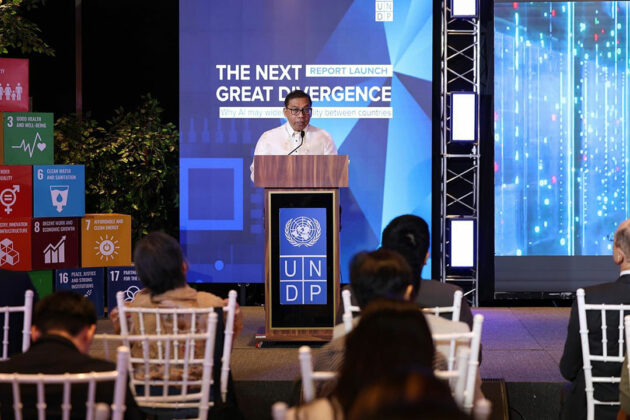
UNDP’S RECENT REPORT, “The Next Great Divergence,” underscores a defining challenge for countries across Asia and the Pacific: they are entering the AI era with uneven foundations and this may create a divide among them. Large gaps already exist in the region in infrastructure, skills, and governance systems creating a dual challenge — slower capture of benefits alongside wider exposure to disruption. Just like the Industrial Revolution, AI can be the next great divergence among countries.
Yet this divergence is not inevitable. It is first a matter of choice at a national level. The policy choices, investments, and institutions that countries put in place today will determine whether AI becomes a force for competitiveness and inclusion, or whether they are outpaced and left behind. This applies to the Philippines.
The country enters the AI era with strong momentum. In 2024, its digital economy contributed 8.5% of GDP and supported 23.1% of total employment — equivalent to 11.3 million jobs. Looking ahead, AI adoption across key industries could unlock an additional $50.7 billion in economic value by 2030.
This progress is underpinned by a strong policy drive led by the Department of Science and Technology and involving the Department of Trade and Industry, and the Department of Information and Communications Technology, among others. The completion of the country’s AI readiness assessment in 2026, the adoption of a National AI Strategy, alongside the recent establishment of the National Artificial Intelligence Center for Research and Innovation, reflects a clear vision and strong resolve to strengthen country’s AI ecosystem.
What lies ahead is translating this momentum into institutions and frameworks that ensure AI benefits all economic actors in the country and strengthens nationwide competitiveness. To achieve this, four strategic priorities stand out.
First, expanding affordable and reliable connectivity is a matter of urgency. With 67.25% of individuals using the internet, the Philippines is far behind Singapore and Malaysia, and below Thailand and Vietnam. Broadband costs remain high — at 11% of GNI per capita, nearly double the ASEAN average. Without improvements in connectivity and affordability, the benefits of AI in economic and social sectors will remain concentrated among those already connected. Education illustrates what is at risk. AI tools such as Khanmigo are already being deployed in the Philippines, but addressing gaps in connectivity, devices, and cost is critical to expanding their reach to millions more and prepare an AI-ready new generation.
Second, data must be mobilized as a public good for all economic actors and citizens. The persistence of “data deserts” can render communities and languages invisible, creating economic and social exclusion. AI systems rely on data, yet much of the information that could improve public services and the value chains remains fragmented. Without interoperability, secure sharing, and accountability, there is a risk of developing isolated AI applications that fail to yield benefits at scale, thus hampering national competitiveness.
Third, stronger governance is essential to enable inclusive and responsible AI development. As the Philippines develops its National AI Framework, it has a timely opportunity to align policies across sectors — such as energy — so the growing demand for computer and data infrastructure translates into affordable access for all, including MSMEs. While “sovereign AI” is increasingly discussed worldwide, developing countries must approach the concept pragmatically. The Philippines may not yet have the scale to build frontier models, but it can still secure meaningful sovereignty by strengthening AI systems and governance. In parallel and as ASEAN chair in 2026, the Philippines can champion regional cooperation — especially on shared computing infrastructure — to cut duplication, lower costs, and strengthen ASEAN’s collective voice in shaping AI.
Finally, developing skills for the entire Filipino population is critical. Time is of the essence as AI reshapes at high speed the nature of work and learning, requiring not only technical skills but also the ability to think critically, act creatively, and engage collaboratively. Making both the current workforce and the new generations AI-proficient is a high return on investment for the long-term competitiveness of the Philippine economy.
If these priorities are pursued with urgency — connectivity, data as a public good, governance that enables innovation with clear safeguards, pragmatic sovereign AI, and skills for all — the Philippines can turn AI into a driver of productivity, inclusion, and long-term competitiveness.
Christophe Bahuet is the UNDP resident representative in the Philippines.


Ayrıca Şunları da Beğenebilirsiniz

LDO Price Prediction: Neutral Consolidation Targets $0.33 Resistance Retest by Mid-April

Your crypto strategy should be about how much pain you can handle, not how much money you’ll make, Schwab finds




