Balancer will overhaul its tokenomics, planning to stop all new BAL issuing, and instead start buybacks.Balancer will overhaul its tokenomics, planning to stop all new BAL issuing, and instead start buybacks.

Balancer overhauls tokenomics after $116M hack, ending emissions to stabilize BAL and restore sustainability

2026/03/24 23:10
3 min read
For feedback or concerns regarding this content, please contact us at crypto.news@mexc.com

Balancer will overhaul its tokenomics in response to the late 2025 hack. The DeFi protocol, one of the most long-lived platforms, will change its reward system to stabilize the BAL token and rely on sustainable growth. 

Balancer has proposed a vote on a new reward system following the protocol’s difficulties after the November 2025 hack. As Cryptopolitan reported, Balancer was drained of $116M, with most of the funds targeting its wrapped ETH collaterals. 

Marcus Hardt, the CEO of Balancer Labs, remarked the months since the hack were one of the most difficult in Balancer’s history. The protocol shrank its total value locked to just around $158M, down from a peak of over $3B in 2022. 
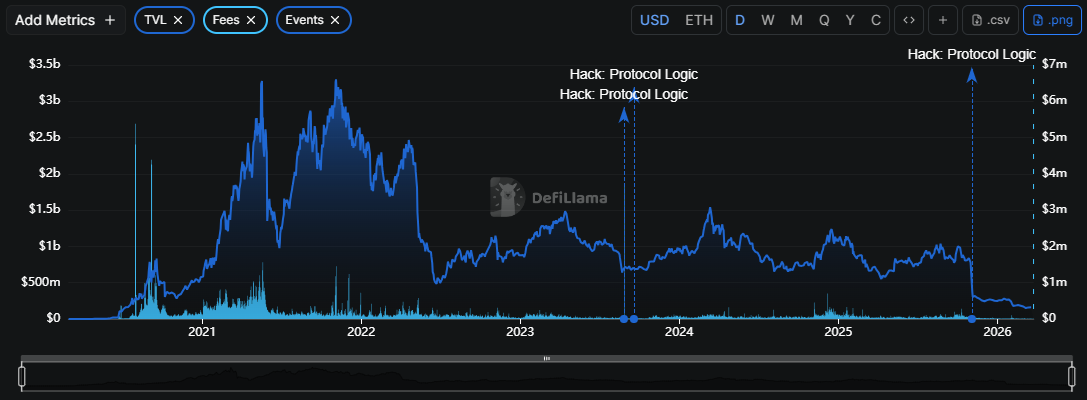
Balancer ends BAL emissions, rebuilds tokenomics after late 2025 hackBalancer was damaged by the second hack in its history, with fees and TVL falling near record lows after November 2025. | Source: DeFi Llama

We had the exploit, a long crisis response, a lot of difficult decisions, and some very painful conversations about what was and was not sustainable anymore. We also had to let go of people we deeply respect, not because they were not good enough, but because the structure around the protocol had stopped making sense,’ explained Hardt in an X post.

Balancer aims for more sustainable liquidity

Balancer is one of the few protocols to still rely on liquidity mining, with a long-term BAL unlock curve. Based on the current tokenomics, BAL production and unlocks were expected to continue on a gradual curve until 2034.

According to Hardt, the current model was too expensive for Balancer to attract liquidity. The protocol spent more on incentives than the revenue generated. Following the hack, daily Balancer fees fell below $15,000, making it harder for Balancer to survive in the DeFi space. Additionally, the protocol was diluting BAL holders, and the model no longer served the long-term survival of Balancer.

BAL holders to receive compensation

The new proposal aims to discontinue BAL emissions entirely, to be enforced immediately after the vote. Balancer will route 100% of fees to its treasury. Additionally, Balancer will move forward with a leaner operating structure and a smaller team. 

Holders of locked veBAL tokens may lose the most, so Balancer will try to offset the loss with buybacks and a compensation campaign. 

The proposal offers to reduce the V3 swap fee protocol share from 50% to 25%, so liquidity providers can retain a bigger share of fees, instead of receiving newly unlocked BAL. 

The veBAL locking program will also end immediately, with compensation for the holders of $500K. For users who want to abandon their positions, there will be a buyback at 35% of Treasury value, or around $3.6M in total exit liquidity. The burn and compensation may retire up to 35% of the BAL circulating supply. 

Balancer will also dismiss its DAO, which will stop receiving fee allocations. The day-to-day governance decisions will revert to the core team. Remaining veBAL and BAL holders will retain voting power on major decisions. 

BAL traded near an all-time low of $0.15, following the steep decline from last year’s hack. 

If you're reading this, you’re already ahead. Stay there with our newsletter.

Market Opportunity
balancer Logo
balancer Price(BAL)
$0.145
$0.145$0.145
-1.42%
USD
balancer (BAL) Live Price Chart
Disclaimer: The articles reposted on this site are sourced from public platforms and are provided for informational purposes only. They do not necessarily reflect the views of MEXC. All rights remain with the original authors. If you believe any content infringes on third-party rights, please contact crypto.news@mexc.com for removal. MEXC makes no guarantees regarding the accuracy, completeness, or timeliness of the content and is not responsible for any actions taken based on the information provided. The content does not constitute financial, legal, or other professional advice, nor should it be considered a recommendation or endorsement by MEXC.

You May Also Like

OpenVPP accused of falsely advertising cooperation with the US government; SEC commissioner clarifies no involvement

OpenVPP accused of falsely advertising cooperation with the US government; SEC commissioner clarifies no involvement

PANews reported on September 17th that on-chain sleuth ZachXBT tweeted that OpenVPP ( $OVPP ) announced this week that it was collaborating with the US government to advance energy tokenization. SEC Commissioner Hester Peirce subsequently responded, stating that the company does not collaborate with or endorse any private crypto projects. The OpenVPP team subsequently hid the response. Several crypto influencers have participated in promoting the project, and the accounts involved have been questioned as typical influencer accounts.
Share
PANews2025/09/17 23:58
China Blocks Nvidia’s RTX Pro 6000D as Local Chips Rise

China Blocks Nvidia’s RTX Pro 6000D as Local Chips Rise

The post China Blocks Nvidia’s RTX Pro 6000D as Local Chips Rise appeared on BitcoinEthereumNews.com. China Blocks Nvidia’s RTX Pro 6000D as Local Chips Rise China’s internet regulator has ordered the country’s biggest technology firms, including Alibaba and ByteDance, to stop purchasing Nvidia’s RTX Pro 6000D GPUs. According to the Financial Times, the move shuts down the last major channel for mass supplies of American chips to the Chinese market. Why Beijing Halted Nvidia Purchases Chinese companies had planned to buy tens of thousands of RTX Pro 6000D accelerators and had already begun testing them in servers. But regulators intervened, halting the purchases and signaling stricter controls than earlier measures placed on Nvidia’s H20 chip. Image: Nvidia An audit compared Huawei and Cambricon processors, along with chips developed by Alibaba and Baidu, against Nvidia’s export-approved products. Regulators concluded that Chinese chips had reached performance levels comparable to the restricted U.S. models. This assessment pushed authorities to advise firms to rely more heavily on domestic processors, further tightening Nvidia’s already limited position in China. China’s Drive Toward Tech Independence The decision highlights Beijing’s focus on import substitution — developing self-sufficient chip production to reduce reliance on U.S. supplies. “The signal is now clear: all attention is focused on building a domestic ecosystem,” said a representative of a leading Chinese tech company. Nvidia had unveiled the RTX Pro 6000D in July 2025 during CEO Jensen Huang’s visit to Beijing, in an attempt to keep a foothold in China after Washington restricted exports of its most advanced chips. But momentum is shifting. Industry sources told the Financial Times that Chinese manufacturers plan to triple AI chip production next year to meet growing demand. They believe “domestic supply will now be sufficient without Nvidia.” What It Means for the Future With Huawei, Cambricon, Alibaba, and Baidu stepping up, China is positioning itself for long-term technological independence. Nvidia, meanwhile, faces…

Share
BitcoinEthereumNews2025/09/18 01:37
Top 10 Meme Coins 2026 Investors Can’t Ignore: How Early Crypto Presales Are Driving the Next Bull Run

Top 10 Meme Coins 2026 Investors Can’t Ignore: How Early Crypto Presales Are Driving the Next Bull Run

Market excitement is intensifying as momentum builds around Pudgy Penguins ($PENGU), SPX6900 ($SPX), Cheems ($CHEEMS), Official Trump ($TRUMP), Apeing ($APEING),
Share
Timestabloid2026/03/28 01:15
