In a wide-ranging CoinDesk interview released yesterday, Cardano founder Charles Hoskinson sharpened a years-long critique of Ethereum’s long-term viability, arguing that the network’s reliance on rollups and external scaling layers has created economic incentives that will ultimately hollow out the base chain. While acknowledging Ethereum’s technical progress, he contended that “as a general-purpose, smart-contract ledger,” the project has nurtured an ecosystem that “will slowly but surely eat [it] alive.” Why Ethereum Is Doomed To Fail: Cardano Founder Hoskinson framed the core problem as one of misaligned incentives between Ethereum’s L1 and its expanding constellation of L2s. “To make Ethereum better, they’ve had to embrace layer twos,” he said. “The layer twos are not strong allies… they’re partners of necessity.” In his view, rollup teams “don’t particularly care if they’re attached to Solana or they become a layer one,” so if better economics or user growth lie elsewhere, “they could simply migrate or go multi-chain.” New applications and liquidity, he added, are already “outside of the Ethereum ecosystem,” eroding the network’s historical network effects. Related Reading: Cardano Pushes Past $0.85: Falling Wedge Breakout Confirmed? “So if they’re gobbling up the transaction volume and gobbling up the users and they’re gobbling up the token appreciation, if there’s a more attractive target, they could simply migrate or go multi-chain,” Hoskinson said, adding that this trend is already observable with LayerZero and Espresso. That erosion, Hoskinson argued, is set to accelerate as two external forces gather momentum. First, he described Bitcoin DeFi as a “sleeping giant” that could attract “hundreds of billions” in total value once primitives such as stablecoins, DEXs and lending are built with credible security assumptions. “When Bitcoin wakes up… its TVL will be… larger than the market cap of Ethereum,” he said, noting that sovereigns and major asset managers would likely prefer to build around Bitcoin exposure. Second, he expects large technology platforms and traditional financial institutions to enter with their own infrastructure, adjacent to public chains but not economically dependent on Ethereum’s base layer—“Microsoft… Google… Amazon… have no incentive to go boost Ethereum or deploy on Ethereum,” he said. The technological arc, in Hoskinson’s telling, also tilts away from shared-state blockchains. As zero-knowledge proofs and “proof-carrying code” mature, more computation can be executed off-chain—in secure enclaves, on devices, or within MPC systems—leaving the chain to verify succinct proofs. “Why… spend billions of dollars a year maintaining this very weak computer that’s shared and replicated,” he asked, “when you can turn it into a distributed problem that runs everywhere?” Like Microsoft missing mobile and pivoting from Windows dominance to Azure, he suggested, Ethereum may ultimately need to “pivot to a new McGuffin” to retain relevance even if it remains present in the stack. Related Reading: Cardano Sentiment Crashes To 5-Month Low As ADA Defends Key Price Level Notably, Hoskinson’s assessment was not unqualified dismissal. He credited Ethereum for “keeping up with the times,” investing in rollups and zero-knowledge technology, and building a “Goliath” ecosystem that survived early funding scares and the DAO crisis. “They’ve done some really incredible things,” he said, and he allowed that “it’s entirely possible that Ethereum could pivot… and get very good at that” new role. The nub of his skepticism is not competence but structure: in his view, the more rollups succeed, the less compelling the L1 becomes as the economic hub. The remarks reprise and elaborate on a stance Hoskinson aired earlier this year, when he said during an AMA: “I don’t think Ethereum will survive more than 10 to 15 years,” predicting that L2s would “suckle out all of the alpha.” Hoskinson’s analysis also folds into his own current bets for Cardano. He cast Bitcoin-centric DeFi as a three-rule design target—security derived from Bitcoin, fees paid in Bitcoin, and yields returned in Bitcoin—and argued that companion chains and trust-minimized bridges will be necessary to make it work. He presented Cardano’s extended-UTXO design and its privacy sidechain Midnight as infrastructure positioned to serve that market while offering selective-disclosure compliance for institutions. At press time, ADA traded at $0.89. Featured image created with DALL.E, chart from TradingView.comIn a wide-ranging CoinDesk interview released yesterday, Cardano founder Charles Hoskinson sharpened a years-long critique of Ethereum’s long-term viability, arguing that the network’s reliance on rollups and external scaling layers has created economic incentives that will ultimately hollow out the base chain. While acknowledging Ethereum’s technical progress, he contended that “as a general-purpose, smart-contract ledger,” the project has nurtured an ecosystem that “will slowly but surely eat [it] alive.” Why Ethereum Is Doomed To Fail: Cardano Founder Hoskinson framed the core problem as one of misaligned incentives between Ethereum’s L1 and its expanding constellation of L2s. “To make Ethereum better, they’ve had to embrace layer twos,” he said. “The layer twos are not strong allies… they’re partners of necessity.” In his view, rollup teams “don’t particularly care if they’re attached to Solana or they become a layer one,” so if better economics or user growth lie elsewhere, “they could simply migrate or go multi-chain.” New applications and liquidity, he added, are already “outside of the Ethereum ecosystem,” eroding the network’s historical network effects. Related Reading: Cardano Pushes Past $0.85: Falling Wedge Breakout Confirmed? “So if they’re gobbling up the transaction volume and gobbling up the users and they’re gobbling up the token appreciation, if there’s a more attractive target, they could simply migrate or go multi-chain,” Hoskinson said, adding that this trend is already observable with LayerZero and Espresso. That erosion, Hoskinson argued, is set to accelerate as two external forces gather momentum. First, he described Bitcoin DeFi as a “sleeping giant” that could attract “hundreds of billions” in total value once primitives such as stablecoins, DEXs and lending are built with credible security assumptions. “When Bitcoin wakes up… its TVL will be… larger than the market cap of Ethereum,” he said, noting that sovereigns and major asset managers would likely prefer to build around Bitcoin exposure. Second, he expects large technology platforms and traditional financial institutions to enter with their own infrastructure, adjacent to public chains but not economically dependent on Ethereum’s base layer—“Microsoft… Google… Amazon… have no incentive to go boost Ethereum or deploy on Ethereum,” he said. The technological arc, in Hoskinson’s telling, also tilts away from shared-state blockchains. As zero-knowledge proofs and “proof-carrying code” mature, more computation can be executed off-chain—in secure enclaves, on devices, or within MPC systems—leaving the chain to verify succinct proofs. “Why… spend billions of dollars a year maintaining this very weak computer that’s shared and replicated,” he asked, “when you can turn it into a distributed problem that runs everywhere?” Like Microsoft missing mobile and pivoting from Windows dominance to Azure, he suggested, Ethereum may ultimately need to “pivot to a new McGuffin” to retain relevance even if it remains present in the stack. Related Reading: Cardano Sentiment Crashes To 5-Month Low As ADA Defends Key Price Level Notably, Hoskinson’s assessment was not unqualified dismissal. He credited Ethereum for “keeping up with the times,” investing in rollups and zero-knowledge technology, and building a “Goliath” ecosystem that survived early funding scares and the DAO crisis. “They’ve done some really incredible things,” he said, and he allowed that “it’s entirely possible that Ethereum could pivot… and get very good at that” new role. The nub of his skepticism is not competence but structure: in his view, the more rollups succeed, the less compelling the L1 becomes as the economic hub. The remarks reprise and elaborate on a stance Hoskinson aired earlier this year, when he said during an AMA: “I don’t think Ethereum will survive more than 10 to 15 years,” predicting that L2s would “suckle out all of the alpha.” Hoskinson’s analysis also folds into his own current bets for Cardano. He cast Bitcoin-centric DeFi as a three-rule design target—security derived from Bitcoin, fees paid in Bitcoin, and yields returned in Bitcoin—and argued that companion chains and trust-minimized bridges will be necessary to make it work. He presented Cardano’s extended-UTXO design and its privacy sidechain Midnight as infrastructure positioned to serve that market while offering selective-disclosure compliance for institutions. At press time, ADA traded at $0.89. Featured image created with DALL.E, chart from TradingView.com
Cardano Founder Hoskinson Says Ethereum Is Doomed To Fail: Here’s How

2025/09/11 10:00
4 min read

In a wide-ranging CoinDesk interview released yesterday, Cardano founder Charles Hoskinson sharpened a years-long critique of Ethereum’s long-term viability, arguing that the network’s reliance on rollups and external scaling layers has created economic incentives that will ultimately hollow out the base chain. While acknowledging Ethereum’s technical progress, he contended that “as a general-purpose, smart-contract ledger,” the project has nurtured an ecosystem that “will slowly but surely eat [it] alive.”

Why Ethereum Is Doomed To Fail: Cardano Founder

Hoskinson framed the core problem as one of misaligned incentives between Ethereum’s L1 and its expanding constellation of L2s. “To make Ethereum better, they’ve had to embrace layer twos,” he said. “The layer twos are not strong allies… they’re partners of necessity.”

In his view, rollup teams “don’t particularly care if they’re attached to Solana or they become a layer one,” so if better economics or user growth lie elsewhere, “they could simply migrate or go multi-chain.” New applications and liquidity, he added, are already “outside of the Ethereum ecosystem,” eroding the network’s historical network effects.

“So if they’re gobbling up the transaction volume and gobbling up the users and they’re gobbling up the token appreciation, if there’s a more attractive target, they could simply migrate or go multi-chain,” Hoskinson said, adding that this trend is already observable with LayerZero and Espresso.

That erosion, Hoskinson argued, is set to accelerate as two external forces gather momentum. First, he described Bitcoin DeFi as a “sleeping giant” that could attract “hundreds of billions” in total value once primitives such as stablecoins, DEXs and lending are built with credible security assumptions. “When Bitcoin wakes up… its TVL will be… larger than the market cap of Ethereum,” he said, noting that sovereigns and major asset managers would likely prefer to build around Bitcoin exposure.

Second, he expects large technology platforms and traditional financial institutions to enter with their own infrastructure, adjacent to public chains but not economically dependent on Ethereum’s base layer—“Microsoft… Google… Amazon… have no incentive to go boost Ethereum or deploy on Ethereum,” he said.

The technological arc, in Hoskinson’s telling, also tilts away from shared-state blockchains. As zero-knowledge proofs and “proof-carrying code” mature, more computation can be executed off-chain—in secure enclaves, on devices, or within MPC systems—leaving the chain to verify succinct proofs. “Why… spend billions of dollars a year maintaining this very weak computer that’s shared and replicated,” he asked, “when you can turn it into a distributed problem that runs everywhere?”

Like Microsoft missing mobile and pivoting from Windows dominance to Azure, he suggested, Ethereum may ultimately need to “pivot to a new McGuffin” to retain relevance even if it remains present in the stack.

Notably, Hoskinson’s assessment was not unqualified dismissal. He credited Ethereum for “keeping up with the times,” investing in rollups and zero-knowledge technology, and building a “Goliath” ecosystem that survived early funding scares and the DAO crisis. “They’ve done some really incredible things,” he said, and he allowed that “it’s entirely possible that Ethereum could pivot… and get very good at that” new role. The nub of his skepticism is not competence but structure: in his view, the more rollups succeed, the less compelling the L1 becomes as the economic hub.

The remarks reprise and elaborate on a stance Hoskinson aired earlier this year, when he said during an AMA: “I don’t think Ethereum will survive more than 10 to 15 years,” predicting that L2s would “suckle out all of the alpha.”

Hoskinson’s analysis also folds into his own current bets for Cardano. He cast Bitcoin-centric DeFi as a three-rule design target—security derived from Bitcoin, fees paid in Bitcoin, and yields returned in Bitcoin—and argued that companion chains and trust-minimized bridges will be necessary to make it work. He presented Cardano’s extended-UTXO design and its privacy sidechain Midnight as infrastructure positioned to serve that market while offering selective-disclosure compliance for institutions.

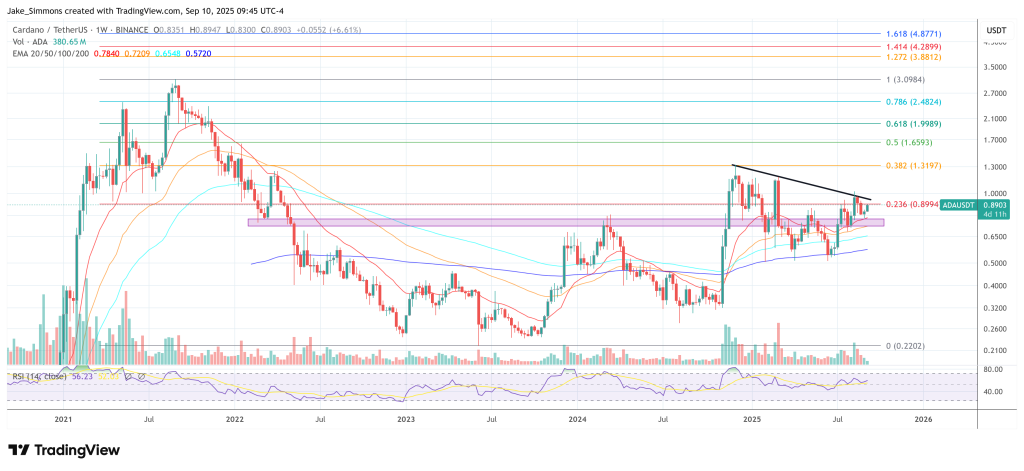
At press time, ADA traded at $0.89.

Cardano price
Market Opportunity
Threshold Logo
Threshold Price(T)
$0.006928
$0.006928$0.006928
-1.09%
USD
Threshold (T) Live Price Chart
Disclaimer: The articles reposted on this site are sourced from public platforms and are provided for informational purposes only. They do not necessarily reflect the views of MEXC. All rights remain with the original authors. If you believe any content infringes on third-party rights, please contact service@support.mexc.com for removal. MEXC makes no guarantees regarding the accuracy, completeness, or timeliness of the content and is not responsible for any actions taken based on the information provided. The content does not constitute financial, legal, or other professional advice, nor should it be considered a recommendation or endorsement by MEXC.

You May Also Like

Valour launches bitcoin staking ETP on London Stock Exchange

Valour launches bitcoin staking ETP on London Stock Exchange

The post Valour launches bitcoin staking ETP on London Stock Exchange appeared on BitcoinEthereumNews.com. Valour Digital Securities, a subsidiary of DeFi Technologies, has launched its Bitcoin Physical Staking exchange-traded product (ETP) on the London Stock Exchange, the firm announced on Friday. The listing expands Valour’s yield-bearing bitcoin product beyond mainland Europe, where it has traded since November 2024 on Germany’s Xetra market. The ETP is restricted to professional and institutional investors under current UK regulations, with retail access expected to open on October 8 under new Financial Conduct Authority rules. The product, listed under ticker 1VBS, is physically backed 1:1 by bitcoin held in cold storage with Copper, a regulated custodian. It offers an estimated annual yield of 1.4%, which is distributed by increasing the product’s net asset value (NAV). Yield is generated through a staking process that uses the Core Chain’s Satoshi Plus consensus mechanism. Rewards earned in CORE tokens are converted into bitcoin and added to the ETP’s holdings. Valour has emphasized that while the process involves short-term lockups during stake transactions, the underlying bitcoin is not subject to traditional staking risks such as slashing. The launch comes as the UK begins to loosen restrictions on crypto-linked investment products. Earlier this year, the Financial Conduct Authority moved toward allowing retail access to certain crypto exchange-traded notes and products, a shift that will test demand for regulated, yield-bearing bitcoin exposure. This is a developing story. This article was generated with the assistance of AI and reviewed by editor Jeffrey Albus before publication. Get the news in your inbox. Explore Blockworks newsletters: Source: https://blockworks.co/news/valour-launches-bitcoin-staking-etp
Share
BitcoinEthereumNews2025/09/20 02:48
USDT Transfer Stuns Market: $238 Million Whale Movement to Bitfinex Reveals Critical Patterns

USDT Transfer Stuns Market: $238 Million Whale Movement to Bitfinex Reveals Critical Patterns

BitcoinWorld USDT Transfer Stuns Market: $238 Million Whale Movement to Bitfinex Reveals Critical Patterns In a stunning development that captured global cryptocurrency
Share
bitcoinworld2026/02/06 21:45
The market value of NFTs has fallen back to pre-2021 levels, close to $1.5 billion.

The market value of NFTs has fallen back to pre-2021 levels, close to $1.5 billion.

PANews reported on February 6th, citing Cointelegraph, that the global NFT market capitalization has fallen below $1.5 billion, returning to pre-2021 levels. This
Share
PANews2026/02/06 21:13