Bitcoin (BTC) has just flashed a ‘Death Cross,’ a technical signal that has historically preceded major market bottoms. Market analyst CrypFlow, who identified Bitcoin (BTC) has just flashed a ‘Death Cross,’ a technical signal that has historically preceded major market bottoms. Market analyst CrypFlow, who identified

Bitcoin Just Flashed Death Cross That Has Led To Previous Bottoms, But What’s The Target?

2026/03/06 05:00
3 min read
For feedback or concerns regarding this content, please contact us at crypto.news@mexc.com

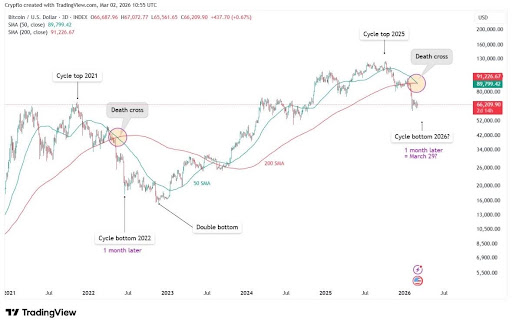
Bitcoin (BTC) has just flashed a ‘Death Cross,’ a technical signal that has historically preceded major market bottoms. Market analyst CrypFlow, who identified the chart pattern, notes that the current setup is unfolding almost identically to the 2022 bear market cycle. In his analysis, he outlines a potential price target for a Bitcoin bottom and shares what history suggests could come next if the death cross follows the same trajectory as in previous cycles. 

Bitcoin Death Cross Signals More Downside

CrypFlow shared his foreboding analysis on X, confirming a Death Cross on the three-day BTC chart that had previously signaled bear-market bottoms. The formation comes as Bitcoin faces significant selling pressure and market volatility, with investor sentiment down the drain and geopolitical tensions fueling more fear and panic, pushing holders to exit the market. 

CrypFlow has stated that the current Death Cross formed against a backdrop of Bitcoin trading around $66,200 at the time of the analysis, with the figure well below the 50 Simple Moving Average (SMA) at $89,799 and the 200 SMA at $91,226. The massive gap between the price and both moving averages underscores how aggressively the market has deteriorated since Bitcoin’s cycle top above $126,000 in October 2025. 
Bitcoin

The analyst draws a direct comparison between the current Death Cross and the 2022 bear market cycle, in which an identical Death Cross pattern preceded Bitcoin’s most devastating price crash to a final bottom. In that cycle, CrypFlow noted that the Death Cross formation came after reaching a peak above $66,000. 

Once Bitcoin reached this ATH level, it began trending downwards, forming a Death Cross, which eventually led to a final capitulation low one month later. Interestingly, the cryptocurrency experienced a Double Bottom after crashing again in 2023, with this final decline serving as the foundation for the next bull run. 

Analyst Shares BTC Bottom Target And Timeline

The Death Cross pattern is widely recognized as a bearish warning sign, indicating more pain ahead for Bitcoin. Following the 2022 cycle, when the market bottomed roughly one month after the cross was confirmed, CrypFlow has identified March 29, 2026, as a critical window to watch for Bitcoin’s potential price floor this cycle. He suggests a possible target near $50,000, framing the projected one-month timeframe as a historically informed inflection point rather than a guaranteed outcome.  

CrypFlow has outlined three distinct conditions it intends to monitor as that window approaches. The first is continued price weakness into late March, which could serve as a behavioral confirmation that the current cycle is mirroring past patterns. The second condition the analyst is watching for is evidence of seller exhaustion near the March 29 window. 

His third and perhaps most important condition is the reclaiming of key moving averages following any potential bottom. CrypFlow stressed that this reclaim should be viewed as confirmation of a completed bottom.

Bitcoin
Disclaimer: The articles reposted on this site are sourced from public platforms and are provided for informational purposes only. They do not necessarily reflect the views of MEXC. All rights remain with the original authors. If you believe any content infringes on third-party rights, please contact crypto.news@mexc.com for removal. MEXC makes no guarantees regarding the accuracy, completeness, or timeliness of the content and is not responsible for any actions taken based on the information provided. The content does not constitute financial, legal, or other professional advice, nor should it be considered a recommendation or endorsement by MEXC.

You May Also Like

Two companies account for 97% of the market, and transaction volume surges by 1100%: Predicting the reshaping of the market landscape and the next wave of entrepreneurial opportunities.

Two companies account for 97% of the market, and transaction volume surges by 1100%: Predicting the reshaping of the market landscape and the next wave of entrepreneurial opportunities.

Author: MetaHub Research Introduction: Redefining the Boundaries of Prediction Markets Prediction markets are markets that allow participants to trade on the outcomes
Share
PANews2026/03/06 08:30
The U.S. Securities and Exchange Commission (SEC) dismissed charges against Justin Sun and the Tron Foundation; Rainberry agreed to pay a $10 million fine.

The U.S. Securities and Exchange Commission (SEC) dismissed charges against Justin Sun and the Tron Foundation; Rainberry agreed to pay a $10 million fine.

PANews reported on March 6th that, according to The Block, the U.S. Securities and Exchange Commission (SEC) has dropped its 2023 charges against TRON founder Justin
Share
PANews2026/03/06 08:05
UK crypto holders brace for FCA’s expanded regulatory reach

UK crypto holders brace for FCA’s expanded regulatory reach

The post UK crypto holders brace for FCA’s expanded regulatory reach appeared on BitcoinEthereumNews.com. British crypto holders may soon face a very different landscape as the Financial Conduct Authority (FCA) moves to expand its regulatory reach in the industry. A new consultation paper outlines how the watchdog intends to apply its rulebook to crypto firms, shaping everything from asset safeguarding to trading platform operation. According to the financial regulator, these proposals would translate into clearer protections for retail investors and stricter oversight of crypto firms. UK FCA plans Until now, UK crypto users mostly encountered the FCA through rules on promotions and anti-money laundering checks. The consultation paper goes much further. It proposes direct oversight of stablecoin issuers, custodians, and crypto-asset trading platforms (CATPs). For investors, that means the wallets, exchanges, and coins they rely on could soon be subject to the same governance and resilience standards as traditional financial institutions. The regulator has also clarified that firms need official authorization before serving customers. This condition should, in theory, reduce the risk of sudden platform failures or unclear accountability. David Geale, the FCA’s executive director of payments and digital finance, said the proposals are designed to strike a balance between innovation and protection. He explained: “We want to develop a sustainable and competitive crypto sector – balancing innovation, market integrity and trust.” Geale noted that while the rules will not eliminate investment risks, they will create consistent standards, helping consumers understand what to expect from registered firms. Why does this matter for crypto holders? The UK regulatory framework shift would provide safer custody of assets, better disclosure of risks, and clearer recourse if something goes wrong. However, the regulator was also frank in its submission, arguing that no rulebook can eliminate the volatility or inherent risks of holding digital assets. Instead, the focus is on ensuring that when consumers choose to invest, they do…
Share
BitcoinEthereumNews2025/09/17 23:52
