

Enterprise Cloud Index: AI Drives Container Adoption but Silos and Shadow AI Create New Risks
The Enterprise Cloud Index makes one point clear. AI innovation is accelerating faster than enterprise readiness.
Is AI Quietly Reshaping Enterprise Infrastructure—and CX Along with It?
Imagine this scenario.
A company launches an AI-powered chatbot to reduce customer service wait times.
The tool promises faster answers and happier customers.
But within weeks, problems appear.
The AI tool pulls outdated product data.
Another department deploys a different AI assistant without IT approval.
Customer responses vary across channels.
Customers notice the inconsistency. Trust drops.
Behind the scenes, the real problem is not AI.
It is fragmented infrastructure and disconnected teams.
This scenario is becoming common across enterprises globally.
The latest findings from the Nutanix Enterprise Cloud Index (ECI) highlight a growing reality:
AI adoption is accelerating innovation—but also exposing gaps in enterprise infrastructure, governance, and collaboration.
For CX and EX leaders, these gaps directly affect experience delivery, trust, and operational agility.
What Is the Enterprise Cloud Index and Why CX Leaders Should Care?
The Enterprise Cloud Index (ECI) is a global research report that tracks enterprise cloud adoption, infrastructure modernisation, and AI readiness.
The latest study from Nutanix, conducted with Wakefield Research, surveyed 1,600 cloud, IT, and engineering leaders across 14 markets, including India.
For CX teams, the report matters because:
- Customer experiences depend on application speed and reliability
- AI-driven experiences require modern infrastructure
- Data governance impacts customer trust
When infrastructure fails, customer journeys break.
Why Is AI Driving Container Adoption Across Enterprises?
AI applications require scalable, portable infrastructure. Containers provide that foundation.
Containers package applications and dependencies together.
They allow software to run consistently across environments.
According to the report:
- 87% of global respondents say AI accelerates container adoption
- 97% of Indian enterprises expect container use to grow
- 82% already build new applications using containers
Containers allow enterprises to deploy AI workloads faster.
They also improve reliability and scalability.
As Lee Caswell, SVP of Product and Solutions Marketing at Nutanix, explains:
“Organisations need enterprise-grade security, resilience, and portability as AI workloads can run anywhere.”
For CX leaders, this infrastructure shift matters because:
- AI assistants need real-time data access
- Personalisation engines need scalable compute
- Omnichannel platforms require consistent deployment environments
Without containerisation, these experiences become difficult to scale.
Why Are Organisational Silos Becoming an AI Risk?
Silos between IT and business teams slow AI execution and create operational complexity.
The report reveals a striking insight:
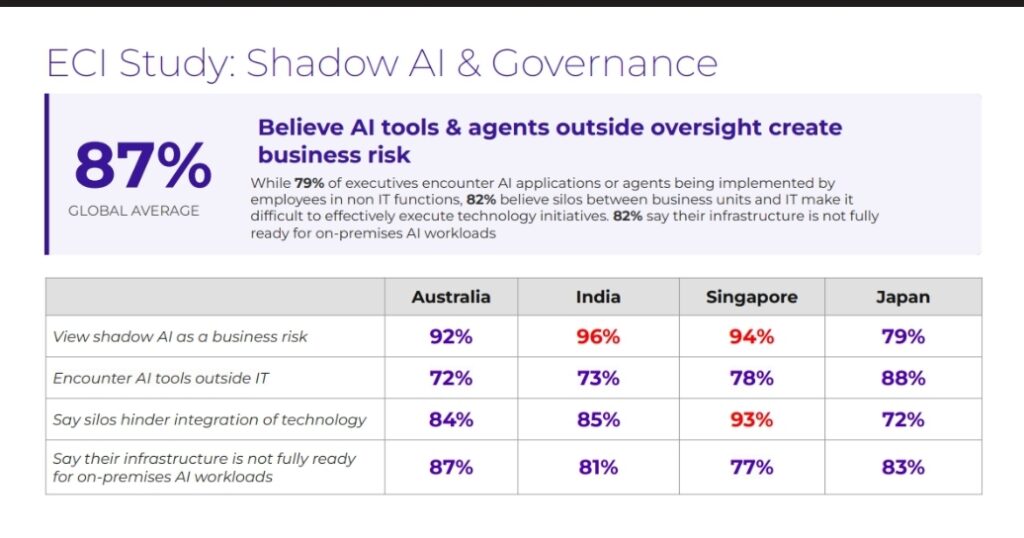
85% of Indian executives say organisational silos make technology execution difficult.
This fragmentation creates multiple problems:
- AI projects remain stuck in pilot phases
- Different departments deploy conflicting tools
- Customer data becomes fragmented across systems
According to Faiz Shakir, VP & Managing Director India & ASEAN at Nutanix:
For CX leaders, siloed operations often lead to:
- Disconnected customer journeys
- Inconsistent AI responses
- Slow product innovation
Breaking silos is therefore not just an IT challenge.
It is a customer experience imperative.
What Is Shadow AI—and Why Should CX Teams Be Concerned?
Shadow AI refers to AI tools or agents deployed by employees without official IT oversight.
The report highlights a rising concern:
- 73% of organisations report employees deploying AI tools independently
- 96% of Indian IT leaders believe this creates business risk
These risks include:
- Sensitive customer data exposure
- Compliance violations
- AI hallucinations affecting customer responses
For example, imagine a marketing team using an unofficial AI tool to generate customer communications.
If that tool:
- Uses unapproved data sources
- Generates incorrect information
- Stores customer data externally
The organisation faces reputational and regulatory risk.
Shadow AI grows when employees feel innovation barriers within IT processes.
The solution is not restriction alone.
It requires structured governance frameworks.
How Can AI Agents Transform Customer and Employee Experiences?
AI agents automate decision-making, task execution, and interactions across digital ecosystems.
The ECI report shows strong enterprise optimism:
- 68% believe AI agents will improve CX and EX
- 61% expect productivity gains
- 57% see new revenue opportunities
AI agents are already transforming several CX scenarios:
Customer Experience
AI agents can:
- Resolve support requests autonomously
- Recommend products in real time
- Predict churn risks
Employee Experience
AI copilots help employees:
- Access knowledge instantly
- Automate repetitive tasks
- Reduce operational workload
However, these benefits depend heavily on data access and infrastructure maturity.
Without unified platforms, AI agents struggle to function effectively.
Why Is Data Sovereignty Becoming a Strategic CX Issue?
Data sovereignty refers to regulations requiring data to remain within specific geographic boundaries.
In the survey:
- 82% of respondents prioritise data sovereignty
- 57% prefer infrastructure within a single country
For CX leaders, this matters because customer data fuels:
- Personalisation
- Analytics
- AI recommendations
When data residency rules restrict data movement, companies must redesign infrastructure strategies.
Hybrid multicloud environments often become the solution.
Platforms like those from Nutanix help organisations run applications across on-premises systems and cloud regions while maintaining compliance.
Are Enterprises Actually Ready for AI Workloads?
Many enterprises are accelerating AI adoption, but infrastructure readiness remains limited.
The ECI findings reveal a major gap:
- 87% say AI is accelerating container adoption
- 81% believe current infrastructure cannot fully support AI workloads
This gap creates several CX risks:
| Infrastructure Gap | CX Impact |
|---|---|
| Legacy systems | Slow response times |
| Fragmented data platforms | Inconsistent personalisation |
| Limited compute capacity | AI model latency |
| Lack of governance | Trust and compliance issues |
In short, AI ambition often exceeds infrastructure capability.
Key Insights for CX and EX Leaders
Several strategic insights emerge from the report.
1. AI adoption is now infrastructure-driven
Customer experiences depend on scalable compute environments.
2. Containers are becoming the backbone of AI-enabled CX platforms
They enable faster deployment of AI features.
3. Governance must evolve alongside innovation
Shadow AI threatens data security and brand trust.
4. Silos remain the biggest barrier to AI transformation
Technology alone cannot solve organisational fragmentation.
5. Data sovereignty will shape future experience architectures
Infrastructure location matters as much as capability.
Common Pitfalls CX Leaders Must Avoid
As AI adoption accelerates, CX leaders often fall into several traps.
Treating AI as a standalone initiative
AI must integrate with existing journey orchestration systems.
Ignoring IT collaboration
Experience teams must partner closely with infrastructure leaders.
Underestimating governance requirements
AI policies must include data usage, model oversight, and security controls.
Deploying AI without unified data foundations
Fragmented data produces inconsistent experiences.
A Practical Framework for AI-Ready CX Infrastructure
CX leaders can use a simple four-layer framework.
1. Infrastructure Layer
Modernise platforms using containers and hybrid cloud environments.
2. Data Layer
Unify customer data across CRM, analytics, and support systems.
3. AI Governance Layer
Define policies for:
- Model deployment
- Data access
- AI ethics
4. Experience Layer
Deploy AI agents across customer touchpoints:
- chat
- voice
- web
- mobile
When these layers align, organisations achieve scalable AI-powered experiences.
FAQ: AI Infrastructure and Customer Experience
Why are containers important for AI applications?
Containers allow AI workloads to run consistently across environments, improving scalability, reliability, and deployment speed.
What risks does Shadow AI create for enterprises?
Shadow AI can expose sensitive data, create compliance violations, and produce inconsistent AI outputs.
How do organisational silos impact CX transformation?
Silos prevent collaboration between IT and business teams, slowing AI deployment and fragmenting customer experiences.
Why is data sovereignty important for CX platforms?
Customer data must often remain within specific regions to meet regulatory requirements and protect privacy.
Are enterprises fully ready for AI infrastructure demands?
Most organisations are not fully prepared. Many still rely on legacy systems that cannot support large-scale AI workloads.
Actionable Takeaways for CX and EX Leaders
- Audit your AI infrastructure readiness.
Assess compute capacity, data platforms, and container adoption. - Break down silos between CX, IT, and data teams.
Create cross-functional AI governance groups. - Establish a Shadow AI policy.
Define approved AI tools and data usage guidelines. - Adopt container-based architectures.
They enable scalable deployment of AI-powered experiences. - Prioritise data governance and sovereignty.
Ensure compliance with regional regulations. - Invest in unified customer data platforms.
AI models require clean, centralised data. - Pilot AI agents with measurable CX outcomes.
Track metrics like resolution time and satisfaction. - Design AI strategies around customer journeys, not technology.
AI adoption is accelerating across industries.
But technology alone will not define the winners.
The organisations that succeed will build secure, scalable, and collaborative foundations for AI-driven experiences.
As the Enterprise Cloud Index from Nutanix makes clear, the next era of customer experience will depend on infrastructure as much as innovation.
The post Enterprise Cloud Index: AI Drives Container Adoption but Silos and Shadow AI Create New Risks appeared first on CX Quest.
You May Also Like

X money beta expands with 6% yield and cashback in beta

Crucial US Stock Market Update: What Wednesday’s Mixed Close Reveals
