WHEN WE visited Watami at S Maison for a tasting on Feb. 27, there wasn’t anything that we haven’t tried before — we already liked the ramen, and the non-traditionalWHEN WE visited Watami at S Maison for a tasting on Feb. 27, there wasn’t anything that we haven’t tried before — we already liked the ramen, and the non-traditional

Watami (and The Bistro Group) jazz things up
2026/03/05 00:06
3 min read
For feedback or concerns regarding this content, please contact us at crypto.news@mexc.com

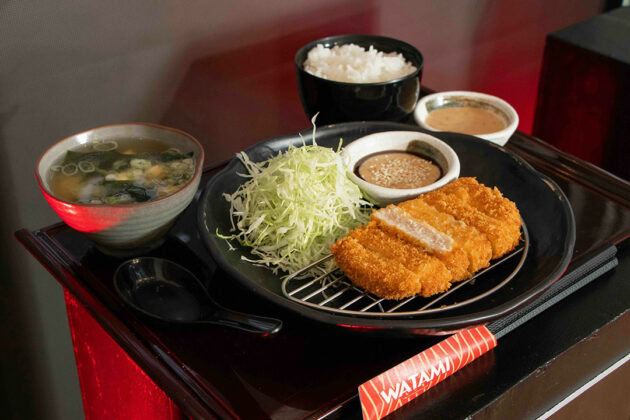
WHEN WE visited Watami at S Maison for a tasting on Feb. 27, there wasn’t anything that we haven’t tried before — we already liked the ramen, and the non-traditional sushi (California rolls and dragon rolls are on the menu), and the tonkatsu. What they were introducing was a new way of presenting things.

“We have not changed our core classics. What we did with some of these dishes — because they’re also bestsellers — is we just elevated the way we present it,” said Lisa Ronquillo-Along, The Bistro Group’s chief marketing officer, of the dishes at the Japanese-Casual franchise from Japan. Watami has over 700 branches in the Asia-Pacific region, while in the Philippines, according to Ms. Ronquillo-Along’s count, they have over 20 branches nationwide.

“That’s how they experience food. It’s not just the taste, but the look,” she said.

This is in keeping with a new policy to polish their dining spaces (we heard the same explanation at two other Bistro Group offerings). That ties up with the younger millennial and Gen Z predilection for documenting their dining experiences and posting it on social media.

“There’s been a dilution of the segment. We see the younger age group, they are very strong in the dining segment scene.” She pointed at a change in this segment’s behavior: they no longer scrimp on dining out. “Now, the food experience is important to them,” she said. “We don’t want us to be not relevant to this market.”

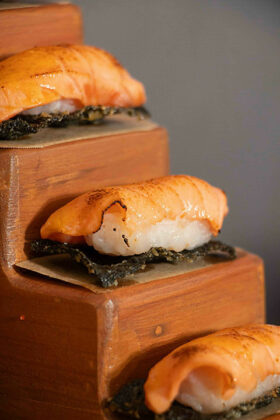
Still, Watami’s Japanese chef Masaaki Ishikawa said that they’re still concentrating on taste. While there weren’t too many new things to try (save perhaps for seeing sushi served on a miniature staircase), they’re planning to execute seasonal and quarterly items to match with Japan’s four seasons.

He’s also proud of one particular item: “Please check the ramen broth. Our broth is very good,” he said. The broth, according to him, had to be simmered for 20 hours (equivalent to two working days). That imparts a lot of bone-derived gelatin and collagen into the soup: “Very creamy.”

NEW DIGS
Ms. Ronquillo-Along talked about The Bistro Group’s expansion plans, saying “We’ve been aggressive since 2022.” They’re laying out bigger plans to expand outside Metro Manila, with locations in Iloilo, La Union, and Bacolod. They’re prioritizing their older brands first (TGI Friday’s for example, which has been here since the 1990s). In total, they’re targeting to open a minimum of 30 restaurants nationwide this year (with a possible maximum of 50, should conditions turn well).

Moreover, they’re exploring new directions in opening standalone restaurants, not within malls. “We’re going outside our comfort zone, the mall,” she said. Though “’yun pa rin naman ang strength (that’s still our strength).”

“People now are not limited to impulse dining,” she said, meaning people no longer eat at whatever happens to be there; but make a conscious decision on where to eat. “It’s easier for them to go,” she added, meaning bypassing mall parking and all other inconveniences. “You’re not confined with high mall rents also.

“We shouldn’t close our doors on that opportunity,” she said. — Joseph L. Garcia

Market Opportunity
SUSHI Logo
SUSHI Price(SUSHI)
$0.19
$0.19$0.19
-0.10%
USD
SUSHI (SUSHI) Live Price Chart
Disclaimer: The articles reposted on this site are sourced from public platforms and are provided for informational purposes only. They do not necessarily reflect the views of MEXC. All rights remain with the original authors. If you believe any content infringes on third-party rights, please contact crypto.news@mexc.com for removal. MEXC makes no guarantees regarding the accuracy, completeness, or timeliness of the content and is not responsible for any actions taken based on the information provided. The content does not constitute financial, legal, or other professional advice, nor should it be considered a recommendation or endorsement by MEXC.

You May Also Like

OpenVPP accused of falsely advertising cooperation with the US government; SEC commissioner clarifies no involvement

OpenVPP accused of falsely advertising cooperation with the US government; SEC commissioner clarifies no involvement

PANews reported on September 17th that on-chain sleuth ZachXBT tweeted that OpenVPP ( $OVPP ) announced this week that it was collaborating with the US government to advance energy tokenization. SEC Commissioner Hester Peirce subsequently responded, stating that the company does not collaborate with or endorse any private crypto projects. The OpenVPP team subsequently hid the response. Several crypto influencers have participated in promoting the project, and the accounts involved have been questioned as typical influencer accounts.
Share
PANews2025/09/17 23:58
China Blocks Nvidia’s RTX Pro 6000D as Local Chips Rise

China Blocks Nvidia’s RTX Pro 6000D as Local Chips Rise

The post China Blocks Nvidia’s RTX Pro 6000D as Local Chips Rise appeared on BitcoinEthereumNews.com. China Blocks Nvidia’s RTX Pro 6000D as Local Chips Rise China’s internet regulator has ordered the country’s biggest technology firms, including Alibaba and ByteDance, to stop purchasing Nvidia’s RTX Pro 6000D GPUs. According to the Financial Times, the move shuts down the last major channel for mass supplies of American chips to the Chinese market. Why Beijing Halted Nvidia Purchases Chinese companies had planned to buy tens of thousands of RTX Pro 6000D accelerators and had already begun testing them in servers. But regulators intervened, halting the purchases and signaling stricter controls than earlier measures placed on Nvidia’s H20 chip. Image: Nvidia An audit compared Huawei and Cambricon processors, along with chips developed by Alibaba and Baidu, against Nvidia’s export-approved products. Regulators concluded that Chinese chips had reached performance levels comparable to the restricted U.S. models. This assessment pushed authorities to advise firms to rely more heavily on domestic processors, further tightening Nvidia’s already limited position in China. China’s Drive Toward Tech Independence The decision highlights Beijing’s focus on import substitution — developing self-sufficient chip production to reduce reliance on U.S. supplies. “The signal is now clear: all attention is focused on building a domestic ecosystem,” said a representative of a leading Chinese tech company. Nvidia had unveiled the RTX Pro 6000D in July 2025 during CEO Jensen Huang’s visit to Beijing, in an attempt to keep a foothold in China after Washington restricted exports of its most advanced chips. But momentum is shifting. Industry sources told the Financial Times that Chinese manufacturers plan to triple AI chip production next year to meet growing demand. They believe “domestic supply will now be sufficient without Nvidia.” What It Means for the Future With Huawei, Cambricon, Alibaba, and Baidu stepping up, China is positioning itself for long-term technological independence. Nvidia, meanwhile, faces…

Share
BitcoinEthereumNews2025/09/18 01:37
Top 10 Meme Coins 2026 Investors Can’t Ignore: How Early Crypto Presales Are Driving the Next Bull Run

Top 10 Meme Coins 2026 Investors Can’t Ignore: How Early Crypto Presales Are Driving the Next Bull Run

Market excitement is intensifying as momentum builds around Pudgy Penguins ($PENGU), SPX6900 ($SPX), Cheems ($CHEEMS), Official Trump ($TRUMP), Apeing ($APEING),
Share
Timestabloid2026/03/28 01:15
