The post Apollo CEO Marc Rowan says traditional investing model is ‘broken’ appeared on BitcoinEthereumNews.com. A version of this article appeared in CNBC’s Inside Alts newsletter, a guide to the fast-growing world of alternative investments, from private equity and private credit to hedge funds and venture capital. Sign up to receive future editions, straight to your inbox. The revolution in private markets and private lending is setting the stage for a sweeping investor shift out of publicly traded stocks and into alternatives, according to Apollo Global CEO Marc Rowan. With the stock market increasingly driven by passive investing and indexing, and dominated by a handful of mega-tech stocks, investors seeking diversification will need to start turning to the rapidly expanding private markets, Rowan told CNBC. “I do think [investing] is broken,” he said. “We had this notion 40 years ago that private was risky and public was safe. What if that’s just fundamentally wrong?” Rowan and Apollo are at the forefront of a tectonic shift in the investing landscape, with the lines between public and private markets blurring and the burgeoning business of private credit funding a growing share of corporate America’s growth. Get Inside Alts directly to your inbox A handful of private equity giants are now muscling out the banks and stock markets to make trillions of dollars of loans and open up new opportunities – and risks – for investors. Apollo, Blackstone and KKR together now have more than $2.6 trillion of assets under management, more than quadruple what they held a decade ago. Apollo alone has $840 billion in assets, up from $40 billion in 2008, Rowan said. “I’d like to attribute that to good management, but that wouldn’t be true,” Rowan said. “The answer is, there are just fundamental factors that are reshaping and growing private markets.” Those factors start with the post-financial crisis regulations that curbed bank lending and allowed the private credit… The post Apollo CEO Marc Rowan says traditional investing model is ‘broken’ appeared on BitcoinEthereumNews.com. A version of this article appeared in CNBC’s Inside Alts newsletter, a guide to the fast-growing world of alternative investments, from private equity and private credit to hedge funds and venture capital. Sign up to receive future editions, straight to your inbox. The revolution in private markets and private lending is setting the stage for a sweeping investor shift out of publicly traded stocks and into alternatives, according to Apollo Global CEO Marc Rowan. With the stock market increasingly driven by passive investing and indexing, and dominated by a handful of mega-tech stocks, investors seeking diversification will need to start turning to the rapidly expanding private markets, Rowan told CNBC. “I do think [investing] is broken,” he said. “We had this notion 40 years ago that private was risky and public was safe. What if that’s just fundamentally wrong?” Rowan and Apollo are at the forefront of a tectonic shift in the investing landscape, with the lines between public and private markets blurring and the burgeoning business of private credit funding a growing share of corporate America’s growth. Get Inside Alts directly to your inbox A handful of private equity giants are now muscling out the banks and stock markets to make trillions of dollars of loans and open up new opportunities – and risks – for investors. Apollo, Blackstone and KKR together now have more than $2.6 trillion of assets under management, more than quadruple what they held a decade ago. Apollo alone has $840 billion in assets, up from $40 billion in 2008, Rowan said. “I’d like to attribute that to good management, but that wouldn’t be true,” Rowan said. “The answer is, there are just fundamental factors that are reshaping and growing private markets.” Those factors start with the post-financial crisis regulations that curbed bank lending and allowed the private credit…

Apollo CEO Marc Rowan says traditional investing model is ‘broken’

6 min read

A version of this article appeared in CNBC’s Inside Alts newsletter, a guide to the fast-growing world of alternative investments, from private equity and private credit to hedge funds and venture capital. Sign up to receive future editions, straight to your inbox.

The revolution in private markets and private lending is setting the stage for a sweeping investor shift out of publicly traded stocks and into alternatives, according to Apollo Global CEO Marc Rowan.

With the stock market increasingly driven by passive investing and indexing, and dominated by a handful of mega-tech stocks, investors seeking diversification will need to start turning to the rapidly expanding private markets, Rowan told CNBC.

“I do think [investing] is broken,” he said. “We had this notion 40 years ago that private was risky and public was safe. What if that’s just fundamentally wrong?”

Rowan and Apollo are at the forefront of a tectonic shift in the investing landscape, with the lines between public and private markets blurring and the burgeoning business of private credit funding a growing share of corporate America’s growth.

Get Inside Alts directly to your inbox

A handful of private equity giants are now muscling out the banks and stock markets to make trillions of dollars of loans and open up new opportunities – and risks – for investors.

Apollo, Blackstone and KKR together now have more than $2.6 trillion of assets under management, more than quadruple what they held a decade ago. Apollo alone has $840 billion in assets, up from $40 billion in 2008, Rowan said.

“I’d like to attribute that to good management, but that wouldn’t be true,” Rowan said. “The answer is, there are just fundamental factors that are reshaping and growing private markets.”

Those factors start with the post-financial crisis regulations that curbed bank lending and allowed the private credit market to step in and provide long-term (and in many cases riskier) loans to large corporate borrowers.

Marc Rowan, chief executive officer of Apollo Global Management LLC, speaks during an interview on an episode of Bloomberg Wealth with David Rubenstein in New York, U.S., on Tuesday, April 5, 2022. Jeenah Moon/Bloomberg via Getty Images

Jeenah Moon | Bloomberg | Getty Images

Private credit as an investment class expanded, first among endowments, sovereign wealth funds and pensions and later among family offices and high-net-worth investors. With returns of up to 15% or more, hundreds of billions of dollars flowed into private credit funds.

At the same time, the effectiveness of the 60-40 portfolio of stocks and bonds has become outdated, Rowan said. The rise of exchange-traded funds and indexing means most investors do little research about the individual stocks they own. Even the indexes are now driven by a handful of mega-tech stocks. And as stocks and bonds have become more correlated, diversification needs to be redefined.

Rowan said the decline in the number of publicly traded companies – from 8,000 in the 1990s to about 4,000 today – means investors aren’t actually getting the investment benefits of the American economy.

“When we own the S&P 500, do we actually own the 500?” he said. “Ten stocks are now 40% of the index. We have lost the ability to really invest in a way that reflects the strength of the U.S. market, or, quite frankly, the strength of any market.”

Instead, he said, investors will start allocating more of their fixed income and their equities portfolios in private investments.

Private credit firms have about $450 billion available to invest, according to Preqin.

And today’s private credit loans often involve big, publicly traded companies. Meta Platforms, for instance, just secured $29 billion in financing from a group led by Blue Owl Capital and Pacific Investment Management Co. for a data center in Louisiana.

Air France, AB InBev, Intel and AT&T have all turned to Apollo for loans rather than traditional banks. Investors and companies are just waking up to the potential size of the market, Rowan said.

“If private credit is direct lending, leverage lending, below investment grade, it’s roughly a $1.5 trillion market,” he said. “If private credit is investment grade and the low investment grade, it’s a $40 trillion market today. Today, the vast majority of what we do is investment grade, and that always shocks people.”

While the risks of investing in private credit are well known, Rowan said they’re often misunderstood. Investing in a loan to Meta, for instance, shouldn’t be considered more risky than buying its stock through an index.

“What if private is both safe and risky, and public is both safe and risky, and they are just differing degrees of liquidity?” he said. “That’s the world I think we’re in.”

As alternatives start to move down the investing ladder, from institutions to family offices and eventually to retail investors, concerns are growing that retail investors would be putting a portion of their retirement savings into less liquid assets. After all, Harvard, Yale and other endowments are now struggling to sell a portion of their private equity and alternatives investments at discounts to raise needed cash.

Rowan said the rise of new funds, market makers and ETF products will provide increasing levels of liquidity as the private credit world matures. Yet, he said some level of illiquidity is important for higher returns.

“If you work with Apollo today and you want to be 100% private investment grade, every 30 days, you can take 100% of your money out,” he said. “As an investor, if you don’t have the capacity to bear 30 days of illiquidity, you should not be in private markets.”

Last month, the Trump administration issued an executive order that will start opening the door for more alternative investments and crypto in 401(k) plans. Rowan said the process will take time but that the experience of countries that allow more alternatives in national retirement plans – including Australia, Israel and Mexico – bodes well for U.S. investors.

Expanding access will also eventually lead to lower fees, stronger performance and more transparency in an investment segment that’s still widely seen as opaque.

“There’s no market in the world where transparency and opening up the market has not brought better access, lower prices and a weeding out of the poor managers,” he said.

Source: https://www.cnbc.com/2025/09/02/apollo-ceo-marc-rowan-says-traditional-investing-model-is-broken.html

Market Opportunity
DAR Open Network Logo
DAR Open Network Price(D)
$0.01079
$0.01079$0.01079
-3.48%
USD
DAR Open Network (D) Live Price Chart
Disclaimer: The articles reposted on this site are sourced from public platforms and are provided for informational purposes only. They do not necessarily reflect the views of MEXC. All rights remain with the original authors. If you believe any content infringes on third-party rights, please contact service@support.mexc.com for removal. MEXC makes no guarantees regarding the accuracy, completeness, or timeliness of the content and is not responsible for any actions taken based on the information provided. The content does not constitute financial, legal, or other professional advice, nor should it be considered a recommendation or endorsement by MEXC.

You May Also Like

Best Crypto to Buy as Saylor & Crypto Execs Meet in US Treasury Council

Best Crypto to Buy as Saylor & Crypto Execs Meet in US Treasury Council

The post Best Crypto to Buy as Saylor & Crypto Execs Meet in US Treasury Council appeared on BitcoinEthereumNews.com. Michael Saylor and a group of crypto executives met in Washington, D.C. yesterday to push for the Strategic Bitcoin Reserve Bill (the BITCOIN Act), which would see the U.S. acquire up to 1M $BTC over five years. With Bitcoin being positioned yet again as a cornerstone of national monetary policy, many investors are turning their eyes to projects that lean into this narrative – altcoins, meme coins, and presales that could ride on the same wave. Read on for three of the best crypto projects that seem especially well‐suited to benefit from this macro shift:  Bitcoin Hyper, Best Wallet Token, and Remittix. These projects stand out for having a strong use case and high adoption potential, especially given the push for a U.S. Bitcoin reserve.   Why the Bitcoin Reserve Bill Matters for Crypto Markets The strategic Bitcoin Reserve Bill could mark a turning point for the U.S. approach to digital assets. The proposal would see America build a long-term Bitcoin reserve by acquiring up to one million $BTC over five years. To make this happen, lawmakers are exploring creative funding methods such as revaluing old gold certificates. The plan also leans on confiscated Bitcoin already held by the government, worth an estimated $15–20B. This isn’t just a headline for policy wonks. It signals that Bitcoin is moving from the margins into the core of financial strategy. Industry figures like Michael Saylor, Senator Cynthia Lummis, and Marathon Digital’s Fred Thiel are all backing the bill. They see Bitcoin not just as an investment, but as a hedge against systemic risks. For the wider crypto market, this opens the door for projects tied to Bitcoin and the infrastructure that supports it. 1. Bitcoin Hyper ($HYPER) – Turning Bitcoin Into More Than Just Digital Gold The U.S. may soon treat Bitcoin as…
Share
BitcoinEthereumNews2025/09/18 00:27
Breaking: CME Group Unveils Solana and XRP Options

Breaking: CME Group Unveils Solana and XRP Options

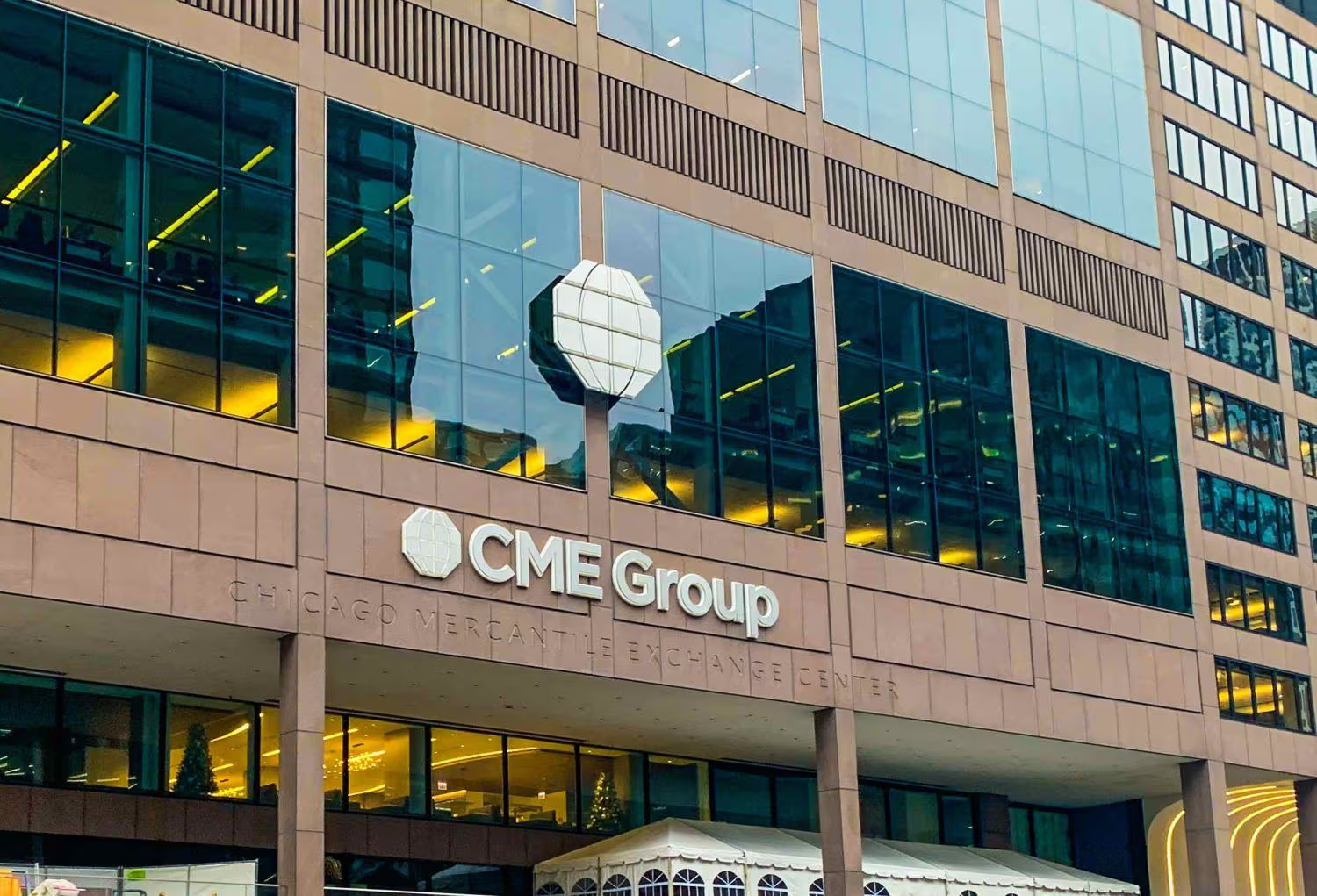
CME Group launches Solana and XRP options, expanding crypto offerings. SEC delays Solana and XRP ETF approvals, market awaits clarity. Strong institutional demand drives CME’s launch of crypto options contracts. In a bold move to broaden its cryptocurrency offerings, CME Group has officially launched options on Solana (SOL) and XRP futures. Available since October 13, 2025, these options will allow traders to hedge and manage exposure to two of the most widely traded digital assets in the market. The new contracts come in both full-size and micro-size formats, with expiration options available daily, monthly, and quarterly, providing flexibility for a diverse range of market participants. This expansion aligns with the rising demand for innovative products in the crypto space. Giovanni Vicioso, CME Group’s Global Head of Cryptocurrency Products, noted that the new options offer increased flexibility for traders, from institutions to active individual investors. The growing liquidity in Solana and XRP futures has made the introduction of these options a timely move to meet the needs of an expanding market. Also Read: Vitalik Buterin Reveals Ethereum’s Bold Plan to Stay Quantum-Secure and Simple! Rapid Growth in Solana and XRP Futures Trading CME Group’s decision to roll out options on Solana and XRP futures follows the substantial growth in these futures products. Since the launch of Solana futures in March 2025, more than 540,000 contracts, totaling $22.3 billion in notional value, have been traded. In August 2025, Solana futures set new records, with an average daily volume (ADV) of 9,000 contracts valued at $437.4 million. The average daily open interest (ADOI) hit 12,500 contracts, worth $895 million. Similarly, XRP futures, which launched in May 2025, have seen significant adoption, with over 370,000 contracts traded, totaling $16.2 billion. XRP futures also set records in August 2025, with an ADV of 6,600 contracts valued at $385 million and a record ADOI of 9,300 contracts, worth $942 million. Institutional Demand for Advanced Hedging Tools CME Group’s expansion into options is a direct response to growing institutional interest in sophisticated cryptocurrency products. Roman Makarov from Cumberland Options Trading at DRW highlighted the market demand for more varied crypto products, enabling more advanced risk management strategies. Joshua Lim from FalconX also noted that the new options products meet the increasing need for institutional hedging tools for assets like Solana and XRP, further cementing their role in the digital asset space. The launch of options on Solana and XRP futures marks another step toward the maturation of the cryptocurrency market, providing a broader range of tools for managing digital asset exposure. SEC’s Delay on Solana and XRP ETF Approvals While CME Group expands its offerings, the broader market is also watching the progress of Solana and XRP exchange-traded funds (ETFs). The U.S. Securities and Exchange Commission (SEC) has delayed its decisions on multiple crypto-related ETF filings, including those for Solana and XRP. Despite the delay, analysts anticipate approval may be on the horizon. This week, REX Shares and Osprey Funds are expected to launch an XRP ETF that will hold XRP directly and allocate at least 40% of its assets to other XRP-related ETFs. Despite the delays, some analysts believe that approval could come soon, fueling further interest in these assets. The delay by the SEC has left many crypto investors awaiting clarity, but approval of these ETFs could fuel further momentum in the Solana and XRP futures markets. Also Read: Tether CEO Breaks Silence on $117,000 Bitcoin Price – Market Reacts! The post Breaking: CME Group Unveils Solana and XRP Options appeared first on 36Crypto.
Share
Coinstats2025/09/18 02:35
Optimizely Named a Leader in the 2026 Gartner® Magic Quadrant™ for Personalization Engines

Optimizely Named a Leader in the 2026 Gartner® Magic Quadrant™ for Personalization Engines

Company recognized as a Leader for the second consecutive year NEW YORK, Feb. 5, 2026 /PRNewswire/ — Optimizely, the leading digital experience platform (DXP) provider
Share
AI Journal2026/02/06 00:47