This is a very meaningful perspective. It seems to be the most positive interpretation of Ethereum layer 2 that we have seen for a long time: the real value of layer 2s is an "experimental innovation sandbox" For example, Arbtrium can explore DAO governance, Optimism can implement the RetroPGF funding mechanism, Base can try CEX integration, ZKSync can promote account abstraction, etc. If these innovations are implemented directly on the main network, the risks will be too great, but even if they fail on layer2, they will not endanger the entire ecosystem. What’s interesting is that it seems that different layer2s can serve completely different user groups. For example, there are enterprise chains that focus on compliance, privacy chains that claim to be censorship-resistant, gaming chains that can achieve high-frequency transactions, and so on. Looking back, there are indeed quite a few layer2+layer3 solutions built on the basis of various stacks. Although none of them has become the expected savior for Ethereum, they have indeed made outstanding contributions in terms of the "diversity" of experimental scalability solutions. Of course, you can also say that they are all for the purpose of issuing tokens in the end, but there is an underlying logic: they at least continue and inherit the decentralized security features of Ethereum to a certain extent. Otherwise, the current star product Hyperliquid and some Wall Street giants’ independent exclusive chain layer 1 thinking, although it can achieve a smooth upgrade in experience, are essentially sacrificing decentralization in exchange for extreme performance. Moreover, these independent chains are also likely to issue tokens. What they do may not be fundamentally different from layer 2 or even worse, but this step is a complete negation of the layer 2 experimental field. Therefore, there is actually a very clear path in front of Layer 2. Abandoning the big and comprehensive idea of the General-Purpose chain, the right way is to explore how to conduct Sepecific-Chain under the new Mass Adoption needs. For example, how to introduce well-known game IPs, how to meet privacy transactions and compliance, how to serve the high-frequency interaction needs of AI Agents, how to provide a compliant facial channel for RWA assets, etc. In other words, as long as Layer2s abandons the internal competition in the purely technical architecture, abandons the obsession with the big and comprehensive universal chain, and focuses on the business integration with TradFi, the situation of layer2 may not be as pessimistic as everyone thinks.This is a very meaningful perspective. It seems to be the most positive interpretation of Ethereum layer 2 that we have seen for a long time: the real value of layer 2s is an "experimental innovation sandbox" For example, Arbtrium can explore DAO governance, Optimism can implement the RetroPGF funding mechanism, Base can try CEX integration, ZKSync can promote account abstraction, etc. If these innovations are implemented directly on the main network, the risks will be too great, but even if they fail on layer2, they will not endanger the entire ecosystem. What’s interesting is that it seems that different layer2s can serve completely different user groups. For example, there are enterprise chains that focus on compliance, privacy chains that claim to be censorship-resistant, gaming chains that can achieve high-frequency transactions, and so on. Looking back, there are indeed quite a few layer2+layer3 solutions built on the basis of various stacks. Although none of them has become the expected savior for Ethereum, they have indeed made outstanding contributions in terms of the "diversity" of experimental scalability solutions. Of course, you can also say that they are all for the purpose of issuing tokens in the end, but there is an underlying logic: they at least continue and inherit the decentralized security features of Ethereum to a certain extent. Otherwise, the current star product Hyperliquid and some Wall Street giants’ independent exclusive chain layer 1 thinking, although it can achieve a smooth upgrade in experience, are essentially sacrificing decentralization in exchange for extreme performance. Moreover, these independent chains are also likely to issue tokens. What they do may not be fundamentally different from layer 2 or even worse, but this step is a complete negation of the layer 2 experimental field. Therefore, there is actually a very clear path in front of Layer 2. Abandoning the big and comprehensive idea of the General-Purpose chain, the right way is to explore how to conduct Sepecific-Chain under the new Mass Adoption needs. For example, how to introduce well-known game IPs, how to meet privacy transactions and compliance, how to serve the high-frequency interaction needs of AI Agents, how to provide a compliant facial channel for RWA assets, etc. In other words, as long as Layer2s abandons the internal competition in the purely technical architecture, abandons the obsession with the big and comprehensive universal chain, and focuses on the business integration with TradFi, the situation of layer2 may not be as pessimistic as everyone thinks.

Say goodbye to big and comprehensive, the breakthrough of Layer2 lies in "verticalization"

2025/09/01 15:00
3 min read

This is a very meaningful perspective. It seems to be the most positive interpretation of Ethereum layer 2 that we have seen for a long time: the real value of layer 2s is an "experimental innovation sandbox"

For example, Arbtrium can explore DAO governance, Optimism can implement the RetroPGF funding mechanism, Base can try CEX integration, ZKSync can promote account abstraction, etc. If these innovations are implemented directly on the main network, the risks will be too great, but even if they fail on layer2, they will not endanger the entire ecosystem.

What’s interesting is that it seems that different layer2s can serve completely different user groups. For example, there are enterprise chains that focus on compliance, privacy chains that claim to be censorship-resistant, gaming chains that can achieve high-frequency transactions, and so on.

Looking back, there are indeed quite a few layer2+layer3 solutions built on the basis of various stacks. Although none of them has become the expected savior for Ethereum, they have indeed made outstanding contributions in terms of the "diversity" of experimental scalability solutions.

Of course, you can also say that they are all for the purpose of issuing tokens in the end, but there is an underlying logic: they at least continue and inherit the decentralized security features of Ethereum to a certain extent.

Otherwise, the current star product Hyperliquid and some Wall Street giants’ independent exclusive chain layer 1 thinking, although it can achieve a smooth upgrade in experience, are essentially sacrificing decentralization in exchange for extreme performance. Moreover, these independent chains are also likely to issue tokens. What they do may not be fundamentally different from layer 2 or even worse, but this step is a complete negation of the layer 2 experimental field.

Therefore, there is actually a very clear path in front of Layer 2. Abandoning the big and comprehensive idea of the General-Purpose chain, the right way is to explore how to conduct Sepecific-Chain under the new Mass Adoption needs. For example, how to introduce well-known game IPs, how to meet privacy transactions and compliance, how to serve the high-frequency interaction needs of AI Agents, how to provide a compliant facial channel for RWA assets, etc.

In other words, as long as Layer2s abandons the internal competition in the purely technical architecture, abandons the obsession with the big and comprehensive universal chain, and focuses on the business integration with TradFi, the situation of layer2 may not be as pessimistic as everyone thinks.

Market Opportunity
RealLink Logo
RealLink Price(REAL)
$0.0585
$0.0585$0.0585
-2.75%
USD
RealLink (REAL) Live Price Chart
Disclaimer: The articles reposted on this site are sourced from public platforms and are provided for informational purposes only. They do not necessarily reflect the views of MEXC. All rights remain with the original authors. If you believe any content infringes on third-party rights, please contact service@support.mexc.com for removal. MEXC makes no guarantees regarding the accuracy, completeness, or timeliness of the content and is not responsible for any actions taken based on the information provided. The content does not constitute financial, legal, or other professional advice, nor should it be considered a recommendation or endorsement by MEXC.

You May Also Like

Fed Decides On Interest Rates Today—Here’s What To Watch For

Fed Decides On Interest Rates Today—Here’s What To Watch For

The post Fed Decides On Interest Rates Today—Here’s What To Watch For appeared on BitcoinEthereumNews.com. Topline The Federal Reserve on Wednesday will conclude a two-day policymaking meeting and release a decision on whether to lower interest rates—following months of pressure and criticism from President Donald Trump—and potentially signal whether additional cuts are on the way. President Donald Trump has urged the central bank to “CUT INTEREST RATES, NOW, AND BIGGER” than they might plan to. Getty Images Key Facts The central bank is poised to cut interest rates by at least a quarter-point, down from the 4.25% to 4.5% range where they have been held since December to between 4% and 4.25%, as Wall Street has placed 100% odds of a rate cut, according to CME’s FedWatch, with higher odds (94%) on a quarter-point cut than a half-point (6%) reduction. Fed governors Christopher Waller and Michelle Bowman, both Trump appointees, voted in July for a quarter-point reduction to rates, and they may dissent again in favor of a large cut alongside Stephen Miran, Trump’s Council of Economic Advisers’ chair, who was sworn in at the meeting’s start on Tuesday. It’s unclear whether other policymakers, including Kansas City Fed President Jeffrey Schmid and St. Louis Fed President Alberto Musalem, will favor larger cuts or opt for no reduction. Fed Chair Jerome Powell said in his Jackson Hole, Wyoming, address last month the central bank would likely consider a looser monetary policy, noting the “shifting balance of risks” on the U.S. economy “may warrant adjusting our policy stance.” David Mericle, an economist for Goldman Sachs, wrote in a note the “key question” for the Fed’s meeting is whether policymakers signal “this is likely the first in a series of consecutive cuts” as the central bank is anticipated to “acknowledge the softening in the labor market,” though they may not “nod to an October cut.” Mericle said he…
Share
BitcoinEthereumNews2025/09/18 00:23
While Shiba Inu and Turbo Chase Price, 63% APY Staking Puts APEMARS at the Forefront of the Best Meme Coin Presale 2026 – Stage 6 Ends in 3 Days!
While Shiba Inu and Turbo Chase Price, 63% APY Staking Puts APEMARS at the Forefront of the Best Meme Coin Presale 2026 – Stage 6 Ends in 3 Days!

What if your meme coin investment could generate passive income without selling a single token? Shiba Inu climbed 4.97% as 207 billion tokens left exchanges. Turbo
Share
Coinstats2026/02/04 03:15
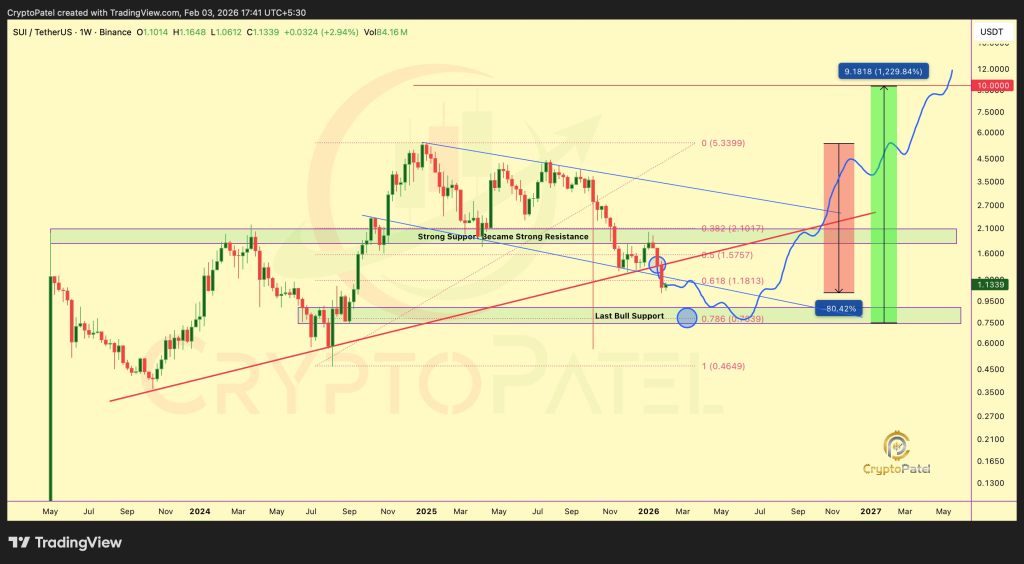
SUI Price Is Down 80%: Price Nears Level Bulls Cannot Afford to Lose

SUI Price Is Down 80%: Price Nears Level Bulls Cannot Afford to Lose

SUI price has quietly slipped into a zone that usually decides everything. Charts show an 80% drop from the peak, yet the market is no longer moving fast. This
Share
Captainaltcoin2026/02/04 03:00