The presence of Department of Homeland Security agents in Minnesota compelled many people there to use songs as a means of protest. Those songs were from secular as well as religious traditions.
On Jan. 8, 2026, the day after Immigration and Customs Enforcement agent Jonathan Ross killed Minneapolis resident Renée Good on Portland Avenue, an anonymous post appeared on Reddit that featured an uncredited text clearly adapted from the lyrics of a Depression-era protest song from Appalachia, “Which Side Are You On?” The Reddit text criticized the recent federal presence in Minnesota and implored Minnesotans to take a stand.
For centuries, songs have served as vehicles for expressing community responses to sociopolitical crises, whether government repression or corporate exploitation. “Which Side Are You On?” resonated with Minnesotans, in part because it has been recorded by numerous artists over the decades.
The song dates back to another societal struggle that occurred in another part of the United States during another crisis moment in American history. “Which Side Are You On?” has consoled and empowered countless people for generations during struggles in red as well as blue states. It has also inspired people to write new protest songs in the face of new crises.
Birth of a protest anthem
“Which Side Are You On?” was composed in 1931, a woman’s spontaneous response to a coal company’s effort to prevent miners in Harlan County, Kentucky, from joining the United Mine Workers of America. Those miners hoped the labor union would improve their working conditions and overturn imposed reductions to their wages.
In support of the coal company, sheriff J. H. Blair and armed deputies broke into the house of union organizer Sam Reece to apprehend him and locate evidence of union activity. Reece was in hiding elsewhere, but his wife, Florence, and their children were present. After ransacking the house, the sheriff and deputies left.
Florence tore a page out of a calendar and jotted down lyrics for an impromptu song, which she recalled setting to the melody of a Baptist hymn “I’m gonna land on the shore.” Others have observed that the melody in Florence’s song was similar to that of the traditional British ballad “Jack Monroe,” which features the haunting refrain “Lay the Lily Low.”
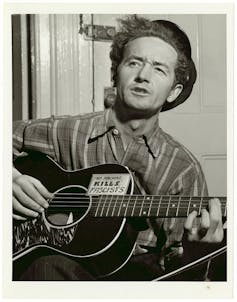
Woody Guthrie, one of America’s most celebrated folk singers of the 20th century, sang many protest songs. Al Aumuller, via the Library of Congress
“Which Side Are You On?” channeled Florence’s reaction to that traumatic experience. Throughout the 1930s, she and others sang the song during labor strikes in the Appalachian coalfields, and the lyrics were included in union songbooks. Then, in 1941, the Almanac Singers, a folk supergroup featuring Woody Guthrie and Pete Seeger, recorded the song, and it reached many people beyond Appalachia.
Since then, a range of musicians – including Charlie Byrd; Peter, Paul and Mary; the Dropkick Murphys; Natalie Merchant; Ani DiFranco; and the Kronos Quartet – performed “Which Side Are You On?” in concert settings and for recordings. A solo live performance with a concert audience joining the chorus was a focal point of Seeger’s “Greatest Hits” album in 1967.
The Academy Award-winning documentary film “Harlan County U.S.A.” (1976) included a clip of Florence Reece singing her song during a 1973 strike. “Which Side Are You On?” was translated into other languages – a testament to its universal theme of encouraging solidarity to people confronting authoritarian power.
Florence Reece sings ‘Which side are you on?’ four decades after she wrote the song.
Protest songs of the modern era
While the American protest song tradition can be traced back to the origins of the nation, “Which Side Are You On?” served as a prototype for the modern-era protest song because of its lyrical directness. Many memorable, risk-taking protest songs were composed in the wake of, and in the spirit of, “Which Side Are You On?”
Noteworthy are numerous protest classics in the folk vein, epitomized by a sizable part of Guthrie’s repertoire, by early Bob Dylan songs like “Masters of War” (1963), “The Times They Are a-Changin’” (1964) and “Only A Pawn in Their Game” (1964), and by Phil Ochs’ mid-1960s songs of political critique, such as “Here’s to the State of Mississippi” (1965).
But protest songs have hailed from all music genres. Rock and rhythm and blues, for instance, have spawned many iconic recordings of protest music: Sam Cooke’s “A Change Is Gonna Come” (1964), Buffalo Springfield’s “For What It’s Worth” (1966), Creedence Clearwater Revival’s “Fortunate Son” (1969), Edwin Starr’s “War” (1970) and Crosby, Stills, Nash and Young’s “Ohio” (1970) among many others.
Blues, country, reggae and hip-hop have spawned broadly inspirational protest songs, and jazz too has yielded classic protest recordings, such as Abel Meeropol’s “Strange Fruit” (1939), popularized by Billie Holiday, and Gil Scott-Heron’s 1971 recording of the jazz-poem “The Revolution Will Not Be Televised.”
Indeed, there are so many enduring contributions to the American protest song canon that a list like Rolling Stone’s recent “100 Best Protest Songs of All Time” is only the tip of the iceberg. Regardless of the genre, effective protest songs retain their power to move and motivate people today despite having been composed in response to past situations or circumstances. And protest songs from the past are often adapted to help people more effectively respond to the crisis of the moment.
Songs for this moment
“Which Side Are You On?” was sung – and its theme invoked – in Minnesota throughout January 2026. On Jan. 24, shortly after Border Patrol agents killed Alex Pretti on Nicollet Avenue, Minneapolis Mayor Jacob Frey referred to the song’s title during a public address to his constituents: “Stand up for America. Recognize that your children will ask you what side you were on.” That same day, the grassroots organization 50501: Minnesota posted online an appeal to those in power: “[E]very politician and person in uniform must ask themselves one question – which side are you on?”
The next day, Minnesota Gov. Tim Walz acknowledged divisions in the U.S. during a televised briefing, urging citizens in his state and across the nation to consider the choice before them: “I’ve got a question for all of you. What side do you want to be on?”
People protesting ICE and Customs and Border Protection actions in Minnesota and elsewhere have been singing “Which Side Are You On?” and other well-known protest songs, but musicians have also been writing new protest songs about the crisis. On Jan. 8, the Dropkick Murphys posted on social media a clip of “Citizen I.C.E.,” a revamped version of the group’s 2005 song “Citizen C.I.A.,” augmented by video of the Jan. 7 fatal shooting of Renée Good. On Jan. 27, British musician Billy Bragg released “City of Heroes,” which he composed in tribute to the Minneapolis protesters.
Following suit was Bruce Springsteen, a longtime champion of the protest song legacy. On Jan. 28, Springsteen released online his newly composed and recorded “Streets of Minneapolis.” Millions of people around the world heard the song and saw its accompanying video.
On Jan. 30, Springsteen made a surprise appearance at the Minneapolis club First Avenue, performing his new song at the “Defend Minnesota” benefit concert, organized by musician Tom Morello to raise funds for the families of Good and Pretti.
Bruce Springsteen’s ‘Streets of Minneapolis’ rages against the killings of Renée Good and Alex Pretti.
Making a difference
On the day Pretti was shot dead, hundreds of Minneapolis protesters attended a special service at Minneapolis’ Hennepin Avenue United Methodist Church. Pastor Elizabeth MacAuley, in a televised interview with CNN’s Anderson Cooper, reflected on the role of song in helping people cope: “It’s been a time when it is pretty tempting to feel so disempowered. … [T]he singing resistance movement … brought out the hope and the grief and the rage and the beauty.”
Cooper asked: “Do you think song makes a difference?” MacAuley replied: “I know song makes a difference.”
Ted Olson, Professor of Appalachian Studies and Bluegrass, Old-Time and Roots Music Studies, East Tennessee State University
This article is republished from The Conversation under a Creative Commons license. Read the original article.