Xinbi, the Chinese-language crypto platform tied to scams, pig butchering rings, and cybercrime, has still processed $17.9 billion worth of transactions even afterXinbi, the Chinese-language crypto platform tied to scams, pig butchering rings, and cybercrime, has still processed $17.9 billion worth of transactions even after

Telegram bans groups while Xinbi pushes users to SafeW

2026/02/09 23:24
4 min read

Xinbi, the Chinese-language crypto platform tied to scams, pig butchering rings, and cybercrime, has still processed $17.9 billion worth of transactions even after getting kicked off Telegram and being targeted by U.S. regulators.

TRM Labs tracked the numbers and confirmed the wallets linked to Xinbi took in $8.9 billion in crypto so far. The service is now operating mostly on SafeW, a lesser-known messaging app, with a connected wallet system called XinbiPay.

Both were rolled out after Telegram started deleting the group’s channels. The people running Xinbi didn’t disappear; they doubled down. After Telegram banned it in May 2025, the group came right back using the same usernames and channels.
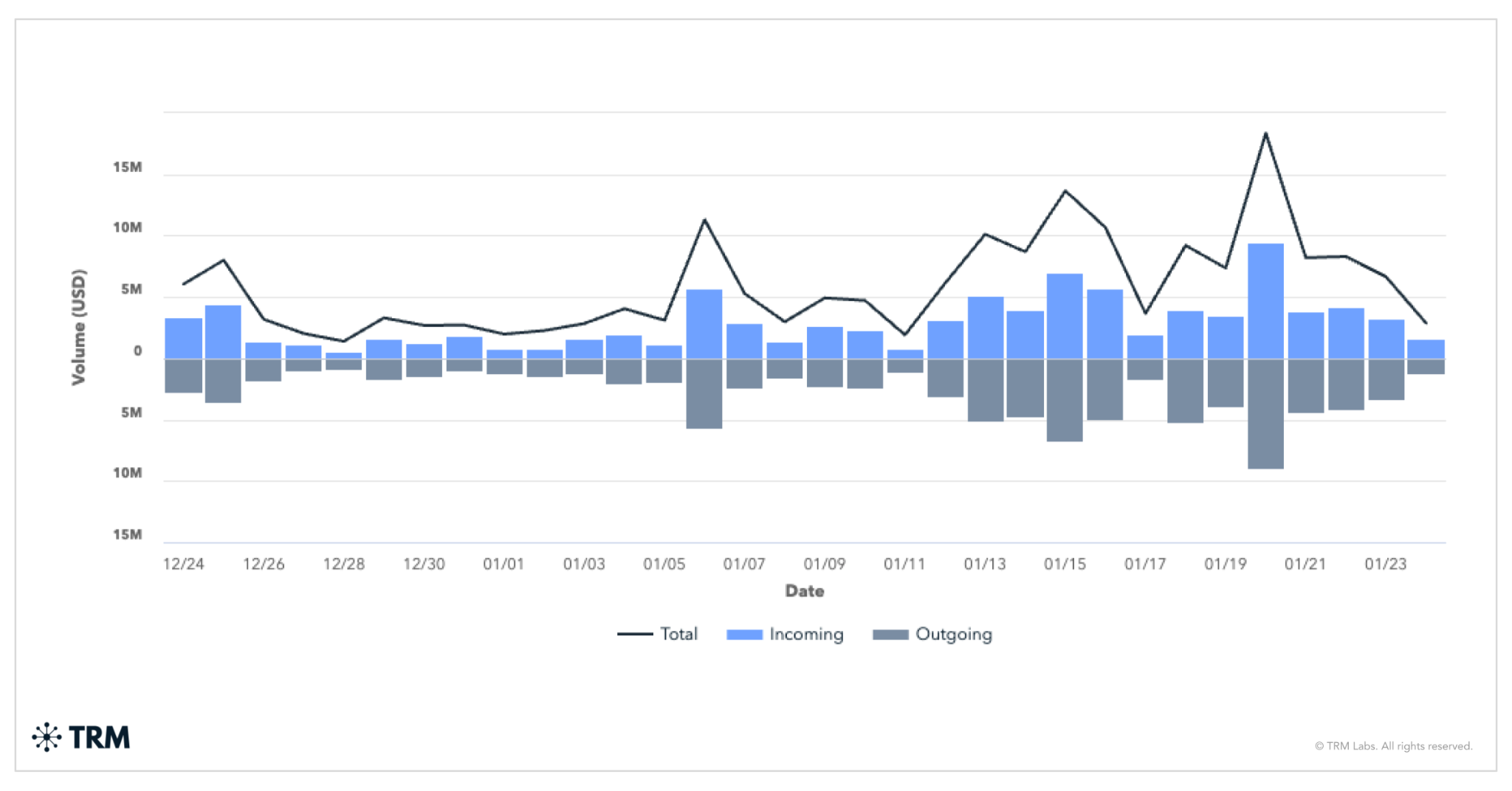
China XinbiNewly established XinbiPay Wallet service hot wallet inflow and outflow since December 24, 2025. Source: TRM Labs

At the same time, they started pushing users to download SafeW and use XinbiPay, which also goes by NewPay. Traffic started to drop in December, but by January, users were sending large volumes through the new system.

The arrest of Chen Zhi, the head of Prince Group, and the collapse of Tudou Guarantee in January 2026 made users nervous. That’s when most people started jumping to SafeW, because by then, Xinbi already had everything in place.

Xinbi is believed to be based around the Golden Triangle, where Myanmar, Thailand, and Laos meet. It’s long been used by fraud networks to wash money and cash out stolen crypto.

Telegram bans groups while Xinbi pushes users to SafeW

Telegram used to be the core of the Chinese-speaking guarantee service world. Since around 2019, groups like Huione, Haowang, and Tudou have been using bots, escrow features, and built-in wallets to handle anonymous crypto deals inside chat windows.
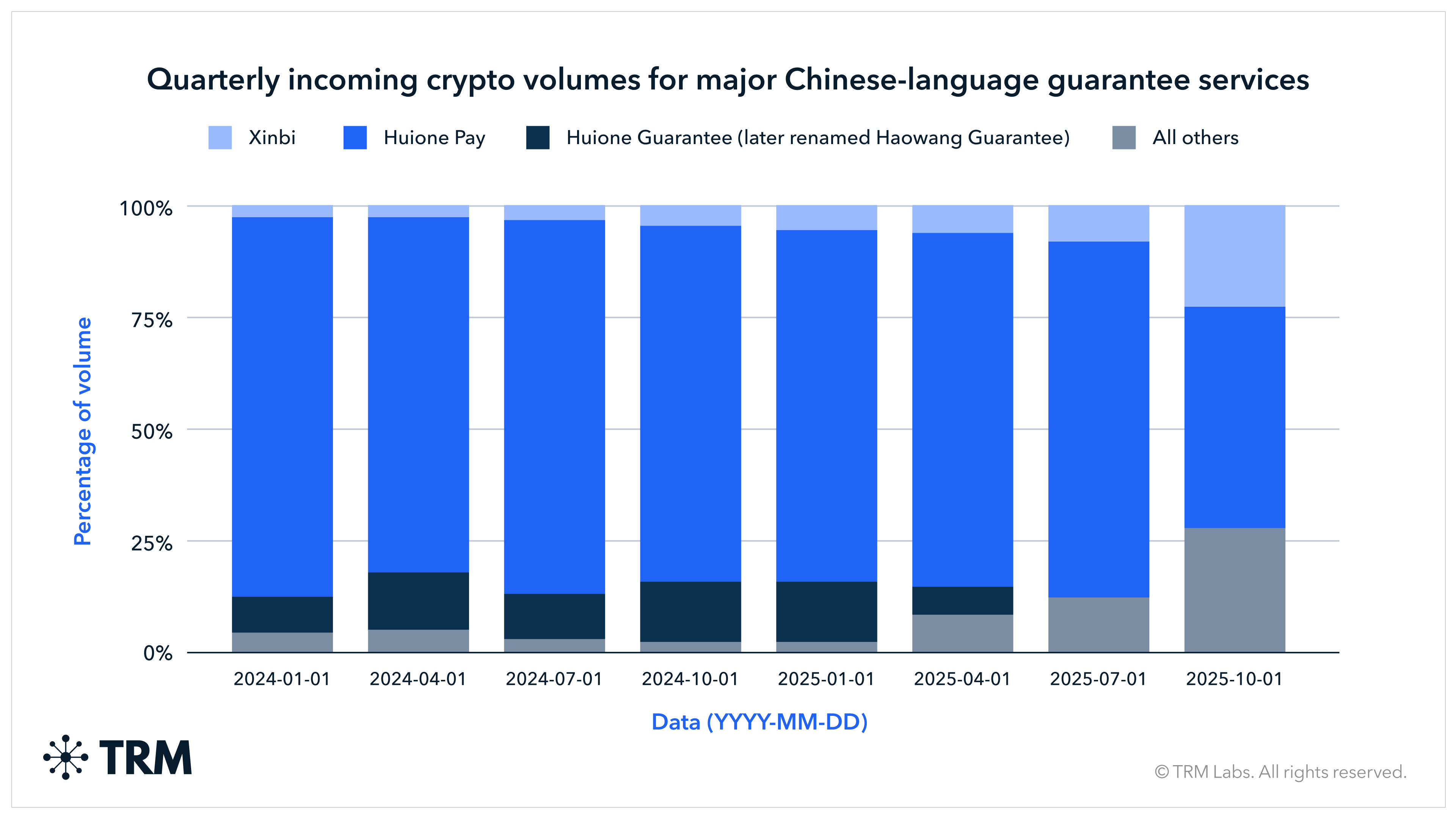
China's crypto marketplace Xinbi posts $17.9 billion in volume even after regulatory actionsSource: TRM Labs

Xinbi joined that list in 2022 and quickly became like the top channel for criminals to swap funds without identity checks, according to TRM Labs.

But that all changed in May 2025 when FinCEN called Huione and Haowang the primary money laundering risks. The U.S. Treasury then used Section 311 to cut them off from the global financial system. Soon after, Telegram deleted huge clusters of channels, including ones tied to Xinbi.

Huione and Haowang tried to move to ChatMe, but barely anyone followed. Users complained about delays, vanished admins, and stuck funds. Both platforms eventually shut down, according to TRM, but Xinbi handled it differently, in that it actually never told users to leave Telegram right away.

Instead, it slowly introduced SafeW and XinbiPay while keeping the old channels active.

Xinbi absorbs users while rivals shut down

From May to December 2025, Xinbi’s inflows nearly doubled, even after Telegram kicked it off. Meanwhile, Haowang and Huione saw their activity drop almost 100 percent. Tudou lost about 74 percent. These numbers came straight from TRM Labs’ on-chain tracking. Xinbi didn’t just avoid collapse. It took advantage of the chaos and pulled in more users.

That growth happened because Xinbi’s system is built to handle volume fast. Anyone offering shady services needs to send a security deposit to the admin team, sometimes as high as tens of thousands of USDT, depending on what they’re selling.

Once approved, they get a private channel. Deals are done in shared chat rooms with an admin acting as escrow. If something goes wrong, the admin uses the vendor’s deposit to settle it.

Once crypto lands inside XinbiPay, TRM Labs said it becomes a pain to trace, because the wallets are managed by the platform, not individuals.

TRM says investigators have to study the movement patterns inside the system. They watch for areas where large amounts of crypto gather, or where it exits the system.

Since 2022, Xinbi has handled at least $16.4 billion in transactions. Some of its listings included stolen data, fake IDs, deepfake tools, and money laundering services. Xinbi even claimed it was registered with FinCEN in the U.S. and FINTRAC in Canada. That gave it a fake sense of credibility, even though it was being used by fraud groups.

The smartest crypto minds already read our newsletter. Want in? Join them.

Market Opportunity
Union Logo
Union Price(U)
$0,001502
$0,001502$0,001502
+1,34%
USD
Union (U) Live Price Chart
Disclaimer: The articles reposted on this site are sourced from public platforms and are provided for informational purposes only. They do not necessarily reflect the views of MEXC. All rights remain with the original authors. If you believe any content infringes on third-party rights, please contact service@support.mexc.com for removal. MEXC makes no guarantees regarding the accuracy, completeness, or timeliness of the content and is not responsible for any actions taken based on the information provided. The content does not constitute financial, legal, or other professional advice, nor should it be considered a recommendation or endorsement by MEXC.

You May Also Like

Which Altcoins Stand to Gain from the SEC’s New ETF Listing Standards?

Which Altcoins Stand to Gain from the SEC’s New ETF Listing Standards?

On Wednesday, the US SEC (Securities and Exchange Commission) took a landmark step in crypto regulation, approving generic listing standards for spot crypto ETFs (exchange-traded funds). This new framework eliminates the case-by-case 19b-4 approval process, streamlining the path for multiple digital asset ETFs to enter the market in the coming weeks. Grayscale’s Multi-Crypto Milestone Grayscale secured a first-mover advantage as its Digital Large Cap Fund (GDLC) received approval under the new listing standards. Products that will be traded under the ticker GDLC include Bitcoin, Ethereum, XRP, Solana, and Cardano. “Grayscale Digital Large Cap Fund $GDLC was just approved for trading along with the Generic Listing Standards. The Grayscale team is working expeditiously to bring the FIRST multi-crypto asset ETP to market with Bitcoin, Ethereum, XRP, Solana, and Cardano,” wrote Grayscale CEO Peter Mintzberg. The approval marks the US’s first diversified, multi-crypto ETP, signaling a shift toward broader portfolio products rather than single-asset ETFs. Bloomberg’s Eric Balchunas explained that around 12–15 cryptocurrencies now qualify for spot ETF consideration. However, this is contingent on the altcoins having established futures trading on Coinbase Derivatives for at least six months. This includes well-known altcoins like Dogecoin (DOGE), Litecoin (LTC), and Chainlink (LINK), alongside the majors already included in Grayscale’s GDLC. Altcoins in the Spotlight Amid New Era of ETF Eligibility Several assets have already met the key condition, regulated futures trading on Coinbase. For example, Solana futures launched in February 2024, making the token eligible as of August 19. “The SEC approved generic ETF listing standards. Assets with a regulated futures contract trading for 6 months qualify for a spot ETF. Solana met this criterion on Aug 19, 6 months after SOL futures launched on Coinbase Derivatives,” SolanaFloor indicated. Crypto investors and communities also identified which tokens stand to gain. Chainlink community liaison Zach Rynes highlighted that LINK could soon see its own ETF. He noted that both Bitwise and Grayscale have already filed applications. Meanwhile, the Litecoin Foundation indicated that the new standards provide the regulatory framework for LTC to be listed on US exchanges. Hedera is also in the spotlight, with digital asset investor Mark anticipating an HBAR ETF. Market observers see the decision as a potential turning point for broader adoption, bringing the much-needed clarity and accessibility for investors. At the same time, it boosts confidence in the market’s maturity. The general sentiment is that with the SEC’s approval, the next phase of crypto ETFs is no longer a question of ‘if,’ but ‘when.’ The shift to generic listing standards could expand the US-listed digital asset ETFs roster beyond Bitcoin and Ethereum. Such a move would usher in new investment vehicles covering a dozen or more altcoins. This represents the clearest path yet toward mainstream, regulated access to diversified crypto exposure. More importantly, it comes without the friction of direct custody. “We’re gonna be off to the races in a matter of weeks,” ETF analyst James Seyffart quipped.
Share
Coinstats2025/09/18 12:57
Zhongchi Chefu acquired $1.87 billion worth of digital assets from a crypto giant for $1.1 billion.

Zhongchi Chefu acquired $1.87 billion worth of digital assets from a crypto giant for $1.1 billion.

PANews reported on February 10th that Autozi Internet Technology (Global) Ltd. (AZI), a US-listed Chinese company, has successfully acquired approximately $1.87
Share
PANews2026/02/10 20:36
XRP news: Ripple expands RLUSD stablecoin use in UAE via Zand Bank

XRP news: Ripple expands RLUSD stablecoin use in UAE via Zand Bank

Ripple has expanded the reach of its RLUSD stablecoin in the Middle East through a new strategic partnership with UAE-based digital bank Zand, a move that could
Share
Crypto.news2026/02/10 20:08