Tether is beefing up its U.S. game plan — and it just hired someone who knows the D.C. playbook inside out. The stablecoin powerhouse announced that former White House Crypto Council Executive Director Bo Hines will join as a strategic adviser for digital assets and U.S. strategy, a move that signals Tether’s intent to plant firmer roots in the world’s biggest, most hostile-yet-coveted crypto market.Tether is beefing up its U.S. game plan — and it just hired someone who knows the D.C. playbook inside out. The stablecoin powerhouse announced that former White House Crypto Council Executive Director Bo Hines will join as a strategic adviser for digital assets and U.S. strategy, a move that signals Tether’s intent to plant firmer roots in the world’s biggest, most hostile-yet-coveted crypto market.

Tether Taps Former White House Crypto Director Bo Hines as U.S. Strategy Adviser

3 min read
Tether is beefing up its U.S. game plan — and it just hired someone who knows the D.C. playbook inside out. The stablecoin powerhouse announced that former White House Crypto Council Executive Director Bo Hines will join as a strategic adviser for digital assets and U.S. strategy, a move that signals Tether’s intent to plant firmer roots in the world’s biggest, most hostile-yet-coveted crypto market.

Hines is no stranger to the crypto–policy battlefield. During his tenure in the Trump administration, he worked on initiatives aimed at setting “guardrails” for stablecoin issuers, encouraging blockchain innovation, and bridging the gap between federal policymakers and industry players. His policy chops — and Rolodex of Capitol Hill connections — are precisely what Tether needs as it inches closer to launching a U.S.-centric stablecoin, reportedly on the roadmap for late 2025 or early 2026.

Tether CEO Paolo Ardoino framed the hire as more than just symbolic:

“Bo’s appointment demonstrates our commitment to building a strong U.S.-based presence that spans across multiple sectors… including a deep focus on potential further investments in domestic infrastructure.”

Why Tether Wants the U.S. — and Why the U.S. Might Not Want Tether

Let’s be clear: this isn’t just about pushing more USDt into American hands. Tether has already reinvested close to $5 billion into the U.S. economy, with splashy deals like a $775 million stake in Rumble (the “alt-YouTube”) and a $100 million bet on Adecoagro, a Latin American agricultural giant. These aren’t random moves — they’re Tether signaling that it wants to be treated as more than just a shadow bank in the Bahamas.

But the optics are tricky. Tether has long been under fire from regulators who question its reserves, transparency, and role in offshore liquidity. Bringing on a former White House insider is a calculated play to rebrand itself as not just compliant, but indispensable, to U.S. financial infrastructure. It’s essentially saying: “We’re investing here. We’re hiring your guys. We’re domestic now. Don’t ban us — partner with us.”

The Bigger Picture: Stablecoins, Bitcoin, and Budget-Neutral Magic Tricks

Hines isn’t just a technocrat. He’s floated some pretty radical monetary ideas in the past, including revaluing U.S. gold reserves and converting part into Bitcoin as a way to build a national BTC treasury “without touching the budget.” He even suggested funding Bitcoin buys with tariff revenue — a proposal that sounds like it came straight from a parallel MAGA-crypto universe.
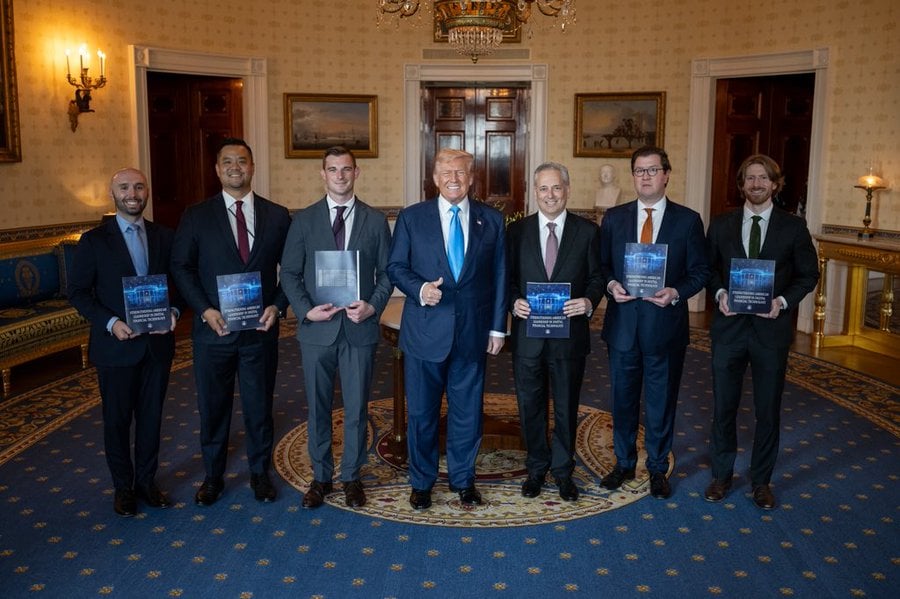
Tether is beefing up its U.S. game plan — and it just hired someone who knows the D.C. playbook inside out. The stablecoin powerhouse announced that former White House Crypto Council Executive Director Bo Hines will join as a strategic adviser for digital assets and U.S. strategy, a move that signals Tether’s intent to plant firmer roots in the world’s biggest, most hostile-yet-coveted crypto market.

Bo Hines earlier this year after the publication of the crypto advisory group’s report. Source: Bo Hines

While those ideas never made it past the brainstorming stage, they show where Hines’ loyalties lie: stablecoins and Bitcoin as strategic tools to modernize payments, cut remittance costs, and even strengthen national reserves. Now, instead of shaping U.S. crypto policy, he’ll be helping Tether navigate — or bulldoze — the regulatory thicket.

What This Means

  • For Tether: This is a credibility grab. Hiring Hines doesn’t guarantee regulatory approval, but it buys Tether access, legitimacy, and someone fluent in Beltway dialect.

  • For the U.S.: It tests whether Washington will engage with stablecoin issuers it can’t fully control. Circle (USDC) has played the “good citizen” card; Tether is taking the “we’re too big to ignore” approach.

  • For crypto: If Tether manages to secure a U.S. foothold, it legitimizes stablecoins not just as crypto rails but as infrastructure — the same way PayPal or Visa are.

And let’s be honest — this move puts pressure on U.S. lawmakers. Stablecoins are already systemically important globally. If America keeps dragging its feet, the market won’t wait. Tether knows this. Hines knows this. The question is whether D.C. wakes up before Tether becomes more embedded in U.S. markets than regulators are comfortable admitting.


 

Disclaimer: The articles reposted on this site are sourced from public platforms and are provided for informational purposes only. They do not necessarily reflect the views of MEXC. All rights remain with the original authors. If you believe any content infringes on third-party rights, please contact service@support.mexc.com for removal. MEXC makes no guarantees regarding the accuracy, completeness, or timeliness of the content and is not responsible for any actions taken based on the information provided. The content does not constitute financial, legal, or other professional advice, nor should it be considered a recommendation or endorsement by MEXC.

You May Also Like

Unlocking Massive Value: Curve Finance Revenue Sharing Proposal for CRV Holders

Unlocking Massive Value: Curve Finance Revenue Sharing Proposal for CRV Holders

BitcoinWorld Unlocking Massive Value: Curve Finance Revenue Sharing Proposal for CRV Holders The dynamic world of decentralized finance (DeFi) is constantly evolving, bringing forth new opportunities and innovations. A significant development is currently unfolding at Curve Finance, a leading decentralized exchange (DEX). Its founder, Michael Egorov, has put forth an exciting proposal designed to offer a more direct path for token holders to earn revenue. This initiative, centered around a new Curve Finance revenue sharing model, aims to bolster the value for those actively participating in the protocol’s governance. What is the “Yield Basis” Proposal and How Does it Work? At the core of this forward-thinking initiative is a new protocol dubbed Yield Basis. Michael Egorov introduced this concept on the CurveDAO governance forum, outlining a mechanism to distribute sustainable profits directly to CRV holders. Specifically, it targets those who stake their CRV tokens to gain veCRV, which are essential for governance participation within the Curve ecosystem. Let’s break down the initial steps of this innovative proposal: crvUSD Issuance: Before the Yield Basis protocol goes live, $60 million in crvUSD will be issued. Strategic Fund Allocation: The funds generated from the sale of these crvUSD tokens will be strategically deployed into three distinct Bitcoin-based liquidity pools: WBTC, cbBTC, and tBTC. Pool Capping: To ensure balanced risk and diversified exposure, each of these pools will be capped at $10 million. This carefully designed structure aims to establish a robust and consistent income stream, forming the bedrock of a sustainable Curve Finance revenue sharing mechanism. Why is This Curve Finance Revenue Sharing Significant for CRV Holders? This proposal marks a pivotal moment for CRV holders, particularly those dedicated to the long-term health and governance of Curve Finance. Historically, generating revenue for token holders in the DeFi space can often be complex. The Yield Basis proposal simplifies this by offering a more direct and transparent pathway to earnings. By staking CRV for veCRV, holders are not merely engaging in governance; they are now directly positioned to benefit from the protocol’s overall success. The significance of this development is multifaceted: Direct Profit Distribution: veCRV holders are set to receive a substantial share of the profits generated by the Yield Basis protocol. Incentivized Governance: This direct financial incentive encourages more users to stake their CRV, which in turn strengthens the protocol’s decentralized governance structure. Enhanced Value Proposition: The promise of sustainable revenue sharing could significantly boost the inherent value of holding and staking CRV tokens. Ultimately, this move underscores Curve Finance’s dedication to rewarding its committed community and ensuring the long-term vitality of its ecosystem through effective Curve Finance revenue sharing. Understanding the Mechanics: Profit Distribution and Ecosystem Support The distribution model for Yield Basis has been thoughtfully crafted to strike a balance between rewarding veCRV holders and supporting the wider Curve ecosystem. Under the terms of the proposal, a substantial portion of the value generated by Yield Basis will flow back to those who contribute to the protocol’s governance. Returns for veCRV Holders: A significant share, specifically between 35% and 65% of the value generated by Yield Basis, will be distributed to veCRV holders. This flexible range allows for dynamic adjustments based on market conditions and the protocol’s performance. Ecosystem Reserve: Crucially, 25% of the Yield Basis tokens will be reserved exclusively for the Curve ecosystem. This allocation can be utilized for various strategic purposes, such as funding ongoing development, issuing grants, or further incentivizing liquidity providers. This ensures the continuous growth and innovation of the platform. The proposal is currently undergoing a democratic vote on the CurveDAO governance forum, giving the community a direct voice in shaping the future of Curve Finance revenue sharing. The voting period is scheduled to conclude on September 24th. What’s Next for Curve Finance and CRV Holders? The proposed Yield Basis protocol represents a pioneering approach to sustainable revenue generation and community incentivization within the DeFi landscape. If approved by the community, this Curve Finance revenue sharing model has the potential to establish a new benchmark for how decentralized exchanges reward their most dedicated participants. It aims to foster a more robust and engaged community by directly linking governance participation with tangible financial benefits. This strategic move by Michael Egorov and the Curve Finance team highlights a strong commitment to innovation and strengthening the decentralized nature of the protocol. For CRV holders, a thorough understanding of this proposal is crucial for making informed decisions regarding their staking strategies and overall engagement with one of DeFi’s foundational platforms. FAQs about Curve Finance Revenue Sharing Q1: What is the main goal of the Yield Basis proposal? A1: The primary goal is to establish a more direct and sustainable way for CRV token holders who stake their tokens (receiving veCRV) to earn revenue from the Curve Finance protocol. Q2: How will funds be generated for the Yield Basis protocol? A2: Initially, $60 million in crvUSD will be issued and sold. The funds from this sale will then be allocated to three Bitcoin-based pools (WBTC, cbBTC, and tBTC), with each pool capped at $10 million, to generate profits. Q3: Who benefits from the Yield Basis revenue sharing? A3: The proposal states that between 35% and 65% of the value generated by Yield Basis will be returned to veCRV holders, who are CRV stakers participating in governance. Q4: What is the purpose of the 25% reserve for the Curve ecosystem? A4: This 25% reserve of Yield Basis tokens is intended to support the broader Curve ecosystem, potentially funding development, grants, or other initiatives that contribute to the platform’s growth and sustainability. Q5: When is the vote on the Yield Basis proposal? A5: A vote on the proposal is currently underway on the CurveDAO governance forum and is scheduled to run until September 24th. If you found this article insightful and valuable, please consider sharing it with your friends, colleagues, and followers on social media! Your support helps us continue to deliver important DeFi insights and analysis to a wider audience. To learn more about the latest DeFi market trends, explore our article on key developments shaping decentralized finance institutional adoption. This post Unlocking Massive Value: Curve Finance Revenue Sharing Proposal for CRV Holders first appeared on BitcoinWorld.
Share
Coinstats2025/09/18 00:35
Best Crypto To Buy Now: Pepeto vs BlockDAG, Layer Brett, Remittix, Little Pepe, Compared

Best Crypto To Buy Now: Pepeto vs BlockDAG, Layer Brett, Remittix, Little Pepe, Compared

Today we compare Pepeto (PEPETO), BlockDAG, Layer Brett, Remittix, Little Pepe (and how they stack up today) by the main […] The post Best Crypto To Buy Now: Pepeto vs BlockDAG, Layer Brett, Remittix, Little Pepe, Compared appeared first on Coindoo.
Share
Coindoo2025/09/18 02:39
Solana Price Plummets: SOL Crashes Below $90 in Stunning Market Reversal

Solana Price Plummets: SOL Crashes Below $90 in Stunning Market Reversal

BitcoinWorld Solana Price Plummets: SOL Crashes Below $90 in Stunning Market Reversal In a dramatic shift for one of cryptocurrency’s leading networks, Solana (
Share
bitcoinworld2026/02/05 06:45