Rising stablecoin volumes have provided insights into the crypto market’s growth despite the decline in Bitcoin and Ethereum prices. A recent report noted that Rising stablecoin volumes have provided insights into the crypto market’s growth despite the decline in Bitcoin and Ethereum prices. A recent report noted that

Forget Bitcoin And Ethereum, Here’s What Stablecoin Volumes Say About The Crypto Market

3 min read

Rising stablecoin volumes have provided insights into the crypto market’s growth despite the decline in Bitcoin and Ethereum prices. A recent report noted that these stablecoins have evolved from speculation to utility, particularly as the number of daily active users increased in the last quarter.

Stablecoin Volumes Highlight Crypto Market Growth Despite Bitcoin And Ethereum Decline

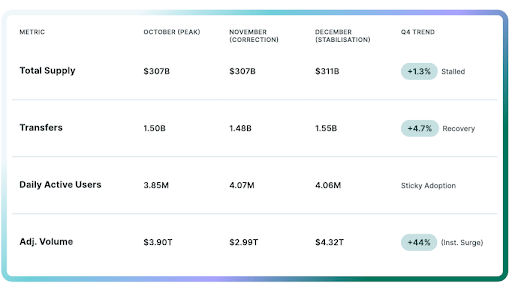
According to an Orbital report, the fourth quarter of 2025 marked the peak of stablecoin growth, accounting for 33.5% of the year’s transaction volume. Q4 2025 is said to have been defined by a fundamental shift from speculation to utility as velocity surged while supply growth decelerated to 1.3%. The report noted that the stablecoin market peaked in October, around the time Bitcoin and Ethereum reached new highs, hitting an all-time high of 1.5 billion in transactions.  

Furthermore, the stablecoin market hit an unadjusted volume of $7.6 trillion at the time. Notably, the crypto market decline following the October 10 crash saw stablecoin volumes drop by around 23% and peer-to-peer (P2P) activity fall 29% in November. Despite this, the number of daily active users rose to 4.07 million, which the report noted signals a crossover into mainstream payment infrastructure. 
Stablecoin

Meanwhile, Orbital revealed that in December last year, a more stable market structure emerged with a new, elevated baseline of 1.55 billion monthly transfers. This occurred even as the prices of Bitcoin and Ethereum stalled. Amid the rise in stablecoin volumes in Q4, the Aptos network emerged as the breakout retail chain, with its market share rising from 6% to 25% through autonomous expansion. 

Aptos’ growth appears organic and additive, enabling the network to rank alongside BSC as a co-leader in retail activity. Orbital also mentioned that the narrowing gap between unadjusted and adjusted stablecoin volumes signals a decline in wash trading and bot activity, indicating that the crypto market is now driven by organic institutional demand. The reported volume is said to reflect genuine capital allocation and settlement rather than artificial noise. 

Stablecoin Volume Surpasses $8 Trillion

Artemis data shows that the adjusted stablecoin transaction volume has now surpassed $8 trillion, with stablecoins like World Liberty Financial’s USD1 recording significant growth. USD1’s market cap notably jumped from just over $3 billion to $5 billion within a week towards the end of last month. 

The surge in stablecoin volumes comes despite the recent crypto decline, with the Bitcoin and Ethereum prices reaching new lows. It is worth noting that stablecoins are seeing increased utility with more markets moving on-chain. Crypto traders are now able to trade stocks and commodities on exchanges like Hyperliquid, which has also likely contributed to the increase in stablecoin transaction volumes. 

At the time of writing, the stablecoin market cap stands at $310 billion, according to data from CoinGecko.

Bitcoin
Disclaimer: The articles reposted on this site are sourced from public platforms and are provided for informational purposes only. They do not necessarily reflect the views of MEXC. All rights remain with the original authors. If you believe any content infringes on third-party rights, please contact service@support.mexc.com for removal. MEXC makes no guarantees regarding the accuracy, completeness, or timeliness of the content and is not responsible for any actions taken based on the information provided. The content does not constitute financial, legal, or other professional advice, nor should it be considered a recommendation or endorsement by MEXC.

You May Also Like

Over 60% of crypto press releases linked to high-risk or scam projects: Report

Over 60% of crypto press releases linked to high-risk or scam projects: Report

A data analysis shows crypto press release wires are dominated by scam-linked projects, hype-driven content and low-impact announcements, raising concerns about
Share
Crypto.news2026/02/04 22:02
ArtGis Finance Partners with MetaXR to Expand its DeFi Offerings in the Metaverse

ArtGis Finance Partners with MetaXR to Expand its DeFi Offerings in the Metaverse

By using this collaboration, ArtGis utilizes MetaXR’s infrastructure to widen access to its assets and enable its customers to interact with the metaverse.
Share
Blockchainreporter2025/09/18 00:07
Crucial US Stock Market Update: What Wednesday’s Mixed Close Reveals

Crucial US Stock Market Update: What Wednesday’s Mixed Close Reveals

BitcoinWorld Crucial US Stock Market Update: What Wednesday’s Mixed Close Reveals The financial world often keeps us on our toes, and Wednesday was no exception. Investors watched closely as the US stock market concluded the day with a mixed performance across its major indexes. This snapshot offers a crucial glimpse into current investor sentiment and economic undercurrents, prompting many to ask: what exactly happened? Understanding the Latest US Stock Market Movements On Wednesday, the closing bell brought a varied picture for the US stock market. While some indexes celebrated gains, others registered slight declines, creating a truly mixed bag for investors. The Dow Jones Industrial Average showed resilience, climbing by a notable 0.57%. This positive movement suggests strength in some of the larger, more established companies. Conversely, the S&P 500, a broader benchmark often seen as a barometer for the overall market, experienced a modest dip of 0.1%. The technology-heavy Nasdaq Composite also saw a slight retreat, sliding by 0.33%. This particular index often reflects investor sentiment towards growth stocks and the tech sector. These divergent outcomes highlight the complex dynamics currently at play within the American economy. It’s not simply a matter of “up” or “down” for the entire US stock market; rather, it’s a nuanced landscape where different sectors and company types are responding to unique pressures and opportunities. Why Did the US Stock Market See Mixed Results? When the US stock market delivers a mixed performance, it often points to a tug-of-war between various economic factors. Several elements could have contributed to Wednesday’s varied closings. For instance, positive corporate earnings reports from certain industries might have bolstered the Dow. At the same time, concerns over inflation, interest rate policies by the Federal Reserve, or even global economic uncertainties could have pressured growth stocks, affecting the S&P 500 and Nasdaq. Key considerations often include: Economic Data: Recent reports on employment, manufacturing, or consumer spending can sway market sentiment. Corporate Announcements: Strong or weak earnings forecasts from influential companies can significantly impact their respective sectors. Interest Rate Expectations: The prospect of higher or lower interest rates directly influences borrowing costs for businesses and consumer spending, affecting future profitability. Geopolitical Events: Global tensions or trade policies can introduce uncertainty, causing investors to become more cautious. Understanding these underlying drivers is crucial for anyone trying to make sense of daily market fluctuations in the US stock market. Navigating Volatility in the US Stock Market A mixed close, while not a dramatic downturn, serves as a reminder that market volatility is a constant companion for investors. For those involved in the US stock market, particularly individuals managing their portfolios, these days underscore the importance of a well-thought-out strategy. It’s important not to react impulsively to daily movements. Instead, consider these actionable insights: Diversification: Spreading investments across different sectors and asset classes can help mitigate risk when one area underperforms. Long-Term Perspective: Focusing on long-term financial goals rather than short-term gains can help weather daily market swings. Stay Informed: Keeping abreast of economic news and company fundamentals provides context for market behavior. Consult Experts: Financial advisors can offer personalized guidance based on individual risk tolerance and objectives. Even small movements in major indexes can signal shifts that require attention, guiding future investment decisions within the dynamic US stock market. What’s Next for the US Stock Market? Looking ahead, investors will be keenly watching for further economic indicators and corporate announcements to gauge the direction of the US stock market. Upcoming inflation data, statements from the Federal Reserve, and quarterly earnings reports will likely provide more clarity. The interplay of these factors will continue to shape investor confidence and, consequently, the performance of the Dow, S&P 500, and Nasdaq. Remaining informed and adaptive will be key to understanding the market’s trajectory. Conclusion: Wednesday’s mixed close in the US stock market highlights the intricate balance of forces influencing financial markets. While the Dow showed strength, the S&P 500 and Nasdaq experienced slight declines, reflecting a nuanced economic landscape. This reminds us that understanding the ‘why’ behind these movements is as important as the movements themselves. As always, a thoughtful, informed approach remains the best strategy for navigating the complexities of the market. Frequently Asked Questions (FAQs) Q1: What does a “mixed close” mean for the US stock market? A1: A mixed close indicates that while some major stock indexes advanced, others declined. It suggests that different sectors or types of companies within the US stock market are experiencing varying influences, rather than a uniform market movement. Q2: Which major indexes were affected on Wednesday? A2: On Wednesday, the Dow Jones Industrial Average gained 0.57%, while the S&P 500 edged down 0.1%, and the Nasdaq Composite slid 0.33%, illustrating the mixed performance across the US stock market. Q3: What factors contribute to a mixed stock market performance? A3: Mixed performances in the US stock market can be influenced by various factors, including specific corporate earnings, economic data releases, shifts in interest rate expectations, and broader geopolitical events that affect different market segments uniquely. Q4: How should investors react to mixed market signals? A4: Investors are generally advised to maintain a long-term perspective, diversify their portfolios, stay informed about economic news, and avoid impulsive decisions. Consulting a financial advisor can also provide personalized guidance for navigating the US stock market. Q5: What indicators should investors watch for future US stock market trends? A5: Key indicators to watch include upcoming inflation reports, statements from the Federal Reserve regarding monetary policy, and quarterly corporate earnings reports. These will offer insights into the future direction of the US stock market. Did you find this analysis of the US stock market helpful? Share this article with your network on social media to help others understand the nuances of current financial trends! To learn more about the latest stock market trends, explore our article on key developments shaping the US stock market‘s future performance. This post Crucial US Stock Market Update: What Wednesday’s Mixed Close Reveals first appeared on BitcoinWorld.
Share
Coinstats2025/09/18 05:30