Unsealed records by the U.S. Department of Justice related to Jeffrey Epstein now contain mentions of Blockstream executives and a different email that talks aboutUnsealed records by the U.S. Department of Justice related to Jeffrey Epstein now contain mentions of Blockstream executives and a different email that talks about

Blockstream, Michael Saylor Named in Newly Unsealed Epstein Files – What’s the Real Story?

4 min read

Unsealed records by the U.S. Department of Justice related to Jeffrey Epstein now contain mentions of Blockstream executives and a different email that talks about a charity contribution made by MicroStrategy co-founder Michael Saylor.

The files, which have been published as part of a wider transparency project, have sparked public reaction regarding the names mentioned within them.

The latest batch includes emails, travel records, and correspondence involving a wide range of figures in finance, politics, academia, and technology.

The DOJ has stressed that the appearance of a person’s name in the documents does not, on its own, indicate wrongdoing.

Epstein Files Surface Emails Linked to Blockstream’s 2014 Fundraise

Among the newly surfaced records is a July 2014 email exchange in which Blockstream co-founder Austin Hill discussed the company’s oversubscribed $18 million seed round with Epstein and Ito.
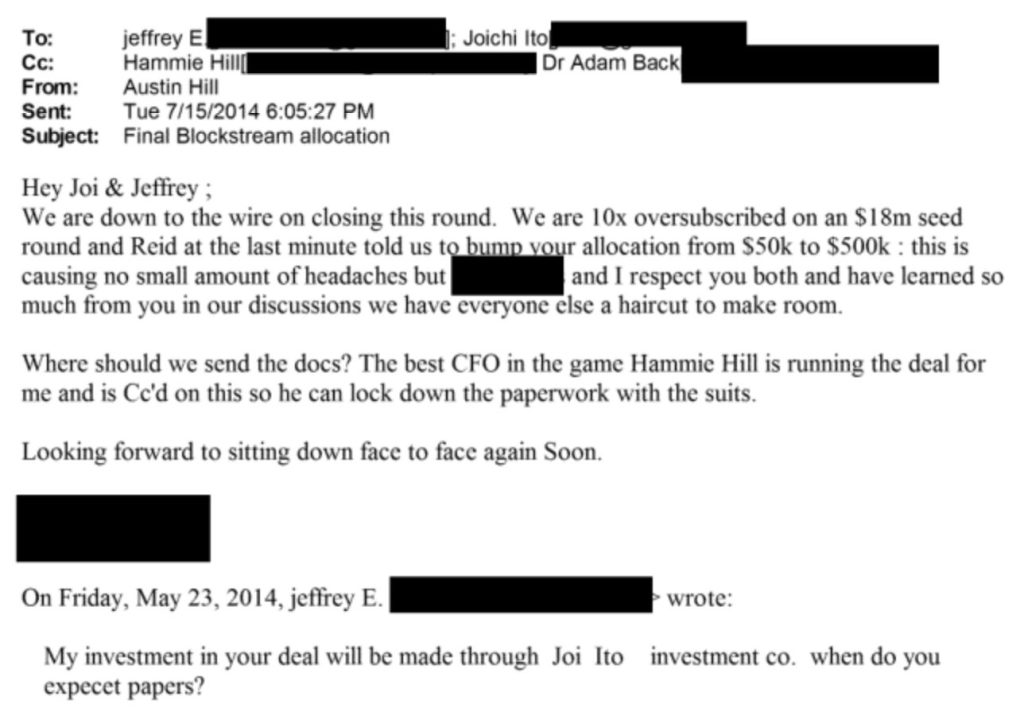
Source: US DOJ

In the message, Hill wrote that the round was “10x oversubscribed” and suggested increasing an allocation from $50,000 to $500,000. Adam Back was included in the email thread.

On X, Back claimed that in 2014, Blockstream participated in a seed-round investor roadshow coffee at which Joi Ito, then the director of the MIT Media Lab, was introduced to the company.

Through that connection, Blockstream later met Epstein, who was described at the time as a limited partner in an investment fund associated with Ito.

Co-founder and CEO of Blockstream, Adam Back, responded to the documents, admitting that his company has no continuing or material relationship with Epstein.

That fund went on to take a minority stake in Blockstream, but Back said it later divested its shares due to potential conflicts of interest and other concerns.

Files Show Saylor Mentioned in Pre-Bitcoin Charity Correspondence

Michael Saylor’s name appears in a different context within the files.

An email dated May 8, 2010, sent by Hollywood publicist Peggy Siegal, detailed arrangements for the Robin Hood Foundation’s annual gala and related Cannes social events.

The message noted that Michael Saylor donated $25,000 to a charity initiative, which granted him access to attend the events and potentially meet members of an exclusive social circle.

However, Siegal characterized Saylor as socially awkward, describing him as difficult to engage with and lacking awareness of basic social norms.

The message predates Saylor’s later prominence as one of Bitcoin’s most vocal corporate advocates and does not mention cryptocurrency.

Saylor only began acquiring Bitcoin for MicroStrategy in 2020, years after the correspondence cited in the Epstein materials.

Other unsealed documents reference travel arrangements involving Hill and Back, including bookings connected to St. Thomas, an island near Epstein’s private property.

The documents have also emphasized Epstein’s broader interest in cryptocurrency during Bitcoin’s formative years.

Email communications reveal him discussing with one of the biggest tech investors, Peter Thiel, how to define Bitcoin and whether it was more of a store of value, a currency, or a technological architecture.

Individual correspondence suggests that Epstein kept a close eye on the debates in the crypto ecosystem and shared his views on rival blockchain projects.

In 2016, he also offered suggestions connected with digital currencies in the Middle East, such as a Sharia-compliant type based on the technology of Bitcoin.

Other notable names mentioned throughout the documents are former director of MIT Media Lab Joi Ito, PayPal co-founder Peter Thiel, and Kevin Warsh, who was recently appointed by President Donald Trump to the role of Federal Reserve chair.

The Epstein files were unsealed following earlier court orders in 2024 that released names from a separate civil case involving Epstein’s associate Ghislaine Maxwell.

While more than 150 previously anonymized names have now entered the public record, others remain redacted, particularly where victims’ identities or ongoing investigations are involved.

Epstein died in 2019 while awaiting trial on federal charges, including sex trafficking of minors and conspiracy to commit sex trafficking of minors.

Disclaimer: The articles reposted on this site are sourced from public platforms and are provided for informational purposes only. They do not necessarily reflect the views of MEXC. All rights remain with the original authors. If you believe any content infringes on third-party rights, please contact service@support.mexc.com for removal. MEXC makes no guarantees regarding the accuracy, completeness, or timeliness of the content and is not responsible for any actions taken based on the information provided. The content does not constitute financial, legal, or other professional advice, nor should it be considered a recommendation or endorsement by MEXC.
Tags:

You May Also Like

Victra Named 2025 Recipient of Verizon’s Best Build Compliance Award
Victra Named 2025 Recipient of Verizon’s Best Build Compliance Award

Verizon Recognizes Victra for Industry-Leading Excellence in Store Design and Brand Compliance. RALEIGH, N.C., Feb. 3, 2026 /PRNewswire/ — Verizon has named Victra
Share
AI Journal2026/02/03 20:49
Stablecoins could face yield compression after Fed’s rate cut

Stablecoins could face yield compression after Fed’s rate cut

The post Stablecoins could face yield compression after Fed’s rate cut appeared on BitcoinEthereumNews.com. The Federal Reserve reduced its policy rate by 25 basis points to 4.00%–4.25%, the first rate cut this year. The move, framed as a response to weakening labor data, signals the start of a cautious easing cycle. Projections show two more cuts possible before year-end, with further reductions likely in 2026. Inflation remains above target, but Chairman Jerome Powell emphasized risk management over immediate price control, prioritizing stability in employment conditions. Stablecoins will be quickly affected by this. Issuers like Tether and Circle have generated large profits by holding reserves in short-term Treasuries during the high-rate environment of the past two years. That income stream now begins to erode. DeFi protocols that offered tokenized Treasury exposure face the same squeeze, with returns set to fall further if the Fed continues cutting into next year. A multi-cut easing cycle could substantially reduce stablecoin profitability, forcing issuers and protocols to adapt. The decline in dollar yields also alters the balance between holding stablecoins passively and seeking higher returns in risk assets. Bitcoin benefits most from this reallocation. As nominal rates move lower and inflation remains sticky, real yields decline, making non-yielding assets more attractive. The weaker dollar and improving risk appetite amplify the effect, positioning Bitcoin as a relative winner of the Fed’s shift. The September cut is modest, but it could bring significant changes to the crypto market. Stablecoin models built on Treasury income face structural headwinds after the rate cut, while Bitcoin and other high-beta assets stand to gain from falling real yields and increased liquidity. The Fed has opened an easing cycle, and crypto’s internal capital flows will move with it. The post Stablecoins could face yield compression after Fed’s rate cut appeared first on CryptoSlate. Source: https://cryptoslate.com/insights/stablecoins-could-face-yield-compression-after-feds-rate-cut/
Share
BitcoinEthereumNews2025/09/18 19:31
Wormhole Jumps 11% on Revised Tokenomics and Reserve Initiative

Wormhole Jumps 11% on Revised Tokenomics and Reserve Initiative

The post Wormhole Jumps 11% on Revised Tokenomics and Reserve Initiative appeared on BitcoinEthereumNews.com. Cross-chain bridge Wormhole plans to launch a reserve funded by both on-chain and off-chain revenues. Wormhole, a cross-chain bridge connecting over 40 blockchain networks, unveiled a tokenomics overhaul on Wednesday, hinting at updated staking incentives, a strategic reserve for the W token, and a smoother unlock schedule. The price of W jumped 11% on the news to $0.096, though the token is still down 92% since its debut in April 2024. W Chart In a blog post, Wormhole said it’s planning to set up a “Wormhole Reserve” that will accumulate on-chain and off-chain revenues “to support the growth of the Wormhole ecosystem.” The protocol also said it plans to target a 4% base yield for governance stakers, replacing the current variable APY system, noting that “yield will come from a combination of the existing token supply and protocol revenues.” It’s unclear whether Wormhole will draw from the reserve to fund this target. Wormhole did not immediately respond to The Defiant’s request for comment. Wormhole emphasized that the maximum supply of 10 billion W tokens will remain the same, while large annual token unlocks will be replaced by a bi-weekly distribution beginning Oct. 3 to eliminate “moments of concentrated market pressure.” Data from CoinGecko shows there are over 4.7 billion W tokens in circulation, meaning that more than half the supply is yet to be unlocked, with portions of that supply to be released over the next 4.5 years. Source: https://thedefiant.io/news/defi/wormhole-jumps-11-on-revised-tokenomics-and-reserve-initiative
Share
BitcoinEthereumNews2025/09/18 01:31