OpCo has launched and is actively managing the RAD program to incentivize delegate participation, enhance voting transparency, and provide public insights into OpCo has launched and is actively managing the RAD program to incentivize delegate participation, enhance voting transparency, and provide public insights into

Arbitrum’s Rewards For Active Delegates Program Gains Momentum With Operational And Compliance Milestones

3 min read
Arbitrum’s Rewards For Active Delegates Program Gains Momentum With Operational And Compliance Milestones

OpCo, the operational arm of the Arbitrum ecosystem, has provided an update on its Rewards for Active Delegates (RAD) program, which launched on January 1st and will run through December 31st. Unlike previous initiatives administered by the Arbitrum Foundation, OpCo manages this program directly, requiring delegates to complete KYC/KYB verification and sign a grant agreement—a one-time compliance process for participants.

The program’s structure includes quarterly budget reviews, with the first set to conclude by March 31st, and semi-annual transparency reports, the first scheduled for publication by July 1st. Delegates can also expect monthly reward calculations for any votes cast or program adjustments, while quarterly updates will detail budget reviews and changes.

Operationally, OpCo has made significant progress since taking on RAD. The team published a delegate application thread, engaged SEED as program manager, and shared SEED’s scope of work and compensation publicly. A compliance flow was established using Sumsub for KYC and Provenance for KYB, and a grant agreement template was created with external counsel. Additionally, a multisig wallet was set up with signed legal agreements, and OpCo formalized a legal agreement with the Arbitrum Foundation to transfer funds to its control. As of January 29th, 38 delegates had applied, 24 completed compliance, 7 were in progress, and 4 had not started, representing over 200,000 voting power.

Regarding rewards, retroactive payments for November and December 2025 have been calculated and published on the forum, with disbursement expected to delegates’ wallets by the end of January. Since no votes occurred in January, no rewards will be distributed for that month. The update underscores OpCo’s ongoing efforts to streamline program operations and maintain transparency for the Arbitrum delegate community.

RAD: Incentivizing Delegate Participation And Enhancinng Governance Transparency

The Rewards for Active Delegates (RAD) program is designed to incentivize delegates based on their voting activity and the transparency of their voting rationale, representing the first initiative in a series of proposals under the broader DAO Incentive Program (DIP 2.1). Within this framework, a delegate is defined as an entity with voting power that participates in proposal decisions, with the program specifically emphasizing voting engagement and providing publicly accessible insights to facilitate sentiment analysis on why proposals succeed or fail.

The RAD program has three primary objectives. The first is to increase active voting power by encouraging greater participation over time. The second is to reduce voter apathy, measured by the proportion of active voting power relative to total delegated power, which should rise as delegates engage consistently. The third goal is to generate meaningful, publicly available data that supports sentiment analysis, enabling stakeholders to understand the reasoning behind votes and gain insights into DAO decision-making dynamics.

Success for RAD is defined by sustained delegate participation, the onboarding of new delegates into the voting process, and the creation of a transparent feedback loop. Even when a proposal does not pass, the program allows proposers and the community to gauge sentiment across the DAO through publicly shared reasoning, promoting accountability, clarity, and a deeper understanding of governance outcomes.

The post Arbitrum’s Rewards For Active Delegates Program Gains Momentum With Operational And Compliance Milestones appeared first on Metaverse Post.

Disclaimer: The articles reposted on this site are sourced from public platforms and are provided for informational purposes only. They do not necessarily reflect the views of MEXC. All rights remain with the original authors. If you believe any content infringes on third-party rights, please contact service@support.mexc.com for removal. MEXC makes no guarantees regarding the accuracy, completeness, or timeliness of the content and is not responsible for any actions taken based on the information provided. The content does not constitute financial, legal, or other professional advice, nor should it be considered a recommendation or endorsement by MEXC.
Tags:

You May Also Like

Victra Named 2025 Recipient of Verizon’s Best Build Compliance Award
Victra Named 2025 Recipient of Verizon’s Best Build Compliance Award

Verizon Recognizes Victra for Industry-Leading Excellence in Store Design and Brand Compliance. RALEIGH, N.C., Feb. 3, 2026 /PRNewswire/ — Verizon has named Victra
Share
AI Journal2026/02/03 20:49
Stablecoins could face yield compression after Fed’s rate cut

Stablecoins could face yield compression after Fed’s rate cut

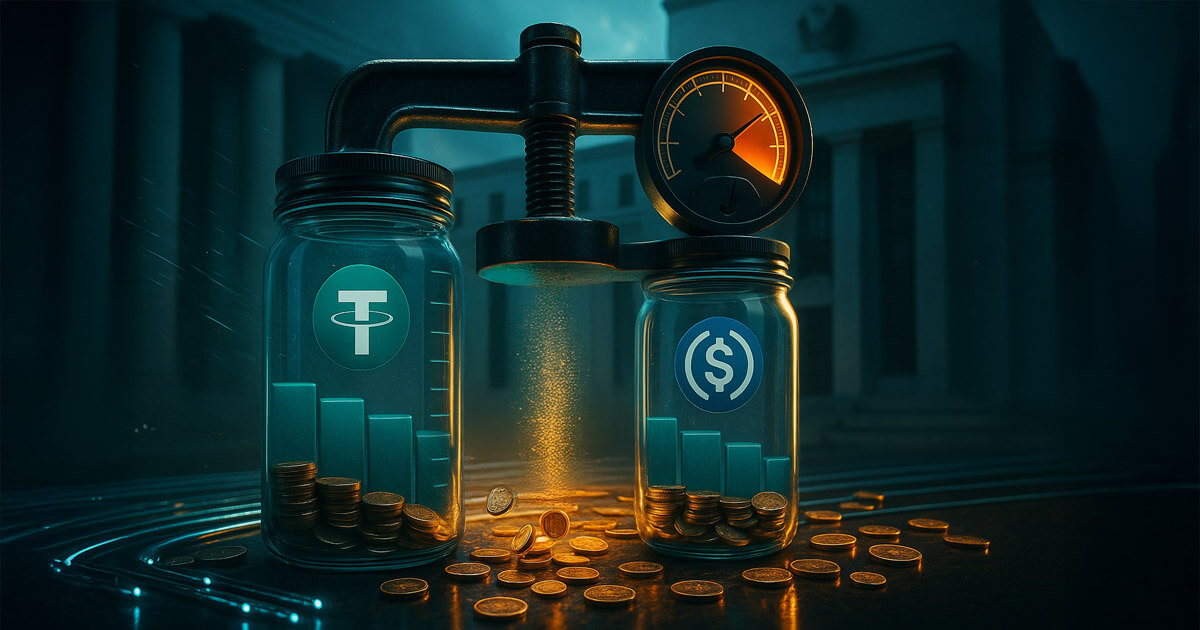
The post Stablecoins could face yield compression after Fed’s rate cut appeared on BitcoinEthereumNews.com. The Federal Reserve reduced its policy rate by 25 basis points to 4.00%–4.25%, the first rate cut this year. The move, framed as a response to weakening labor data, signals the start of a cautious easing cycle. Projections show two more cuts possible before year-end, with further reductions likely in 2026. Inflation remains above target, but Chairman Jerome Powell emphasized risk management over immediate price control, prioritizing stability in employment conditions. Stablecoins will be quickly affected by this. Issuers like Tether and Circle have generated large profits by holding reserves in short-term Treasuries during the high-rate environment of the past two years. That income stream now begins to erode. DeFi protocols that offered tokenized Treasury exposure face the same squeeze, with returns set to fall further if the Fed continues cutting into next year. A multi-cut easing cycle could substantially reduce stablecoin profitability, forcing issuers and protocols to adapt. The decline in dollar yields also alters the balance between holding stablecoins passively and seeking higher returns in risk assets. Bitcoin benefits most from this reallocation. As nominal rates move lower and inflation remains sticky, real yields decline, making non-yielding assets more attractive. The weaker dollar and improving risk appetite amplify the effect, positioning Bitcoin as a relative winner of the Fed’s shift. The September cut is modest, but it could bring significant changes to the crypto market. Stablecoin models built on Treasury income face structural headwinds after the rate cut, while Bitcoin and other high-beta assets stand to gain from falling real yields and increased liquidity. The Fed has opened an easing cycle, and crypto’s internal capital flows will move with it. The post Stablecoins could face yield compression after Fed’s rate cut appeared first on CryptoSlate. Source: https://cryptoslate.com/insights/stablecoins-could-face-yield-compression-after-feds-rate-cut/
Share
BitcoinEthereumNews2025/09/18 19:31
Wormhole Jumps 11% on Revised Tokenomics and Reserve Initiative

Wormhole Jumps 11% on Revised Tokenomics and Reserve Initiative

The post Wormhole Jumps 11% on Revised Tokenomics and Reserve Initiative appeared on BitcoinEthereumNews.com. Cross-chain bridge Wormhole plans to launch a reserve funded by both on-chain and off-chain revenues. Wormhole, a cross-chain bridge connecting over 40 blockchain networks, unveiled a tokenomics overhaul on Wednesday, hinting at updated staking incentives, a strategic reserve for the W token, and a smoother unlock schedule. The price of W jumped 11% on the news to $0.096, though the token is still down 92% since its debut in April 2024. W Chart In a blog post, Wormhole said it’s planning to set up a “Wormhole Reserve” that will accumulate on-chain and off-chain revenues “to support the growth of the Wormhole ecosystem.” The protocol also said it plans to target a 4% base yield for governance stakers, replacing the current variable APY system, noting that “yield will come from a combination of the existing token supply and protocol revenues.” It’s unclear whether Wormhole will draw from the reserve to fund this target. Wormhole did not immediately respond to The Defiant’s request for comment. Wormhole emphasized that the maximum supply of 10 billion W tokens will remain the same, while large annual token unlocks will be replaced by a bi-weekly distribution beginning Oct. 3 to eliminate “moments of concentrated market pressure.” Data from CoinGecko shows there are over 4.7 billion W tokens in circulation, meaning that more than half the supply is yet to be unlocked, with portions of that supply to be released over the next 4.5 years. Source: https://thedefiant.io/news/defi/wormhole-jumps-11-on-revised-tokenomics-and-reserve-initiative
Share
BitcoinEthereumNews2025/09/18 01:31