The expansion of blockchain technology has long moved beyond the realm of cryptocurrency transactions and the virtual world. The industry is evolving at such a rapid pace that companies across a wide range of sectors are now actively integrating blockchain into their operational and production systems. One compelling example of blockchain’s real-world application is the […] Сообщение What Is DePIN — Decentralized Physical Infrastructure Networks? появились сначала на INCRYPTED .The expansion of blockchain technology has long moved beyond the realm of cryptocurrency transactions and the virtual world. The industry is evolving at such a rapid pace that companies across a wide range of sectors are now actively integrating blockchain into their operational and production systems. One compelling example of blockchain’s real-world application is the […] Сообщение What Is DePIN — Decentralized Physical Infrastructure Networks? появились сначала на INCRYPTED .

What Is DePIN — Decentralized Physical Infrastructure Networks?

7 min read
In this article:

1. What Is DePIN?

2. How Does DePIN Work?

3. Advantages and Disadvantages of DePIN

4. DePIN: Forecasts and Future Prospects

5. Conclusions

The expansion of blockchain technology has long moved beyond the realm of cryptocurrency transactions and the virtual world. The industry is evolving at such a rapid pace that companies across a wide range of sectors are now actively integrating blockchain into their operational and production systems.

One compelling example of blockchain’s real-world application is the rise of Decentralized Physical Infrastructure Networks, or DePIN. The team at Incrypted took a closer look at what makes these systems unique — and why they could play a pivotal role in the future of decentralized technology.

At its core, DePIN refers to the use of blockchain technology and decentralization principles to create, maintain, expand, and operate networks of physical infrastructure.

These networks are community-governed, and participants are rewarded with tokens for contributing to the system’s functionality and decentralization. In essence, users become stakeholders in the infrastructure they help support.

The idea of applying blockchain to real-world infrastructure first emerged nearly a decade ago. However, back then it wasn’t yet known under the unified term “DePIN.” Early innovators in this space include the developers behind Filecoin — a project often regarded as a pioneer in decentralized infrastructure.

The concept aims to aggregate and optimize the use of service providers’ resources for end users. With built-in economic incentives, providers are motivated to boost the efficiency of their computing power, while users benefit from significantly lower fees compared to traditional corporate services.

DePIN operates at the intersection of blockchain technology and real-world physical infrastructure — and here’s how it works in practice.

A provider manages a physical asset, while middleware software handles the interaction between that asset and the blockchain. This software collects real-time data on the activity of each device or resource and transmits it to the decentralized network.

The blockchain protocol acts like an autonomous coordinator, distributing demand across providers and calculating token-based rewards based on their performance and contribution.

This structure incentivizes providers to make the most of their unused or underutilized resources — turning idle capacity into productive infrastructure.

DePIN projects generally fall into two broad categories:

  1. Physical Resource Networks (PRNs) – These rely heavily on geolocation and offer non-fungible resources tied to a specific place. Their services are usually localized and often relate to mobile technologies or energy systems.
  2. Digital Resource Networks (DRNs) – These provide computing power or storage space, and their resources are location-agnostic and interchangeable.

DePIN is already reshaping various industries, with notable use cases across:

  • Wireless connectivity (Helium)
  • Decentralized cloud storage  (Arweave)
  • Smart energy grids (Arcreen)
  • Mobile data solutions (Dimo)
  • Decentralized computing (Nunet)
  • Mapping and geolocation services (Hivemapper)
  • Healthcare data systems (Healthblocks)

Next, let’s take a closer look at some of the most prominent and successful DePIN projects in the space.

Filecoin

Filecoin is a decentralized data storage platform built on the InterPlanetary File System (IPFS). Launched as one of the earliest real-world applications of the DePIN concept, the idea behind Filecoin dates all the way back to 2014.

The system allows users to store their data across a distributed network by paying network miners for available storage space. But there’s a twist — pricing is dynamic and constantly shifting, as miners compete to offer the lowest rates. The more space a miner contributes, the higher their potential reward in the network’s native cryptocurrency, FIL.

This competitive model not only drives down storage costs for users but also incentivizes miners to maximize their available capacity.

As of March 8, 2024, FIL was trading at $10.09.

Helium

Helium is a decentralized wireless network designed to provide low-cost internet access — often more affordable than traditional providers in countries like the United States or Canada.

Data is transmitted through user-operated hotspots that utilize Helium LongFi technology. Miners who maintain these network nodes earn HNT tokens, while subscribers receive MOBILE tokens, which can be used to renew their data plans.

As of the time of writing, the Helium network boasts over 984,900 active hotspots across more than 170 countries, with the highest concentration found in the U.S. and parts of Europe. 

Render

Render is a decentralized rendering platform that connects creators with unused GPU power across the network. Providers offer up their graphics processing units (GPUs) to support visual content creation — from animations to complex 3D scenes — and are rewarded in RENDER tokens for their contributions.

In theory, the DePIN model has the potential to radically transform how we manage and interact with physical infrastructure. By leveraging blockchain and smart contracts, it introduces greater efficiency and transparency, allowing communities — rather than corporations — to make key decisions collectively.

DePIN can be seen as a form of “industrial DAO,” where all participants have equal rights and contribute to a truly independent infrastructure. 

The system is also highly flexible and horizontally scalable. With a motivated user and operator base, the deployment of decentralized physical infrastructure can be accelerated exponentially.

DePIN’s pricing model is often considered more accessible and equitable. Because the infrastructure is community-owned, service costs are driven not by profit margins, but by fairness and availability.

Another key advantage is the token-based incentive system, which allows participants to earn passive income while contributing to the health and growth of the ecosystem.

However, DePIN is not without its drawbacks:

  • vulnerability to hacks and system errors
  • high volatility of token values
  • the need for participants to have a certain level of technical expertise

Additionally, the lack of regulatory oversight poses risks. In some cases, DePIN networks could be misused for illegal activities — such as storing or distributing unlawful content — due to their decentralized and often anonymous nature.

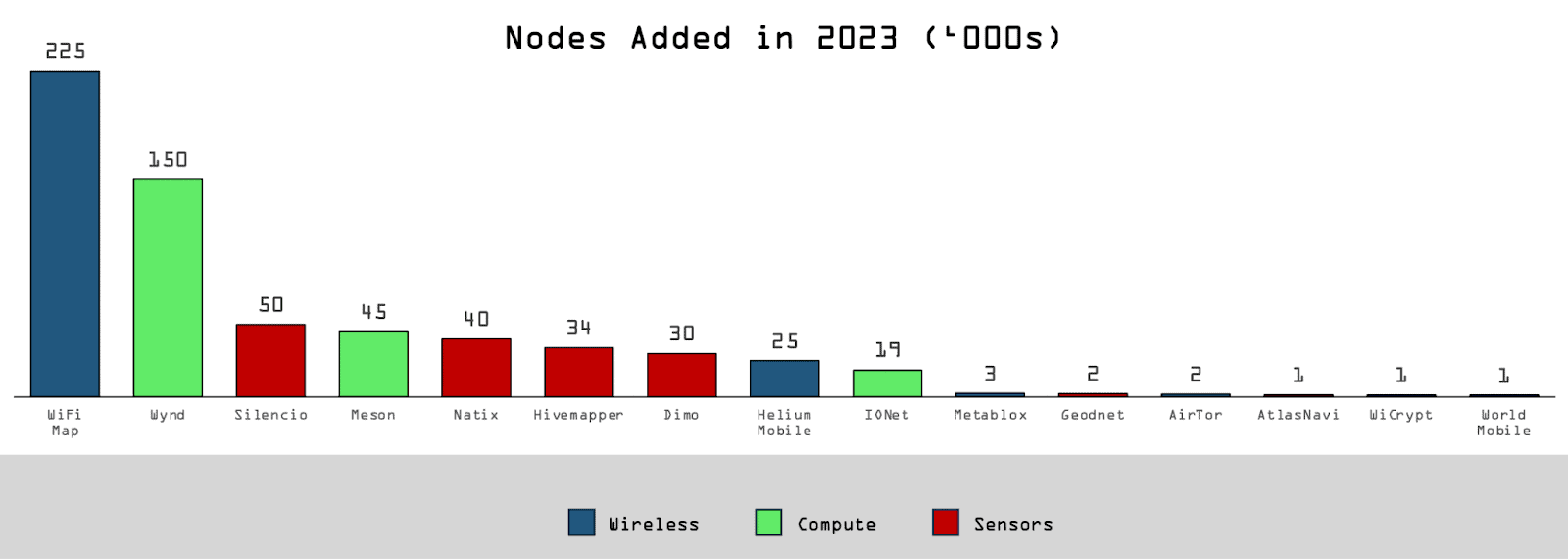
In 2023, the DePIN ecosystem expanded rapidly, surpassing 650 projects, according to analysts at Messari. During the same period, infrastructure projects collectively added over 600,000 new nodes to their networks, highlighting robust growth and increasing adoption.

Number of New Nodes in DePIN Projects in 2023 Source: Messari.

Analysts at Messari have identified several major trends shaping the development of DePIN in 2024. According to experts, meme tokens could play a significant role in driving mass adoption of DePIN projects. To illustrate their point, they cite the BONK airdrop for users of the Solana Saga smartphone as a successful example.

Additionally, analysts view Asia as the region with the greatest potential for rapid growth and deployment of decentralized infrastructure projects. They expect some of the most impactful initiatives in the sector to emerge from this region between 2024 and 2025.

Lex Sokolin, founder of Generative Ventures, predicts a close interplay between DePIN systems and artificial intelligence: 

The earliest DePIN developments appeared roughly a decade ago, and since then, the number of projects in this field has grown exponentially.

The sector’s market capitalization now exceeds $20 billion, excluding real-world assets (RWA) and blockchain oracles, according to Messari. Yet, DePIN projects remain relatively niche — even within the crypto community — let alone in terms of widespread mainstream adoption.

Implementing decentralized physical infrastructure will take time, as significant challenges still need to be addressed. Nevertheless, experts agree that DePIN systems will play a crucial role in shaping the future and have the potential to fundamentally transform how physical infrastructure operates.

Market Opportunity
RealLink Logo
RealLink Price(REAL)
$0,05756
$0,05756$0,05756
-4,32%
USD
RealLink (REAL) Live Price Chart
Disclaimer: The articles reposted on this site are sourced from public platforms and are provided for informational purposes only. They do not necessarily reflect the views of MEXC. All rights remain with the original authors. If you believe any content infringes on third-party rights, please contact service@support.mexc.com for removal. MEXC makes no guarantees regarding the accuracy, completeness, or timeliness of the content and is not responsible for any actions taken based on the information provided. The content does not constitute financial, legal, or other professional advice, nor should it be considered a recommendation or endorsement by MEXC.

You May Also Like

Ethereum unveils roadmap focusing on scaling, interoperability, and security at Japan Dev Conference

Ethereum unveils roadmap focusing on scaling, interoperability, and security at Japan Dev Conference

The post Ethereum unveils roadmap focusing on scaling, interoperability, and security at Japan Dev Conference appeared on BitcoinEthereumNews.com. Key Takeaways Ethereum’s new roadmap was presented by Vitalik Buterin at the Japan Dev Conference. Short-term priorities include Layer 1 scaling and raising gas limits to enhance transaction throughput. Vitalik Buterin presented Ethereum’s development roadmap at the Japan Dev Conference today, outlining the blockchain platform’s priorities across multiple timeframes. The short-term goals focus on scaling solutions and increasing Layer 1 gas limits to improve transaction capacity. Mid-term objectives target enhanced cross-Layer 2 interoperability and faster network responsiveness to create a more seamless user experience across different scaling solutions. The long-term vision emphasizes building a secure, simple, quantum-resistant, and formally verified minimalist Ethereum network. This approach aims to future-proof the platform against emerging technological threats while maintaining its core functionality. The roadmap presentation comes as Ethereum continues to compete with other blockchain platforms for market share in the smart contract and decentralized application space. Source: https://cryptobriefing.com/ethereum-roadmap-scaling-interoperability-security-japan/
Share
BitcoinEthereumNews2025/09/18 00:25
Cloud mining is gaining popularity around the world. LgMining’s efficient cloud mining platform helps you easily deploy digital assets and lead a new wave of crypto wealth.

Cloud mining is gaining popularity around the world. LgMining’s efficient cloud mining platform helps you easily deploy digital assets and lead a new wave of crypto wealth.

The post Cloud mining is gaining popularity around the world. LgMining’s efficient cloud mining platform helps you easily deploy digital assets and lead a new wave of crypto wealth. appeared on BitcoinEthereumNews.com. SPONSORED POST* As the cryptocurrency market continues its recovery, Ethereum has once again become the center of attention for investors. Recently, the well-known crypto mining platform LgMining predicted that Ethereum may surpass its previous all-time high and surge past $5,000. In light of this rare market opportunity, choosing a high-efficiency, secure, and low-cost mining platform has become the top priority for many investors. With its cutting-edge hardware, intelligent technology, and low-cost renewable energy advantages, LgMining Cloud Mining is rapidly emerging as a leader in the cloud mining industry. Ethereum: The Driving Force of the Crypto Market Ethereum is not only the second-largest cryptocurrency by market capitalization but also the backbone of the blockchain smart contract ecosystem. From DeFi (Decentralized Finance) to NFTs (Non-Fungible Tokens) and the broader Web3.0 infrastructure, most innovations are built on Ethereum. This widespread utility gives Ethereum tremendous growth potential. With the upcoming scalability upgrades, the Ethereum network is expected to offer improved performance and transaction speed—likely triggering a fresh wave of market enthusiasm. According to the LgMining research team, Ethereum’s share among institutional and retail investors continues to grow. Combined with shifting monetary policies and global economic uncertainties, Ethereum is expected to break past its previous high of over $4,000 and aim for $5,000 or more in the coming months. LgMining Cloud Mining: Unlocking a Low-Barrier Path to Wealth Traditional crypto mining often requires expensive mining rigs, stable electricity, and complex maintenance—making it inaccessible for the average person. LgMining Cloud Mining breaks down these barriers, allowing anyone to easily participate in mining Ethereum and Bitcoin without owning hardware. LgMining builds its robust and efficient mining infrastructure around three core advantages: 1. High-End Equipment LgMining uses top-tier mining hardware with exceptional computing power and reliability. The platform’s ASIC and GPU miners are carefully selected and tested to…
Share
BitcoinEthereumNews2025/09/18 03:04
The Giants Are Stumbling: Why BlockDAG’s 20-Exchange Launch is the Market’s New Safe Haven

The Giants Are Stumbling: Why BlockDAG’s 20-Exchange Launch is the Market’s New Safe Haven

The cryptocurrency market seems to have caught headwinds entering February. Portfolios across the globe are flashing red as the flash crash of February 2nd wreaks
Share
Captainaltcoin2026/02/04 02:30