

Bitcoin Price Prediction 2026: Can BTC Break Above $90,000 Soon?
- Bitcoin faces critical resistance at $88,586, will bullish momentum return?
- 2026 sees Bitcoin’s key breakdown; support at $78,000 looms ahead.
- Bitcoin price recovery hinges on reclaiming crucial $88,586 resistance level.
Bitcoin price today trades near $82,853 after breaking below the ascending trendline that had supported its rally since December 2025. This move marks a significant shift in short-term market sentiment, as BTC has lost key support levels. The drop follows a rare cross-asset liquidation event that was triggered by a sharp 35% collapse in silver prices, forcing over $142 million in tokenized metals positions to unwind. This cascade of liquidations pulled Bitcoin lower as the broader market sentiment worsened, exacerbating the selloff.
While Bitcoin had been in a strong uptrend for most of January, the breakdown has now shifted the technical structure from consolidation to a bearish continuation. Immediate support is seen at $82,420, with the next major demand zone near $78,000. As the market braces for further volatility, the question remains: Can Bitcoin regain its bullish momentum, or is a deeper correction ahead?
Also Read: White Whale (WHALE) Price Prediction 2026–2030: Can WHALE Hit $0.4200 Soon?
Bitcoin’s Technical Breakdown and the EMA Structure
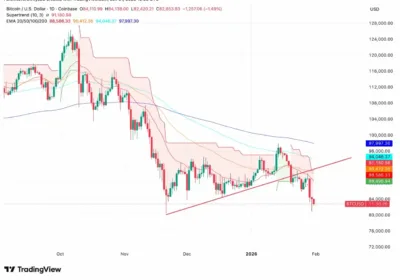
On the daily chart, Bitcoin has broken below the key ascending trendline that supported its price through multiple tests in January. The price now trades well below all four major EMAs, with the 20-day EMA at $88,586, the 50-day at $90,412, the 100-day at $94,046, and the 200-day EMA at $97,997. These moving averages act as resistance levels, with the $88,586 level now serving as the most immediate barrier to any potential rally.
The breakdown below the trendline has shifted the broader technical structure toward a bearish outlook. Immediate support is seen at $82,420, with further support at the December low near $78,000. Any further decline below this support could open the door to additional downside, especially if the broader market remains under pressure.
Bulls Confront Resistance at $88,586
For Bitcoin to shift momentum back toward a bullish outlook, it will need to reclaim the $88,586 level, which would confirm a reversal from the recent breakdown. This level coincides with the 20-day EMA, and a close above it would signal that the trendline breakdown was a false move, allowing for a potential rally back toward the $90,000 level.
Source: Tradingview
However, failure to reclaim this resistance could keep Bitcoin contained below key resistance levels, increasing the likelihood of further downside. A rejection at this level would likely trigger a move back toward the $81,000–$82,000 range, with the possibility of testing the major support at $78,000.
Key Support and Resistance Levels for Bitcoin
For the bullish case to remain intact, Bitcoin must hold above the $82,420 level and secure a daily close above $88,586. A daily close above this level would confirm that the bearish breakdown was a false signal and open the door toward a recovery, possibly targeting $90,000 or higher. On the downside, failure to hold the $81,000 level would weaken momentum, potentially exposing the $78,000 support zone.
Bitcoin Price Prediction 2026–2030
| Year | Minimum Price | Average Price | Maximum Price |
|---|---|---|---|
| 2026 | $78,000 | $85,000 | $90,000 |
| 2027 | $82,000 | $88,000 | $95,000 |
| 2028 | $85,000 | $92,000 | $100,000 |
| 2029 | $88,000 | $95,000 | $105,000 |
| 2030 | $90,000 | $100,000 | $120,000 |
2026
Bitcoin enters 2026 after a sharp breakdown below key support levels, leaving behind a bearish structure. While the price has dropped below $85,000, the year will be about Bitcoin attempting to stabilize and transition out of the corrective phase. The market will likely see periods of consolidation, with a significant focus on whether Bitcoin can reclaim critical levels, especially $88,586, to reverse the trend.
Bitcoin’s price could hover between $78,000 and $90,000 in 2026, as it consolidates and attempts to recover from recent declines. A clear trend reversal will be seen if Bitcoin successfully reclaims $88,586.
2027
If Bitcoin manages to reclaim key technical levels and overcome the bearish sentiment, 2027 could mark the beginning of a more sustainable recovery. Strong institutional adoption, increased use cases, and reduced sell pressure might push Bitcoin back into the $85,000 to $95,000 range. However, the broader market sentiment and macroeconomic factors will continue to be pivotal.
The range for 2027 could lie between $82,000 and $95,000, with price action driven by improving fundamentals and recovery from the 2026 breakdown.
2028
By 2028, Bitcoin may experience more stability, with gradual but consistent price growth. This period could be marked by Bitcoin solidifying its place as a leading digital asset in the financial ecosystem. The price may begin to touch the $100,000 level as market confidence returns and a steady uptrend forms. However, growth will be slow and measured, with periods of small corrections along the way.
A more stable period for Bitcoin could push prices between $85,000 and $100,000 in 2028, reflecting steady long-term growth after recovery.
2029
Bitcoin’s price could be on the verge of breaking new ground by 2029. If Bitcoin continues to defend higher support levels and the market sentiment shifts more bullishly, price action could push towards $105,000 or beyond. This phase would be marked by increasing demand, both from retail and institutional investors, and a more solidified market presence for Bitcoin.
A potential push toward $100,000 or more could occur in 2029, especially if Bitcoin breaks through prior resistance levels and sustained adoption continues.
2030
By 2030, Bitcoin could be in a more mature phase of its price cycle. If Bitcoin successfully establishes itself above prior cycle resistance points, the price could reflect a more sustained trend rather than speculative peaks. Bitcoin may achieve widespread institutional adoption and be more integrated into global financial systems, further solidifying its position above $100,000.
Long-term growth potential could see Bitcoin at prices between $100,000 and $120,000, depending on its role in the global economy and continued market acceptance.
Conclusion
Bitcoin enters 2026 with a bearish outlook after breaking below key technical levels. While the price has shown some stabilization in the short term, it faces significant resistance at the $88,586 level. A daily close above this level is crucial for reversing the current bearish trend and opening the door to higher levels. However, the current market structure points to continued selling pressure, with the $78,000 level as the next major support.
FAQs
1. Why is Bitcoin price falling now?
The recent decline in Bitcoin price is driven by a combination of large-scale liquidations in the crypto market, particularly in silver futures, and broader market weakness.
2. What is the key support level for Bitcoin?
The primary near-term support is at $82,420, with the next major support zone at $78,000.
3. What resistance must Bitcoin break to turn bullish?
A daily close above $88,586 is required to signal a trend reversal and push toward higher levels.
4. Could Bitcoin fall back to $78,000?
Yes. If Bitcoin fails to hold its current support at $81,000 and continues to face selling pressure, it could test the $78,000 support.
5. Is Bitcoin still in a downtrend?
Currently, Bitcoin is in a downtrend, as it has broken below key support levels and remains below major moving averages. A reversal above $88,586 could signal the end of the downtrend.
Also Read: Quant Price Prediction 2026–2030: Can QNT Break Above $100 Soon?
The post Bitcoin Price Prediction 2026: Can BTC Break Above $90,000 Soon? appeared first on 36Crypto.
You May Also Like

The Role of Blockchain in Building Safer Web3 Gaming Ecosystems
- Immutable Ownership of Assets Blockchain records can be manipulated by anyone. If a player owns a sword, skin, or plot of land as an NFT, it is verifiably in their ownership, and it cannot be altered or deleted by the developer or even hacked. This has created a proven track record of ownership, providing control back to the players, unlike any centralised gaming platform where assets can be revoked.
- Decentralized Infrastructure Blockchain networks also have a distributed architecture where game data is stored in a worldwide network of nodes, making them much less susceptible to centralised points of failure and attacks. This decentralised approach makes it exponentially more difficult to hijack systems or even shut off the game’s economy.
- Secure Transactions with Cryptography Whether a player buys an NFT or trades their in-game tokens for other items or tokens, the transactions are enforced by cryptographic algorithms, ensuring secure, verifiable, and irreversible transactions and eliminating the risks of double-spending or fraudulent trades.
- Smart Contract Automation Smart contracts automate the enforcement of game rules and players’ economic exchanges for the developer, eliminating the need for intermediaries or middlemen, and trust for the developer. For example, if a player completes a quest that promises a reward, the smart contract will execute and distribute what was promised.
- Anti-Cheating and Fair Gameplay The naturally transparent nature of blockchain makes it extremely simple for anyone to examine a specific instance of gameplay and verify the economic outcomes from that play. Furthermore, multi-player games that enforce smart contracts on things like loot sharing or win sharing can automate and measure trustlessness and avoid cheating, manipulations, and fraud by developers.
- Cross-Platform Security Many Web3 games feature asset interoperability across platforms. This interoperability is made viable by blockchain, which guarantees ownership is maintained whenever assets transition from one game or marketplace to another, thereby offering protection to players who rely on transfers for security against fraud. Key Security Dangers in Web3 Gaming Although blockchain provides sound first principles of security, the Web3 gaming ecosystem is susceptible to threats. Some of the most serious threats include:

Vitalik Buterin Challenges Ethereum’s Layer 2 Paradigm
