The post Putin aide pitches Russia as ‘perfect’ destination for US data centers appeared on BitcoinEthereumNews.com. Russia can be the right destination for AmericanThe post Putin aide pitches Russia as ‘perfect’ destination for US data centers appeared on BitcoinEthereumNews.com. Russia can be the right destination for American

Putin aide pitches Russia as ‘perfect’ destination for US data centers

Russia can be the right destination for American data centers, a high-ranking member of President Putin’s administration is now suggesting.

The offer comes against the backdrop of figures showing that such facilities, often used by Russian companies for cryptocurrency mining, are growing in capacity.

Moscow courting Washington with another business proposal

With its cheaply priced energy, the Russian Federation could be the “perfect place” for the United States and other nations to set up their data centers, a top representative of the Kremlin has been quoted as stating.

The idea comes from Boris Titov, who is Vladimir Putin’s “special presidential envoy for relations with international organizations to achieve sustainable development goals.”

“Technology is advancing these days. And, of course, Americans are building a huge number of data centers now. Major American companies are doing so,” the Russian official told reporters at the UN headquarters in New York.

Quoted by the official TASS news agency on Friday, he elaborated further:

That means running data centers in the country is very profitable, Titov emphasized. “And not just for the Americans. It could be for the Chinese, too, or perhaps for other companies from other countries,” he added.

The president’s aide admitted, however, that for all this to work, trust must be established first, as well as the proper investment climate. Nevertheless, “this is a potentially profitable area of cooperation,” stressed the Russian envoy.

If bilateral relations between the RF and the U.S. improve, “the abolition of the broad interpretation of sanctions by companies will be the first step,” Titov is convinced.

When that happens, businesses will start communicating, and then restrictions on financial settlements may be lifted, he predicted, highlighting that the latter are currently the main obstacle.

This isn’t Russia’s first lure for America

Moscow and Washington have been engaged in a difficult dialogue to end the war in Ukraine since U.S. President Donald Trump returned to the White House a year ago. Officials in both capitals have commented on potential business opportunities that can be realized for the mutual benefit, once the bitter conflict is resolved.

The proposals range from the possible cooperation in areas such as energy exploration and exploitation to reviving decades-old ideas that never materialized. Last October, another Putin aide, his special envoy for economic cooperation with other nations, Kirill Dmitriev, suggested boring an underwater tunnel under the Bering Strait to boost economic ties.

Dmitriev, who is also involved in the Ukraine talks, referred to a similar project, dating back to the Cold War era, to build a “Peace Bridge” between the U.S. State of Alaska and Chukotka in Russia’s Far East.

In late December, Putin himself unveiled that Russia and the United States were discussing the option to jointly run the Zaporizhzhia nuclear power plant in occupied Eastern Ukraine.

Quoted by the business daily Kommersant, the president reportedly said the American side was interested in using electricity generated by the largest NPP in Europe for crypto mining operations. Meanwhile, another report by TASS revealed earlier this week that the total capacity of Russian mining farms and data processing centers, also often used to mint digital coins, has reached 4 GW in 2025.

That is over 33% higher than the figure from the previous year, according to Russia’s System Operator of the Unified Power System (SO UPS). The state-owned entity, which manages the vast country’s massive power distribution network, highlighted that the energy-intensive computing facilities now account for roughly 2% of the nation’s gross electricity consumption.

The smartest crypto minds already read our newsletter. Want in? Join them.

Source: https://www.cryptopolitan.com/putin-aide-pitches-russia-for-data-centers/

Disclaimer: The articles reposted on this site are sourced from public platforms and are provided for informational purposes only. They do not necessarily reflect the views of MEXC. All rights remain with the original authors. If you believe any content infringes on third-party rights, please contact service@support.mexc.com for removal. MEXC makes no guarantees regarding the accuracy, completeness, or timeliness of the content and is not responsible for any actions taken based on the information provided. The content does not constitute financial, legal, or other professional advice, nor should it be considered a recommendation or endorsement by MEXC.
Tags:

You May Also Like

Hadron Labs Launches Bitcoin Summer on Neutron, Offering 5–10% BTC Yield

Hadron Labs Launches Bitcoin Summer on Neutron, Offering 5–10% BTC Yield

Hadron Labs launches 'Bitcoin Summer' on Neutron, BTC vaults for WBTC, eBTC, solvBTC, uniBTC and USDC. Earn 5–10% BTC via maxBTC, with up to 10x looping.
Share
Blockchainreporter2025/09/18 02:00
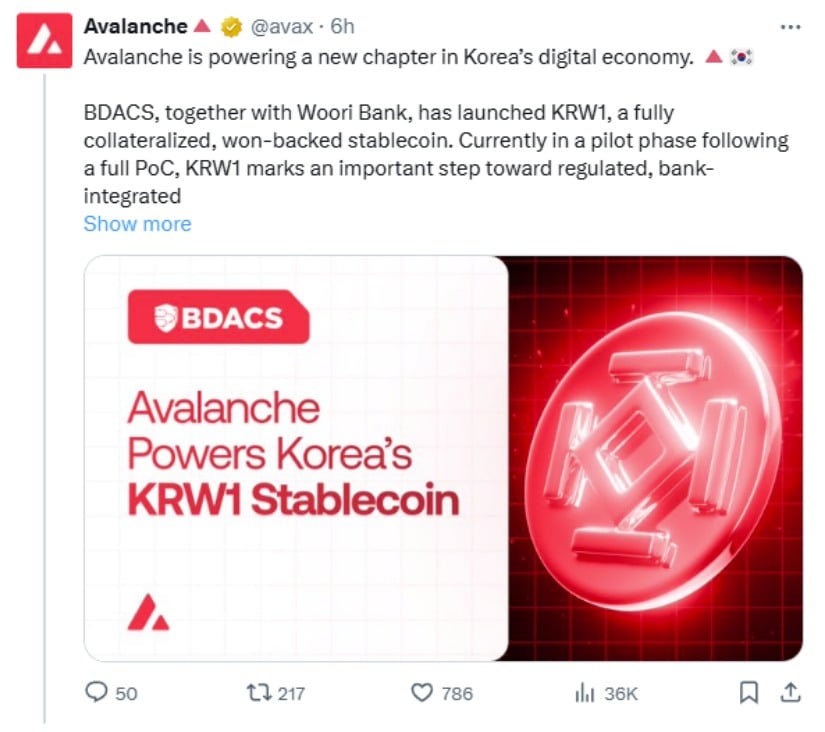
South Korea Launches First Won-Backed Stablecoin KRW1 on Avalanche

South Korea Launches First Won-Backed Stablecoin KRW1 on Avalanche

South Korea made history this week by launching its first Korean won-backed stablecoin.
Share
Brave Newcoin2025/09/19 03:15
Curve Finance votes on revenue-sharing model for CRV holders

Curve Finance votes on revenue-sharing model for CRV holders

The post Curve Finance votes on revenue-sharing model for CRV holders appeared on BitcoinEthereumNews.com. Curve Finance has proposed a new protocol called Yield Basis that would share revenue directly with CRV holders, marking a shift from one-off incentives to sustainable income. Summary Curve Finance has put forward a revenue-sharing protocol to give CRV holders sustainable income beyond emissions and fees. The plan would mint $60M in crvUSD to seed three Bitcoin liquidity pools (WBTC, cbBTC, tBTC), with 35–65% of revenue distributed to veCRV stakers. The DAO vote runs from up to Sept. 24, with the proposal seen as a major step to strengthen CRV tokenomics after past liquidity and governance challenges. Curve Finance founder Michael Egorov has introduced a proposal to give CRV token holders a more direct way to earn income, launching a system called Yield Basis that aims to turn the governance token into a sustainable, yield-bearing asset.  The proposal has been published on the Curve DAO (CRV) governance forum, with voting open until Sept. 24. A new model for CRV rewards Yield Basis is designed to distribute transparent and consistent returns to CRV holders who lock their tokens for veCRV governance rights. Unlike past incentive programs, which relied heavily on airdrops and emissions, the protocol channels income from Bitcoin-focused liquidity pools directly back to token holders. To start, Curve would mint $60 million worth of crvUSD, its over-collateralized stablecoin, with proceeds allocated across three pools — WBTC, cbBTC, and tBTC — each capped at $10 million. 25% of Yield Basis tokens would be reserved for the Curve ecosystem, and between 35% and 65% of Yield Basis’s revenue would be given to veCRV holders. By emphasizing Bitcoin (BTC) liquidity and offering yields without the short-term loss risks associated with automated market makers, the protocol hopes to draw in professional traders and institutions. Context and potential impact on Curve Finance The proposal comes as Curve continues to modify…
Share
BitcoinEthereumNews2025/09/18 14:37