How much is $1000 worth of a Shiba Inu?
Use the worked examples and the pre-purchase checklist as a template. Replace sample numbers with live quotes from a price site and your chosen exchange's published fees when you are ready to buy shiba inu coin.
What Shiba Inu (SHIB) is and how its price is quoted
Shiba Inu, commonly shown as SHIB, is an ERC-20 token that lives on Ethereum and uses 18 decimals for on-chain amounts. That means many tools show whole-token prices while on-chain balances use 10^18 units, so a small technical step is required when you move between display values and raw on-chain units. Verify the token contract and decimals in a block explorer before you rely on an on-chain number, for example by checking the token page on Etherscan Etherscan token page.
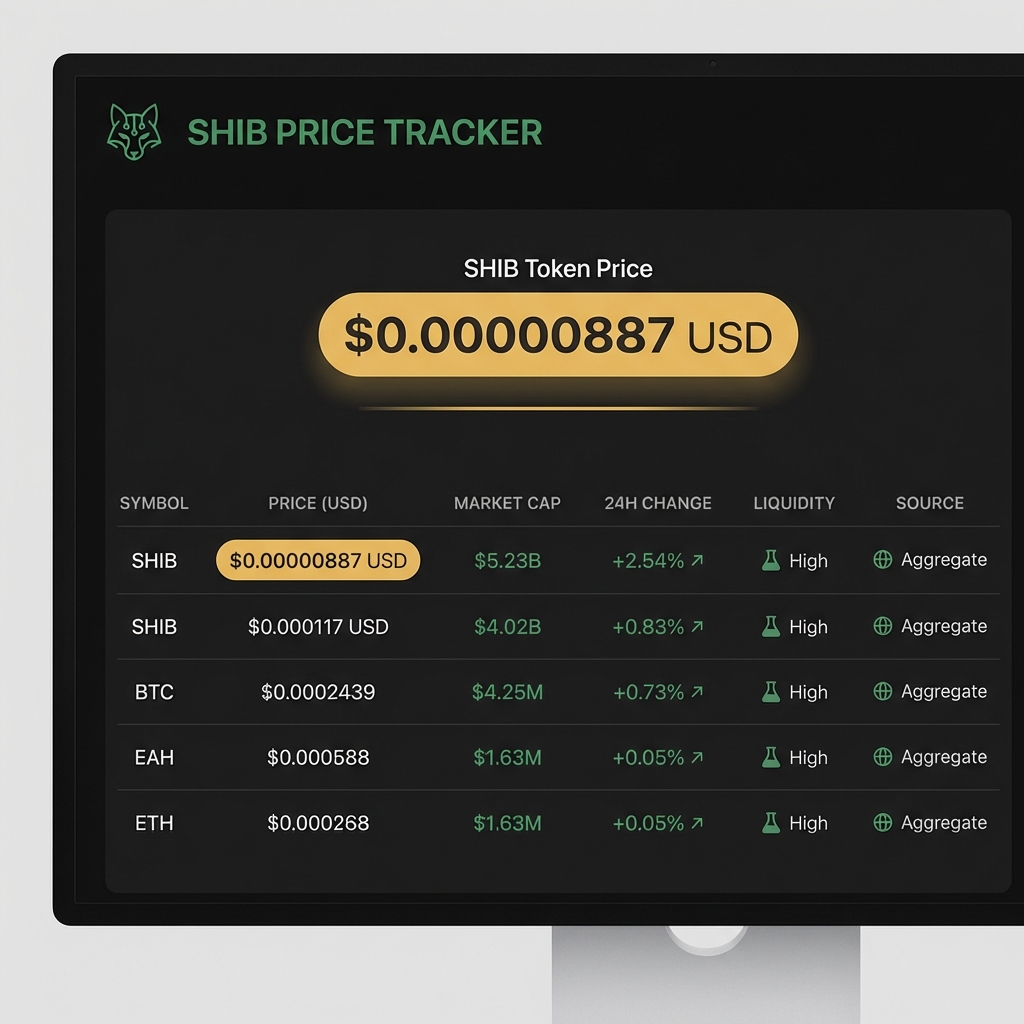
Public price aggregators publish a live USD price per SHIB that many people use for quick conversions. These aggregators provide a market snapshot that is useful for a first estimate, but snapshot converters do not include platform trading fees, spreads, or on-chain gas costs. For a live per-token quote you can use a price page such as CoinGecko to copy the current USD price per SHIB CoinGecko Shiba Inu page.
Copy the live per-token USD price from a price site and paste it into your conversion formula
Use the live quote at the time you plan to trade
A simple formula: How to calculate how many SHIB $1,000 buys
The basic math explained, buy shiba inu coin
The basic formula is simple: divide the USD you plan to spend by the current USD price per SHIB. That gives the raw token quantity before any fees or slippage. For example, if the quoted price is 0.00001 USD per SHIB, then 1,000 divided by 0.00001 equals 100,000,000 SHIB before fees and slippage. For a live price check you can compare the current USD price per SHIB on CoinGecko CoinGecko.
Price feeds often show the per-token price for a whole token while wallets display a formatted balance that hides the 18-decimal representation. When you move from the display number to on-chain units, multiply the displayed token amount by 10^18 to get the integer value used on Ethereum. This matters when you import balances or build a converter that will sign on-chain transactions, because contract calls expect the 10^18 style units Etherscan token page.

Remember that the raw division only gives an ideal quantity. Centralized exchanges and brokers apply trading fees and spreads, and on-chain transfers add gas or bridge costs. Treat the raw result as a starting point and then subtract or adjust for those costs before you finalise a purchase.
Exchange fees, spreads, and how they change the final SHIB amount
Most exchanges and brokers publish fee schedules that reduce the USD available to buy SHIB. Fees can be a fixed fee per trade, a percentage of the order, or both, and many platforms also add a spread between their buy and sell prices. Check the exchange help pages for the exact fee schedule before you trade Coinbase fee schedule.
Check exchange fees and spreads before buying
Before you place an order, open the chosen exchange's fee page and copy any maker, taker, or spread values into your conversion so you can see the net SHIB you will receive.
Open fee page and copy values
To see how fees reduce token quantity, convert the USD to SHIB using the per-token price, then subtract the fee amount in USD or reduce the USD by the fee percentage before dividing. For a percentage fee, multiply your USD amount by one minus the fee percent to get the net USD available to buy SHIB. Do not forget to confirm whether fees are taken in USD, in SHIB, or both.
Some platforms show the spread as a separate line in their order preview. If your order preview shows both a price and a fee, use the net price shown there as your per-token price for a more accurate estimate, and save a screenshot of the preview as a reference for the final calculation.
Slippage and order types: limit orders, market orders, and execution risk
Slippage is the difference between the expected price when you submit an order and the actual price when the trade executes. It grows when orders are large relative to available liquidity and can meaningfully reduce the final tokens you receive. An educational explainer helps define slippage and how it happens Investopedia slippage explainer.
Limit orders let you cap the execution price so slippage is controlled, while market orders execute immediately but expose you to whatever price is available at the time. For lower liquidity assets or large orders, consider splitting the purchase into smaller tranches or using limit orders with a reasonable price cushion.
Worked examples: how many SHIB does $1,000 buy at sample prices
Start with a clean USD-to-SHIB conversion using a sample per-token price from a price aggregator. For example, if a price page shows 0.00001 USD per SHIB, the raw conversion is 1,000 divided by 0.00001, which equals 100,000,000 SHIB. Use the live quote when you run this yourself to get an accurate number CoinGecko Shiba Inu page. You can also compare related market coverage such as our Bitcoin price analysis for an example of market commentary on price moves.
Now apply a hypothetical fee to show how the final amount differs. If the exchange charges a 0.5 percent trading fee, first reduce your USD by 0.5 percent. That turns 1,000 into 995 net USD. Dividing 995 by the same per-token price 0.00001 gives 99,500,000 SHIB instead of 100,000,000.
Get a live per-token USD price from a reputable price site, divide your USD by that price to get a raw token amount, then adjust for your exchange's fees, any spread in the quoted price, and expected slippage to estimate the final SHIB you will receive.
If you also account for slippage, the final quantity falls further. For example, assume slippage of 0.2 percent on execution. Apply the slippage to the net USD so 995 becomes approximately 993.01 USD. Dividing that by 0.00001 gives about 99,301,000 SHIB. This example shows how fees and slippage together can reduce the final token amount compared with the raw snapshot conversion.
These worked numbers are illustrative. When you calculate your result, replace the sample price and assumed fee amounts with your live quote and the exchange’s published fee values to get a final expected token amount for buy shiba inu coin. For reference you can check CoinMarketCap’s live SHIB page CoinMarketCap Shiba Inu page and related explainers such as Investopedia.
On-chain details: ERC-20 decimals, contract verification, and wallet import
SHIB uses 18 decimals, so many on-chain tools show integer values that represent the token amount multiplied by 10^18. If you build a converter or paste a number into a wallet, convert between the display amount and the 10^18 units to avoid rounding or transfer errors. The token contract and decimals are listed on a block explorer token page Etherscan token page.
Always verify the contract address before you add any token to a wallet. Adding the wrong contract can show a token that is not SHIB or, worse, lead to funds being sent to an incorrect contract. Use a reputable block explorer to confirm the address and decimal count, or see our crypto category for related coverage.
Secure custody options: wallets, hardware wallets, and custody trade-offs
For small or active holdings, a noncustodial wallet can be appropriate; for larger balances, hardware wallets reduce custody risk by keeping private keys offline. Follow ERC-20 best practices when you add SHIB to any wallet and verify the token contract first Ledger Academy ERC-20 guide.
Operationally, adding SHIB to a wallet usually means providing the token contract address and decimal count so the wallet can display balances correctly. Back up any seed phrase or private key you use, and store recovery data separately from your everyday devices. For more on our site, see Finance Police.
Custody choices involve trade-offs. Noncustodial wallets give you control and responsibility. Custodial services may be more convenient but mean you do not directly control the private keys. Consider the amount you plan to hold and your comfort with the operational steps before deciding.
A quick pre-purchase checklist: what to verify before you hit buy
Confirm the live per-token USD price on a trusted price site and copy that number into your conversion formula so you work with a live quote. Price aggregators provide the snapshot price you need to compute a starting token amount CoinMarketCap Shiba Inu page.
Check the exchange’s fee schedule, estimate slippage for your order size, and look for any network or bridge fees that apply to transfers. If you plan to move tokens off an exchange, add expected gas costs to your calculation so you know the final on-chain balance you will see.
Verify the SHIB contract address in your wallet and decide on custody before completing the purchase. If you will use a hardware wallet, confirm the steps to receive ERC-20 tokens and test with a small amount first.
Common mistakes to avoid when converting USD to SHIB
Do not rely on snapshot converters without accounting for platform fees and execution slippage. Snapshot tools are useful for a quick estimate, but the final tokens you receive are usually lower after fees and slippage are applied CoinGecko Shiba Inu page.
Never add a token to a wallet without verifying the correct contract address. Scam tokens can mimic names and symbols, so always confirm the contract on a reputable block explorer first Etherscan token page.
Avoid placing a large market order in a low-liquidity environment. Instead, consider smaller tranches or limit orders to manage slippage risk and execution uncertainty.
Bottom line and realistic expectations for $1,000 of SHIB
The calculation to see how many SHIB $1,000 buys is straightforward: divide the USD by the current USD price per SHIB and then adjust for fees and slippage. Use a live price from a price aggregator and the exchange’s fee schedule to turn the raw result into a realistic estimate CoinGecko Shiba Inu page.
Next steps are practical. Copy a live per-token price into the formula, check the chosen platform’s published fees and likely slippage, decide on custody, and place an order type that matches your tolerance for price movement. Keep records of the live quotes and fees you used so you can reconcile the final amount received against your expectations.
Divide the USD amount by the current USD price per SHIB to get the raw token quantity, then adjust for trading fees, spreads, and any on-chain costs to estimate the final amount you will receive.
No. Public price converters give a snapshot per-token price but do not include exchange fees, spreads, or slippage, so the final tokens received are usually lower than the raw conversion.
Verify the SHIB contract address on a reputable block explorer, confirm the token decimals match the wallet, and securely back up your private keys or seed phrase before moving larger amounts.
References
- https://etherscan.io/token/0x95aD61b0a150d79219dCF64E1E6Cc01f0B64C4cE
- https://www.coingecko.com/en/coins/shiba-inu
- https://help.coinbase.com/en/coinbase/trading-and-funding/trading-fees/fees
- https://www.investopedia.com/terms/s/slippage.asp
- https://coinmarketcap.com/currencies/shiba-inu/
- https://www.ledger.com/academy/what-is-an-erc-20-token
- https://financepolice.com/advertise/
- https://financepolice.com/category/crypto/
- https://financepolice.com/
- https://financepolice.com/bitcoin-price-analysis-btc-slips-below-90000-as-leveraged-liquidations-rock-market/
You May Also Like

Over 60% of crypto press releases linked to high-risk or scam projects: Report

ArtGis Finance Partners with MetaXR to Expand its DeFi Offerings in the Metaverse