TLDR The U.S. dollar index fell to 96.16 on January 27, its lowest level since mid-February 2022, raising concerns about its status as the global reserve currencyTLDR The U.S. dollar index fell to 96.16 on January 27, its lowest level since mid-February 2022, raising concerns about its status as the global reserve currency

Tucker Carlson Asks Peter Schiff If Bitcoin Can Replace U.S. Dollar

2026/01/28 16:11
3 min read

TLDR

  • The U.S. dollar index fell to 96.16 on January 27, its lowest level since mid-February 2022, raising concerns about its status as the global reserve currency.
  • Tucker Carlson interviewed economist Peter Schiff on January 26 about whether Bitcoin could replace the U.S. dollar as the global reserve currency.
  • Schiff argued that Bitcoin cannot replace the dollar because it lacks intrinsic value and operates on the “greater fool” theory, with buyers hoping to sell at higher prices later.
  • The economist stated that Bitcoin shares nothing with gold and has no actual use beyond speculation, making it unsuitable as a reserve currency for central banks.
  • Gold prices rose above $5,000 in January with a 17% increase, while Bitcoin dropped below $86,000 during the same period.

The U.S. dollar index dropped to 96.16 on January 27, marking its lowest point since mid-February 2022. This decline has sparked fresh debate about the dollar’s future as the world’s primary reserve currency.
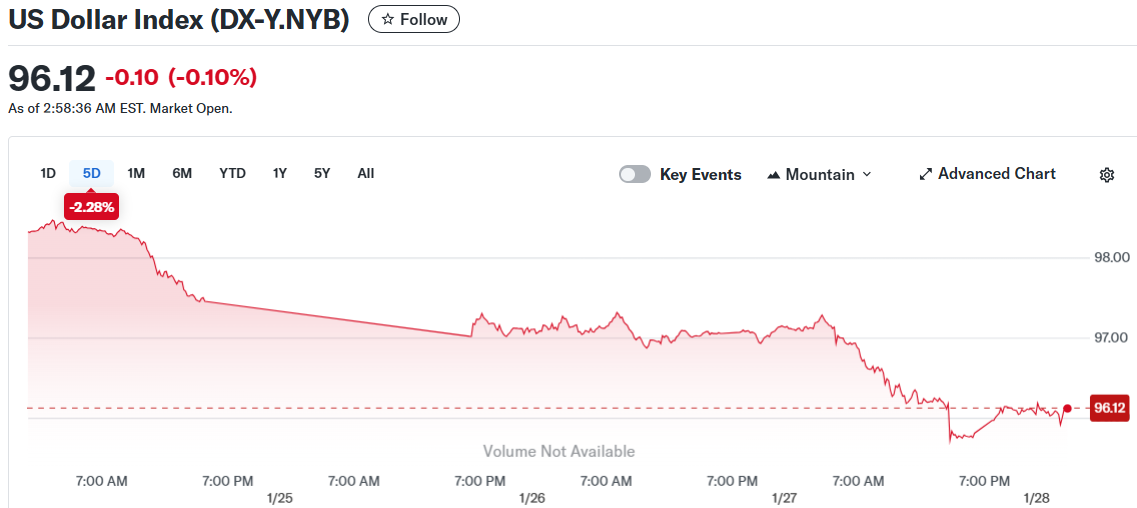
US Dollar Index (DX-Y.NYB)US Dollar Index (DX-Y.NYB)

Conservative commentator Tucker Carlson addressed this issue by interviewing economist Peter Schiff on January 26. The discussion centered on whether Bitcoin could serve as a replacement for the weakening dollar.

Schiff, known for his pro-gold stance and skepticism of cryptocurrencies, firmly rejected the idea. He explained that Bitcoin cannot function as a global reserve currency because it lacks intrinsic value.

The economist compared Bitcoin to the “greater fool” theory. This theory suggests people buy assets not for their inherent worth but hoping to sell them to someone else at higher prices later.

The Gold Standard and Modern Fiat Currency

Schiff traced the dollar’s history to provide context. From the late 1800s to World War I, the global economy operated on the gold standard. Each currency unit represented a specific amount of gold.

After World War II, the Bretton Woods system emerged. The U.S. dollar became backed by gold while other currencies were backed by the dollar. This established the dollar as the global reserve currency.

President Richard Nixon ended dollar-to-gold convertibility in 1971. The dollar became a fiat currency, backed only by government authority rather than physical gold.

Carlson argued that the current system already lacks “real money.” He said the dollar’s value depends on faith, and that faith is declining as the currency gets used as a political weapon.

Schiff responded that both the dollar and Bitcoin rely on faith. However, he stressed that most people buy Bitcoin hoping to get more dollars through price appreciation, not as a safe store of value.

Bitcoin’s Market Performance

Bitcoin has a market capitalization of $1.7 trillion since its 2009 launch. Despite this size, Schiff maintained that Bitcoin has no actual use beyond speculation.

He argued that Bitcoin will never generate income as it is a non-income-producing digital asset. Central banks need reliable, long-term stores of value, which Bitcoin cannot provide, according to the economist.

Gold prices climbed above $5,000 in January with a 17% increase during the month. Bitcoin fell below $86,000 in the same timeframe.

Schiff used this price movement to support his argument. He said investors are choosing traditional stores of value over speculative assets during uncertain times.

Schiff stated that gold has tangible uses in jewelry, electronics, aerospace, and medicine. Bitcoin, by contrast, has no intrinsic utility for central banks or global monetary systems.

U.S. debt has risen above $37 trillion. Trade tensions and monetary policy continue to drive debates about the dollar’s future role in global markets.

The post Tucker Carlson Asks Peter Schiff If Bitcoin Can Replace U.S. Dollar appeared first on CoinCentral.

Disclaimer: The articles reposted on this site are sourced from public platforms and are provided for informational purposes only. They do not necessarily reflect the views of MEXC. All rights remain with the original authors. If you believe any content infringes on third-party rights, please contact service@support.mexc.com for removal. MEXC makes no guarantees regarding the accuracy, completeness, or timeliness of the content and is not responsible for any actions taken based on the information provided. The content does not constitute financial, legal, or other professional advice, nor should it be considered a recommendation or endorsement by MEXC.

You May Also Like

Crucial Fed Rate Cut: October Probability Surges to 94%

Crucial Fed Rate Cut: October Probability Surges to 94%

BitcoinWorld Crucial Fed Rate Cut: October Probability Surges to 94% The financial world is buzzing with a significant development: the probability of a Fed rate cut in October has just seen a dramatic increase. This isn’t just a minor shift; it’s a monumental change that could ripple through global markets, including the dynamic cryptocurrency space. For anyone tracking economic indicators and their impact on investments, this update from the U.S. interest rate futures market is absolutely crucial. What Just Happened? Unpacking the FOMC Statement’s Impact Following the latest Federal Open Market Committee (FOMC) statement, market sentiment has decisively shifted. Before the announcement, the U.S. interest rate futures market had priced in a 71.6% chance of an October rate cut. However, after the statement, this figure surged to an astounding 94%. This jump indicates that traders and analysts are now overwhelmingly confident that the Federal Reserve will lower interest rates next month. Such a high probability suggests a strong consensus emerging from the Fed’s latest communications and economic outlook. A Fed rate cut typically means cheaper borrowing costs for businesses and consumers, which can stimulate economic activity. But what does this really signify for investors, especially those in the digital asset realm? Why is a Fed Rate Cut So Significant for Markets? When the Federal Reserve adjusts interest rates, it sends powerful signals across the entire financial ecosystem. A rate cut generally implies a more accommodative monetary policy, often enacted to boost economic growth or combat deflationary pressures. Impact on Traditional Markets: Stocks: Lower interest rates can make borrowing cheaper for companies, potentially boosting earnings and making stocks more attractive compared to bonds. Bonds: Existing bonds with higher yields might become more valuable, but new bonds will likely offer lower returns. Dollar Strength: A rate cut can weaken the U.S. dollar, making exports cheaper and potentially benefiting multinational corporations. Potential for Cryptocurrency Markets: The cryptocurrency market, while often seen as uncorrelated, can still react significantly to macro-economic shifts. A Fed rate cut could be interpreted as: Increased Risk Appetite: With traditional investments offering lower returns, investors might seek higher-yielding or more volatile assets like cryptocurrencies. Inflation Hedge Narrative: If rate cuts are perceived as a precursor to inflation, assets like Bitcoin, often dubbed “digital gold,” could gain traction as an inflation hedge. Liquidity Influx: A more accommodative monetary environment generally means more liquidity in the financial system, some of which could flow into digital assets. Looking Ahead: What Could This Mean for Your Portfolio? While the 94% probability for a Fed rate cut in October is compelling, it’s essential to consider the nuances. Market probabilities can shift, and the Fed’s ultimate decision will depend on incoming economic data. Actionable Insights: Stay Informed: Continue to monitor economic reports, inflation data, and future Fed statements. Diversify: A diversified portfolio can help mitigate risks associated with sudden market shifts. Assess Risk Tolerance: Understand how a potential rate cut might affect your specific investments and adjust your strategy accordingly. This increased likelihood of a Fed rate cut presents both opportunities and challenges. It underscores the interconnectedness of traditional finance and the emerging digital asset space. Investors should remain vigilant and prepared for potential volatility. The financial landscape is always evolving, and the significant surge in the probability of an October Fed rate cut is a clear signal of impending change. From stimulating economic growth to potentially fueling interest in digital assets, the implications are vast. Staying informed and strategically positioned will be key as we approach this crucial decision point. The market is now almost certain of a rate cut, and understanding its potential ripple effects is paramount for every investor. Frequently Asked Questions (FAQs) Q1: What is the Federal Open Market Committee (FOMC)? A1: The FOMC is the monetary policymaking body of the Federal Reserve System. It sets the federal funds rate, which influences other interest rates and economic conditions. Q2: How does a Fed rate cut impact the U.S. dollar? A2: A rate cut typically makes the U.S. dollar less attractive to foreign investors seeking higher returns, potentially leading to a weakening of the dollar against other currencies. Q3: Why might a Fed rate cut be good for cryptocurrency? A3: Lower interest rates can reduce the appeal of traditional investments, encouraging investors to seek higher returns in alternative assets like cryptocurrencies. It can also be seen as a sign of increased liquidity or potential inflation, benefiting assets like Bitcoin. Q4: Is a 94% probability a guarantee of a rate cut? A4: While a 94% probability is very high, it is not a guarantee. Market probabilities reflect current sentiment and data, but the Federal Reserve’s final decision will depend on all available economic information leading up to their meeting. Q5: What should investors do in response to this news? A5: Investors should stay informed about economic developments, review their portfolio diversification, and assess their risk tolerance. Consider how potential changes in interest rates might affect different asset classes and adjust strategies as needed. Did you find this analysis helpful? Share this article with your network to keep others informed about the potential impact of the upcoming Fed rate cut and its implications for the financial markets! To learn more about the latest crypto market trends, explore our article on key developments shaping Bitcoin price action. This post Crucial Fed Rate Cut: October Probability Surges to 94% first appeared on BitcoinWorld.
Share
Coinstats2025/09/18 02:25
USD/INR edges lower as Indian Rupee gains on improving equity inflows

USD/INR edges lower as Indian Rupee gains on improving equity inflows

The post USD/INR edges lower as Indian Rupee gains on improving equity inflows appeared on BitcoinEthereumNews.com. USD/INR loses ground on Tuesday after two days
Share
BitcoinEthereumNews2026/02/10 12:37
Sahara AI has entered into a strategic partnership with South Korean payment giant Danal Fintech to jointly build a stablecoin AI payment system.

Sahara AI has entered into a strategic partnership with South Korean payment giant Danal Fintech to jointly build a stablecoin AI payment system.

PANews reported on February 10th that artificial intelligence company Sahara AI has entered into a deep collaboration with Danal Fintech, one of South Korea's largest
Share
PANews2026/02/10 12:42