

Bitcoin dips on Trump’s Greenland tariffs as prediction markets stay cool
Trump’s Greenland tariff threat sparks a Bitcoin selloff, but prediction markets keep annexation odds low as analysts stress macro and structural BTC demand.
- Trump’s 10–25% tariffs on eight European allies over Greenland trigger a sharp but short‑lived risk‑off move in Bitcoin and equities.
- Polymarket odds assign low probabilities to a U.S. Greenland takeover as analysts say prediction markets reflect sentiment but face liquidity and regulatory limits.
- Experts see Bitcoin’s path driven more by macro policy and structural demand than tariff noise, with some warning current BTC bid remains structurally weak.
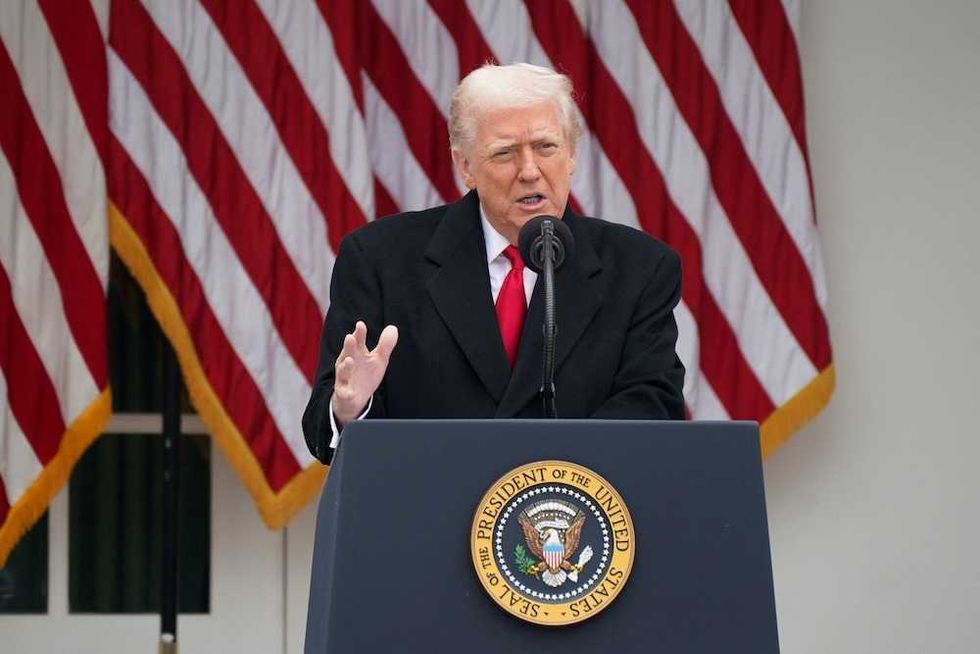
Former President Donald Trump announced on Jan. 17 that the United States would impose 10% tariffs on goods from eight European countries for opposing the annexation of Greenland, a self-governing Danish territory. The tariffs are scheduled to increase to 25% on June 1.
Trump’s Greenland pivot signals worry for Bitcoin price
Denmark, Finland, France, Germany, Norway, the Netherlands, the United Kingdom and Sweden — all NATO allies of the United States — would face the tariffs starting February 1, according to Trump’s statement on Truth Social.
The announcement triggered a selloff in risk assets. Bitcoin declined nearly 7% following the statement, while the S&P 500 fell 2% on Tuesday, extending losses from the previous session.
Prediction markets, however, indicate skepticism about the likelihood of a Greenland acquisition. Polymarket data shows a 20% probability that the U.S. will acquire Greenland by Dec. 31, 2026, and a 30% probability by Mar. 31 this year.
“Prediction markets have shown growing traction in forecasting political outcomes, but they are not always accurate,” said Illia Otychenko, lead analyst at crypto exchange CEX.io. “They can be best viewed as an additional signal rather than a definitive measure. They can help gauge sentiment and probability, but their figures should not be taken at face value without broader context.”
Otychenko cautioned that thin liquidity, regulatory uncertainty and speculative behavior can distort prices in prediction markets.
Crypto-based prediction markets have experienced substantial growth in recent years. The sector is expected to have reached approximately $40 billion in transaction volume at the end of 2025, up more than 400% from the previous year, according to industry analysts. At this pace, the sector could rival the $300 billion global sports betting industry in 2026, analysts said, driven by regulatory clarity in the U.S., institutional participation and changing information consumption patterns.
The sector, dominated by platforms Polymarket and Kalshi, has expanded beyond crypto-native users to mainstream audiences. Real-world events including politics, sports, culture and economic indicators have become tradable instruments. During recent U.S. election cycles, Polymarket reported increased volume as users wagered on outcomes ranging from presidential races to interest rate decisions.
Georgii Verbitskii, founder of crypto yield platform Tymio, said prediction market prices “reflect a consensus on probabilities, not directional bets by crypto traders.” Verbitskii stated that the markets have “matured into fairly reliable tools for assessing political risk,” adding that “the low odds assigned to extreme outcomes like a Greenland takeover suggest participants are distinguishing political noise from realistic scenarios, and doing so with reasonable accuracy.”
The cryptocurrency market’s reaction to Trump’s tariff announcement aligns with patterns observed during previous tariff-driven volatility, according to analysts, where cryptocurrencies initially sold off alongside equities before stabilizing.
“So far, the market reaction looks more like short-term volatility rather than a structural macro shift,” Otychenko said. “The impact is smaller than what we saw in early March 2025, when U.S. steel and aluminum tariffs triggered EU countermeasures. At that time, price volatility was largely localized.”
Otychenko said similar behavior could occur again, “with brief risk-off moves rather than a sustained trend change, unless the confrontation escalates into a more critical conflict.”
Bitcoin has established a reputation as a store of value similar to gold, but the cryptocurrency continues to behave like a high-risk asset during periods of geopolitical uncertainty, often moving in correlation with stocks as traders reduce exposure.
Trump’s tariff threat represents a return to the protectionist policies that characterized much of his first presidency, when levies on Chinese goods and European metals prompted retaliation and contributed to market turbulence. Trump first proposed purchasing Greenland in 2019, but Denmark declined.
The territory of 55,000 people in the Arctic holds strategic value due to its location along emerging shipping routes and reserves of rare earth minerals used in defense industries and clean energy technology, according to analysts. While Trump has framed his interest in Greenland as a matter of “national security,” analysts predict any acquisition would face significant political and legal barriers. Some European countries have deployed military troops to defend Greenland against potential U.S. action, according to reports.
“A potential Greenland takeover would carry much broader geopolitical consequences,” Otychenko said, adding that “Trump also has a history of stepping back from some high-stakes scenarios, which helps explain the low odds seen on prediction platforms.”
Some analysts say Bitcoin’s long-term trajectory depends less on trade disputes and more on macroeconomic factors including central bank policy, inflation trends and institutional adoption.
“Generally speaking, I’d expect the Bitcoin price to respond to tariffs and market volatility by first declining in the short-term,” said John Haar, managing director at Swan Bitcoin. “But after the short-term reaction, market participants realize that the tariffs ultimately do not affect Bitcoin’s trajectory as much as other factors such as central bank policy, government spending, inflation, and adoption, all of which continue to be supportive of Bitcoin.”
Verbitskii offered a contrasting view, stating that Bitcoin currently faces structural weakness. “There’s a clear lack of sustained demand from large buyers,” Verbitskii said. “In that environment, any risk-on event, including renewed tariff rhetoric from Donald Trump, tends to push BTC lower very quickly. Markets are treating these headlines more as short-term volatility triggers than as a fundamental macro shift, but the sensitivity itself is telling.”
Verbitskii added that “until structural demand returns and the market regime changes, geopolitical shocks are more likely to add downside pressure than reinforce Bitcoin’s hedge narrative.”
You May Also Like
Trump swears he'll donate winnings in $10 billion lawsuit against his own IRS

US President Donald Trump says Warsh would’ve lost Fed if he pledged rate hike
