Iran’s Revolutionary Guard (IRGC) has allegedly been using crypto to slip past Western sanctions for at least 3 years now, according to a report by TRM Labs. SinceIran’s Revolutionary Guard (IRGC) has allegedly been using crypto to slip past Western sanctions for at least 3 years now, according to a report by TRM Labs. Since

Iran Revolutionary Guard moved nearly $1B through Zedcex, Zedxion exchanges in 3 years

4 min read

Iran’s Revolutionary Guard (IRGC) has allegedly been using crypto to slip past Western sanctions for at least 3 years now, according to a report by TRM Labs.

Since early 2023, the Guard has funneled about $1 billion through two UK-based crypto exchanges, Zedcex and Zedxion. Allegedly, these exchanges are helping the Guard send large amounts of USDT across borders without going through banks.

Iranian Guard used crypto to reach groups and suppliers abroad

For the uninitiated, the IRGC is the most powerful piece of Iran’s military, and it’s been under tough sanctions from the United States and others since it was decided that it was too powerful of an ally to Russia during the early days of the Ukraine war.

These rules were meant to block Iran’s Supreme Leader Ayatollah Khamenei from aiding his so-called ‘great friend’ Vladimir Putin and also doing business around the world, specifically when it comes to buying parts for weapons or allegedly supporting groups like Hezbollah, Hamas, and the Houthis.

However, TRM who couldn’t say exactly what the crypto funds were used for, just pointed out that the U.S. Treasury has already said Iranian financiers have used crypto to keep oil sales going.
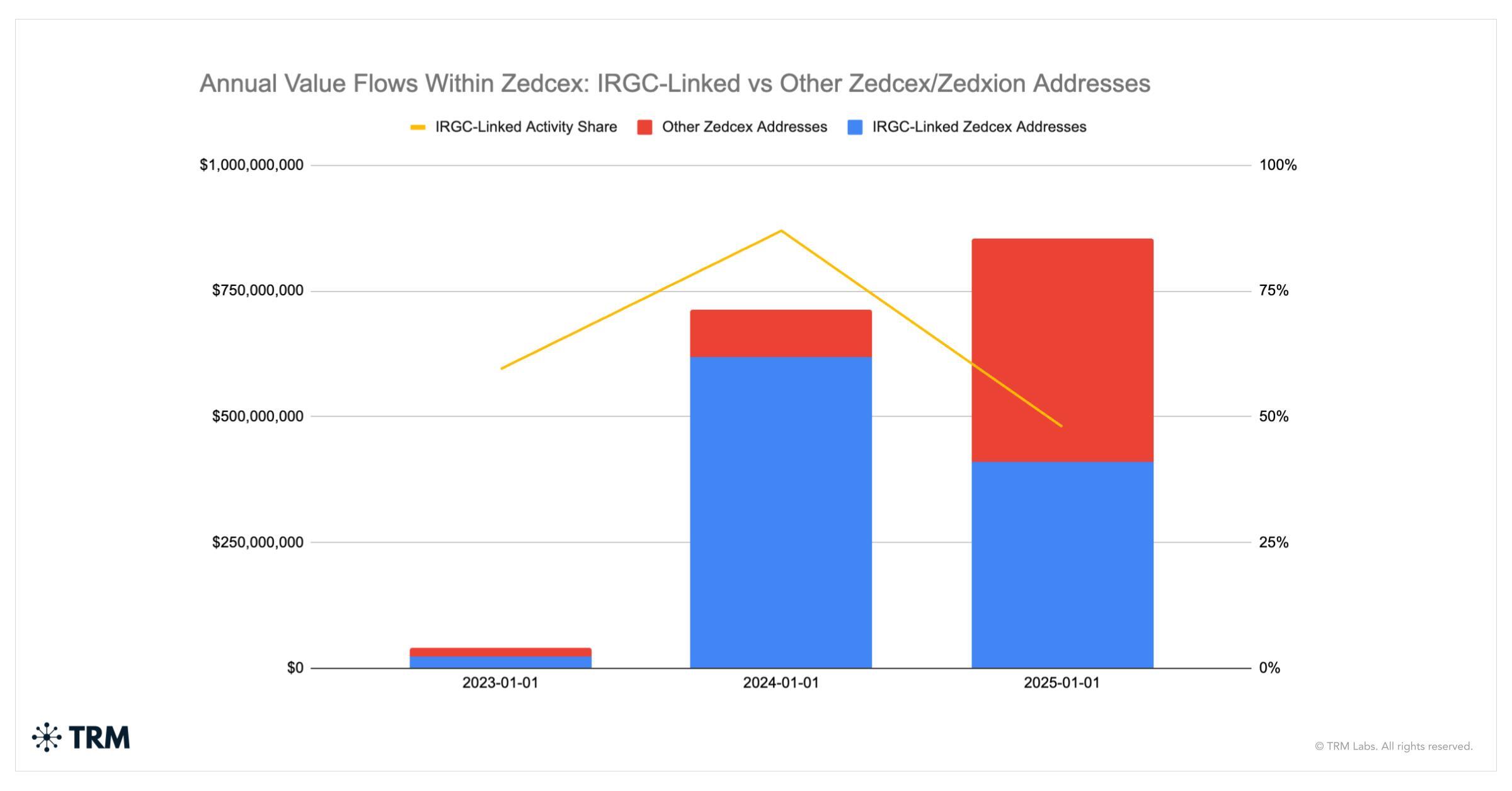
Iran’s Revolutionary Guard uses crypto USDT to evade Western sanctionsSource: TRM Labs

For years, the Guard and others in Iran have run front companies to keep business alive. The report says they’ve now added these two crypto exchanges to the list.

TRM found that between 2023 and 2025, the Guard’s transfers made up 56% of all the activity on Zedcex and Zedxion. It also said both brands are just different faces of the same company.

Ari Redbord, TRM’s policy chief, said, “Iranian-linked actors (including sanctioned military organizations) appear to be testing more persistent crypto infrastructure.”

Zedcex and Zedxion were tied to known Iranian oil smuggler

The numbers were massive: about $24 million in 2023, $619 million in 2024, and $410 million in 2025. Almost all of it went through USDT, the stablecoin made by Tether, and was sent over the Tron network.

TRM reportedly ran test transactions through the exchanges, then tracked where the money went. They followed a list of 187 wallet addresses, flagged by Israel, which were said to be run by the Guard. The money bounced between these wallets, offshore accounts, and other crypto firms inside Iran.

In one case, $10 million ended up in the wallet of a Yemeni man sanctioned by the U.S. in 2021. He was accused of selling Iranian fuel to raise cash for the Houthis.

The Guard also seemed to be working with Babak Zanjani, a name Iran watchers will know well. One of the exchange directors had the same name and birthday as him.

Zanjani was the guy who helped the government sell oil when Mahmoud Ahmadinejad was president. He got slapped with sanctions by Barack Obama in 2013 and was later accused by the Iranian government of stealing more than $2 billion.

Zanjani said he wasn’t guilty, blaming the sanctions for freezing the money. He was sentenced to death, but that never happened. His sentence was dropped in 2024, and he’s now free. The U.S. lifted its sanctions on him back in 2016 after Iran signed a nuclear deal, and those sanctions were never brought back.

Crypto channels helped Iran bypass official systems easily

Snir Levi, who runs the Israeli crypto analysis firm Nominis, backed up TRM’s findings, saying that his team allegedly looked at the same data and found at least $150 million that went through Zedxion and Zedcex tied to the Guard, though he provided absolutely no proof.

The exchanges claim on their websites that they follow anti-money-laundering rules, including checking IDs and banning users in about 30 to 50 countries. Iran is supposed to be on those lists. But the report shows that the Guard still used them.

TRM said they were able to make deposits and withdrawals from the platforms to trace how the Guard moved the money around.

Miad Maleki, who used to work at the U.S. Treasury, said, “The $1 billion figure over two years demonstrates that digital currencies are becoming a financial channel for Iran’s shadow banking apparatus.”

Tron, the crypto network involved in most of the transfers, said it had worked with Tether and TRM to try to stop this kind of activity. They claimed shady transactions have dropped “precipitously.” But clearly, the system worked well enough for the Guard to use it for $800 million over three years.

The smartest crypto minds already read our newsletter. Want in? Join them.

Market Opportunity
Nowchain Logo
Nowchain Price(NOW)
$0.0016
$0.0016$0.0016
+67.64%
USD
Nowchain (NOW) Live Price Chart
Disclaimer: The articles reposted on this site are sourced from public platforms and are provided for informational purposes only. They do not necessarily reflect the views of MEXC. All rights remain with the original authors. If you believe any content infringes on third-party rights, please contact service@support.mexc.com for removal. MEXC makes no guarantees regarding the accuracy, completeness, or timeliness of the content and is not responsible for any actions taken based on the information provided. The content does not constitute financial, legal, or other professional advice, nor should it be considered a recommendation or endorsement by MEXC.
Tags:

You May Also Like

Botanix launches stBTC to deliver Bitcoin-native yield

Botanix launches stBTC to deliver Bitcoin-native yield

The post Botanix launches stBTC to deliver Bitcoin-native yield appeared on BitcoinEthereumNews.com. Botanix Labs has launched stBTC, a liquid staking token designed to turn Bitcoin into a yield-bearing asset by redistributing network gas fees directly to users. The protocol will begin yield accrual later this week, with its Genesis Vault scheduled to open on Sept. 25, capped at 50 BTC. The initiative marks one of the first attempts to generate Bitcoin-native yield without relying on inflationary token models or centralized custodians. stBTC works by allowing users to deposit Bitcoin into Botanix’s permissionless smart contract, receiving stBTC tokens that represent their share of the staking vault. As transactions occur, 50% of Botanix network gas fees, paid in BTC, flow back to stBTC holders. Over time, the value of stBTC increases relative to BTC, enabling users to redeem their original deposit plus yield. Botanix estimates early returns could reach 20–50% annually before stabilizing around 6–8%, a level similar to Ethereum staking but fully denominated in Bitcoin. Botanix says that security audits have been completed by Spearbit and Sigma Prime, and the protocol is built on the EIP-4626 vault standard, which also underpins Ethereum-based staking products. The company’s Spiderchain architecture, operated by 16 independent entities including Galaxy, Alchemy, and Fireblocks, secures the network. If adoption grows, Botanix argues the system could make Bitcoin a productive, composable asset for decentralized finance, while reinforcing network consensus. This is a developing story. This article was generated with the assistance of AI and reviewed by editor Jeffrey Albus before publication. Get the news in your inbox. Explore Blockworks newsletters: Source: https://blockworks.co/news/botanix-launches-stbtc
Share
BitcoinEthereumNews2025/09/18 02:37
PBOC sets USD/CNY reference rate at 6.9590 vs. 6.9570 previous

PBOC sets USD/CNY reference rate at 6.9590 vs. 6.9570 previous

The post PBOC sets USD/CNY reference rate at 6.9590 vs. 6.9570 previous appeared on BitcoinEthereumNews.com. On Friday, the People’s Bank of China (PBOC) sets the
Share
BitcoinEthereumNews2026/02/06 09:28
UK and US Seal $42 Billion Tech Pact Driving AI and Energy Future

UK and US Seal $42 Billion Tech Pact Driving AI and Energy Future

The post UK and US Seal $42 Billion Tech Pact Driving AI and Energy Future appeared on BitcoinEthereumNews.com. Key Highlights Microsoft and Google pledge billions as part of UK US tech partnership Nvidia to deploy 120,000 GPUs with British firm Nscale in Project Stargate Deal positions UK as an innovation hub rivaling global tech powers UK and US Seal $42 Billion Tech Pact Driving AI and Energy Future The UK and the US have signed a “Technological Prosperity Agreement” that paves the way for joint projects in artificial intelligence, quantum computing, and nuclear energy, according to Reuters. Donald Trump and King Charles review the guard of honour at Windsor Castle, 17 September 2025. Image: Kirsty Wigglesworth/Reuters The agreement was unveiled ahead of U.S. President Donald Trump’s second state visit to the UK, marking a historic moment in transatlantic technology cooperation. Billions Flow Into the UK Tech Sector As part of the deal, major American corporations pledged to invest $42 billion in the UK. Microsoft leads with a $30 billion investment to expand cloud and AI infrastructure, including the construction of a new supercomputer in Loughton. Nvidia will deploy 120,000 GPUs, including up to 60,000 Grace Blackwell Ultra chips—in partnership with the British company Nscale as part of Project Stargate. Google is contributing $6.8 billion to build a data center in Waltham Cross and expand DeepMind research. Other companies are joining as well. CoreWeave announced a $3.4 billion investment in data centers, while Salesforce, Scale AI, BlackRock, Oracle, and AWS confirmed additional investments ranging from hundreds of millions to several billion dollars. UK Positions Itself as a Global Innovation Hub British Prime Minister Keir Starmer said the deal could impact millions of lives across the Atlantic. He stressed that the UK aims to position itself as an investment hub with lighter regulations than the European Union. Nvidia spokesman David Hogan noted the significance of the agreement, saying it would…
Share
BitcoinEthereumNews2025/09/18 02:22