With $1 billion in pledged funds withdrawn in a single week and daily active users plummeting by nearly 60%, the Solana ecosystem is undergoing its most severe test in the past six months.With $1 billion in pledged funds withdrawn in a single week and daily active users plummeting by nearly 60%, the Solana ecosystem is undergoing its most severe test in the past six months.

$1 billion fled in a single week, daily active users fell by nearly 60%, Solana faces MEME retreat and inflation variables

2025/03/01 15:50
5 min read

Author: Frank, PANews

With $1 billion of pledged funds withdrawn in a single week and daily active users plummeting by nearly 60%, the Solana ecosystem is experiencing its most severe test in the past six months. With more than $600 million of chips dumped from platforms such as Pump.fun, and validators’ confidence in pledge shaken by the SIMD proposal, coupled with the vacuum period after the MEME craze, the SOL token plummeted 57% in 40 days, leading the decline of mainstream currencies.

When the on-chain data changes and the market sell-off form a death cross, how will this public chain giant, once regarded as the "Ethereum killer", survive the double stranglehold of ecological reconstruction and capital flight?

The withdrawal of pledge funds is accelerating: $1 billion of funds fled in a single week
$1 billion fled in a single week, daily active users fell by nearly 60%, Solana faces MEME retreat and inflation variables

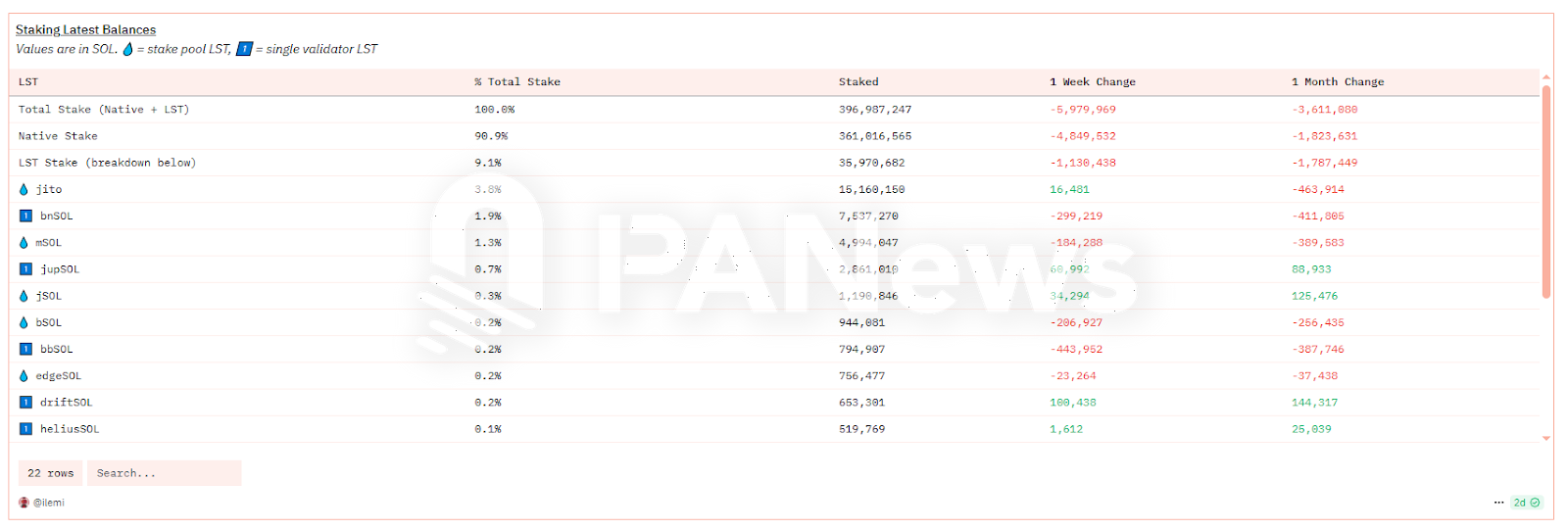
In the past week, the amount of Solana tokens pledged decreased by 5.97 million tokens, and in the past month, it decreased by 3.61 million tokens. This shows that in order to avoid the risk of decline, many large stakers began to withdraw SOL funds in the past week. The weekly decline rate was about 1.5%, and the reduction in pledged funds was about US$1 billion.

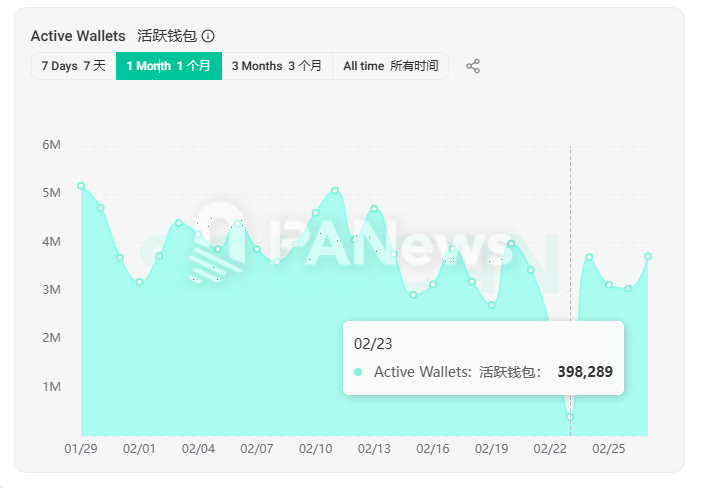
From the perspective of the changes in the Solana network, on February 23, the Solana network underwent drastic changes in the network. The number of active users and new wallets on the same day dropped by about 90%, and then returned to normal levels. This drastic fluctuation is most likely caused by the collective downtime or shutdown of some trading robots on the chain that day, but it also exposed the problem of too high a proportion of robots in the Solana network from this perspective.
$1 billion fled in a single week, daily active users fell by nearly 60%, Solana faces MEME retreat and inflation variables

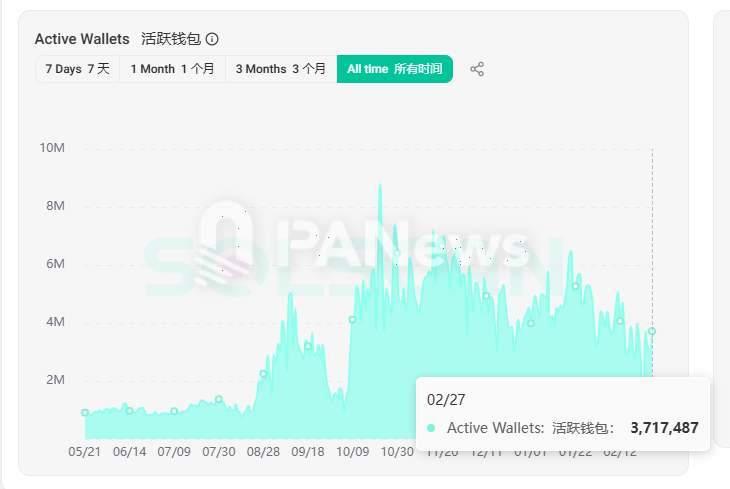
Data as of February 28 shows that the current level of active users has also dropped significantly from the peak in October last year. On October 22, the number of daily active addresses reached a peak of 8.78 million, and on February 27, the data dropped to 3.71 million, a decrease of about 58%.
$1 billion fled in a single week, daily active users fell by nearly 60%, Solana faces MEME retreat and inflation variables

​Five whales concentrated their selling: $317 million in chips hit the market

Recently, several large SOL holders chose to sell their tokens or release their pledges. PANews conducted an incomplete statistics based on the information exposed on social media. Five whales sold about 2.09 million SOL in a short period of time, worth about $317 million, with an average selling price of about $151.

Among them, the AMekyY73RJBd4urgZ2HvWV8yFzvk4nRsGmahuJcWiQri address has unstaked a total of 236,000 tokens, and only 60,000 tokens have been sold so far. It is unknown whether the remaining tokens will continue to be sold in the near future.

$1 billion fled in a single week, daily active users fell by nearly 60%, Solana faces MEME retreat and inflation variables

In addition, Pump.fun is also a major seller on the chain. As of February 28, Pump.fun has sold a total of about 3.02 million SOL tokens, with a total cash amount of about US$610 million. In the past month, Pump.fun has sold a total of 440,000 SOL tokens, worth about US$78.39 million. This has made the already panic market even worse.

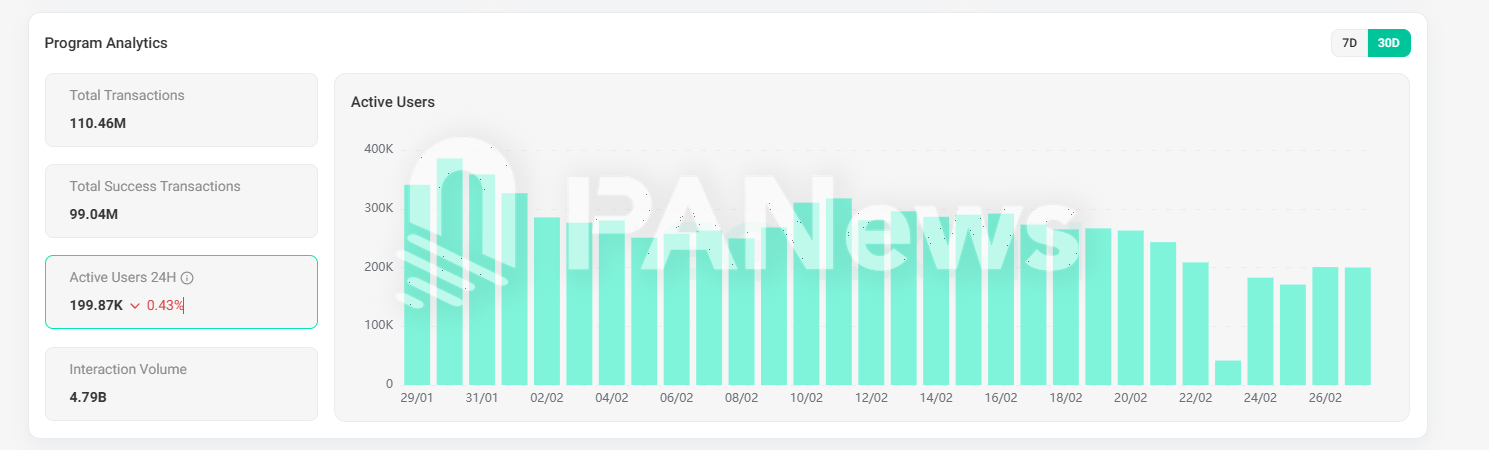
However, as the popularity of MEME declined, Pump's data continued to decline. On February 23, the number of active users of Pump.fun dropped to 41,000, and recovered to around 180,000 the next day. The overall data has dropped by more than half in the past month.
$1 billion fled in a single week, daily active users fell by nearly 60%, Solana faces MEME retreat and inflation variables

FalconX, a crypto brokerage service provider, is also one of the important channels for big investors to flee. According to PANews statistics, 386,700 SOL tokens were transferred from FalconX to Binance in February, worth about $66 million. However, further research found that big investors seemed to have fled as early as January. In January, 1.37 million SOL tokens were transferred from FalconX to Binance, worth $315 million, with an average transfer price of about $229. This data value is much higher than other months.
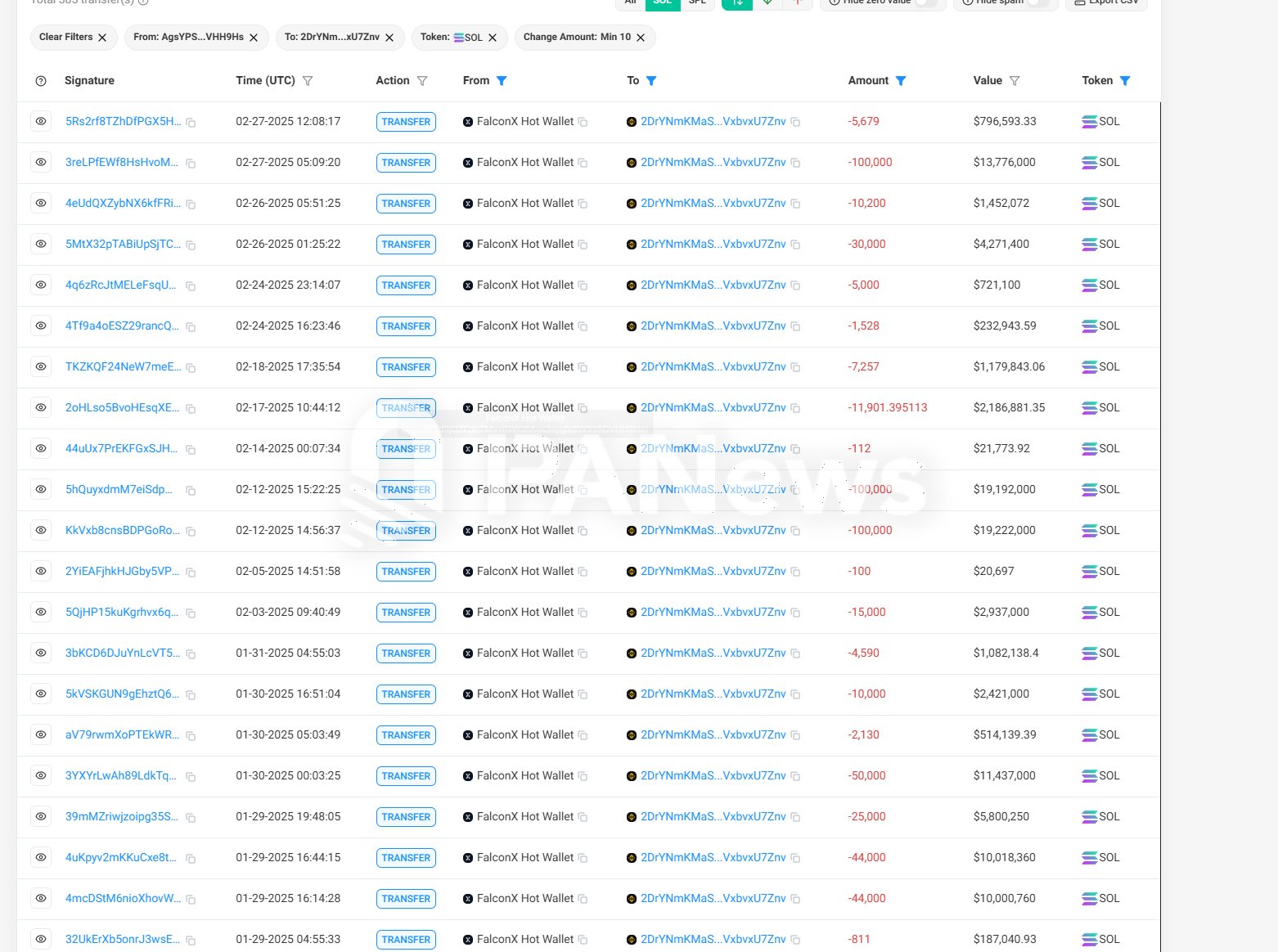
$1 billion fled in a single week, daily active users fell by nearly 60%, Solana faces MEME retreat and inflation variables

Of course, some people left the market while others rushed in. From February 27 to 28, a large investor with the address EhuKBFXyUYgwc4nUMJMQHjY4A7w5nTTrMtY6z4TtZSFK bought 83,000 SOL tokens, spending a total of $10.88 million, with an average entry price of about $134.

SIMD proposal impact: shrinking staking returns cause validators to panic

However, overall, the funds entering the market are still in the minority, and the majority are large sellers. The main reason for this is not only the shock to the financial market caused by changes in the overall macro environment, but also the uncertainty of the Solana ecosystem itself. The recently launched SIMD-0228 proposal proposes to modify the issuance curve of SOL tokens. The premise of reducing the inflation rate is to reduce the staking income. Therefore, for many large validator nodes, this has also become an important factor of uncertainty in the short term. (Related reading: Solana Inflation Revolution: SIMD-0228 Proposal Sparks Community Controversy, 80% of the Increased Issuance Reduces the Risk of "Death Spiral" )

Under internal and external troubles, Solana's ecological data and token market prices are facing double pressure. As of the afternoon of February 28, the price of SOL has fallen by 57% in the past 40 days, becoming the mainstream token with the largest decline in recent times.

At present, new narratives have failed to emerge to lead the industry, and the MEME track has gradually died down. How Solana can maintain its popularity on the chain may become the biggest problem.


Market Opportunity
SIX Logo
SIX Price(SIX)
$0.01041
$0.01041$0.01041
0.00%
USD
SIX (SIX) Live Price Chart
Disclaimer: The articles reposted on this site are sourced from public platforms and are provided for informational purposes only. They do not necessarily reflect the views of MEXC. All rights remain with the original authors. If you believe any content infringes on third-party rights, please contact service@support.mexc.com for removal. MEXC makes no guarantees regarding the accuracy, completeness, or timeliness of the content and is not responsible for any actions taken based on the information provided. The content does not constitute financial, legal, or other professional advice, nor should it be considered a recommendation or endorsement by MEXC.

You May Also Like

The Channel Factories We’ve Been Waiting For

The Channel Factories We’ve Been Waiting For

The post The Channel Factories We’ve Been Waiting For appeared on BitcoinEthereumNews.com. Visions of future technology are often prescient about the broad strokes while flubbing the details. The tablets in “2001: A Space Odyssey” do indeed look like iPads, but you never see the astronauts paying for subscriptions or wasting hours on Candy Crush.  Channel factories are one vision that arose early in the history of the Lightning Network to address some challenges that Lightning has faced from the beginning. Despite having grown to become Bitcoin’s most successful layer-2 scaling solution, with instant and low-fee payments, Lightning’s scale is limited by its reliance on payment channels. Although Lightning shifts most transactions off-chain, each payment channel still requires an on-chain transaction to open and (usually) another to close. As adoption grows, pressure on the blockchain grows with it. The need for a more scalable approach to managing channels is clear. Channel factories were supposed to meet this need, but where are they? In 2025, subnetworks are emerging that revive the impetus of channel factories with some new details that vastly increase their potential. They are natively interoperable with Lightning and achieve greater scale by allowing a group of participants to open a shared multisig UTXO and create multiple bilateral channels, which reduces the number of on-chain transactions and improves capital efficiency. Achieving greater scale by reducing complexity, Ark and Spark perform the same function as traditional channel factories with new designs and additional capabilities based on shared UTXOs.  Channel Factories 101 Channel factories have been around since the inception of Lightning. A factory is a multiparty contract where multiple users (not just two, as in a Dryja-Poon channel) cooperatively lock funds in a single multisig UTXO. They can open, close and update channels off-chain without updating the blockchain for each operation. Only when participants leave or the factory dissolves is an on-chain transaction…
Share
BitcoinEthereumNews2025/09/18 00:09
Markets await Fed’s first 2025 cut, experts bet “this bull market is not even close to over”

Markets await Fed’s first 2025 cut, experts bet “this bull market is not even close to over”

Will the Fed’s first rate cut of 2025 fuel another leg higher for Bitcoin and equities, or does September’s history point to caution? First rate cut of 2025 set against a fragile backdrop The Federal Reserve is widely expected to…
Share
Crypto.news2025/09/18 00:27
Best Crypto to Buy as Saylor & Crypto Execs Meet in US Treasury Council

Best Crypto to Buy as Saylor & Crypto Execs Meet in US Treasury Council

The post Best Crypto to Buy as Saylor & Crypto Execs Meet in US Treasury Council appeared on BitcoinEthereumNews.com. Michael Saylor and a group of crypto executives met in Washington, D.C. yesterday to push for the Strategic Bitcoin Reserve Bill (the BITCOIN Act), which would see the U.S. acquire up to 1M $BTC over five years. With Bitcoin being positioned yet again as a cornerstone of national monetary policy, many investors are turning their eyes to projects that lean into this narrative – altcoins, meme coins, and presales that could ride on the same wave. Read on for three of the best crypto projects that seem especially well‐suited to benefit from this macro shift:  Bitcoin Hyper, Best Wallet Token, and Remittix. These projects stand out for having a strong use case and high adoption potential, especially given the push for a U.S. Bitcoin reserve.   Why the Bitcoin Reserve Bill Matters for Crypto Markets The strategic Bitcoin Reserve Bill could mark a turning point for the U.S. approach to digital assets. The proposal would see America build a long-term Bitcoin reserve by acquiring up to one million $BTC over five years. To make this happen, lawmakers are exploring creative funding methods such as revaluing old gold certificates. The plan also leans on confiscated Bitcoin already held by the government, worth an estimated $15–20B. This isn’t just a headline for policy wonks. It signals that Bitcoin is moving from the margins into the core of financial strategy. Industry figures like Michael Saylor, Senator Cynthia Lummis, and Marathon Digital’s Fred Thiel are all backing the bill. They see Bitcoin not just as an investment, but as a hedge against systemic risks. For the wider crypto market, this opens the door for projects tied to Bitcoin and the infrastructure that supports it. 1. Bitcoin Hyper ($HYPER) – Turning Bitcoin Into More Than Just Digital Gold The U.S. may soon treat Bitcoin as…
Share
BitcoinEthereumNews2025/09/18 00:27