

US Launches ‘Genesis Mission’ to Centralize Scientific Data for AI

The road to the Genesis Mission was paved by technocrats like Larry Ellison and Tony Blair: perspective
The US “Genesis Mission” takes a page from Larry Ellison and Tony Blair’s agenda to unify government datasets on a single platform to feed AI.
On November 24, US President Donald Trump issued an executive order launching the Genesis Mission, headed by the Department of Energy (DOE) in collaboration with the White House Office of Science and Technology Policy (OSTP) that aims to
“dramatically accelerate scientific discovery, strengthen national security, secure energy dominance, enhance workforce productivity, and multiply the return on taxpayer investment into research and development.”
\
\ According to the EO, “The Genesis Mission will dramatically accelerate scientific discovery, strengthen national security, secure energy dominance, enhance workforce productivity, and multiply the return on taxpayer investment into research and development, thereby furthering America’s technological dominance and global strategic leadership.”
\ To achieve these goals, the Secretary of Energy will create the “American Science and Security Platform” that will provide access to federal scientific datasets to train AI systems while deploying the most advanced supercomputers in the world.
\
\ The American Science and Security Platform will specifically provide:
- DOE national laboratory supercomputers and secure cloud-based AI computing environments, capable of supporting large-scale model training, simulation, and inference.
- AI modeling and analysis frameworks, including AI agents to explore design spaces, evaluate experimental outcomes, and automate workflows.
- Computational tools, including AI-enabled predictive models, simulation models, and design optimization tools.
- Domain-specific foundation models across the range of scientific domains covered.
- Secure access to appropriate datasets, including proprietary, federally curated, and open scientific datasets, in addition to synthetic data generated through DOE computing resources.
- Experimental and production tools to enable autonomous and AI-augmented experimentation and manufacturing in high-impact domains.
\
https://x.com/WhiteHouse/status/1993331904926421100?embedable=true
\ With this American Science and Security Platform, the goal is for “multiple Federal research agencies and the private sector to collaborate to achieve breakthroughs currently thought impossible, and to win and stay ahead in the AI race,” according to the White House fact sheet.
The idea of unifying all the datasets about a country and putting them on a single platform to feed AI was proposed by Oracle co-founder Larry Ellison at the World Governments Summit on February 12, 2025.
There, Ellison called for the creation of a single, unified data platform to combine all the fragmented datasets about a country in order to feed AI systems and make governments more efficient.
\
https://x.com/TimHinchliffe/status/1889731814270345293?embedable=true
\ In a one-on-one chat with former UK Prime Minister Tony Blair on “Reimagining Technology for Government,” Ellison proposed that in order for governments to provide better services to the people, there should be a single, unified platform and database to store all the information about a country.
“We need to unify all of the national data, put it into a database where it’s easily consumable by the AI model and then ask whatever question you like,” Ellison told Blair.
“Right now, countries’ data is fragmented […] You can pipe data from these 3,000 separate data sources into a single, unified database, and that’s what we need to do.
“We need to layer on top of all of this fragmented data — all this information we have about our country — and we need to take that and unify that into a single database, so when we ask questions, the data model has all the information it needs to answer the question, discover the insight, and recommend an action,” he added.
\
https://x.com/TimHinchliffe/status/1889735457342185499?embedable=true
\
\ Just two weeks after the conversation between Ellison and Blair at the World Governments Summit, the Tony Blair Institute for Global Change published a lengthy blueprint for the creation and execution of a National Data Library that would require all Britons to have a digital ID.
Seven months after the Tony Blair Institute published its report, the British government announced it was mandating digital ID as a work requirement for all Britons.
According to the Tony Blair Institute report, “Governing in the Age of AI: Building Britain’s National Data Library:”
“The National Data Library (NDL) has the potential to become a vital piece of enabling infrastructure for public-service delivery and economic growth in the United Kingdom.
“It is intended to unlock the full potential of public-sector data by enabling secure, seamless, quick and scalable access to linked data sets.”
The UK National Data Library is envisioned to house all of Britain’s data, including that related to:
- Health
- Energy
- Households
- Pensions
- Agriculture
- Education
- Labor
- Taxation
- Justice
- And so much more
Similar to the Genesis Mission, the idea is to create a unified, interoperable library that links all the data in the country and to feed it to AI systems.
But one area in which the US and Tony Blair’s institute differ, at least for now, is in scope. At present the Genesis Mission is looking to just Health, Energy, and National Security.
Another area in which the agendas currently differ is the integration of digital identity schemes. The US hasn’t committed to this yet while the UK has gone fully authoritarian.
\
\ On June 6, 2025 President Trump issued an executive order amending former President Joe Biden’s executive order on “STRENGTHENING AND PROMOTING INNOVATION IN THE NATION’S CYBERSECURITY” from January 16, 2025.
Part of that amendment was to completely eliminate the entire section on encouraging “the acceptance of digital identity documents” and supporting “digital identity verification” relating to cybersecurity.
This; however, doesn’t rule out the possibility that digital identity will be integrated into the Genesis Mission in some capacity because the removal of that section only relates to digital identity as one of the “solutions to combat cybercrime and fraud.”
In July, the White House gave an update on efforts to modernize the health tech ecosystem, which included exploring how to encourage, require, and in some cases mandate digital ID for patients, providers, and payers.
\
\
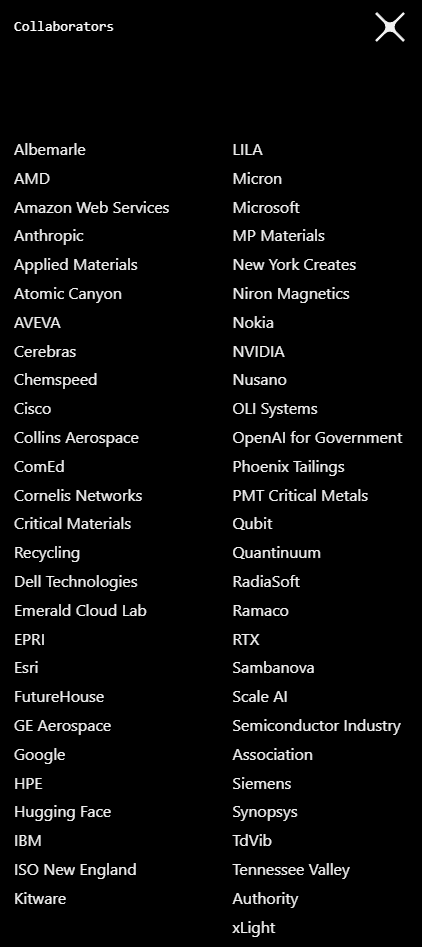
\ As it stands, the Genesis Mission “will create a national discovery platform that unites the world’s most powerful supercomputers, AI systems, and emerging quantum technologies with the nation’s most advanced scientific instruments. Together, they form an integrated infrastructure for scientific exploration—an intelligent network capable of sensing, simulating, and understanding nature at every scale,” according to the mission’s official portal on the DOE website.
“By connecting these systems, Genesis Mission will transform how science is done. It will generate a new class of high-fidelity data to train advanced AI models, empower researchers to solve the hardest scientific challenges, and accelerate discovery from years to months.“
Collaborating on this massive undertaking on par with the Manhattan Project are some of the biggest companies in tech, along with academic institutions and the DOE’s 17 National Laboratories.
https://x.com/ENERGY/status/1993102758812303725?embedable=true
\ On the energy front, the Genesis Mission looks to:
- Harness fusion energy
- Advance nuclear energy
- Build an intelligent, resilient grid
In the area of discovery science, the Genesis Mission aims to:
- Uncover insights that accelerate breakthroughs in materials and medicine
- Understand the laws of nature and the universe
- Discover new quantum algorithms
When it comes to national security, the Genesis Mission strives to:
- Secure critical minerals
- Accelerate advanced manufacturing
- Discover new materials like alloys, polymers, and composites
The US Department of Energy has its own research and development funding arm modeled after DARPA called the Advanced Research Projects Agency for Energy (ARPA-E).
Since 2009, ARPA-E has provided $4.21 billion in R&D funding to more than 1,700 projects.
The road to the Genesis Mission was paved by technocrats like Larry Ellison and Tony Blair.
\
:::info Tim Hinchliffe, Editor, The Sociable
:::
\
You May Also Like

⁉️ Epstein, a convicted pedo, invested in Coinbase

How The ByteDance App Survived Trump And A US Ban
